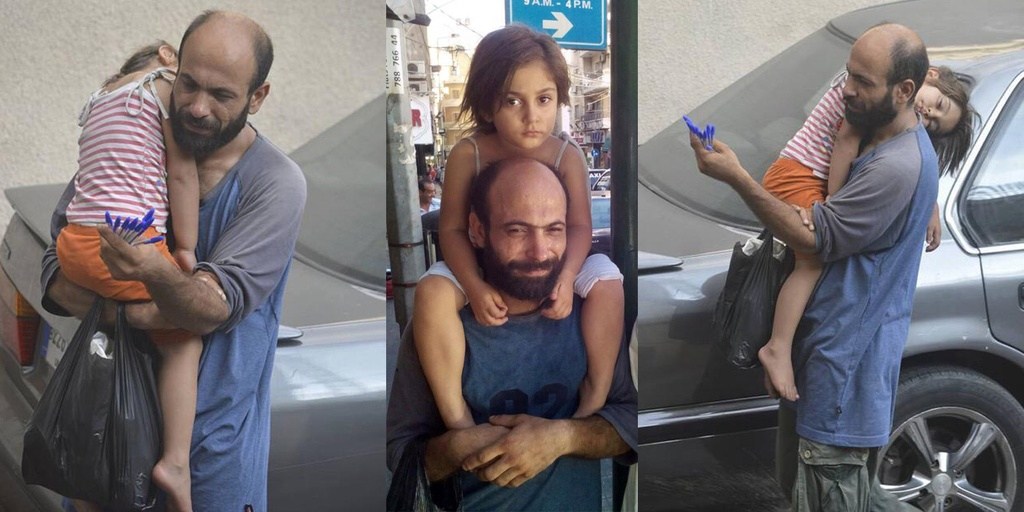
In 2015, an unassuming photograph taken in Beirut, Lebanon, began circulating online and quickly captured the attention of millions around the world. The image showed a man walking through traffic, holding a box of pens for sale, while his young daughter slept on his shoulder. There were no captions needed to explain the scene. The message was immediate and universal: a father struggling to survive while still caring for his child.
That man was Abdul Halim al-Attar, a Syrian refugee living in Lebanon after fleeing the conflict in his home country. At the time the photograph was taken, he was living in extremely difficult conditions, relying on selling pens on the street to support himself and his family. The image resonated deeply because it reflected both hardship and quiet dignity—an ordinary moment that carried extraordinary emotional weight.
The Photo That Sparked a Global Reaction
Once shared online, the image spread rapidly across social media platforms. Users from different countries, backgrounds, and languages reacted with shock, empathy, and sadness. Many were moved not only by the visible poverty, but by the tenderness of the father protecting his sleeping child despite his circumstances.
Within hours, the photo became a viral symbol of refugee struggles and human resilience. Hashtags calling for support and solidarity began circulating, and discussions about refugees and humanitarian responsibility intensified online.
But unlike many viral moments that fade quickly, this one led to something tangible.
The Birth of a Crowdfunding Movement
Inspired by the image, individuals from around the world began organizing fundraising efforts. A crowdfunding campaign was launched with the goal of supporting Abdul Halim al-Attar and his children, helping him move beyond street survival into a more stable life.
The response exceeded all expectations.
Donations poured in from thousands of contributors. People who had never met him, and likely never would, felt compelled to act. In total, the campaign raised approximately $191,000 USD, according to widely reported figures.
For many supporters, the motivation was simple: the photograph made the suffering personal. It transformed an abstract humanitarian crisis into a human face, a father, and a child.
More Than Money: A Chance to Rebuild
While the financial support was significant, the deeper impact lay in what it represented. For Abdul Halim al-Attar, the funds became an opportunity to rebuild his life with stability and dignity.
Rather than treating the support as a temporary relief, he focused on long-term sustainability. Reports indicate that he used the money to establish small businesses, including food-related ventures and other modest entrepreneurial efforts designed to generate steady income.
In addition, he became involved in supporting others in similar situations. By creating work opportunities for fellow refugees, he extended the impact of the crowdfunding far beyond his own household.
A Father’s Priority: His Children’s Future
One of the most powerful aspects of his story is the way he prioritized his children’s future. The viral image had already shown his daughter sleeping peacefully despite hardship, symbolizing innocence amid struggle. After the fundraising campaign, one of Abdul Halim al-Attar’s main goals was to ensure that his children could access education and a more stable environment.
Education, often difficult for refugee families to secure, became a central focus. The support he received allowed him to provide greater stability, helping his children move toward opportunities that had previously been out of reach.
For many who followed the story, this transformation was the most meaningful outcome of all.
Why the Image Resonated So Deeply
The emotional power of the photograph can be understood through its simplicity. It did not rely on dramatic staging or sensationalism. Instead, it captured a real moment of vulnerability and love.
Experts in visual communication often note that images of parent-child relationships tend to evoke strong emotional responses. In this case, the combination of economic hardship and parental care created a powerful contrast that resonated globally.
The father was not portrayed as helpless, but as determined. The child was not depicted as suffering, but as protected. Together, they created a narrative of resilience that many people found impossible to ignore.
The Internet’s Rare Positive Impact
In an era where social media is often criticized for negativity, misinformation, and division, this story is frequently cited as an example of the internet’s potential for good.
The viral spread of the image did not lead only to discussion—it led to action. Strangers collectively contributed resources to change a real person’s life in a measurable way.
This kind of global response is rare, but it demonstrates how digital platforms can be used to mobilize empathy at scale. It also shows how visual storytelling can bridge cultural and geographic divides.
A Symbol of Refugee Struggles Worldwide
Beyond the individual story, Abdul Halim al-Attar’s experience became symbolic of the broader refugee crisis. Millions of people worldwide have been displaced due to conflict, economic hardship, or instability, often facing similar struggles in unfamiliar countries.
The image served as a reminder that behind every statistic is a human story—families trying to survive, parents working tirelessly, and children growing up in uncertain conditions.
For many observers, the photograph helped humanize a crisis that is often discussed in political or abstract terms.
Life After the Viral Moment
Unlike many viral figures who quickly fade from public attention, Abdul Halim al-Attar’s story remained an example of transformation. While he did not become wealthy in a conventional sense, he achieved something arguably more important: stability.
He was able to move from day-to-day survival toward structured livelihood, business activity, and family support. His efforts to reinvest in his community further strengthened the long-term impact of the donations he received.
The story continues to be referenced in discussions about humanitarian aid, social media activism, and the ethics of viral fundraising.
The Lasting Message
At its core, the story of Abdul Halim al-Attar is about dignity. It is about how a single moment captured on camera can shift global attention and inspire collective action.
It is also about responsibility—both individual and collective. The individuals who donated did not solve global poverty or the refugee crisis, but they changed one family’s trajectory in a meaningful way.
And perhaps most importantly, the story highlights a simple truth: empathy, when shared across borders and cultures, has the power to create real change.
Conclusion
From a street corner in Beirut to a global wave of compassion, the journey of Abdul Halim al-Attar reflects the unexpected ways in which modern connectivity can reshape lives.
A father selling pens to survive became a symbol of hope, resilience, and humanity’s capacity for kindness.
In a world often dominated by negative headlines, this story remains a reminder that sometimes, one image is enough to move millions—and sometimes, millions of small acts of kindness are enough to change one life forever.