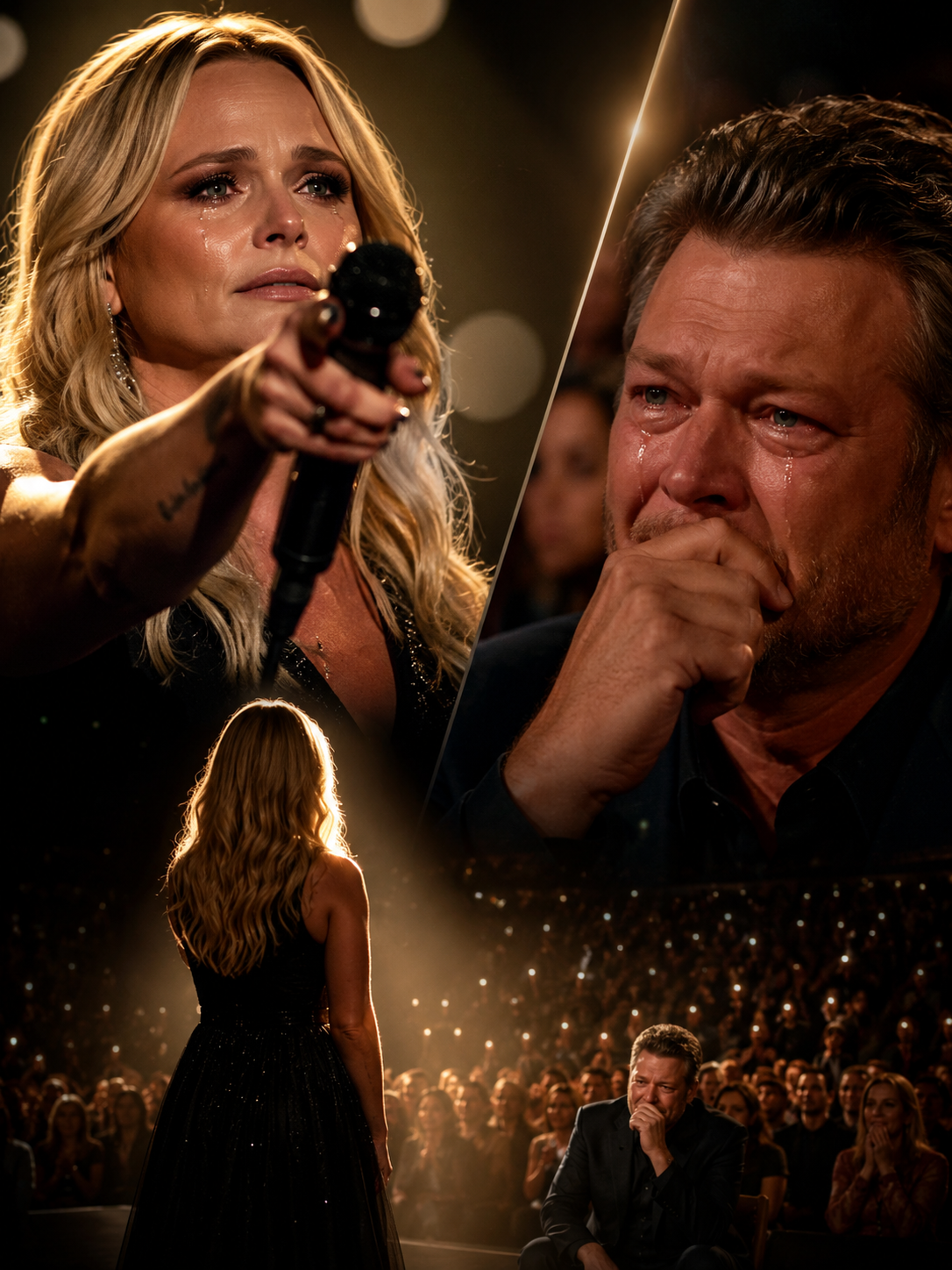
For a few hours, social media was flooded with dramatic posts claiming that Miranda Lambert dedicated an emotional performance to her ex-husband Blake Shelton during the 60th Academy of Country Music Awards. According to the viral narrative, Lambert reportedly paused before beginning a song and quietly said, “This is for you, Blake.” The posts went even further, alleging that Shelton, seated in the audience, broke down in tears while the entire venue watched in stunned silence.
It is the kind of story perfectly designed for today’s social media algorithms. It combines two of country music’s biggest stars, an emotional reunion, an awards-show setting, and the lingering fascination surrounding one of the genre’s most famous former couples. Unsurprisingly, millions of users reacted before stopping to ask an important question:
Did it actually happen?
As compelling as the story may sound, there is no credible evidence that such a moment took place during the ACM Awards. No official broadcast footage, reputable news reports, or verified statements from either Miranda Lambert or Blake Shelton support the claims circulating online.
That hasn’t stopped the rumor from spreading.
The popularity of the story speaks less about what happened on stage and more about why audiences remain captivated by Lambert and Shelton’s history. Even years after their divorce, nearly every interaction—or even the possibility of one—generates enormous public interest.
Miranda Lambert and Blake Shelton were once considered country music’s golden couple. After years together, they married in 2011, becoming one of Nashville’s most recognizable power couples. Their chemistry both on and off stage earned admiration from fans, and their collaborations became memorable moments in modern country music.
When the couple announced their divorce in 2015, the news shocked the entertainment world. Although they released a joint statement asking for privacy, the breakup became one of the most discussed celebrity separations of the decade.
In the years that followed, both artists moved forward with their personal lives and careers. Shelton eventually married Gwen Stefani, while Lambert found happiness with Brendan McLoughlin. Publicly, both have largely avoided fueling speculation about their past relationship.
Yet fans have never completely let go.
Every award show appearance, every emotional ballad, every interview, and every social media post is often analyzed for possible hidden meanings. Lyrics are dissected. Facial expressions become headlines. Even seating arrangements at major events sometimes spark online theories.
That ongoing fascination helps explain why fabricated stories can gain traction so quickly.
The fictional ACM narrative follows a familiar formula frequently seen in viral entertainment posts. It begins with a supposedly intimate statement. It then escalates into a dramatic emotional reaction before ending with a suggestion that unresolved feelings still exist between former partners.
These elements are highly effective at attracting clicks because they appeal to universal emotions: heartbreak, nostalgia, forgiveness, and second chances.
Psychologists have long observed that audiences become emotionally invested in celebrity relationships in much the same way they become attached to fictional television characters. When those relationships end, many fans continue hoping for reconciliation, even when the individuals involved have clearly moved on.
As a result, stories hinting at an emotional reunion often spread much faster than ordinary entertainment news.
Awards shows are especially fertile ground for these rumors.
Live television naturally creates unpredictable moments, and viewers expect surprises. Cameras frequently capture audience reactions, standing ovations, laughter, and tears. Those genuine emotional moments can easily be removed from their original context and paired with fabricated captions that tell an entirely different story.
In today’s social media environment, a convincing headline combined with an emotional image can circulate around the world before fact-checkers or legitimate news organizations have a chance to respond.
This illustrates a broader challenge facing audiences online.
Artificial intelligence, sophisticated editing tools, and increasingly realistic image manipulation have made it easier than ever to create convincing—but entirely fictional—celebrity moments. A dramatic thumbnail, an emotional caption, and a few carefully selected photographs can make an invented event appear authentic.
That is why media literacy has become increasingly important.
When extraordinary celebrity stories emerge, it is worth checking whether established entertainment outlets have independently reported the event. If no verified video exists and no reputable publication has covered the alleged incident, there is good reason to remain skeptical.
In the case of the viral ACM story involving Lambert and Shelton, no such independent confirmation has surfaced.
That doesn’t mean fans are wrong for feeling nostalgic about the pair’s musical legacy.
Their collaborations remain beloved by many country music listeners, and both artists continue to enjoy successful careers individually. Their shared history is undeniably an important chapter in modern country music.
But admiration for that history should not be confused with accepting unsupported claims as fact.
Interestingly, the popularity of stories like this also demonstrates the remarkable emotional power of music itself. Country music has always excelled at telling stories of love, loss, regret, redemption, and hope. When artists perform emotional songs, audiences naturally connect those lyrics to real-life experiences, especially when performers have lived through highly publicized personal events.
That emotional connection is genuine.
The fictional details surrounding viral rumors, however, are another matter entirely.
For fans, perhaps the most meaningful takeaway is not whether an imagined six-word dedication ever occurred, but rather how deeply music continues to resonate across generations. Songs often become soundtracks to people’s own relationships, heartbreaks, and personal memories. They remind listeners of moments in their own lives, regardless of the artist’s original inspiration.
Miranda Lambert and Blake Shelton each continue to command enormous respect within country music because of their talent, songwriting, and longevity—not because of internet speculation.
As social media continues rewarding emotionally charged content, similar rumors will almost certainly appear again. Some will involve former couples. Others will center on emotional reunions, surprise confessions, or tearful award-show moments that never actually happened.
The best approach is simple: enjoy the music, appreciate genuine performances, and verify extraordinary claims before sharing them.
Sometimes the most powerful stories are the real ones—and they don’t need fictional drama to leave a lasting impression.