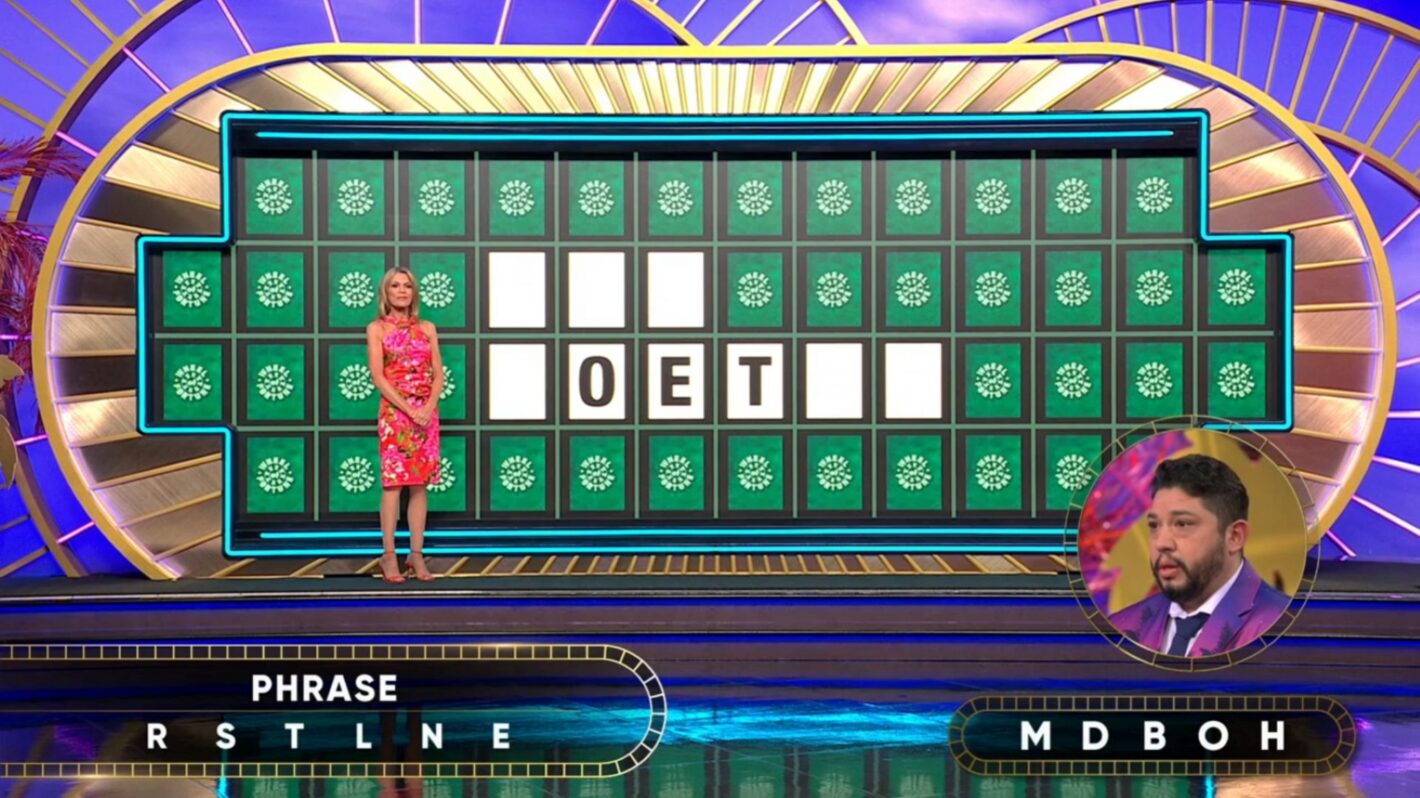
A recent episode of Wheel of Fortune has ignited heated debate online after a bonus round puzzle left both contestants and viewers stunned — and, in many cases, frustrated.
The final answer, “Wax Poetic,” appeared to stump the contestant completely and quickly became a trending topic among fans who questioned whether the phrase was too obscure for a high-stakes finale. While some viewers praised the puzzle’s cleverness, others argued it was unfairly difficult and not commonly used in everyday language.
A Tough Setup in the Bonus Round
The controversy began when the contestant was given the standard bonus round letters: R, S, T, L, N, and E, a familiar starting point for longtime viewers of Wheel of Fortune.
To complete the puzzle, the contestant selected additional letters: M, D, B, O, and H, hoping to reveal enough of the phrase to make an educated guess.
After the board was filled in, the puzzle appeared as:
_ _ _ _ O E T _ _
Despite having several key letters revealed, the contestant failed to submit a guess before the timer ran out. The tension in the studio was palpable as the clock ticked down with no answer.
Host Ryan Seacrest acknowledged the difficulty, saying on air, “This is so tough to figure out without the letters there,” reflecting the moment’s pressure and ambiguity.
The Answer: “Wax Poetic”
When the solution was revealed as “Wax Poetic,” reactions were immediate — both in the studio and online. The phrase, meaning to speak or write in an overly elaborate or sentimental way, is known in literary contexts but is not commonly used in everyday conversation.
That unfamiliarity became the center of the debate.
While bonus puzzles on Wheel of Fortune often challenge contestants with idioms, phrases, or cultural references, many viewers argued that “Wax Poetic” crossed the line into obscurity.
A Prize That Slipped Away
The stakes made the moment even more dramatic. The contestant had a potential $45,000 in the bonus envelope. Had the puzzle been solved correctly, the total winnings would have increased to $60,747.
That missed opportunity added emotional weight to the moment, with fans expressing sympathy for the contestant who came so close to a significant payday but ultimately walked away empty-handed from the bonus round.
Fans React: “Too Hard” vs “Fair Game”
As soon as the episode aired, social media and Reddit lit up with reactions. Many viewers expressed frustration, arguing that the puzzle was far too difficult for a bonus round in Wheel of Fortune.
One viewer wrote, “Terrible final puzzle,” reflecting a sentiment shared by others who felt the phrase was too obscure or outdated for mainstream contestants.
Another commenter reacted with disbelief: “What the what? Phrase in the final?” questioning whether the category and wording were appropriate for such a high-pressure moment.
Some fans also pointed out that the puzzle felt especially confusing due to repetition in the episode’s vocabulary. “Having ‘poet’ twice in one game threw me off,” one viewer noted, suggesting that earlier clues may have unintentionally misled both contestants and audience members.
For critics, the core issue wasn’t just difficulty — it was familiarity. Many argued that bonus round puzzles should rely on widely recognized phrases that allow contestants to make logical deductions under pressure.
But Not Everyone Agreed
Despite the backlash, not all viewers saw the puzzle as unfair. A number of fans defended the challenge, arguing that bonus rounds are meant to be difficult and unpredictable.
Some even admitted they solved the puzzle themselves — but only at the very last moment.
“I can’t believe I solved the final puzzle tonight. WAX POETIC,” one viewer shared online. They went on to explain their reasoning: noticing the structure of the word “OET _,” they deduced that “poetic” was the most likely fit, while “wax” came from familiarity with older expressions and literature.
This group of viewers argued that the puzzle rewarded deeper vocabulary knowledge and pattern recognition, both essential elements of Wheel of Fortune gameplay.
The Difficulty Debate: Where Is the Line?
The controversy surrounding “Wax Poetic” highlights an ongoing tension in game shows: how difficult is too difficult?
On one hand, the bonus round is designed to be the most challenging part of Wheel of Fortune. Contestants reach this stage after successfully solving multiple puzzles, and the final round is meant to test their ability under pressure with limited information.
On the other hand, fans expect a certain level of fairness — meaning puzzles should be solvable using common knowledge, not specialized or literary expressions that many viewers may never have encountered.
“Wax Poetic” sits right in the middle of that debate. It is a real phrase, but one that exists mostly in literary or academic contexts, making it less accessible to casual viewers.
Why the Puzzle Stuck With Viewers
Part of what made this moment so viral is how quickly audiences of Wheel of Fortune engage in solving puzzles from home. The show’s format encourages viewers to play along, turning every episode into a shared experience.
But when a puzzle feels unfamiliar or overly abstract, that connection breaks. Instead of participation, viewers experience confusion — and in some cases, frustration.
That emotional reaction often fuels online discussion, as fans compare notes on what they thought the answer might be and whether the puzzle was fair.
A Familiar Pattern in Game Show History
This is not the first time Wheel of Fortune has faced criticism over puzzle difficulty. Over the years, certain bonus round answers have sparked similar debates, particularly when they involve uncommon idioms or less frequently used phrases.
These controversies tend to follow a predictable cycle: immediate outrage, viral discussion, and eventually, a return to normal viewing patterns as the next episode airs. However, they often leave behind lingering questions about how game designers choose puzzles and how much prior knowledge should be assumed.
Final Thoughts: A Puzzle That Divided the Audience
In the end, “Wax Poetic” became more than just a bonus round answer — it became a flashpoint for a broader conversation about fairness, language, and expectation in game shows.
For some viewers, it was a brilliant and challenging puzzle that rewarded deep knowledge and quick thinking. For others, it was an example of a game show stepping too far into obscure territory at the expense of accessibility.
What remains clear is that moments like this are part of what keeps Wheel of Fortune in the public conversation. Whether praised or criticized, the show continues to spark strong reactions — and in television, that kind of attention is its own kind of success.