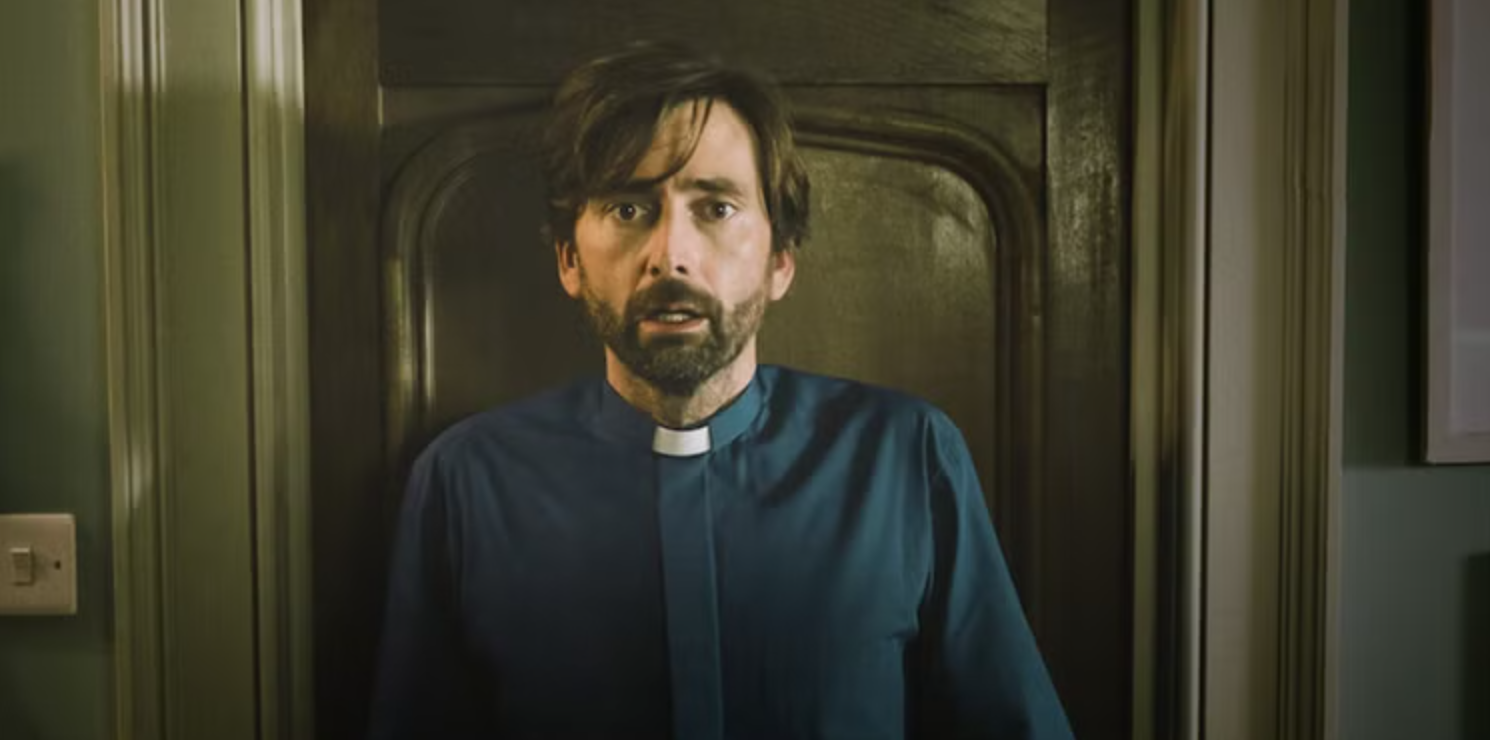
David Tennant has built an extraordinary career by portraying heroes, detectives, villains, and complex historical figures. Yet among his most unsettling performances is his role in Inside Man, a psychological thriller that explores how ordinary people can find themselves trapped in extraordinary circumstances.
Created by acclaimed writer Steven Moffat, Inside Man begins with a premise that seems almost impossible to believe. A respected vicar. A death row inmate. A journalist. A missing tutor. At first, their lives appear to have nothing in common.
But as the story unfolds, a series of seemingly insignificant decisions slowly connects them in ways no one could have predicted.
The result is a tense, emotionally charged thriller that asks an uncomfortable question:
How far would an ordinary person go when every possible choice seems wrong?
David Tennant Plays a Man Losing Control
David Tennant stars as Harry Watling, a well-respected vicar living a quiet life with his family.
He is respected by his community.
He appears calm, thoughtful, and trustworthy.
Nothing about him suggests danger.
Yet one unexpected incident changes everything.
A misunderstanding becomes a secret.
The secret becomes a lie.
The lie creates panic.
Before long, Harry finds himself making increasingly desperate decisions in an attempt to protect the people he loves.
What makes Tennant’s performance so compelling is how believable this gradual transformation feels.
Harry never wakes up intending to become trapped inside a nightmare.
Instead, every terrible decision grows naturally from the one before it.
A Story Built on Impossible Choices
Unlike traditional crime dramas centered on solving a mystery, Inside Man focuses on moral dilemmas.
Almost every major character reaches a point where every available option carries devastating consequences.
Tell the truth?
Someone gets hurt.
Hide the truth?
The situation grows worse.
Protect family?
Risk everything else.
These impossible choices become the emotional engine driving the entire series.
Viewers are constantly forced to ask themselves what they would do under similar circumstances.
The answers are rarely comfortable.
Stanley Tucci Provides a Fascinating Counterpoint
Running parallel to Harry’s story is another unforgettable character.
Jefferson Grieff, played brilliantly by Stanley Tucci, is a former criminology professor awaiting execution on death row for murdering his wife.
Despite his imprisonment, Grieff possesses an extraordinary understanding of criminal behavior.
From his prison cell, he helps solve complex cases by analyzing human psychology.
His conversations offer fascinating insight into guilt, manipulation, fear, and motivation.
Rather than functioning as a traditional detective, Grieff becomes an observer of human nature.
His scenes provide philosophical depth while gradually connecting to the central mystery.
Every Decision Makes the Situation Worse
One reason Inside Man generates such relentless suspense is its refusal to provide easy escape routes.
Most thrillers allow characters opportunities to correct mistakes.
Here, every attempt to fix the problem creates an even larger crisis.
A simple misunderstanding escalates.
Panic replaces reason.
Trust disappears.
Relationships begin collapsing under the pressure.
Watching this chain reaction unfold becomes almost unbearable because viewers can often recognize the exact moment when honesty might have prevented disaster.
But once fear takes control, turning back becomes almost impossible.
David Tennant Captures Psychological Collapse
Throughout the series, Tennant avoids portraying Harry as either hero or villain.
Instead, he presents a deeply flawed human being overwhelmed by impossible circumstances.
His growing anxiety becomes increasingly visible.
Sleep disappears.
Confidence fades.
Rational thinking gives way to desperation.
Yet Harry never completely loses the audience’s sympathy.
Viewers understand that his intentions often remain good, even as his actions become increasingly difficult to defend.
That emotional complexity separates Inside Man from more conventional thrillers.
Suspense Without Constant Violence
Although the series contains moments of genuine danger, its greatest strength lies in psychological tension.
The suspense comes from conversations.
Hidden truths.
Missed opportunities.
Private fears.
Every scene carries emotional weight because viewers understand how fragile the situation has become.
One careless sentence.
One unexpected visitor.
One wrong decision.
Everything could collapse instantly.
That constant uncertainty creates extraordinary tension from beginning to end.
Steven Moffat’s Clever Storytelling
Writer Steven Moffat is well known for constructing intricate narratives, and Inside Man showcases his talent for interconnected storytelling.
Initially, the various storylines appear completely unrelated.
The audience naturally wonders how a death row inmate in America connects to a vicar living quietly in England.
Gradually, those connections begin emerging.
The writing rewards patience.
Every seemingly random conversation eventually gains significance.
Every character contributes something essential to the larger narrative.
The carefully constructed plot keeps viewers engaged until the final revelation.
The Moral Questions Stay With You
Perhaps the most fascinating aspect of Inside Man is its willingness to explore uncomfortable ethical questions.
Can good people commit terrible acts?
How much responsibility belongs to circumstances?
When does protecting loved ones become morally unacceptable?
Is honesty always the safest option?
The series never offers simple answers.
Instead, it trusts viewers to wrestle with these dilemmas themselves.
Long after the final episode ends, many of those questions remain unresolved.
That lingering uncertainty gives the drama lasting emotional impact.
Why David Tennant’s Performance Stands Out
David Tennant has portrayed many memorable characters throughout his career, but Harry Watling feels especially distinctive.
He is not larger than life.
He is painfully ordinary.
His fears are understandable.
His mistakes are believable.
His desperation feels authentic.
Tennant carefully avoids exaggeration, allowing the emotional deterioration to unfold gradually and naturally.
This restraint makes the character feel frighteningly real.
Audiences aren’t watching an action hero.
They’re watching someone who could easily be their neighbor.
That realism becomes one of the series’ greatest strengths.
A Thriller About Human Nature
Although Inside Man contains mystery, suspense, and criminal investigation, it ultimately explores something much deeper.
Human behavior under pressure.
The fragility of morality.
The consequences of fear.
The unpredictability of ordinary people placed in extraordinary situations.
Rather than focusing on elaborate crimes, the series examines the emotional decisions that create those crimes.
Every character believes they are making the best possible choice.
The tragedy lies in how quickly those choices spiral beyond anyone’s control.
Final Thoughts
Inside Man succeeds because it transforms an unlikely premise into an intensely personal psychological thriller.
Through outstanding performances, carefully crafted suspense, and emotionally complex storytelling, the series examines how fear, love, guilt, and desperation can reshape even the most ordinary lives.
David Tennant delivers one of the strongest performances of his career, portraying a man whose carefully ordered world gradually collapses under the weight of impossible decisions.
His work is subtle, emotionally raw, and deeply unsettling.
Combined with Stanley Tucci’s remarkable performance and Steven Moffat’s intelligent writing, Inside Man becomes far more than another crime drama.
It is a thought-provoking exploration of morality, responsibility, and the terrifying realization that the line separating ordinary people from unimaginable actions may be far thinner than any of us would like to believe.
By the time the credits roll, viewers are left with a chilling conclusion:
Sometimes the most dangerous person in the room isn’t a criminal.
It’s an ordinary individual who believes there are no good choices left.