Tennis, at its most elite level, is rarely a game of pure athleticism. When two of the world’s finest strikers step onto the red clay of Court Philippe-Chatrier, the physical battle is merely the prologue. The true match—the one that decides champions—is a silent, invisible struggle fought between the ears. At the 2025 French Open, this truth was laid bare in a visceral, heartbreaking display of unraveling that will be studied by sports psychologists for years to come. Aryna Sabalenka, the powerhouse who had marched through the draw with the aura of inevitability, found herself trapped in a nightmare of her own making, culminating in a post-match apology that felt less like a media obligation and more like a mourning for her own lost potential.
The narrative of that final, which ultimately saw Coco Gauff ascend to the throne, was not defined by Gauff’s brilliance alone—though her resilience was undeniable—but by the profound, structural disintegration of Sabalenka’s game. It was a statistical anomaly that defied logic: 70 unforced errors. To the casual observer, the number is merely a digit; to those who understand the mechanics of professional tennis, it is a staggering indictment of a nervous system under siege.
The Anatomy of the Collapse
The match began in a manner that suggested a coronation. Sabalenka, hitting with the thundering, flat trajectory that had neutralized every opponent prior, dominated the opening set. She was moving with purpose, dictating from the baseline, and forcing Gauff into a defensive shell. She had the aura of a woman who had mastered the clay, a surface that usually asks for patience she rarely gives.
Then, imperceptibly at first, the rhythm shifted.
It began with a double fault at a crucial juncture, followed by a forehand that sailed long—not by inches, but by feet. In tennis, these are “misses of doubt.” A player who is confident misses by the smallest of margins, catching the tape or landing just behind the baseline. A player who is losing the battle with their own mind begins to hit with hesitation. The swing slows down, the follow-through becomes truncated, and the kinetic chain breaks.
As the second set wore on, the “Sabalenka Machine” ground to a shuddering halt. The crowd at Roland Garros, sensing the shift in momentum, became a character in the drama. The roar of the Parisian faithful grew louder with every unforced error, a swell of sound that seemed to feed Gauff’s adrenaline while suffocating the world number one.
Seventy unforced errors in a three-set match is a statistic that usually belongs to a qualifier struggling to find their range on the practice courts, not a Grand Slam champion in a final. It was a visceral reminder that the margin between the pinnacle of sport and the depths of frustration is microscopic. Sabalenka wasn’t just playing Gauff; she was fighting a war against her own biomechanics.
The Psychological Crucible
The “yips”—that indefinable state of competitive paralysis—are often whispered about in sports, rarely seen on the sport’s biggest stage. Yet, as the match slipped away, there was an inescapable feeling that Sabalenka was gripped by a version of this phenomenon. Her serve, usually a weapon of mass destruction, became a liability. Her forehand, the foundation of her entire tactical identity, became erratic.
Every time she stepped up to the line, the tension was palpable. She wasn’t just hitting a tennis ball; she was carrying the weight of expectation. Being the favorite at a Grand Slam is a heavy burden, but being the favorite who should be winning is an entirely different caliber of pressure. Sabalenka had the title in her hands, and as she watched it slide away, the fear of the outcome began to dictate the process.
This is the cruelty of clay court tennis. On grass or hard courts, power can mask deficiencies in movement or tactical patience. On clay, there is nowhere to hide. The surface demands a response to every ball; it requires sliding, recovering, and resetting. When the mind is unsettled, the footwork becomes lazy, the balance is lost, and the shots become “squeezed.” Sabalenka’s collapse was a textbook case of a player trying to force a result that needed to be earned.
The Human Element: An Unfiltered Apology
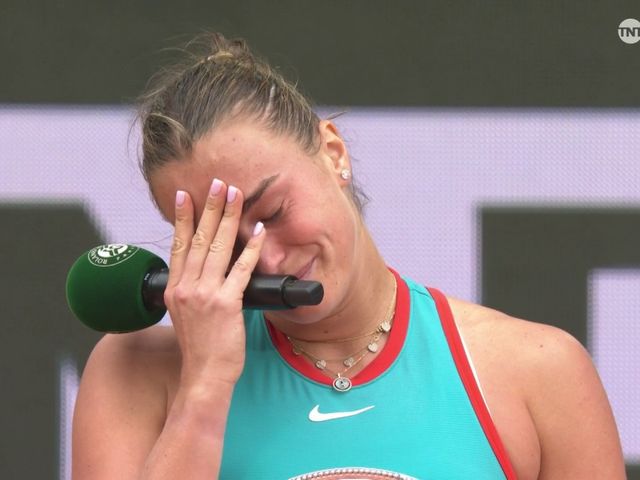
When the final point was struck, and the handshake took place at the net, the cameras caught the raw, unvarnished truth of the experience. The trophy ceremony is typically a place of rehearsed platitudes, where winners thank their teams and runners-up offer gracious, if somewhat hollow, congratulations.
Aryna Sabalenka broke the script.
Standing at the microphone, clutching the runner-up plate, she didn’t offer a polished analysis of the tactical battle. She offered an apology. “I’m sorry for this terrible final,” she said, her voice wavering with a vulnerability that pierced the cold indifference of the stadium.
In that moment, she wasn’t the invincible “Power-Queen” of the WTA tour; she was a human being processing a failure that felt, in the immediacy of the moment, catastrophic. That apology was not just for the fans or the tournament organizers; it was an admission of self-betrayal. She knew, better than anyone, that the match was hers to take and hers to lose. By acknowledging the “terrible” nature of the final, she was essentially grappling with the fact that she hadn’t given the crowd, or her opponent, the spectacle they deserved.
It was an act of profound honesty. In an era of curated social media personas and carefully managed media obligations, Sabalenka’s raw display of emotion resonated deeply. It reminded the world that behind the thunderous serves and the high-octane forehands are people who feel the crushing weight of their own ambitions.
The Legacy of the 2025 Final
History will record Coco Gauff as the victor of that 2025 French Open final, and rightfully so. Gauff played the match that the situation demanded—she was the anvil to Sabalenka’s hammer, waiting for the hammer to shatter itself against the steel of her defense.
But the match will also be remembered for the unraveling of Aryna Sabalenka. It will be the “what if” moment of her career, a dark point in the center of a brilliant timeline. Yet, sports history is filled with legends who had to survive their own collapses before they could solidify their greatness.
The 70 errors were a disaster, yes. The speech was sad, undoubtedly. But the beauty of the sport lies in its ability to offer a clean slate with every new tournament. The red clay of Paris eventually gets washed away, the lines are repainted, and the champions move on.
For Sabalenka, that final was a crucible. It tested her nerves, humiliated her game, and forced her to look into the mirror and confront the fragility of her own power. Whether this loss marks the beginning of a persistent struggle or the necessary friction that sharpens a diamond, remains to be seen. But one thing is certain: on that afternoon in 2025, the world saw the most authentic version of Aryna Sabalenka—a champion who could fall, who could fail, and who had the courage to apologize for it. And in that failure, there was a strange, haunting kind of beauty.