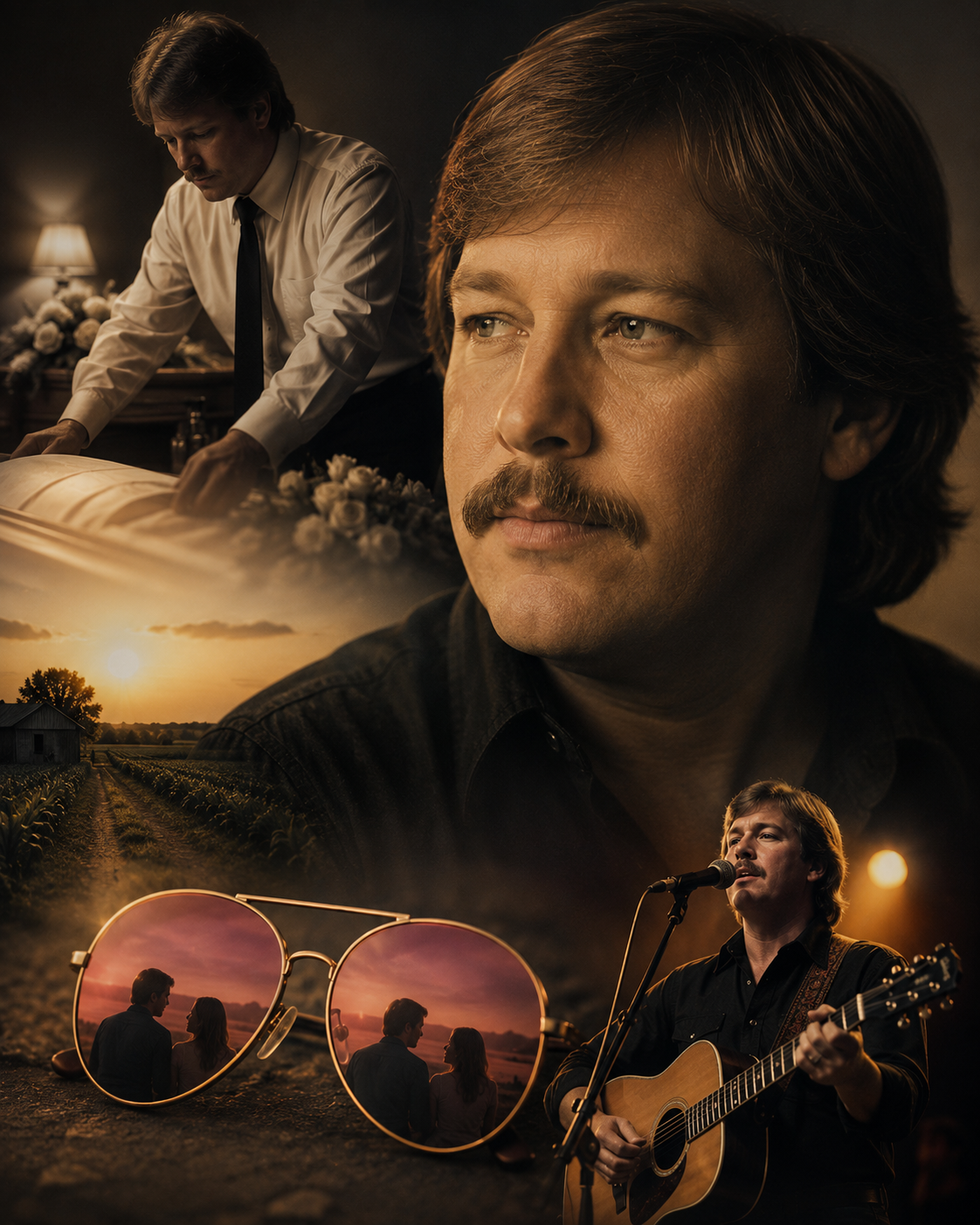
We like our country music stars to have clean, cinematic origin stories. We want them to have spent their youths hitchhiking down dusty highways with nothing but a battered acoustic guitar, or singing for tips in the neon-soaked dive bars of Lower Broadway. We want the romance of the struggle.
But true country music—the kind that gets under your skin and stays there for decades—does not come from a Hollywood script. It comes from the raw, unvarnished corners of real life. And few artists in the history of the genre possess an origin story as profoundly haunting, or as deeply telling, as John Conlee.
Years before he stood on the stage of the Grand Ole Opry singing about a man blinding himself to reality through a pair of “Rose Colored Glasses,” Conlee spent his days in a place where reality was the only thing that mattered. He didn’t start his professional life under the bright lights of a studio.
He started it in a funeral home, surrounded by the dead, learning exactly what families sound like when they have finally run out of words.
The Weight of the Soil and the Silence of the Grave
To understand the emotional gravity John Conlee brought to Nashville in the late 1970s, you have to look at the dirt he came from. Raised on a tobacco farm near Versailles, Kentucky, Conlee was born into a world where work wasn’t an option—it was a prerequisite for survival. He sang as a boy, and he mastered the guitar, but in a farming community, music was viewed as a luxury, not a paycheck.
When it came time to choose a career, Conlee didn’t chase a dream; he chose stability. He trained as a licensed mortician and went to work at a local funeral home.
+-----------------------------------------------------------------------+
|                       THE DUAL LIFE OF JOHN CONLEE                    |
+-----------------------------------------------------------------------+
| THE DAY JOB (The Mortician)         | THE NIGHT JOB (The Musician)    |
| • Facing absolute finality          | • Channeling human emotion      |
| • Witnessing raw, unedited grief   | • Creating melodic escapes      |
| • Managing the weight of reality    | • Exploring the human illusion  |
+-----------------------------------------------------------------------+
It is impossible to overstate how much this formative experience shapes a person’s worldview. A funeral home is a theater of absolute finality. It is a space stripped of all social pretense, politeness, and superficiality. In those quiet rooms, Conlee witnessed humanity at its most vulnerable, broken, and honest. He saw people grieving for lost futures, weeping over missed chances, and confronting the brutal truth that some things, once broken, can never be put back together.
When you spend your twenties looking at the physical end of life, you lose the ability to tolerate fake emotions. You learn the texture of true heartbreak.
From the Mortuary to the Microphone
Eventually, the pull of the airwaves drew Conlee away from the funeral parlor. He transitioned into radio, working as a disc jockey in Kentucky before migrating to the legendary WLAC in Nashville.
When Conlee finally began cutting records, he looked nothing like the highly polished, rhinestone-clad outlaws or pop-country crossovers dominating the airwaves. He looked like an everyday working man. He carried himself with a quiet, sturdy dignity. But the moment he opened his mouth, audiences realized he possessed something far more valuable than a flashy wardrobe: he had an authoritative, soul-stirring baritone that sounded like it had lived a thousand lives.
In April 1978, he unleashed “Rose Colored Glasses,” a song he co-wrote with George Baber. The premise was deceptively simple, centered around a classic country trope—a man who willingly chooses to ignore his partner’s infidelity and emotional detachment.
“These rose-colored glasses, that I’m looking through / They show me the world, the way I want it to.”
                 [ The Human Dilemma ]
                           │
             ┌─────────────┴─────────────┐
             ▼                           ▼
     [ The Cold Truth ]          [ The Warm Illusion ]
     • Painful reality           • False comfort
     • Finality                  • "Rose Colored Glasses"
While the phrase “rose-colored glasses” was a common idiom, Conlee turned it into a devastating psychological profile. The protagonist of the song isn’t stupid; he is terrified. He stays in a toxic, dying love affair because the cold, hard truth of the ending hurts infinitely more than the comfortable lie of the illusion.
The record skyrocketed to No. 5 on the Billboard Hot Country Singles chart, instantly cementing Conlee’s status as a major voice in the genre.
The Voice of the Common Man’s Despair
What separated Conlee from his contemporaries was the absolute lack of guesswork in his vocal delivery. When he followed up his initial success with masterpieces like “Lady Lay Down,” “Backside of Thirty,” and “Common Man,” he wasn’t just playing a character. He was singing about men who had slipped through the cracks of the American Dream—men who had missed their window of opportunity, lost their homes, watched their wives walk out the door, and realized the life they were promised was never coming.
When Conlee sang the line “I’m standing on the backside of thirty, going fast,” it carried the weight of a eulogy.
He didn’t sing with the melodramatic tears of a pop ballad singer. He sang with the stoic, heavy-hearted acceptance of a man who had stood at the edge of a hundred open graves. He knew that when tragedy strikes, people don’t always scream; often, they just go numb. His music became a safe haven for the blue-collar listener who knew what it felt like to fail, to pretend everything was fine, and to watch their world slowly crumble.
Living Without the Illusion
The tragic irony of John Conlee’s career is that the song that gave him his signature identity—and his trademark onstage prop of literal rose-colored sunglasses—was built on a concept he could never personally adopt.
The industry tried to wrap him in the warm, glittering illusion of country music superstardom. They gave him the hits, the applause, and the accolades. But John Conlee had already seen far too much of the real world to ever let the smoke and mirrors blind him.
He had spent his youth in tobacco fields under a scorching sun, in isolated radio booths talking to the lonely night owls of America, and in the hushed, heavily carpeted rooms of funeral homes where there was no point pretending that life hadn’t permanently changed.
“Rose Colored Glasses” became his anthem, but his performance was so hauntingly authentic precisely because he sang it from the perspective of an outsider looking in. He knew the desperate comfort of the glasses, but he also knew that eventually, everyone has to take them off and face the quiet room.