 Signature: vnODMy1Nd2Asg+5W1wW/TFp524srxhgZ09qI6P0pKJ3zgWoqGGGsuVgeA8FF/T5znKzYgdY3v71vT+RJ+mkjxa2oBuHtA39kUtCFxrirYS8/dWAy9u6+KULNoDFB7o0ggPkGCDqXNM1loSaMo5kb0WQdIWcG6BGmFZro2jo33lbymaNVGG6TwpjENVcg7gvM1WXjt1dWQieke1DvpFhPuA==
“Two Navy SEALs Called Me ‘Princess’ in a Bar—Then Their K9 Ran to Me and Exposed Who I Really Was.”
PART 1 — “Wrong Bar, Princess.”
“Wrong bar, princess.”
The words cut through the noise of the Coronado bar like a slap across my face, and the two Navy SEALs in the corner laughed like they had just put me in my place.
My brother laughed too.
That was the part that almost made me turn around.
Not the strangers. Not the smirking men with their broad shoulders, buzzed haircuts, and the kind of confidence that came from being admired everywhere they went.
No.
It was Marco sitting beside me on that barstool, my own brother, chuckling under his breath as if I were some lost little woman who had wandered into the wrong room.
He did not even look guilty.
He just looked away.
And I learned something about him in that moment that seventeen years of silence had been trying to teach me.
I set my menu down slowly.
The bartender glanced at me like he expected me to snap back, but I didn’t.
I had trained myself a long time ago not to waste energy on men who mistook volume for authority.
So I turned to the bartender and said, “Whiskey. Neat.”
Marco shifted beside me.
“Samantha,” he muttered, “don’t take it personally.”
That almost made me smile.
Because people only say “don’t take it personally” after something personal has already happened.
I looked straight ahead.
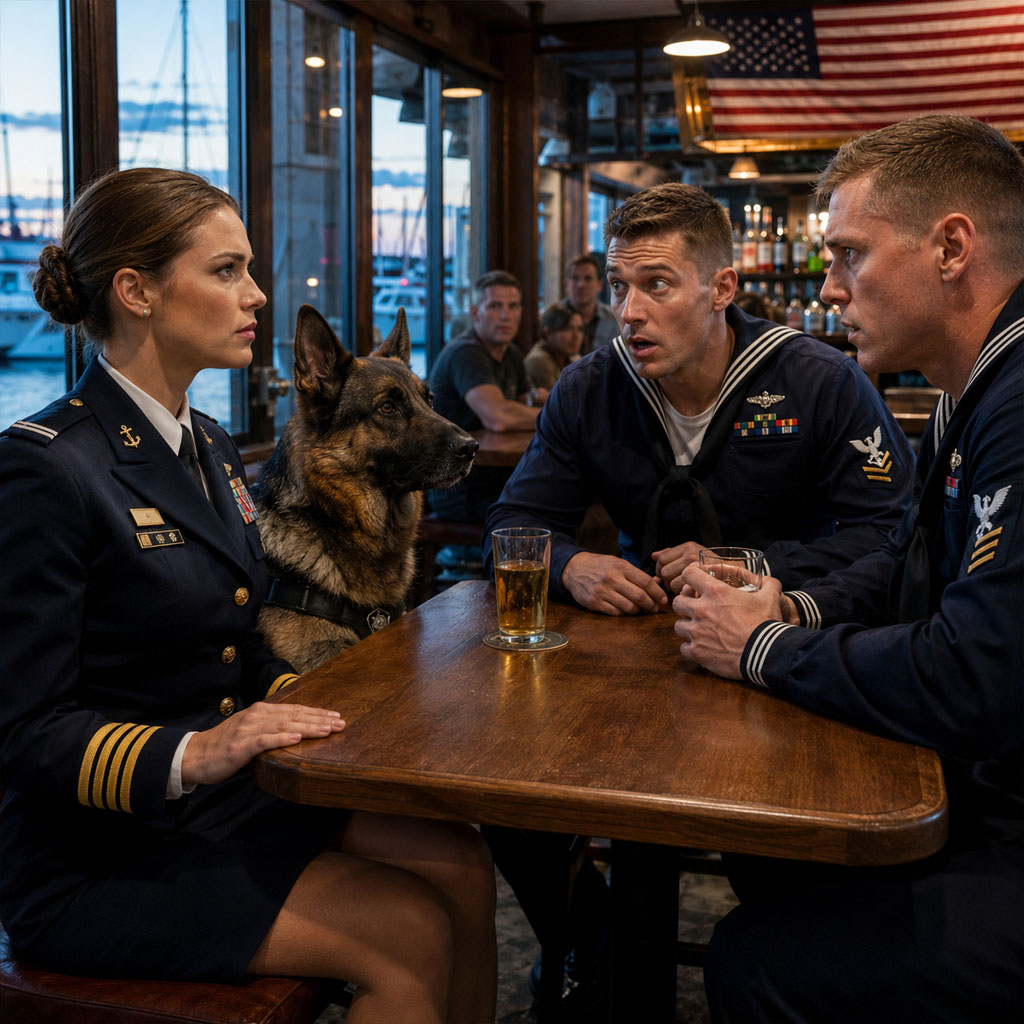
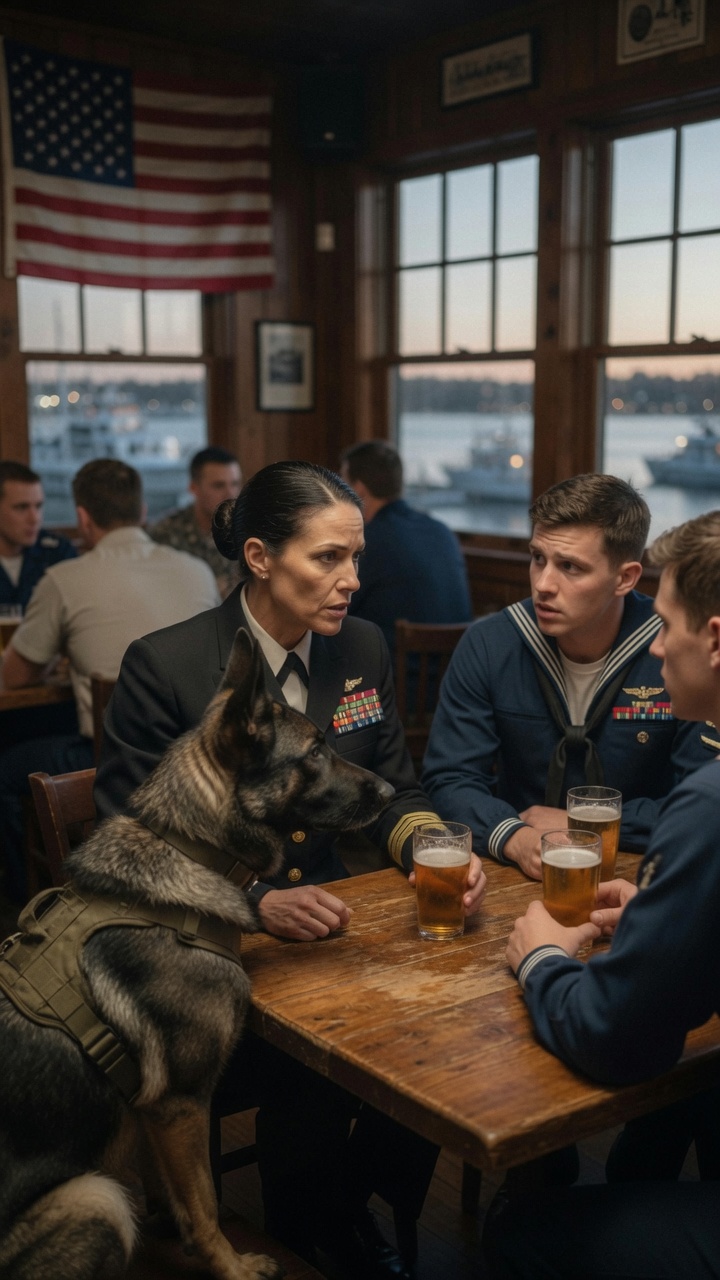
The bar smelled like beer, salt air, fried food, old wood, and expensive cologne. A football game played on the TV above the shelves. There were challenge coins behind the bar, Navy flags on the walls, framed photos of men in uniform, and enough quiet military energy in the room that a civilian could feel it without knowing what to call it.
I knew exactly what to call it.
I had lived inside that world for seventeen years.
But no one in that bar knew it.
Not the bartender.
Not the two SEALs at the corner table.
And apparently, not my brother.
To them, I was just a woman in jeans and a blue blouse, hair down from a long day, no uniform, no rank on my chest, no reason for anyone to stand up straighter when I walked in.
That was fine.
I had spent most of my career being invisible.
The work required it.
My name is Samantha Cooper. I am thirty-seven years old, and for seventeen years I helped build one of the most specialized canine programs in the United States military.
I started as a Navy enlisted handler at Lackland.
I became an officer.
Then a commander.
Then director of the Naval Special Warfare Canine Training Program.
Every operational dog assigned to SEAL teams went through a system I helped shape, refine, or personally oversee.
But if you asked my family what I did, my father would say, “She works with dogs.”
As if I ran a cute kennel behind a strip mall.
As if I spent my days throwing tennis balls.
As if those dogs had not cleared rooms, found explosive devices, protected handlers, saved men whose names I will never be allowed to say out loud.
My father, Carlos Cooper, had served twenty-two years in the Army. Sergeant First Class. Two Gulf tours. Desert training. Germany. Stories with dust, sweat, and weight behind them.
He wore his military service like other men wear wedding rings.
Quietly.
Constantly.
Proudly.
And in his mind, service had a shape.
It looked like boots on sand.
Rifles.
Infantry.
Hard men doing hard things.
It did not look like his daughter kneeling beside a Belgian Malinois, teaching him to recognize threat, scent, tone, pressure, silence, and survival.
When I told him at eighteen that I had enlisted in the Navy, he put his fork down at the kitchen table and stared at me like I had joined a circus.
“The Navy?” he said. “What does the Navy have to do with real service?”
My mother, Rosa, froze near the stove.
Marco, fourteen at the time, watched Dad’s face before deciding what his own face should do.
I said, “I’ll be training military working dogs.”
Dad laughed once.
Not loudly.
Worse.
Quietly.
“Playing with dogs, Samantha? We come from fighters.”
That was the sentence that followed me all the way to basic training.
It followed me into the cab on the August morning I left home.
My mother cried from the front step.
My father stood in the driveway with his arms crossed and did not wave.
Marco hugged me too fast, like he was embarrassed by his own emotion, then ran back inside before the cab even pulled away.
I watched my childhood house disappear around the curve.
Then I turned forward.
That was the first lesson the Navy taught me before I even arrived.
Sometimes the people who love you will not understand where you are going.
Go anyway.
At Lackland, I met my first real working dog, a German Shepherd named Bravo.
He was stubborn, serious, brilliant, and completely unimpressed by human pride.
Bravo did not care that my father thought canine work was soft.
Bravo cared whether I was steady.
Whether I was consistent.
Whether my hands lied.
Whether my voice changed when I was scared.
Dogs know things before people admit them.
By the end of my first month, the instructors told me I had an unusual rapport with working dogs.
I didn’t dominate them.
I didn’t need to.
I listened.
Then I made them want to listen back.
Years passed like that.
Training.
Deployment.
Promotion.
More training.
More dogs.
More missions I cannot describe.
I missed Thanksgiving dinners.
Birthdays.
Graduations.
Marco’s first big construction contract celebration.
My mother’s hospital award ceremony.
Christmas mornings where my father carved turkey at the kitchen counter and everyone pretended my empty chair did not mean anything.
When I came home, everyone asked the same useless questions.
“Are you dating anyone?”
“When are you getting out?”
“Do you still work with dogs?”
Never once did Marco ask, “What did you build?”
Never once did my father ask, “What did those dogs do because of you?”
So I stopped waiting.
I learned to live with the gap.
Then Ranger came into my life.
Eight weeks old.
Belgian Malinois.
Dark mask.
Oversized ears.
Eyes too sharp for a puppy.
From the first morning, I knew he was different.
Some dogs are driven.
Some are intelligent.
Some bond deeply.
Ranger listened to the world like the world owed him information.
He watched doors.
Hands.
Shoulders.
Breathing.
He understood patterns before most humans saw them.
For fourteen months, he was mine to shape.
Every morning, I worked him.
Every night, I wrote notes in a training log.
Not because anyone made me.
Because exceptional things deserve witnesses, even if the witness is only a notebook.
In May of 2022, I signed his deployment paperwork.
Assigned to a SEAL element.
Handler: Petty Officer First Class Jake Halverson.
I held Ranger’s face between my hands before the transport van arrived.
He looked at me with that absolute working-dog focus, like he was memorizing the shape of my breath.
“Go do the work,” I whispered.
The van pulled away at 0900.
I stood in the parking lot until it disappeared.
Then I walked back inside and opened the next file.
That is what military people do when something hurts.
They go back to work.
Three years later, my brother finally came to visit me in San Diego.
For six days, we tried to be siblings again.
We went to the zoo.
We walked the waterfront.
We sat on my balcony drinking coffee, talking around seventeen years of distance.
On Friday night, I took him to a bar near Naval Amphibious Base Coronado.
I thought it would be simple.
One drink.
Maybe two.
Maybe my brother would finally see a small piece of the world I lived in.
Instead, a stranger called me princess.
And my brother laughed.
I said nothing.
But silence is not weakness.
Sometimes silence is where the record begins.
And ten minutes later, the whole bar was about to learn exactly who I was.
PART 2 — The Dog Heard Me First.
The first sound was a whine.
Low.
Sharp.
Impossible to mistake.
Every muscle in my body knew that sound before my mind finished recognizing it.
I looked toward the corner table.
A Belgian Malinois stood beside one of the SEALs, body locked in my direction, ears forward, nose working the air like he had found a ghost.
My glass stopped halfway to my mouth.
The handler tightened his grip on the collar.
“Ranger. Down.”
Ranger did not go down.
My heartbeat changed.
Marco looked from me to the dog.
“What’s happening?” he whispered.
I didn’t answer.
The handler repeated, firmer this time.
“Ranger. Down.”
The dog took one step toward me.
Then another.
The bar began to quiet.
The SEAL who had called me princess stopped smiling.
Ranger pulled free with no aggression, no panic, no confusion.
Just certainty.
He crossed the room, pressed his head against my knee, and let out a sound I had not heard in three years.
Recognition.
I lowered my hand slowly.
“Hey, Ranger.”
His tail exploded against the bar rail.
The handler went pale.
“You know his name?”
I looked up.
“I trained him.”
And then I took out my military ID.
PART 3 — They Stood Up When They Read My Name.
The room changed before anyone spoke.
That is how you know power has entered a room for real.
Not when someone yells.
Not when someone threatens.
Not when someone demands respect.
Real power changes the air.
The handler stepped closer, eyes locked on the ID in my hand.
He took it carefully, like it might burn him.
His gaze moved over the card.
Then back to my face.
Then to the card again.
His throat moved.
“Commander Cooper?”
The other SEAL in the corner straightened so fast his chair scraped against the floor.
The bartender stopped wiping the glass in his hand.
Marco went still beside me.
The handler swallowed.
“Commander Samantha Cooper?”
I said, “That’s right.”
His entire expression collapsed.
Not in fear.
In recognition.
In the kind of horror decent people feel when they realize they have been careless in front of someone they should have respected from the start.
“You wrote the NSW K9 Integration Manual,” he said.
The other SEAL’s face drained.
The bartender blinked.
Someone at a nearby table whispered, “Oh, damn.”
The handler handed my ID back with both hands.
Then he stood at attention.
In a bar.
Beside a pool table.
With country music humming from the jukebox and a half-eaten basket of fries on the table behind him.
“Ma’am,” he said, voice tight, “Petty Officer First Class Jake Halverson. I owe you an apology.”
I looked down at Ranger first.
He was leaning against my leg like he had never left Lackland.
His eyes were bright.
His tail kept moving.
I scratched behind his ear in the exact place he liked, and he closed his eyes for half a second.
Three years vanished.
Eight-week-old puppy.
Training yard dust.
My old notebook.
The transport van.
The morning I let him go.
All of it came back through the weight of his head against my knee.
The SEAL who had called me princess stepped forward.
His confidence had disappeared.
“Commander, I—”
I lifted one hand.
He stopped.
I did not raise my voice.
I did not need to.
“What’s your name?”
“Chief Petty Officer Dex Morales, ma’am.”
I looked at him for a long second.
“Chief Morales,” I said, “you looked at a woman sitting quietly in a bar and decided you knew she did not belong.”
His jaw tightened.
“Yes, ma’am.”
“Then you announced that mistake loudly.”
“Yes, ma’am.”
“You did that in front of your men, in front of your handler, in front of your dog, and in front of my brother.”
His eyes flicked toward Marco.
Marco looked down.
That was the first time all night he looked ashamed.
I kept my voice even.
“Do you know what I teach handlers first?”
“No, ma’am.”
“Observe before you command.”
The words landed harder than anger would have.
Dex Morales stared straight ahead.
“Yes, ma’am.”
Jake Halverson looked like he wanted the floor to open under him.
“Commander, for the record, Ranger has never broken command like that. Not once. Not in training. Not on a plane. Not under pressure. Not in a loud room. Not around food. Not around strangers.”
I nodded.
“He didn’t break command.”
Jake blinked.
“He prioritized recognition.”
For a second, neither man spoke.
Then Jake looked down at Ranger.
The dog was still pressed into my leg, calm now, his whole body relaxed in a way I knew he did not offer easily.
I said, “He knew my voice before you knew my name.”
The sentence moved through the bar like a match dropped in dry grass.
Marco flinched.
Good.
I wanted him to hear it.
I wanted him to feel every word.
Not because I hated him.
Because I had loved him long enough to stop protecting him from the truth.
The bartender cleared his throat.
“Commander,” he said, suddenly respectful, “your drink’s on the house.”
I looked at him.
“No, it isn’t.”
He froze.
“I pay for what I order.”
“Yes, ma’am.”
That got a quiet laugh from one of the older men near the far wall.
Not mocking.
Respectful.
The kind of laugh people give when tension breaks but dignity remains.
Jake crouched near Ranger but did not touch him yet.
“Ranger,” he said softly.
The dog looked back at him.
Then back to me.
I tapped Ranger’s shoulder twice.
“Go on.”
Only then did he return to Jake.
Not because Jake commanded him.
Because I released him.
Everyone saw it.
Especially Jake.
Especially Marco.
Jake clipped Ranger’s lead with hands that looked steadier on a battlefield than they did in that bar.
“Ma’am,” he said, “I am sorry. For all of it.”
I nodded once.
“Apology received.”
Dex Morales looked like those words were not enough to save him from himself.
He was right.
Some apologies are received.
Consequences still arrive.
Marco and I left twenty minutes later.
He had barely touched his drink.
In the parking lot, the ocean air was cold, and the neon bar sign flickered red against the hood of my car.
Marco stopped near the passenger door.
“Samantha.”
I unlocked the car.
“Get in.”
“I didn’t know.”
I turned to him then.
The parking lot was half empty. Somewhere across the street, a motorcycle started. A flag snapped on a pole near the entrance, lit by a security lamp.
“You didn’t know because you never asked.”
He opened his mouth.
Closed it.
I got in the driver’s seat.
For once in his life, Marco did not have a comeback ready.
We drove in silence across the bridge.
San Diego glittered ahead of us, all glass and water and evening light.
Halfway home, he tried.
“I wasn’t laughing at you.”
“Yes, you were.”
His face turned toward me.
“No. I mean—I wasn’t trying to.”
“That is not the same thing.”
He looked out the window.
“I just thought they were joking.”
“They were.”
“Then—”
“And you thought I was the joke.”
That ended the conversation.
At my apartment, he went to the guest room without another word.
I sat at my kitchen table long after midnight with a glass of water in front of me and my phone beside it.
My kitchen was quiet.
Clean counters.
One coffee mug in the sink.
A stack of folders from work near my laptop.
The kind of ordinary American kitchen where people imagine ordinary lives happen.
No one looking in from the outside would have known that the woman sitting there had written doctrine used by SEAL teams.
No one would have known that dogs she trained had saved lives.
No one would have known that her own family had spent seventeen years misunderstanding the shape of her sacrifice.
That was the thing about invisibility.
After a while, it becomes furniture.
People stop noticing it.
Even you.
Until one careless laugh drags it into the middle of the room.
The next morning, Marco made coffee.
That alone told me something was different.
My brother did not make coffee in other people’s kitchens. He waited for coffee to happen near him.
But at seven-thirty, I found him standing at my counter, barefoot, hair messy, pouring coffee into my favorite mug.
He held it out.
“I didn’t know if you still take it black.”
“I do.”
He nodded.
We sat on the balcony.
The bay was pale gray. Joggers moved along the waterfront below. A Navy helicopter cut across the sky in the distance.
Marco looked like he had not slept.
Good.
Some truths should cost at least one night of sleep.
He wrapped both hands around his mug.
“I keep seeing his face.”
“Whose?”
“The dog.”
I looked at him.
“Ranger.”
“Yeah. Ranger.” He exhaled. “The way he knew you.”
I said nothing.
He continued.
“The whole room changed. Those guys changed. The bartender changed. Even the older guys in the back changed.”
“Yes.”
“And I was sitting there thinking…” He stopped.
I let him struggle.
People learn more from finishing the hard sentence themselves.
He finally said, “I was thinking, how did I not know who my own sister was?”
That was the first honest thing he had said since arriving.
So I gave him honesty back.
“Because Dad taught you what respect was supposed to look like, and I didn’t fit the picture.”
He winced.
“I don’t think he meant to.”
“I know.”
“And I don’t think I meant to either.”
“I know that too.”
He looked relieved too soon.
So I added, “But it still happened.”
His relief disappeared.
Good.
I was not interested in punishment.
I was interested in accuracy.
Marco stared out over the balcony rail.
“I remember when you left for basic. Dad said you were being stubborn.”
“He said worse than that.”
Marco nodded.
“He said you were wasting yourself.”
I had not known that.
The words hit, but I did not let them move my face.
He looked at me quickly.
“I’m sorry. I shouldn’t have—”
“No. Say it.”
He swallowed.
“He said you could’ve done something real.”
There it was.
The sentence behind every empty chair at Thanksgiving.
Behind every short phone call.
Behind every “Congrats, Samantha” text that felt like it had been written by a stranger in an elevator.
Something real.
I looked down at my coffee.
“Ranger found a secondary explosive device in a training scenario last year in under four minutes,” I said. “In a live version of that scenario, four minutes is the difference between men walking out and men being carried out.”
Marco went still.
“I trained his foundation.”
He did not speak.
“I wrote the integration framework his handler used. I reviewed that handler’s placement. I signed Ranger’s assignment. I wrote the manual those men follow when they take dogs into operational environments you will never hear about on the news.”
His eyes were wet now.
Mine were not.
I had already spent my tears years ago in places where no one saw them.
“I built something real, Marco. You just couldn’t see it.”
He pressed his thumb against the side of his mug.
“I want to see it now.”
That was the second honest thing.
But wanting does not erase years.
So I stood up, went to my study, and came back with the unclassified version of the NSW K9 Integration Manual.
Three hundred forty-two pages.
Black cover.
My name on the author line.
I set it on the patio table between us.
It landed with weight.
Marco stared at it.
Then he reached out and touched the cover like it was a family Bible.
“You wrote this?”
“Every word.”
He opened it.
Training protocols.
Selection criteria.
Handler integration models.
Deployment readiness frameworks.
Field feedback revisions.
Behavioral conditioning notes.
Ethics guidelines.
Failure-point analysis.
The architecture of a world he had never bothered to enter.
He turned pages slowly.
Not reading everything.
Just understanding the scale of it.
For the first time, my brother looked at my work like it had mass.
Like it took up space.
Like it could not be dismissed with a joke.
His phone buzzed on the table.
He glanced at the screen.
“Dad.”
I almost laughed.
Of course.
Carlos Cooper always found a way to arrive at the worst possible emotional moment without knowing he had done it.
Marco let it ring.
That surprised me.
Then he looked at me.
“Can I tell him?”
“No.”
His face fell.
I held his gaze.
“You can tell him what happened. You can tell him what you saw. But my life is not suddenly evidence for you to present in court because you feel guilty.”
He absorbed that.
Then nodded.
“You’re right.”
Third honest thing.
Progress.
He called Dad later from the living room while I made eggs in the kitchen.
I heard pieces of the conversation.
“No, Dad, listen.”
“No, it wasn’t like that.”
“I’m telling you, the dog knew her.”
“No, Dad. A SEAL dog.”
“No, not a pet.”
Then silence.
Then Marco’s voice, sharper.
“You always do that.”
I stopped with the spatula in my hand.
Marco had never said those words to our father.
Not once.
He continued.
“You make it smaller so you don’t have to admit you didn’t understand it.”
More silence.
I lowered the heat under the pan.
Marco said, “She’s a commander, Dad. They stood at attention in a bar.”
My father must have said something.
Marco answered quietly.
“No. I laughed too. That’s why I’m calling.”
When he came back into the kitchen, his face looked drained.
“He wants to talk to you.”
“I’m sure he does.”
“Are you going to call him?”
“Not today.”
Marco nodded.
This time he did not tell me what Dad meant.
He did not explain him.
He did not translate him into something easier for me to forgive.
He just sat down and accepted the plate I handed him.
That was new too.
The story should have ended there.
Family misunderstanding.
Dog recognizes trainer.
Men apologize.
Brother learns lesson.
Nice clean ending.
But life rarely stops where a Facebook story would prefer.
Three days later, an email landed in my official inbox.
Subject line: Written Apology and Conduct Report.
From: Petty Officer First Class Jake Halverson.
CC’d to his team lead.
I read it twice.
It was formal.
Clear.
No excuses.
He apologized for his own failure to correct Chief Morales before the situation escalated. He acknowledged the disrespect shown in a military-adjacent environment. He noted that Ranger’s response demonstrated prior foundational bonding consistent with early-stage imprinting and long-term voice recognition.
That sentence almost made me smile.
Handlers write feelings like they are incident reports.
Then I opened the attachment.
Chief Dex Morales had submitted his own statement.
Shorter.
Stiffer.
But unmistakable.
“I made an assumption based on appearance and gender. That assumption was wrong. My comment was disrespectful to Commander Cooper, to the canine program, and to the standards of this community.”
I sat back in my office chair.
Outside my window, the training yard was active. A young German Shepherd cleared an obstacle. A handler rewarded him. Another dog barked once from the kennels.
My administrative coordinator, Petty Officer Williams, appeared at my doorway.
“You saw the emails?”
“I did.”
“Word’s moving.”
“I assumed it would.”
She leaned against the frame.
“Morales got pulled into a closed-door with his senior chief this morning.”
I looked at her.
“I didn’t request that.”
“I know.”
Of course I knew what was happening.
Closed communities correct themselves when embarrassment threatens the group.
Men like Morales could dismiss a woman at a bar.
They could not dismiss a commander whose manual their teams used, whose program their dogs came from, whose work their missions depended on.
Not after a dog exposed the truth in front of witnesses.
Not after Ranger walked across that bar like a living receipt.
Williams lowered her voice.
“People are saying Ranger recognized the woman who made him mission-ready.”
I looked back at the window.
“That’s accurate.”
She smiled.
“Hell of a witness.”
“Yes,” I said. “He always was.”
The next week, Marco flew home to San Antonio.
Before he left, he stood in my doorway with his duffel bag over his shoulder.
He looked younger than thirty-three.
Older too.
That is what shame does when it starts becoming responsibility.
“I put something in your email,” he said.
“What?”
“Just read it after I’m gone.”
I raised an eyebrow.
“Marco.”
“Please.”
So I waited.
After his rideshare pulled away from my building, I opened my laptop.
There was an email from him.
Subject: I should have asked.
Inside was a letter.
Not a text.
Not a quick apology.
A letter.
He wrote about the dinner table when I enlisted.
He wrote about Dad’s face.
He wrote about how he had learned, without ever being directly instructed, that approval in our house went to the person whose achievements were easiest to explain.
Football trophies.
Construction contracts.
Promotions people understood.
Money people could count.
Buildings people could drive past and point to.
He admitted that when he could not explain my life, he had made it smaller.
He admitted that was easier than asking.
Then came the line that made me stop reading for a full minute.
“I laughed in that bar because I had been laughing quietly for years, and that was the first time you heard it out loud.”
That one hurt.
Because it was true.
I printed the letter.
Not because I forgave him fully.
Because honesty that precise deserves paper.
My father called the first week of December.
It was a Sunday afternoon.
I was folding laundry on my bed, the TV playing some home renovation show I was not watching.
His name appeared on my phone.
DAD.
I let it ring twice.
Then answered.
“Hi.”
“Hey.”
He sounded older than usual.
That scared me more than anger would have.
He started with weather.
He always started with weather.
“Cold front came through last night.”
“I saw.”
“Your mother made pozole.”
“That’s nice.”
Silence.
Then he cleared his throat.
“Marco told me what happened.”
“Yes.”
“That dog. Ranger.”
“Yes.”
“You trained him from a pup?”
“Eight weeks old.”
Another silence.
I could picture him in the kitchen back home, standing near the counter, phone pressed too tightly to his ear, my mother pretending not to listen from the stove.
He said, “My grandfather had a dog.”
I closed my eyes.
I had not expected that.
“On the ranch,” he continued. “Mutt. Ugly thing. Name was Corazon. Followed him everywhere. Worked cattle. Guarded the porch. Slept outside his door. That dog knew his voice from across the fields.”
I sat down on the edge of the bed.
Dad breathed heavily through his nose.
“When Corazon died, my grandfather didn’t talk much for a while.”
I waited.
My father did not apologize in straight lines.
He built side roads and hoped you knew where they led.
“I used to think dogs were just…” He stopped. “I don’t know. Not just. But not soldiering.”
I said nothing.
He deserved to carry the weight of the next sentence himself.
He finally said, “Maybe I didn’t understand what you were doing.”
My chest tightened.
There it was.
Not enough for a movie scene.
Not enough for a dramatic hug in a driveway.
But real enough for a man like Carlos Cooper.
“I know you didn’t,” I said.
He inhaled.
“Your mother says I should tell you I’m proud.”
A bitter little laugh almost escaped me.
“And are you?”
This silence was the longest.
Then he said, “I’m trying to understand how proud I should have been already.”
That was the closest my father had ever come to kneeling.
I looked toward my bedroom window.
Outside, a neighbor’s dog barked once.
“I can work with that,” I said.
He did not cry.
Neither did I.
But when we hung up, I sat very still for a long time.
Then I folded the laundry.
Because sometimes life changes forever, and you still have towels to put away.
By Christmas, Marco came back to San Diego.
This time he did not pretend it was casual.
He brought tamales from Mom in a cooler bag like some sacred offering.
He brought a notebook.
That made me suspicious.
We were sitting at my kitchen island when I saw it open beside his elbow.
Questions for Sam.
I saw the list before he could close it.
Ask about Ranger.
Ask about promotions.
Ask about SEAL teams without asking classified stuff.
Ask what Lackland was like.
Ask what Dad got wrong.
He went red.
I pretended not to see.
That was my gift to him.
People deserve dignity when they are learning how to love better.
The next day, I took him to the facility.
Only the parts he was allowed to see.
Kennels.
Training yard.
Obstacle course.
Handler lanes.
Equipment storage.
A memorial wall.
The American flag moved in the cold December wind above the main building.
Marco stood with his hands in his jacket pockets, watching a young handler work a German Shepherd through a search pattern.
The dog moved like purpose had taken physical form.
Nose low.
Body sharp.
Handler quiet.
Every signal invisible to people who had never learned the language.
Marco whispered, “It’s like they’re talking.”
“They are.”
“But she barely said anything.”
“Exactly.”
He watched longer.
Then turned to me.
“You taught that?”
“I taught the people who teach that.”
The sentence hit him.
I watched it hit.
His eyes moved from the handler to the dog to the facility around us.
The kennels.
The equipment.
The personnel.
The scale of the thing.
Finally, he saw the architecture.
Not the word “dogs.”
The world.
At the memorial wall, he stopped.
There were names there.
Dogs.
Handlers.
Dates.
Places reduced to initials and numbers where full names could not be used.
Marco’s face changed.
He touched one plaque gently.
“Did you know this one?”
“Yes.”
“What happened?”
“I can’t tell you everything.”
He nodded.
“What can you tell me?”
“That he did his job.”
Marco swallowed.
“And that mattered?”
I looked at him.
“It mattered enough that men went home.”
He stepped back from the wall.
His face had gone pale.
For once, my brother had nothing to say.
That evening, we video-called our parents during dinner.
My mother cried when she saw the tamales on my table.
Dad asked about the facility.
Real questions.
Careful ones.
The kind of questions he used to ask men he respected.
“How do dogs handle multiple operators?”
“How long does it take to build trust with a new handler?”
“What happens if the dog bonds too strongly to the trainer?”
I answered each one.
Marco watched from across the table, quiet, almost protective of the conversation, as if he understood something fragile was happening and did not want to interrupt it.
At the end of the call, Dad said, “Captain soon?”
I blinked.
He had remembered.
“My board package is up.”
He nodded slowly.
“You earned it.”
Two words.
No decoration.
No speech.
No apology.
But my mother covered her mouth.
Marco looked down at his plate.
And I had to stand up to refill water I did not need because my throat had closed.
In January 2026, I went back to work with Ranger still in the field and my family no longer quite as far away as before.
The bar incident had become a story.
I hated that at first.
I do not like being turned into a lesson people repeat over drinks.
But this story had teeth.
It corrected something.
Men who had treated the canine program as support began asking better questions in meetings.
Younger handlers came to my office with more confidence.
One female petty officer stopped me after a briefing and said, “Ma’am, I heard what happened at McGrady’s.”
I said, “I’m sure half of Coronado has.”
She smiled.
“Just wanted to say, I needed that story.”
I looked at her then.
Really looked.
She was maybe twenty-four.
Hair pulled tight.
Face composed.
That careful expression women wear in male spaces when they are trying not to give anyone an excuse.
I knew that face.
I had worn it for years.
“What part?” I asked.
“The part where you didn’t explain yourself first.”
That stayed with me.
Because she was right.
For years, I had believed being unseen was simply part of the job.
But there is a difference between humility and erasure.
There is a difference between quiet strength and letting careless people write your outline for you.
Ranger had crossed a room and rewritten mine.
In February, I briefed senior leadership at Naval Special Warfare Command.
Four admirals.
Two captains.
A Pentagon deputy.
A room full of men and women who knew exactly what my work meant.
I stood at the front with slides behind me and spoke for forty-five minutes on canine integration outcomes, readiness gaps, handler-dog retention, and revised deployment protocols.
No one called it soft.
No one asked if I was “still working with dogs.”
After the briefing, one admiral said, “Commander Cooper, your program saved us money, time, and lives.”
I said, “That was the goal, sir.”
He looked at me.
“No. That was the result. There’s a difference.”
I carried that sentence with me out to the parking lot.
Jake Halverson was waiting near a government vehicle.
Ranger was not with him.
Still deployed.
Still working.
Jake stood as I approached.
“Commander.”
“Petty Officer Halverson.”
He looked steadier than he had in the bar.
Good.
A man should not be judged forever by the worst careless sentence he allowed in a loud room.
He said, “Ranger topped three consecutive training cycles.”
“I saw the reports.”
“Fourth edition protocols helped.”
“I know.”
His mouth twitched.
“Of course you do.”
For a second, we were just two professionals standing in a parking lot under a flat California sky, connected by a dog neither of us owned and both of us loved in the disciplined way working people love working animals.
Then he said, “Chief Morales was reassigned from informal mentorship duties.”
I did not react.
Jake continued.
“Command said judgment matters before senior influence.”
“That sounds accurate.”
“He knows why.”
“Good.”
That was consequence.
Not revenge.
Not humiliation for sport.
A correction inside the system he valued.
A man who mocked a woman for not belonging lost the privilege of shaping younger men’s understanding of who belongs.
That satisfied me more than public embarrassment ever could.
Jake hesitated.
“I also wanted to say… I should have corrected him before Ranger did.”
“Yes,” I said.
He took that without flinching.
“I won’t make that mistake again.”
“Then the mistake became useful.”
He nodded.
I walked to my car feeling something I had not expected.
Not victory.
Not anger.
Cleanliness.
Like a room had been aired out after years of stale air.
In March, a letter arrived from my father.
Handwritten.
Two pages.
Notebook paper.
Folded into an envelope with my name written in his careful block letters.
I opened it at my kitchen table.
He wrote about Corazon again.
About ranch mornings.
About loyalty.
About how some animals do not simply obey, but choose.
Then he wrote about me.
Not in dramatic language.
Not like a man suddenly transformed into someone else.
He wrote like Carlos Cooper.
“I think I mistook quiet for small.”
I stopped there.
Read it again.
And again.
“I think I mistook quiet for small.”
That sentence was better than “I’m sorry.”
Because it named the wound.
He had seen my silence and decided it meant there was less of me.
He had been wrong.
At the bottom, he wrote:
“If that dog knew your voice after all those years, then maybe I should have listened better when you used it.”
I folded the letter carefully.
Then unfolded it.
Then folded it again.
I put it in the drawer where I keep the few things I have truly earned.
My commission certificate.
My mother’s first proud card.
Marco’s printed email.
A photo of Bravo.
A worn corner from Ranger’s puppy training file.
And now my father’s almost-apology.
In April, Ranger’s retirement paperwork hit my desk.
I stared at the notification longer than I should have.
Leg injury.
Training exercise.
Non-surgical.
No threat to normal quality of life.
Disqualifying for operational readiness.
Recommendation: retirement to pet status.
I read the message three times.
Then I filed the adoption application before lunch.
There was no decision to make.
Some things are yours before the paperwork catches up.
The retirement ceremony was small.
Appropriate.
Handlers.
Team members.
Program staff.
A flag in the corner.
Ranger sat beside Jake Halverson with his ears alert and his injured leg held carefully but proudly.
He was four now.
Still powerful.
Still sharp.
Still Ranger.
The remarks were brief.
Military people do not always know what to do with love, so we hide it inside procedure.
Service record.
Deployment cycles.
Performance metrics.
Commendation language.
All true.
None of it enough.
Jake spoke last.
His voice held steady until the final sentence.
“He brought men home.”
That was all.
That was everything.
When the ceremony ended, I stepped forward from the back.
I did not call his name.
I only said, very softly, “Hey, Ranger.”
His ears moved first.
Then his head.
Then his whole body.
The room saw it happen.
He stood.
Jake released the lead.
Ranger crossed to me with that same absolute certainty he had shown in the bar.
No hesitation.
No confusion.
No divided loyalty.
Just recognition.
He pressed his head into my hands.
I knelt and held his face.
“You did the work,” I whispered.
His tail moved.
Behind him, Jake wiped one hand over his face and pretended it was nothing.
Men are funny that way.
A week later, Ranger was under my desk.
Officially cleared as a retired working dog allowed in controlled office areas.
He learned my apartment faster than most people learn new jobs.
He slept near the bedroom door.
Checked the balcony.
Inspected the kitchen.
Ignored the expensive dog bed and chose the old rug near my desk.
Marco sent a ridiculous care package.
Dog treats.
A Navy bandana.
A handwritten note that said, “For the only family member with better instincts than the rest of us.”
I laughed out loud.
Then gave Ranger one treat.
Not the bandana.
He had dignity.
My father called to ask how “the dog” was adjusting.
Then corrected himself.
“How’s Ranger?”
That correction mattered.
My mother mailed homemade cookies for me and homemade dog biscuits for him, which Ranger considered a formal declaration of loyalty.
Life became strangely ordinary after that.
Work.
Coffee.
Reports.
Walks by the waterfront.
Ranger’s chin on my foot during late-night manual revisions.
His head lifting whenever my voice changed during difficult calls.
His body pressing against my leg whenever I stood still too long, as if reminding me I had been found once and could be found again.
On a Wednesday morning in late April, the promotion notification arrived.
Captain.
O-6.
Effective June 1, 2026.
For a moment, I just stared.
Not because I had not earned it.
Because I had.
That was the strange part.
There was no surprise left in me about the work.
Only the impact of seeing the institution put language around what I already knew I had built.
I closed my laptop.
Ranger slept under my desk.
Morning light came through the blinds in clean stripes.
I placed one hand on his back.
He opened one eye.
“Captain Cooper,” I said quietly, testing the sound.
He sighed and went back to sleep.
Perfect response.
I called my mother first.
She cried.
Then told me she was making enchiladas.
Then cried again.
Then called half the church before I even hung up.
I called Marco next.
He shouted so loud I had to pull the phone away from my ear.
“I knew it!”
“You did not know it.”
“I emotionally knew it.”
“That is not a category.”
“It is now.”
Then he got quiet.
“I’m proud of you, Sam.”
No performance.
No guilt.
No making it about his apology.
Just the sentence.
Clean and direct.
“Thank you,” I said.
Then I called my father.
He answered on the second ring.
“Captain?”
I closed my eyes.
“Effective June first.”
He breathed out.
“Well,” he said.
Just that.
Well.
Then, after a pause, “Your grandfather would’ve liked Ranger.”
I smiled.
“I think Ranger would’ve liked Corazon.”
Dad was quiet.
Then he said, “I’m proud of you.”
There it was.
No side road.
No metaphor.
No dog story standing in for the sentence.
The sentence itself.
It arrived seventeen years late.
But it arrived.
I stood in my office with one hand on Ranger’s back and let the words become real.
“Thank you, Dad.”
That evening, I walked Ranger along the waterfront.
The sky over San Diego was gold in the way April sometimes makes California look unreal.
The bay moved gently beside us.
A family took photos near the railing.
A young couple argued softly near a food truck.
A little boy pointed at Ranger and asked if he was a police dog.
I said, “Retired Navy.”
The boy’s eyes went huge.
Ranger ignored him with professional restraint.
We walked until the city lights came on.
At one point, Ranger leaned against my leg.
Exactly the way he had in the bar.
Exactly the way he had when he found me.
I thought about that night again.
Wrong bar, princess.
The laugh.
My brother’s face.
The dog’s whine.
Jake’s pale expression.
Dex Morales standing there with all his arrogance stripped away.
Marco realizing he had spent years sitting beside someone he had never truly seen.
My father learning pride in a language he should have spoken sooner.
I did not feel angry anymore.
That surprised me.
For a long time, anger had been the shape my pain used to stay upright.
But now the pain had been addressed.
Not erased.
Addressed.
There is a difference.
Dex lost standing he had not earned.
Jake learned a lesson without losing his honor.
Marco started doing the work of becoming my brother again.
My father finally said the words.
And I kept the only witness who had never doubted me.
Ranger stopped near the railing and looked out over the water.
His ears moved with every sound.
Still cataloging.
Still working in some private way.
I rested my hand on his back.
“You found me,” I said.
He leaned into my leg.
The most important work I ever did was invisible to most people.
Seventeen years.
Hundreds of dogs.
Thousands of hours.
Missed holidays.
Quiet promotions.
Classified rooms.
Unspoken grief.
A manual that changed how SEAL teams moved with canine assets.
Lives altered by decisions I made in offices, kennels, training yards, and parking lots.
For years, my family saw none of it.
Then one dog crossed a bar because he heard my voice.
That was all it took.
Not a speech.
Not a medal.
Not a confrontation.
A dog heard the woman who had built his foundation.
And he came.
Sometimes integrity is like that.
You build it in silence.
You practice it when no one claps.
You hold the line when people laugh.
You let your work become so true that someday, somewhere, it recognizes you back.
And when it does, the whole room goes quiet.
Not because you demanded respect.
Because the truth finally entered first.