Signature: 18RUJyNBOBDUugMnCTbi2OY1fwPzPf90JH1+ScQg3+lX+t0IfLD6gvrbp3WsHlpH0aRD+LAqlXZpP4rSsH0YHDZRwctJvXVaTgLVobPXFnrTc5Ew5AomR5oOPdcZZ0f/YAptoUDWgHyInU44TvnSFwCVel46PMhu/MlV4y0dT371Smk/EI6FNPhVvHDH5tr3YQaar9ol5E8uDegdBhcsTLotytvF7zJF9eG8N0/wLtZWza6Ys83XY5FiWM6fA20B
### Part 1
My mother’s heel came down before I could stop her.
The Ford F-150 was parked outside my hotel, engine idling, the morning heat already rising off the San Diego pavement. My Navy ID had slipped from my hand when she grabbed my wrist. Her fingernails had scraped my skin hard enough to leave three red lines across the back of my hand.
Then she saw the card.
She looked at my photo. Looked at the seal. Looked at me.
And laughed.
“A secretary?” she said, her voice sharp with disgust. “Her?”
Her suede heel pressed down on the card and dragged it across the dirty floor mat.
Plastic scraped against dried mud and old coffee grit.
“Don’t embarrass your brother today, Evelyn,” she hissed. “This is Cole’s day. He earned it. You’re just tagging along.”
I stared at the card under her shoe.
My chest stayed still. My face stayed calm. Years in command had taught me that real anger was quiet. Real danger didn’t scream.
But inside, something old cracked.
My mother, Marianne Parker, had spent my entire life worshiping my younger brother like he had been born under a spotlight. Cole was the miracle child. The brave one. The strong one. The son she could brag about at church, at grocery stores, at funerals, to strangers trapped beside her in airport lines.
Me?
I was “difficult.” “Cold.” “Too ambitious.” “Unfeminine.”
And when I joined the Navy, she decided I must have failed at that too.
“You file papers,” she said, grinding the card one more time. “That’s all. Don’t go waving some low-level staff badge around like you matter.”
My bleeding hand hovered between us.
I could have told her.
I could have leaned close and explained exactly what that card meant. I could have said that the woman she called a secretary had spent the last thirty-two years climbing through rooms most officers never entered. That men with stars on their shoulders waited when I spoke. That the strategy meeting scheduled later that afternoon could shift ships across half an ocean.
Instead, I bent down and picked up the card.
A smear of mud crossed my face in the photo. I wiped it clean with my sleeve, then slid it into the inside pocket of my navy blazer.
My mother turned away, fixing her lipstick in the mirror as if she had just corrected a child.
“Drive,” she said. “We’re already late.”
So I drove.
The highway unrolled ahead of us, bright and cruel. Palm trees flashed past the windows. The truck smelled like leather, perfume, and the coffee she had spilled without apology.
Mother spent the whole ride talking about Cole.
How hard he had trained. How proud Dad would have been. How real warriors didn’t hide behind desks.
My father had been dead eleven years, but she still used him like a weapon.
I tightened my hands on the wheel.
Dad had been a retired master chief. He had taught me to tie knots, read tide charts, and never let anyone else define my worth. When I left for the Naval Academy, he had hugged me so hard my ribs hurt and whispered, “They’ll underestimate you until they can’t afford to.”
He had been right.
My mother never noticed the silence that followed his name.
She never noticed anything unless Cole was standing in it.
When the gates of Naval Special Warfare Center Coronado came into view, she leaned forward like a queen approaching a coronation.
“There he is,” she breathed.
Cole stood near the entrance in his dress uniform, tall, handsome, polished like a recruiting poster.
Mother opened the door before I had fully parked.
She ran to him.
I sat alone for three seconds, one hand over the card in my pocket.
Then I stepped into the heat and followed them.
By sunset, my mother would wish she had looked at that card longer.
### Part 2
Cole saw me carrying the cooler and looked away.
That was the first cut of the day that actually surprised me.
My mother had shoved it into my arms without turning around. A heavy blue cooler packed with ice, drinks, and enough food to feed half a platoon. Then came the camera bag. Then her purse.
“Make yourself useful,” she said. “Your brother’s hands are for service, not luggage.”
Cole heard her.
He adjusted his white cap and stared at the sidewalk.
I carried everything.
The cooler dug into my hip with each step. Meltwater leaked down my pants leg. The camera strap cut into my shoulder. Around us, families laughed and hugged and posed in front of banners. Fathers clapped sons on the back. Mothers wiped tears carefully so they wouldn’t ruin their makeup.
It was a celebration.
I felt like staff.
At the bronze frogman statue, Mother grabbed Cole by both shoulders and positioned him in front of the monument.
“Stand tall,” she said. “Let people see what a real Navy career looks like.”
I set the cooler down and stepped closer.
Some foolish part of me, some stubborn little girl still waiting at a kitchen table, thought maybe I could be in the photo. Just one picture. One proof that I had been there. That I belonged to the same family.
Mother’s arm shot out.
Her palm struck my chest.
Not hard enough to injure. Hard enough to humiliate.
“This is for people who matter,” she said quietly.
Quiet was worse.
If she had yelled, strangers might have interfered. Quiet made it private. Efficient. Surgical.
I looked at Cole.
He was six foot three, trained to withstand cold water, exhaustion, hunger, fear. But he couldn’t withstand our mother’s displeasure. His eyes dropped to his shoes.
“Evelyn,” he muttered, “just take the picture.”
The camera felt heavy in my hands.
I stepped back and raised it. Through the lens, they looked perfect. Proud mother. Hero son. Sunlight on metal and white cloth. A story any American family would understand.
Except the woman taking the picture had designed operations Cole would never hear about. She had signed orders that pulled men like him out of places they weren’t supposed to survive.
Click.
My own erasure saved to a memory card.
We moved toward the barbecue area, where smoke rolled low across the courtyard. Mesquite, hot grease, sunscreen, ocean air. People balanced paper plates and shook hands. A retired neighbor from Texas, Mr. Hal Brenner, spotted us near the drink table.
“Evelyn Parker?” he said, grinning. “Well, I’ll be. Heard you were doing some serious government work out in D.C.”
His respect was real. Warm. Human.
I opened my mouth.
Mother stepped between us.
“Oh, Hal, don’t be sweet,” she said with a laugh. “She pushes paper in a basement. Coffee, files, phone calls. You know how these government jobs are.”
His smile faltered.
“She made it sound classified,” he said.
Mother rolled her eyes. “Everything is classified when you’re embarrassed.”
The pity that replaced his respect was almost physical. It landed on my skin like damp cloth.
I gave him a small smile.
“Mostly paperwork,” I said.
A young lieutenant passed behind him and froze.
I recognized him immediately. Lieutenant Andrew Miles. Three weeks earlier, I had briefed him inside a secure facility in Virginia. He had stood so straight during that briefing I thought his spine might snap.
Now his eyes locked on mine.
His face went white.
His hand twitched upward.
“Good morning, Adm—”
I stopped him with one look.
Not a head shake. Not even a gesture.
Just command.
He swallowed the word and walked away so quickly he nearly clipped a folding chair.
Mother watched him flee and laughed.
“See?” she said to Mr. Brenner. “Even officers don’t want to be near her.”
The smoke stung my eyes, but I refused to blink.
Then Mother picked up the serving tongs and began building Cole’s plate like an offering.
Perfect ribs. Best brisket. Fresh salad.
When my turn came, only a burned burger patty remained, black and curled at the edges.
Cole reached toward the brisket.
Mother stabbed it with a fork.
“No,” she said. “He needs strength.”
She slid the burned patty onto my plate.
Cole took it with his own hand and placed it in front of me.
That was when the day changed.
Because betrayal hurts most when the coward finally participates.
### Part 3
I ate the burned burger in front of everyone.
Not because I was hungry.
Because I wanted witnesses.
The patty tasted like charcoal, lighter fluid, and old humiliation. It broke apart in dry black crumbs on my tongue. My mother watched with satisfaction. Cole chewed his ribs, eyes fixed on his plate.
A commander at the next table glanced at me twice. I knew his face. I had approved his promotion eighteen months earlier.
He didn’t know me in civilian clothes.
Or maybe he did and couldn’t believe what he was seeing.
Either way, he said nothing.
I swallowed the last bitter bite and stood.
The bench legs scraped the concrete loud enough to turn heads.
“I need a minute,” I said.
No one answered.
Inside the restroom, the air smelled of lemon cleaner and old pipes. Fluorescent light buzzed overhead. I gripped the sink with both hands and stared at my reflection.
Wrinkled blazer. Windblown hair. Red scratches across my hand.
A secretary, apparently.
I bent closer to the mirror and let myself breathe.
Four counts in.
Four counts hold.
Four counts out.
Four counts still.
By the third cycle, my pulse had settled.
The door opened behind me.
A woman in a cream silk dress stepped inside, carrying a designer purse and wearing the careful smile of someone trained for public events.
Then she saw me.
The purse slipped from her hand and hit the tile.
“Oh my God,” she whispered. “Admiral Parker?”
I turned fast.
“Not here.”
She froze.
I knew her. Caroline Westbrook, wife of Admiral Richard Westbrook, commander of Pacific Fleet. Five nights earlier, I had eaten dinner at their residence after a classified briefing that had stretched past midnight. She had called me “ma’am” with the steady ease of a woman who understood rank better than most junior officers.
Now her eyes moved over me.
The scratches. The bag strap marks. The burned smell still clinging to my blazer.
From outside, Mother’s voice carried through the wall.
“My son is the real warrior in the family. Evelyn just sits in air conditioning pretending she serves.”
Caroline’s face changed.
Not shock anymore.
Fury.
“They don’t know,” she said softly.
I dried my hands with a paper towel.
“No.”
“Your own family doesn’t know who you are?”
“They know what they chose to know.”
Her eyes shone. “Ma’am, this is obscene.”
“Caroline,” I said, and my voice dropped into the tone that ended debates in windowless rooms, “you will not say my rank outside this restroom. You will not correct them. You will not interfere.”
She opened her mouth.
“That is a direct order.”
Her jaw tightened, but she nodded.
I reached for the door.
“Why?” she asked.
I stopped with my hand on the handle.
Because I wanted to see how far cruelty would go when it thought nobody important was watching.
Because I was tired.
Because some part of me still wanted my mother to stop on her own.
I didn’t say any of that.
“I have a briefing at sixteen hundred,” I said. “Until then, I’m here for my brother’s ceremony.”
When I stepped outside, a petty officer in dress blues hurried toward me carrying a locked courier pouch. He stopped so abruptly his shoes squeaked.
“Ma’am,” he said under his breath. “The secure room is prepped. INDOPACOM is standing by for your four o’clock call.”
“Any change to the package?”
“No, Admiral.”
I cut my eyes toward the picnic area.
He lowered his voice even more.
“Understood.”
“Tell them I’ll be there after the ceremony.”
“Yes, ma’am.”
He left at a near jog.
Behind me, Mother was laughing.
I walked back to the table and picked up the camera bag.
Cole looked at me then. Really looked.
Maybe he had seen the petty officer. Maybe some animal instinct inside him recognized danger.
“Evie,” he said quietly, “what was that about?”
Mother snapped, “Don’t encourage her.”
I looked at my brother.
For one second, I almost told him.
Then I remembered the burned burger in his hand.
“Nothing you need to worry about,” I said.
His face tightened.
Good.
A little uncertainty might do him good.
### Part 4
The auditorium was cold enough to preserve bodies.
Two thousand seats curved around the stage beneath bright white lights. The air-conditioning blasted from vents overhead, carrying the smell of carpet glue, polished wood, and nervous people wearing expensive clothes.
Mother marched down the center aisle like she owned the building.
Cole had managed to get her a VIP pass. Second row. Excellent view. Close enough to glow in his reflected glory.
I carried the bags.
When I reached the empty chair beside her, she dropped her purse onto it.
Then her jacket.
Then the program.
A barricade.
“Move,” she said.
I looked at the seat.
“Your purse can go on the floor.”
Her smile was small and ugly.
“The floor is filthy. Stand in the back. You’ll ruin the pictures.”
The elderly man beside her stared straight ahead, pretending to read his program upside down.
I could feel people watching.
That was Mother’s gift. She never just hurt you. She staged it.
I leaned slightly closer.
“Careful,” I said.
For the first time that day, her eyes flickered.
Then pride hardened them again.
“Don’t threaten me with your little office voice.”
I stood there long enough for the silence to become visible.
Then I turned and walked up the aisle.
Every step felt longer than the one before it. Rows of uniforms, spouses, contractors, politicians, children holding small flags. They all watched the woman in the wrinkled blazer leave the VIP section like she had been dismissed from a table she hadn’t earned.
At the back wall, I stopped beside a janitor’s cart and a metal trash can.
Two security guards stood near the exit.
One of them glanced at my blazer. His eyes narrowed slightly at the squared outline of my ID case.
I covered it with my hand.
Not yet.
The national anthem began.
Every uniform in the room stiffened. Hands rose. Shoulders squared.
My own body almost betrayed me.
Muscle memory pulled at my spine, my hand, my chin. I wanted to salute the flag with the clean precision of thirty-two years of service.
But I was in civilian clothes.
So I stood still, arms at my sides, jaw tight.
Down in the second row, Mother leaned toward the woman beside her and whispered something. The woman covered a smile.
I didn’t need to hear it.
I knew the shape of it.
On stage, Cole stood among the other graduates, white uniform bright under the lights. He looked straight ahead, but I saw his throat move.
He was swallowing hard.
The ceremony began with speeches.
Courage. Brotherhood. Sacrifice. Honor.
Words I believed in.
Words my mother loved when they belonged to Cole.
Then the announcer’s voice deepened.
“Ladies and gentlemen, the Commander of Naval Special Warfare.”
Vice Admiral Thomas Rourke walked to the podium.
Three stars on his shoulder boards. Weathered face. Silver hair. Eyes like a man who had spent his life measuring storms and walking into them anyway.
The room went silent.
I had known Rourke for twenty years. We had argued in tents, secure rooms, aircraft cabins, and once in a hallway while a senator waited outside wondering why nobody would let him in.
He was not an emotional man.
So when his eyes swept the auditorium and stopped on me, the change in his face was impossible to miss.
Shock.
Then anger.
Then something much worse for my mother.
Respect.
His hands tightened on the podium.
He looked from me to the VIP section, then back again.
I felt the room shift before anyone understood why.
Mother leaned forward, smiling, certain this moment belonged to her son.
Rourke did not look at Cole.
He looked at me.
“Before we proceed,” he said, voice carrying like thunder, “we need to correct a serious breach of protocol.”
A murmur passed through the room.
Mother straightened in her seat.
She probably thought a politician had arrived.
Rourke lifted one hand and pointed toward the back wall.
Toward the janitor’s cart.
Toward me.
“We have left one of the Navy’s most consequential commanders standing in the shadows.”
My mother’s smile died.
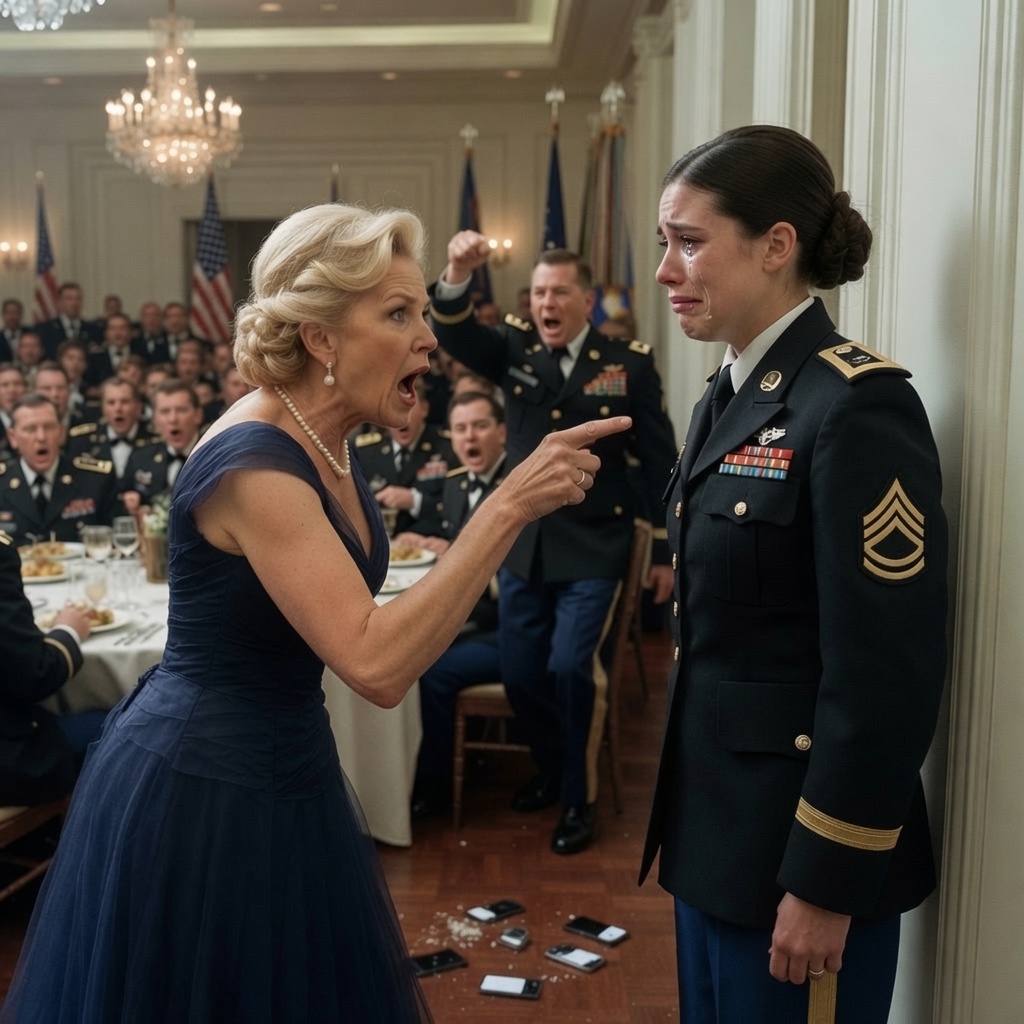
“Ladies and gentlemen,” he said, “welcome Rear Admiral Evelyn Parker.”
### Part 5
Silence fell so hard it felt like pressure.
For one full second, nobody moved.
Then a captain near the stage shouted, “Attention on deck!”
The room exploded.
Hundreds of boots struck the floor at once.
The sound hit my chest like a physical force. Chairs snapped upward. Uniformed bodies rose in perfect instinctive motion. SEAL candidates, officers, enlisted sailors, commanders, all standing rigid as steel.
Every eye turned toward the back of the room.
Toward me.
I stepped away from the wall.
The lights found my face as I entered the center aisle. My shoes struck the carpet in a steady rhythm. I didn’t rush. Command never rushes for recognition. It accepts it.
On both sides, civilians scrambled to stand, knocking over purses and coffee cups. Programs fluttered to the floor. Someone gasped. Someone whispered, “That’s her?”
I kept walking.
My mother was still sitting.
Second row.
Frozen.
Her face had gone pale under her makeup, her mouth open, her hands gripping the arms of her chair. The purse she had used to block my seat sat beside her like evidence.
I passed row after row of saluting service members.
I gave one crisp nod.
“Carry on.”
The command traveled through the room.
Bodies eased from attention, but nobody truly relaxed.
The whispering began instantly.
I reached the front. Vice Admiral Rourke stepped down from behind the podium, crossed the stage, and met me at the aisle.
He did not smile.
He saluted.
A three-star admiral saluted the woman my mother had made carry her cooler.
I returned it.
“Admiral Parker,” he said, loud enough for the front rows to hear, “we are honored by your presence.”
“Thank you, Admiral.”
His eyes flicked once toward my mother.
Not long.
Long enough.
Cole stood on stage, white-faced.
I looked at him.
My brother, the golden child, the newly minted warrior, looked like a boy caught stealing from a church collection plate.
He knew.
Not all of it. Not yet.
But enough.
Enough to understand that the “secretary” he had let our mother mock was not below him. Not beside him. Above him. Far above him in every chain of command that mattered inside that room.
The ceremony continued because ceremonies do. Tridents were pinned. Names were called. Families clapped. Cameras flashed.
But the air had changed.
When Cole’s name was announced, Mother clapped too loudly at first, then stopped when nobody joined her with the same enthusiasm. People were watching her now. Not with admiration. With curiosity. Disgust. Judgment.
Mr. Brenner, our old neighbor, sat three rows back across the aisle. I saw him lean forward and stare at Mother like he had discovered something rotten under fresh paint.
After the final speech, people rose in clusters.
Officers approached me carefully. Some shook my hand. Some simply nodded. Spouses touched my sleeve with quiet warmth. Caroline Westbrook appeared near the aisle, eyes still bright, but she obeyed my order and said nothing about the morning.
Mother bolted.
She pushed past an older couple and stumbled toward the exit, one heel catching on the carpet. She recovered badly, shoulders hunched, head down.
For once, nobody moved aside because they admired her.
They moved aside because they didn’t want to touch her shame.
I followed at a measured pace.
Outside, the California sun had turned harsh and white. The parking lot shimmered. Mother reached the truck first and yanked the passenger door open so hard it bounced back.
By the time I got in, she was breathing like a trapped animal.
The doors shut.
The cabin sealed around us.
Then she erupted.
“You did that on purpose!”
Her fist struck the dashboard. Plastic cracked.
“You let me look like a fool!”
I buckled my seat belt.
Cole climbed into the back, closing the door softly.
“Mom,” he said, voice thin, “stop.”
She spun on him.
“No! She ruined your day!”
I lifted one hand.
Flat palm. Fingers locked.
Cole went silent.
Mother turned back to me, mascara streaking down her cheeks.
“You planned this,” she spat. “You wanted everyone to worship you.”
I looked at her then.
Really looked.
“No,” I said. “I wanted you to stop before someone important noticed.”
That was when fear finally entered her eyes.
### Part 6
The truck stayed parked while heat gathered under the windshield.
Mother’s hands shook in her lap. She tried to hide it by gripping her purse, but I had spent decades reading nervous men across conference tables. Her control was gone. She just hadn’t admitted it yet.
“You lied,” she said. “All these years, you let us think—”
“I let you?” I asked.
My voice was low enough that Cole leaned forward to hear it.
“You never asked.”
Mother’s mouth tightened.
“You said you worked in an office.”
“I did.”
“You said you handled documents.”
“I did.”
“You said you couldn’t talk about it.”
“I couldn’t.”
Her face crumpled into rage because logic gave her nowhere to stand.
“You were always so smug,” she snapped. “Always acting like you were better than everyone.”
I laughed once.
No humor in it.
“Mother, you made me eat burned food in public today.”
Cole flinched.
“You ground my ID under your heel. You told strangers I was a coffee girl. You pushed me out of a family photo. You stole my seat. And you’re still trying to make yourself the victim.”
She looked out the window.
“You embarrassed me.”
“No,” I said. “You embarrassed yourself. I simply stopped covering for you.”
Cole whispered, “Evie, I’m sorry.”
I turned my eyes to the rearview mirror.
His face was pale, damp at the temples. The strong jaw. The perfect uniform. The terrified eyes of a man realizing silence is not neutral when cruelty has a target.
“Are you?” I asked.
He swallowed.
“I didn’t know.”
“You knew she was humiliating me.”
“That’s not what I meant.”
“I know exactly what you meant.”
He looked down.
Mother seized on his weakness instantly.
“She’s turning you against me,” she said. “After everything I sacrificed for you.”
Cole closed his eyes.
I reached into my blazer and took out my wallet. Not the one with credit cards. The old leather one I kept zipped inside an inner pocket. It had been through rain, desert dust, and one medevac flight I barely remembered.
Inside was a laminated photograph.
I placed it on the console.
Mother stared at it.
At first, confusion.
Then denial.
Then horror.
The picture showed me younger, dirt on my face, uniform cut open at the shoulder and chest, medical tape visible, a field tent behind me. Vice Admiral Rourke was there too, younger then, one hand braced near my gurney as if keeping himself upright by force.
Cole leaned forward.
“What is that?” he whispered.
“Thanksgiving,” I said. “2010.”
Mother’s lips parted.
“No.”
“Yes.”
Her fingers hovered over the photograph but did not touch it.
“You called me that day,” I said. “You remember?”
She shook her head too quickly.
“You screamed because I missed dinner. You told me Cole cried because his big sister didn’t care about family. You told me Dad would have been ashamed.”
The air in the truck became small.
“I was in a field medical tent outside Kandahar,” I said. “I had been injured during an extraction. Three men lived because of decisions made in a room you would have called a cubicle.”
Cole covered his mouth.
Mother stared at the photograph like it might accuse her aloud.
“I didn’t tell you because I was tired,” I said. “Tired of begging you to see me. Tired of handing you proof and watching you throw it back.”
Mother’s eyes moved to my collarbone, to the edge of the scar visible above my blouse.
For the first time in my life, she saw it.
Not looked past it.
Saw it.
A sound came out of her then. Small. Broken. Ugly.
“Evelyn,” she whispered.
“No.”
The word stopped her.
She blinked.
“You don’t get to say my name like you just found it.”
Tears spilled down her cheeks.
“I didn’t know.”
“You worked very hard not to know.”
Outside, families crossed the parking lot laughing, carrying flowers, flags, framed certificates.
Inside the truck, my family finally sat inside the truth.
And none of them knew what to do with it.
### Part 7
We ended up at a diner off Interstate 5 because Mother said she couldn’t breathe.
It was a plain place with cracked red booths, humming fluorescent lights, and a waitress who had seen enough family disasters to know when not to ask questions. The air smelled of coffee, frying oil, syrup, and rain even though the sky outside was clear.
Mother sat across from me with both hands wrapped around a mug.
Cole sat beside her, still in uniform, shoulders folded inward.
No one looked heroic under that lighting.
For a long time, nobody spoke.
Then Mother said, “I was scared of you.”
I watched steam rise from my coffee.
“That’s not an apology.”
Her face twisted.
“I’m trying.”
“No,” I said. “You’re explaining.”
The waitress set down three plates. Cole had ordered nothing but toast. Mother had asked for coffee. I had ordered loaded fries with bacon and cheese because when I was nine, I once begged for them at a diner in Amarillo and Mother told me they were for growing boys.
Cole got them that day.
I got dry toast.
When the plate landed in front of me, golden and hot and ridiculous, something inside me settled.
I picked up a fry with my fingers.
The cheese burned.
I ate it anyway.
Mother watched me as if the act itself carried judgment.
It did.
“I needed Cole to be special,” she whispered. “After your father was gone so much, after all those deployments, after years of feeling invisible…”
I held up one hand.
“Do not use Dad’s service to excuse your cruelty.”
Her mouth closed.
“You had a daughter,” I said. “You chose to compete with her.”
Cole stared at the table.
Mother’s eyes filled again.
“When you rose, I felt small.”
“So you made me smaller.”
She nodded once, barely.
The waitress stopped at the coffee station, pretending not to listen.
“I told myself you were just pushing papers,” Mother said. “It made everything easier. Cole was simple. People understood him. My son, the SEAL. My brave boy. But you…” She looked at me with something like awe and shame tangled together. “You became something I couldn’t understand.”
“You didn’t have to understand,” I said. “You only had to love me.”
That broke her.
She folded over the table, sobbing into her hands.
Cole reached for her, then stopped. Maybe he finally understood that comforting her too quickly was part of the old pattern. She hurt someone. She cried. Everyone rescued her from guilt.
Not this time.
I kept eating.
The fries tasted like salt, grease, and childhood returning too late to matter.
When Mother’s sobs quieted, I placed a napkin beside my plate and leaned back.
“Here is what happens now.”
Both of them looked up.
“You will not call my office. You will not contact my staff. You will not tell relatives I abandoned you. You will not rewrite today into a story where you were surprised and I was cruel.”
Mother nodded quickly.
“Cole,” I said.
He straightened.
“You are responsible for your own silence. Not her. Not me. You.”
His eyes shone.
“I know.”
“No, you don’t. But you will.”
He swallowed hard.
“I’m sorry, Evie.”
For the first time all day, his apology sounded like it cost him something.
I studied him.
“I believe you’re sorry.”
Hope flickered across his face.
“But belief is not trust.”
It died just as fast.
Mother whispered, “Can we fix this?”
I looked at her, this woman who had given me life and spent decades making me pay for it.
“No,” I said. “You can live differently. That is not the same as fixing what you broke.”
The diner went quiet around us.
Outside, the sunset turned the parked cars copper.
Mother reached across the table.
I moved my hand away.
She understood.
At last, she understood.
### Part 8
At six the next morning, San Diego airport smelled like exhaust, wet concrete, and burned coffee.
Mother stood beside my rental car with a cheap suitcase at her feet. Sometime during the night, she had changed out of the silk blouse and suede heels. Now she wore jeans, sneakers, and a navy blue T-shirt from some airport gift shop.
The white letters across the front read:
Proud Mother of a Navy Admiral.
They were crooked.
The shirt was ugly.
It was also the first honest thing she had worn in years.
Cole stood a few feet away, hands clasped behind his back, no longer trying to look like the center of the story. His eyes were red. He had spent most of the night calling men he respected and asking how to become worthy of the uniform beyond surviving training.
That was between him and his conscience.
Mother looked at me but did not step closer.
“I won’t ask you to forgive me,” she said.
“Good.”
Her mouth trembled.
“I don’t deserve it.”
“No.”
The answer hurt her. I saw it land.
But she did not argue.
That mattered.
Not enough to heal anything. But enough to mark the difference between yesterday’s woman and this morning’s.
“I told Cole the truth,” she said. “About the food. The pictures. The things I said when you were younger. All of it.”
Cole’s jaw tightened.
“I should have stopped it,” he said.
“Yes,” I replied.
He nodded.
No excuses. No dramatic speech. Just the weight of a man meeting his own reflection for the first time.
Mother lifted her hand, then lowered it.
“I love you,” she whispered.
I studied her face.
For most of my life, I would have paid anything to hear those words without poison in them. I would have traded medals, promotions, years, maybe even blood.
Now they arrived in an airport drop-off lane, too late to raise the child who needed them.
“I know,” I said.
Her eyes filled.
“But love that only appears after public consequences is not enough to rebuild a family.”
She pressed her lips together and nodded.
A shuttle bus hissed at the curb. A man in a business suit cursed at his phone. Somewhere behind us, a child cried because his balloon had slipped free and risen into the gray morning.
Life continued.
That was the strangest part.
Mother stepped back from the car.
Then, awkwardly, she snapped her heels together.
Her posture was wrong. Her elbow too low. Her fingers bent. The salute trembled so badly it barely held its shape.
It was the worst salute I had ever seen.
But it was the first time my mother had ever looked up at me.
I returned it perfectly.
Two beats.
Then I dropped my hand.
“Take care of yourself, Marianne.”
Not Mom.
Marianne.
She heard the difference. Her face crumpled, but she accepted it.
Cole opened his mouth.
I stopped him with a look.
“Earn your next conversation with me,” I said.
He nodded once.
“I will.”
I got into the car and closed the door.
Through the windshield, Mother stood on the curb in that crooked shirt, crying silently. Cole put one hand on her shoulder. For once, he wasn’t being worshiped. He was holding up the ruins.
My secure phone buzzed from my bag.
Red priority light.
I answered with my thumbprint.
“Parker.”
My chief of staff’s voice came through tight and immediate.
“Ma’am, we have movement in the Philippine Sea. INDOPACOM needs you in the Coronado SCIF within twenty minutes.”
I looked once in the rearview mirror.
My mother was getting smaller.
So was the life where I had begged her to see me.
“Understood,” I said. “I’m on my way.”
I pulled into traffic.
The airport disappeared behind me. The morning opened ahead, bright over the Pacific, sharp as a blade.
I had not forgiven my family.
I had simply stopped asking them for permission to be whole.
And for the first time in fifty-two years, that was enough.
THE END!