Signature: uNtdVqdgu93ZYJZlsnRWhAXgIDy+QwpLdUUroJjNuTpQYVY6jojogVzINhRW38VPUoNvMr/uF0J/aH8+xBq3bIO/V2Wjo/nwYYmtNbL4MtZLKa5k/N4HFdkj2gIJ34a1Hc38GGwT/hJ4yDMSqMJOTHY2tMmNpjNwGL+KQ4QF21lLjFebDkNQyDGTDm+3jNYbeLakX2GOz18wdV1CdIfkWQ==
Even the SEALs Gave Up — Until a Female Pilot Turned Her A-10 into a Storm…
Before sunrise, nobody at Nellis cared about my name.
They knew my call sign. Hush. They knew I flew the ugliest jet on the ramp. They knew Colonel Voss liked to call the A-10 “a Cold War lawn mower with a trigger.”
By lunch, they would know something else.
I disobeyed him.
And eight Navy SEALs lived because of it.
PART 1
The first SEAL I ever heard quit did it while a machine gun was still tearing up the canyon around him.
His voice came through my headset thin and scratched raw, buried under static, rain, and the hard metallic chop of rounds hitting rock.
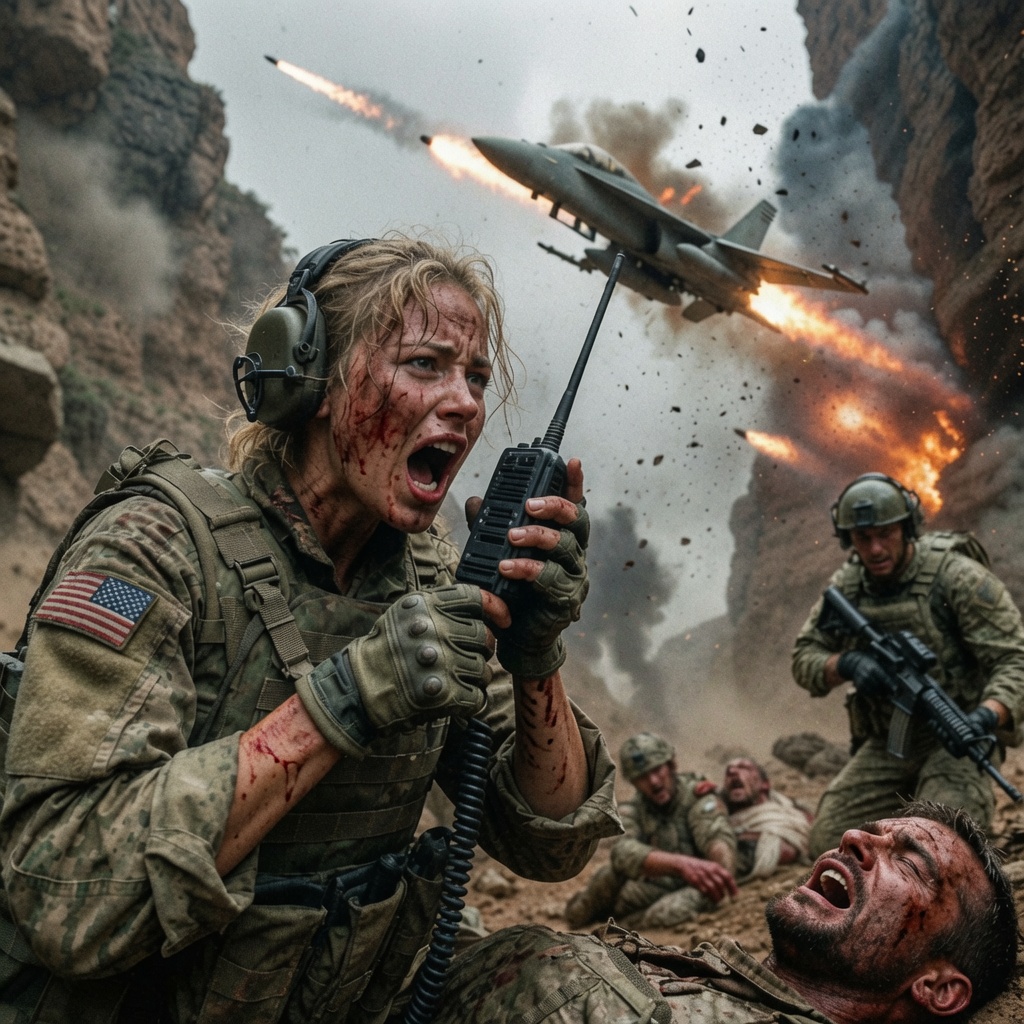
“Any station… any station… this is Mako Three Romeo. We’re black on ammo. Three wounded. North ridge has us boxed in. Requesting immediate close air. Anybody up there?”
I was up there.
Twenty-one thousand feet over the Nevada Test and Training Range, circling above a storm that looked like somebody had dropped a dirty gray mattress over half the desert.
My right hand was on the throttle.
My left was wrapped around the stick.
My shoulders hurt. My knees were stiff. My flight suit smelled like sweat, jet fuel, and the burnt Starbucks Pike Place I had spilled on myself at 0410 because the drive-thru kid outside Nellis had been too busy flirting with a woman in a white Jeep to put the lid on straight.
Not exactly the glamorous part of being an Air Force pilot.
My A-10C Thunderbolt II shuddered around me, old, stubborn, and loud. The Warthog had no interest in being pretty. It was a flying titanium bathtub built around a cannon big enough to make a grown man rethink his religion.
I loved it for that.
Below me, inside a canyon called Blackglass Draw, a SEAL team was pinned down during what had started as a classified joint exercise and turned into a federal nightmare.
Three hours earlier, some genius had decided to run a live-fire demonstration for a defense contractor called Redline Systems.
Redline had brought autonomous target trucks, remote-controlled gun mounts, drone jammers, and a CEO in Italian loafers who kept calling everyone “warrior” like he had learned it from a podcast.
Colonel Grant Voss loved him.
Voss loved anybody with money, cameras, and the ability to make him look like the next four-star general.
He did not love me.
That morning, in the briefing room, he had looked at my blonde ponytail, my flight suit, and the name tape over my chest like all three offended him personally.
“Captain Hayes,” he said, “try not to turn this into a diversity commercial.”
A few officers laughed.
I smiled.
Not because it was funny.
Because men like Voss get nervous when you do not give them the reaction they paid for.
“Copy, sir,” I said. “I’ll keep the jet from learning feminism.”
One of the SEALs at the back choked on his coffee.
Voss did not laugh.
Now that same man was in my ear from a command center with climate control, a wall of screens, and probably a fresh Diet Coke sweating on his desk.
“Bore Two-One, this is Range Control,” Voss said. “You are directed to hold above weather. Repeat, hold above weather.”
Hold.
The cleanest word in the military for doing nothing while people die.
I looked down through the canopy.
There was no canyon.
No desert.
No SEALs.
Just a flat, sealed ceiling of storm cloud rolling over federal land north of Las Vegas.
The weather had come in fast from the west, mean and electric, dropping the ceiling below five hundred feet. The rescue helicopters had turned back. The F-35s had already left for fuel. The Apaches could not work the altitude or the wind shear.
That left me and an aircraft every PowerPoint general loved to retire until bullets started landing near Americans.
“Mako Three Romeo, Bore Two-One,” I said. “I hear you. I have solid weather between us. I need your position verified.”
There was a burst of static.
Then another voice cut in, older, colder, with no panic left in it.
“Bore Two-One, this is Mako Actual. Chief Petty Officer Trevon Shaw. Don’t come down here.”
He paused.
In the background I heard a man yelling for a tourniquet.
Shaw came back on.
“North wall is socked in. East wall is worse. We have automated gun platforms above us and Redline’s drones are jamming our GPS. You drop below that deck, you’re flying blind into rock.”
He breathed once.
Then he said the line nobody in uniform is supposed to say unless the room is already on fire.
“We’re done here. Tell command not to send the birds. Tell them to call our families.”
The radio went quiet.
I stared at my fuel.
Enough to get back to Nellis.
Enough to land, climb down the ladder, peel off my gloves, swipe my Visa at the vending machine, and buy a bag of stale Doritos like nothing had happened.
Range Control came back.
“Bore Two-One, acknowledge hold order.”
I did not answer right away.
My wingman, Miller, was stacked above me in Bore Two-Two. Young guy. Smart. Good hands. Still believed regulations had moral weight.
“Hush,” he said over our private frequency, “do not even think about it.”
“I’m not thinking.”
“That makes it worse.”
He was right.
Thinking was how people found a way to call cowardice procedure.
Voss keyed in again.
“Captain Hayes, you are not authorized to descend. The optics are already bad. We do not need a dead female pilot on CNN because she decided to audition for a movie.”
There it was.
Not “dead pilot.”
Dead female pilot.
Like my body would be a press problem before it was a body.
I reached forward and started flipping switches.
Master arm.
Gun arm.
Stores page.
Manual backup ready.
My breathing slowed.
Not because I was calm.
Because panic is expensive, and I was about to need every penny.
“Range Control, Bore Two-One,” I said. “I’m experiencing a navigation fault.”
Voss snapped, “Say again?”
“My instruments indicate an uncommanded descent.”
“Hush,” Miller said, “don’t.”
I pulled the breaker that fed my main command radio.
Voss vanished from my headset.
Best sound I heard all day.
I switched to the tactical net.
“Mako Actual, Bore Two-One. I’m inbound.”
Shaw came back immediately.
“Pilot, I told you not to come.”
“And I ignored you professionally.”
“You will crash into us.”
“Then duck professionally.”
Nobody laughed.
That was fine.
I pushed the nose of the Warthog down.
The altimeter started unwinding.
Twenty thousand.
Nineteen.
Eighteen.
The cloud deck rose toward me like a wall.
My mouth went dry.
My body knew exactly what I was doing and hated every part of it.
The A-10 hit the storm, and the world outside disappeared.
PART 2
My jet entered the cloud deck, and the United States disappeared.
No mountains.
No desert.
No sky.
Just white violence slamming across the canopy while rain came at me sideways.
The cockpit turned dim and fake, like I had been sealed inside a refrigerator with engines.
“Bore Two-One, Mako Three Romeo,” the young SEAL said. “We cannot see you. We cannot even see the north wall.”
“Good,” I said. “Then you won’t see how stupid this looks.”
My radar altimeter started jumping.
Seven thousand.
Six thousand.
Seventy-two hundred.
The mountains around Blackglass Draw were rising faster than my instruments could make sense of them.
A warning voice filled my headset.
“Terrain. Terrain. Pull up.”
“Noted,” I said, and kept descending.
The Warthog shook hard enough to make my teeth click.
Wind shoved the left wing down. I corrected. Too much. Corrected again.
Inside the storm, your inner ear becomes a liar with a law degree.
It argues.
It insists.
It tells you the ground is where the sky should be and the sky is under your boots.
I ignored it and watched the gauges.
“Mako,” I said. “Talk me down. North ridge relative to your beacon?”
“Three hundred meters uphill,” Romeo answered. His voice cracked. “Maybe more. We lost range. GPS is trash.”
“Any friendlies above you?”
“No.”
“Then keep your heads buried.”
The warning voice came again.
“Pull up. Pull up.”
I slapped the caution reset.
The cockpit went quiet except for engines, rain, and my own breathing.
Two thousand feet.
One thousand.
Five hundred.
Then the cloud tore open.
And Blackglass Draw rushed up like it had been waiting for me.
PART 3
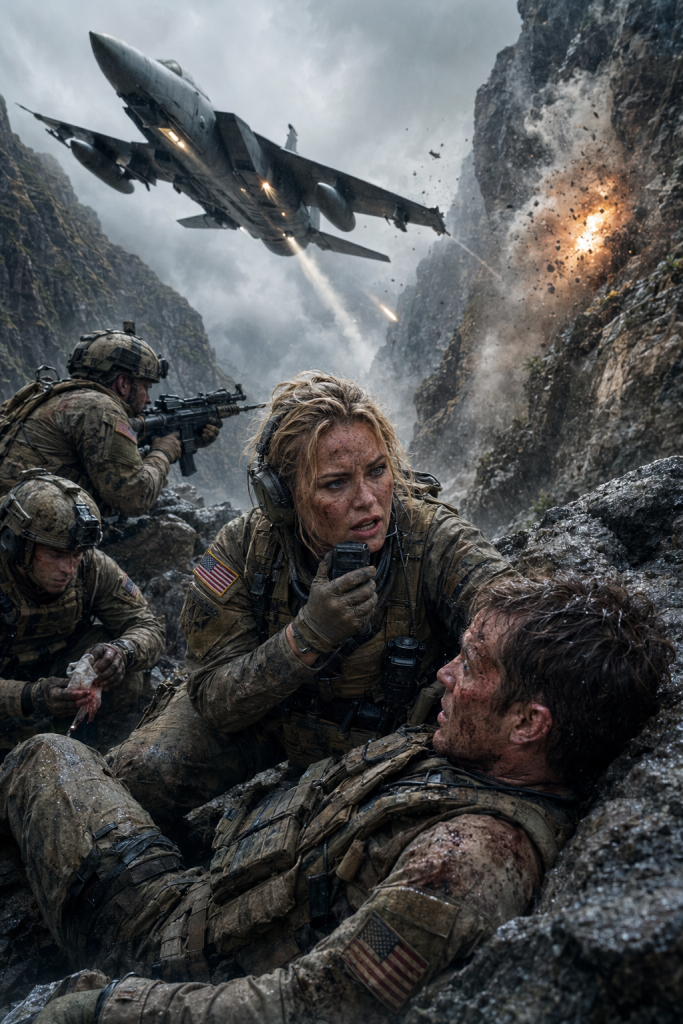
I broke through at four hundred feet, and the canyon wall was so close I could read the cracks in the rock.
I yanked right.
The Warthog rolled with all the elegance of a brick dropped from a parking garage.
My G-suit squeezed my legs. The harness cut into my shoulders. My helmet slammed against the canopy rail.
For half a second, my vision narrowed to a dirty gray tunnel.
Then the jet leveled.
Barely.
Blackglass Draw was not a valley.
It was a knife wound in the Nevada desert.
Wet black walls rose on both sides, steep and jagged, the top half swallowed by storm. Rain hammered the canopy. Dust and water blew sideways in sheets. The canyon floor twisted ahead of me in a hard, ugly line.
“Mako, Bore Two-One. I’m below the deck.”
The radio exploded with noise.
“Jesus,” Romeo shouted. “We hear you.”
“I need your strobe.”
“Popping now.”
I scanned the canyon floor.
For two seconds I saw nothing but rock, scrub brush, mud, and wreckage from one of Redline’s target trucks burning near a wash.
Then a tiny infrared flash pulsed beside a cluster of boulders.
There.
Eight Americans jammed into a pocket of dirt barely bigger than a two-car garage.
Above them, on the north slope, fire snapped out from two remote gun platforms Redline had sworn were “locked safe” during the live exercise.
Locked safe.
Another phrase invented by people who never stand where the bullets land.
The platforms were mounted behind steel shields on tracked carriers. They were supposed to simulate enemy heavy weapons with blanks and laser scoring.
Somebody had loaded them with live belts.
Somebody had overridden the safety grid.
Somebody was going to prison if I lived long enough to be annoying.
“I have your strobe,” I said. “I have the guns.”
Shaw came on. “They’re automated. We tried hitting them. Armor’s too thick.”
“Chief, with respect, your rifles are adorable.”
I banked left, climbing just enough to roll back in.
The canyon gave me almost no room. A normal attack pattern was impossible. Every turn had to be brutal, steep, and late.
The A-10 groaned as I dragged it around.
The pipper settled over the first firing platform.
My thumb found the trigger.
“Bore Two-One, in hot.”
I squeezed.
The GAU-8 did not sound like a gun from inside the cockpit.
It felt like the aircraft had grabbed the sky with both hands and started ripping.
The jet slowed under recoil. The nose vibrated. The panel blurred. A long orange flash lit the rain ahead of me.
Thirty-millimeter rounds punched into the north slope.
The first Redline platform disappeared behind a dirty eruption of sparks, steel, rock, and fire.
I came off the trigger and pulled.
Too late.
The ridge filled my canopy.
I hauled back harder.
The Warthog cleared the slope by less than a truck length.
A strip of antenna whipped past my right wing.
For one stupid second I thought about the rental townhouse off Craig Road where my laundry was still sitting in the dryer.
Then I was climbing back into rain.
“Mako, assess.”
Romeo answered with a laugh that sounded half broken.
“Good hit. First gun is gone.”
“Second?”
“Still firing. East side now. It’s walking rounds down toward us.”
I rolled again.
My arms already hurt.
The A-10 was built to get shot, not to dance inside a canyon with wet walls and bad visibility.
I came around low.
Too low.
The second platform was moving along the ridge on tracks, trying to angle around the boulders where the SEALs were pinned.
Smart software.
Dumb life choice.
I put the pipper on its engine housing and fired a short burst.
The first rounds chewed dirt.
I corrected.
The next burst hit.
The platform jerked sideways, shed pieces, then flipped onto its side with its gun still cycling into the sky like an angry sprinkler.
“Second gun down,” Shaw said. “But drones are still above us.”
Of course they were.
Three Redline quadrotor drones buzzed through the rain, small, black, and hateful. They were not armed with missiles. They carried signal repeaters and cameras, feeding the automated system and jamming Mako’s comms with short bursts.
They were the reason the SEALs could not coordinate evacuation.
They were also too small for bombs and too quick for comfort.
“Miller,” I said on the guard frequency. “Bore Two-Two, you still high?”
“I’m here,” he said. “Command is losing its mind.”
“Put that on a postcard. I need eyes if you can get a gap.”
“Negative. I’m still above soup.”
“Then pray in whatever tax bracket you belong to.”
I selected rockets.
The Hydra pods under my wings were not made for delicate work, but nothing about this day had manners.
I lined up on the drone cluster as they rose above the north wall.
“Rockets, north ridge.”
I fired.
The rockets left in a harsh ripple, streaking into cloud and rain.
Two missed.
One got close enough.
The blast slapped the drones out of formation. One spun into the canyon wall. Another dropped into the wash trailing sparks. The third kept moving.
“Mako,” I said, “I still have one jammer.”
“It’s above us,” Romeo said. “Directly above us.”
Perfect.
Because apparently I had woken up inside a lawsuit.
I shoved the throttle forward and took the Warthog down the canyon floor, coming in from the west.
The drone hovered over the SEAL position, using the boulders below as cover. If I fired the cannon, I risked walking rounds straight into Mako.
So I did the only thing uglier.
I flew at it.
The A-10 screamed down the draw at less than a hundred feet, one wingtip close enough to the canyon wall to make my left hand tighten until my glove creaked.
The drone’s collision system detected me too late.
It tried to climb.
The Warthog’s right wingtip clipped it.
A sharp metallic ping jumped through the airframe.
The drone vanished behind me in pieces.
“Mako, jammer?”
Romeo came back clearer.
“Comms are back. Comms are back.”
I almost smiled.
Then the mountain hit me.
Not literally.
A round from somewhere above the east wall smashed through the right engine cowling with a sound like God kicking a dumpster.
The aircraft yawed hard.
The stick bucked in my hands.
Every warning light that had been waiting for its big moment lit up at once.
“Engine fire. Right engine. Engine fire. Right engine.”
I looked into the mirror.
Black smoke poured behind me.
A tongue of flame snapped against the rain.
I said one word.
Not brave.
Not printable in church.
My hands moved through the checklist faster than my fear could catch up.
Right throttle idle.
Fuel flow shutoff.
Fire handle.
Extinguisher.
Discharge.
The fire died.
So did half my thrust.
The Warthog sagged like somebody had grabbed it by the tail.
I pushed the left engine past where it wanted to go.
The jet shook. My right leg fought the rudder. My thigh started burning almost instantly.
“Hush,” Miller said, voice tight. “Your transponder shows engine loss. Climb out.”
“I would love to read your newsletter about that.”
“You’re sinking.”
“I’m aware.”
Shaw came on. “Bore Two-One, get out. You cleared us enough. We can move.”
“No,” Romeo cut in. “Chief, more contacts east slope. They’re not automated. Redline security guys. They’re coming down.”
That line changed the whole day.
Redline security.
Not targets.
Not machines.
Human beings with rifles, corporate badges, and a panic strong enough to make them stupid.
They were trying to reach the SEALs before the truth got out.
Shaw’s voice went flat.
“Bore, we have armed contractors moving on our wounded.”
I looked down.
Through rain and smoke, I saw them.
Dark figures sliding down the shale from the east ridge, using the storm and wreckage as cover.
Some were carrying rifles.
One was waving what looked like a tablet, probably trying to restart whatever Redline had broken.
My ammo counter showed less than four seconds of cannon.
My right engine was dead.
My hydraulics were dropping pressure.
The canyon ahead narrowed again.
The smart move was to leave.
The kind move was to leave.
The legal move was definitely to leave.
I put the nose down.
“Mako,” I said, “last pass.”
Shaw snapped, “Bore, negative.”
“Chief, you are having a terrible day telling women what to do.”
I rolled in.
The stick felt heavier now. Too heavy.
Hydraulic pressure dropped to zero.
The Warthog shifted into manual reversion, which is a fancy way of saying the aircraft becomes a gym membership with wings.
Every correction took muscle.
Every inch of pull felt like dragging a refrigerator across carpet.
I lined up in front of the armed contractors, not close enough to hit the SEALs, not far enough to make this safe.
“Everybody down,” I said.
I squeezed the trigger.
The cannon ripped a line across the slope in front of the contractors, blasting shale, mud, and brush into a wall of debris.
They broke.
Men who had been brave against wounded SEALs suddenly remembered they had mortgages.
They dropped behind rocks.
One threw his rifle.
Another fell trying to run uphill in wet loafers.
Then the gun went dry.
Flat zero.
No bullets.
No rockets.
No bombs I could use safely.
Just a crippled jet, one angry engine, and a canyon full of people who needed a reason to stay scared.
So I gave them one.
I pushed the A-10 lower.
Fifty feet.
Forty.
The radar altimeter screamed.
I flew straight over the east slope at maximum power on one engine, close enough that my jet wash tore dust and rain off the rocks in a violent sheet.
The contractors dove flat.
The sound hit them like a physical object.
A Warthog at low altitude does not ask permission.
It arrives.
It owns every nerve in your body.
I passed over Mako’s position so low I saw Shaw’s face turn up for half a second.
Not impressed.
Not grateful.
Just furious that I was still alive and still making choices.
“Move!” he roared over the net. “Now! To the culvert! Go!”
The SEALs moved.
Two carried a wounded man.
One dragged another by his plate carrier.
Romeo ran backward, rifle up, stumbling through mud while watching the ridge.
I wanted to cover them again.
I had nothing left.
The canyon opened ahead into a long dry basin, and beyond it, through a torn hole in the cloud deck, I saw pale blue sky.
I pulled.
The stick barely moved.
I pulled harder.
My shoulders screamed.
The Warthog rose like it hated me personally.
For a second, the left engine coughed.
The aircraft dropped.
“Come on,” I said through my teeth. “You ugly American refrigerator, climb.”
It climbed.
Slow.
Dirty.
Shaking.
But it climbed.
The storm swallowed me again.
Then sunlight hit the canopy like a slap.
I broke through above the weather, trailing smoke over Nevada.
Miller’s voice cracked in my headset.
“Bore Two-One, visual. You are missing pieces.”
“Send me a Venmo request.”
“Hush—”
“Tell Nellis to roll crash.”
I looked at my shaking hands.
They did not feel like mine.
“Also,” I said, “record this frequency. Redline security fired on U.S. personnel. Colonel Voss knew the safety grid was compromised.”
Miller went silent.
Then he said, “Say again?”
“You heard me.”
I turned the wounded Warthog toward home.
And this time, I turned my command radio back on.
PART 4
Colonel Voss was waiting on the runway to arrest me before the crash crew had even put foam under my jet.
That tells you almost everything about the man.
My landing was not pretty.
Pretty is for airline commercials and rich people flying into Aspen.
I came into Nellis with one engine, manual controls, bad rudder trim, smoke behind me, and a right hand that kept twitching like it wanted to quit the Air Force without paperwork.
The tower gave me emergency priority.
Fire trucks lined the runway.
Somewhere beyond the perimeter fence, traffic crawled along Las Vegas Boulevard, full of people going to casinos, conference hotels, outlet malls, and brunch places where mimosas cost more than my first car.
I put the Warthog down hard.
The landing gear punched the runway.
The tires screamed.
The whole aircraft bounced once, settled, and tried to drift right.
I stood on the brakes and fought the rudder until we stopped short of the barrier.
The left engine wound down.
Silence dropped into the cockpit.
Then my body noticed what I had done.
My hands shook so badly I missed the canopy latch twice.
A rescue crew chief climbed the ladder and looked in.
He was maybe twenty-two, freckles, buzz cut, eyes huge.
“Ma’am,” he said, “are you injured?”
“Mostly my career.”
He blinked.
Then he helped me out.
My boots hit the runway, and my knees almost folded.
I stayed upright because Voss was walking toward me, and I refused to collapse in front of a man who used PowerPoint animations unironically.
He wore a clean flight suit despite not having flown anything that morning.
His sunglasses were expensive.
His jaw was clenched for the cameras he assumed would someday study it.
Behind him stood Henry Kline, Redline’s CEO, still in his blazer, still holding his phone, still looking like the worst guy at a Scottsdale steakhouse.
Voss stopped three feet from me.
“Captain Hayes,” he said loudly, “you are relieved pending investigation for direct violation of a command order.”
I pulled off my helmet.
Rainwater, sweat, and dust ran down my neck.
“Great,” I said. “Do I get a punch card? Ten violations and the eleventh is free?”
His face tightened.
Kline stepped forward.
“You damaged proprietary Redline equipment.”
I stared at him.
Eight SEALs had nearly died, and this man was worried about his toys.
“Send me an invoice,” I said. “Use thick paper. I like to frame comedy.”
Voss pointed toward security forces.
“Escort her.”
Before they moved, another vehicle came screaming down the service road.
A tan Humvee.
It stopped crooked.
Chief Trevon Shaw climbed out.
He had blood on one sleeve, mud on his boots, and the expression of a man who had spent the afternoon deciding exactly whom he wanted to ruin first.
Romeo climbed out behind him with a bandage around his forearm.
Two other SEALs followed, one limping, one holding his ribs.
Shaw walked straight to Voss.
No salute.
No small talk.
No respect offered to a man who had not earned any.
“Colonel,” Shaw said, “if you put cuffs on that pilot, you better put a camera on me too.”
Voss lowered his voice.
“Chief, you are emotional.”
Shaw smiled.
It was not friendly.
“Sir, I have been shot at by professionals and amateurs. Please do not insult me by being both.”
Kline lifted his phone.
“I’m calling counsel.”
Romeo said, “Call your wife too. She’s going to want to know why federal agents are about to search your company’s server.”
Kline’s face changed.
Just a flicker.
But enough.
Voss saw it.
I saw Voss see it.
That was when the day stopped being a rescue and became a cover-up with witnesses.
The official inquiry started forty-eight hours later in a windowless hearing room on base that smelled like printer toner, burnt coffee, and old carpet.
I sat at the table in service dress with a bruised shoulder, a stiff neck, and a military defense attorney named Captain Marisol Grant who looked like she had been built in a lab to terrify lazy men.
She had a leather folder, a black pen, and no visible patience.
Voss sat across the room with two lawyers.
Kline sat beside him with three.
That alone told the board where to look.
A brigadier general chaired the hearing.
Beside him sat investigators from the Air Force, Navy, DoD Inspector General, and two federal agents who did not introduce themselves beyond last names.
People who do not give first names usually have better badges.
The board started with my disobedience.
Clean.
Simple.
Easy to understand.
Captain Hayes had been ordered to hold.
Captain Hayes descended.
Captain Hayes fired weapons inside a restricted range below minimum weather.
Captain Hayes damaged contractor assets.
Captain Hayes risked strategic embarrassment.
Captain Grant let them talk.
She even took notes.
Then she opened her folder.
“General,” she said, “before my client answers further, we request the board review Bore Two-One’s flight data recorder, helmet audio, wingman relay, Mako Three helmet footage, and Range Control’s internal chat log from 0917 to 1038.”
Voss looked at her like she had thrown a drink in his face.
Kline’s lawyer objected so fast he almost swallowed his own tie.
The general allowed it.
That was when Voss started sweating.
Not movie sweating.
Real sweating.
Small beads at the hairline.
A thumb rubbing against his ring finger.
A man doing math and realizing the numbers wanted him dead.
The first video came from Romeo’s helmet cam.
The room watched Blackglass Draw from the ground.
Rain.
Gunfire.
A wounded operator under a poncho.
The Redline platform firing live rounds from the north ridge.
Then my A-10 dropped under the clouds, huge and gray and impossible, and erased the first gun position.
Nobody spoke.
The second video showed Redline security personnel moving down the east slope with rifles after the automated systems failed.
Kline said, “Those men were attempting recovery operations.”
Shaw, sitting behind me, said, “With rifles aimed at my wounded?”
Kline’s lawyer touched his arm.
That means shut up in rich-person language.
Then came the internal chat log.
It had been pulled from Range Control servers by investigators after Miller reported my radio transmission.
At 0758, a Redline engineer wrote:
SAFETY GRID NOT RESPONDING. LIVE-FIRE LOCKOUT UNCONFIRMED. RECOMMEND ABORT.
At 0801, Kline responded:
NO ABORT. VIP OBSERVERS EN ROUTE. PROCEED MANUAL.
At 0804, Voss wrote:
KEEP THIS OFF OPEN NET. WEATHER WILL CLEAR.
At 0849, after Mako Three reported live incoming fire, another Redline employee wrote:
CONTRACT SECURITY DEPLOYING TO RECOVER HARDWARE AND DATA MODULES.
Not rescue the SEALs.
Recover hardware.
Recover data.
There it was.
The whole ugly American sentence.
People with money had decided machines mattered more than men.
The general leaned back.
His face gave away nothing.
“Colonel Voss,” he said, “did you receive the safety warning before Mako Three entered Blackglass Draw?”
Voss straightened.
“Sir, there was confusion in the timeline.”
Captain Grant slid a printed page across the table.
“Your digital acknowledgment is time-stamped.”
Voss did not touch it.
Smartest thing he did all week.
Kline tried one more time.
“My company’s systems were sabotaged. We are victims here.”
Agent No-First-Name opened a second folder.
“Mr. Kline, your CFO has provided emails showing Redline skipped two required safety certifications to meet the demonstration date.”
Kline went pale.
The agent continued.
“She also provided invoices for live ammunition billed as blank training stock.”
Kline looked at his lawyer.
His lawyer looked at the table.
A marriage ended in that silence somewhere.
Maybe not his.
Maybe his company’s.
Either way, it deserved flowers.
Then Shaw testified.
He did not embellish.
Men like Shaw do not need adjectives.
He described the first gun.
The wounded.
The failed radios.
The order to stop rescue helicopters.
The moment he told me not to descend.
The moment I descended anyway.
The board asked him whether my actions had been reckless.
Shaw looked at me.
Then at Voss.
Then back at the general.
“Yes, sir,” he said.
Voss almost smiled.
Shaw continued.
“They were also the only reason my team is alive.”
The smile died before it was born.
Romeo testified next.
He was younger than I expected, with a shaved head and the kind of nervous energy that makes men tap cups, pens, tables, anything.
He put both hands flat so he would not do it.
“The chief told command not to send anyone,” he said. “We thought we were done. Then Captain Hayes came through the weather like she had a personal problem with physics.”
Someone coughed.
Maybe laughing.
Maybe choking.
Romeo kept going.
“The contractors came down the ridge after their guns were destroyed. Not before. After. They weren’t rescuing us. They were trying to reach their equipment and probably us before we could talk.”
Kline said, “That is speculation.”
Romeo turned in his chair.
“I had one magazine left and a dead man’s blood on my gloves. I was not speculating. I was prioritizing targets.”
The room went quiet again.
Then the general asked me one question.
“Captain Hayes, why did you disregard the order to hold?”
I had prepared three answers.
Legal answer.
Tactical answer.
Career answer.
All of them sounded like something a committee would laminate.
So I gave him the real one.
“Because the order protected everyone except the men dying under it.”
Captain Grant did not move, but I felt her decide not to kick me under the table.
The general watched me for a long second.
“You understood you might be court-martialed?”
“Yes, sir.”
“You understood you might die?”
“Yes, sir.”
“You understood you were operating inside U.S. airspace, over a domestic range, with contractor personnel in the area?”
“Yes, sir.”
“And you fired anyway.”
I looked at Kline.
Then Voss.
Then the general.
“Yes, sir. I fired at weapons systems actively engaging U.S. service members. When armed contractors moved toward those same service members, I used the aircraft to stop their advance without firing into friendly positions.”
Kline muttered, “You terrorized my employees.”
I turned to him.
“No, Mr. Kline. I introduced them to consequences.”
That line made the transcript.
I know because someone leaked it within six hours.
By Friday, Redline’s stock had dropped hard enough to make CNBC use the phrase “catastrophic exposure” before lunch.
By Monday, Kline had resigned.
By Wednesday, federal prosecutors announced charges related to fraud, reckless endangerment, obstruction, and illegal ammunition reporting.
His wife filed for divorce two days later, according to every gossip site that suddenly cared about defense procurement.
I did not celebrate that part.
Much.
Colonel Voss was relieved of command pending disciplinary action.
His promotion package disappeared.
His retirement ceremony got “postponed,” which in the military means somebody took away the cake before the candles arrived.
As for me, the Air Force did what big institutions do when they cannot decide whether to punish you or put you on a poster.
They split the difference.
I received a formal reprimand for violating a lawful order.
I also received a medal in a private ceremony with no press.
Captain Grant called it “bureaucratic yoga.”
Shaw called it “coward paperwork.”
I called it Thursday.
PART 5
Three weeks after they tried to bury me, the SEAL who told me to stay away bought me breakfast at a diner off the 15.
Not some dramatic restaurant with white tablecloths.
A real Nevada diner with cracked vinyl booths, bottomless coffee, a waitress named Pam, and a parking lot full of pickup trucks, rental cars, and one muddy government SUV.
Shaw sat across from me.
Romeo sat beside him.
Miller was there too, pretending he had not cried on the radio when I landed.
Nobody made speeches.
Pam refilled my coffee.
Shaw slid something across the table.
A patch.
Mako Three.
Edges worn.
Mud still ground into the stitching.
“You earned enemies,” he said. “Figured you should get something useful too.”
I picked it up.
“What am I supposed to do with this?”
“Remember that the ugliest thing in the sky can still be the prettiest sound on the ground.”
Romeo raised his mug.
“To Hush.”
Miller added, “And to never letting her near weather again.”
I looked out the window at the desert morning.
Bright sun.
Cheap gas sign.
American flag snapping above a car dealership across the road.
Voss had lost his command.
Kline had lost his company.
Redline had lost its contracts.
Mako Three had gone home alive.
And me?
I paid my bill with a credit card, left Pam a tip too large for the pancakes, and walked out into the Nevada heat with the patch in my pocket.
No parade.
No movie music.
No apology big enough to matter.
Just the sound of jets lifting off from Nellis.
And this time, nobody asked whether I belonged in the cockpit.