Signature: 8EfiRZboAHM9+mjZmkLcY4ZZX4D5zyuzqOUgEy30IvLnbn0LMQ6Zkr6obTOqNGIFAvvzv0W9Nl8OMZwPkYeM9+LHSNctyZxqmuv0E24ZBbsckhWRpf15GYVAyvAru8mUqTAYtfViiECKyjSlH7wATcPouCmqW0OEmE68gqo2NfBYaKQq0znclAxZO2ZZtd92VugOUJUicwmE9oHHp6/NVw==
He Tried to Humiliate Her With a Kick But What Happened Next Shocked the Base
Part 1
The first thing I noticed about the combatives room at Fort Grafton wasn’t the shouting. It was the smell.
Rubber mats warmed by overhead lights have their own kind of breath—like a tire shop mixed with old sweat and disinfectant that never fully wins. The air tasted sharp, metallic at the back of my throat, like I’d been chewing on pennies. Fans shoved the heat around without cooling anything, and every time someone hit the mat, dust puffed up from the seams like the floor was exhaling.
I’d been standing along the cinderblock wall with the other “extras,” the ones who weren’t here to impress anyone. I was the transfer. The late paperwork. The quiet specialist who’d gotten pushed from Supply to Security Forces because somebody up the chain said, We need bodies.
My uniform still had creases like it didn’t belong to me yet. The sleeves swallowed my hands. I kept tugging them down like that could hide my pulse.
“Next!”
The instructor’s voice cracked across the room. Staff Sergeant Lowell—flat nose, cauliflower ear, a whistle on a lanyard he never used—jabbed a finger at the line. People stepped forward in pairs, tried to look mean, tried to look ready. Some did okay. Some got folded and pretended their ribs didn’t hurt. Every time someone went down, a few onlookers laughed too loud, like laughter could keep their own fear from leaking out.
Lowell’s finger landed on me.
My stomach dropped so hard I swear I felt it in my ankles.
I stepped onto the mat and the room’s noise thinned, like everyone decided my turn was worth paying attention to. It wasn’t admiration. It was that particular curiosity people have when they’re about to watch something fragile break.
Across from me, someone moved with the lazy confidence of a man who thought the world was already his. Sergeant Brock Vance. I’d only been on base three weeks and his name had already worked its way into every conversation like a bad song you couldn’t stop hearing.
Six foot something, shoulders like stacked cinder blocks, hair buzzed tight enough to show the pale scar along his scalp. He rolled his neck, cracked his knuckles, and looked me up and down with a grin that didn’t touch his eyes.
“Oh,” he said, loud enough for the back row. “They really are scraping the bottom of the barrel now.”
A few people snickered. Somebody made a coughing noise that suspiciously sounded like “princess.”
I didn’t respond. I kept my eyes on Vance’s chest instead of his face, because staring at someone’s face can turn into a challenge, and staring at the floor can turn into surrender. Chest was neutral. Chest was safe.
Lowell blew his pointless whistle anyway. “Touch gloves. Light contact.”
Vance didn’t touch gloves. He circled me with exaggerated slowness, like he was on a stage. His boots squeaked at the edge of the mat where someone had stepped off in a hurry earlier and left a smear of sweat. He leaned close enough that I caught the smell of his breath—wintergreen dip and coffee.
“You sure you’re in the right place, Lee?” he asked, using my last name like it tasted funny. “This isn’t yoga.”
The laughter hit again, a little louder. My face stayed still, but my ears burned.
My goal was simple: get through the evaluation without making myself a story.
The conflict was obvious: Vance wanted me to be a story.
He lifted his hands in a sloppy guard, like he was mocking the whole exercise. His eyes flicked to the crowd, checking for reaction. He wanted an audience. He wanted witnesses.
Lowell’s voice cut in. “Vance. Light.”
“Light,” Vance echoed, and then his mouth twisted. “Sure.”
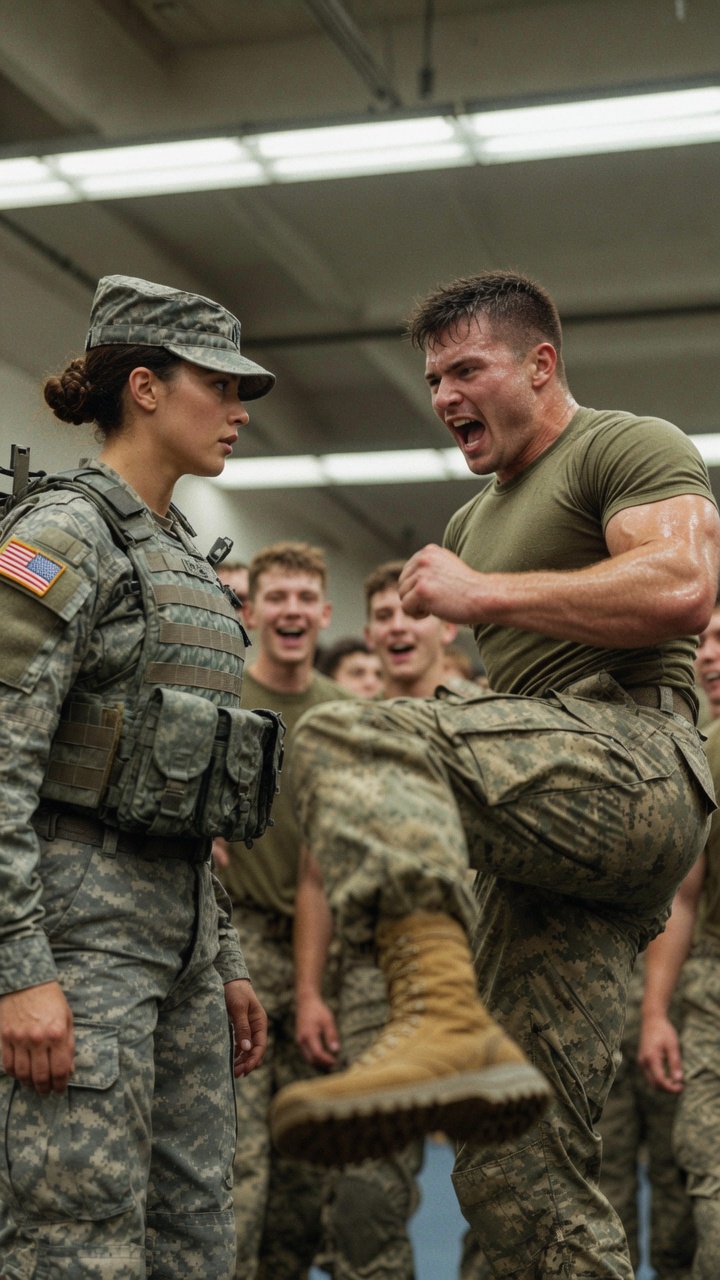
He threw a kick.
Not a real one. Not one meant to break anything. The kind of lazy, sneering tap you use to let someone know you could have hurt them if you’d bothered. His boot swung toward my midsection with the casual cruelty of a guy nudging a stray dog off a porch.
The boot didn’t land where he thought it would.
My body moved before my mind finished naming what was happening. I stepped off-line, just a half turn, like I was avoiding a puddle. His kick slid past empty air. His balance shifted—small mistake, but it was there.
My right hand caught his ankle. Not hard. Just enough.
My left palm pressed into the side of his knee with a controlled push, the kind of pressure that says, I’m not hurting you, but you’re going down anyway.
Vance’s eyes widened. His foot—my hand—his knee—everything betrayed him at once.
He hit the mat like a dropped toolbox.
The sound was pure, heavy shock. The room snapped silent. Even the fans seemed to pause, like they were listening.
Vance blinked up at me with his mouth half open. I could see the exact moment his brain tried to decide whether this was a prank. His cheeks flushed blotchy red.
I released his leg immediately and stepped back into neutral stance, hands open, breathing steady. My heart was pounding, but my hands weren’t shaking. That part surprised me, even though it shouldn’t have.
Lowell stared at me like he’d just realized the quiet transfer had teeth. “Specialist Lee,” he said slowly. “Where’d you learn that?”
I kept my face blank. “Just… basics, Sergeant.”
“Basics,” Vance rasped, pushing himself up on his elbows. His eyes were furious now, darting toward the crowd like he was searching for somebody to laugh with him, somebody to restore the old reality where I was the joke.
Nobody laughed.
That was the first emotional reversal: silence can be louder than mockery.
Vance got to his feet too fast, like speed could erase the fact he’d been on his back. “Lucky,” he said. “Do it again.”
Lowell hesitated, then nodded once. “Reset.”
Vance came in angry this time—hands tighter, shoulders hunched, weight forward. He threw a punch meant to rattle my head, then another meant to herd me where he wanted. He wasn’t just trying to win. He was trying to punish me for changing the room.
My goal shifted: survive without escalating.
The conflict sharpened: Vance didn’t care about rules anymore.
I moved like I’d been taught to move when the other person wanted you hurt—not flashy, not aggressive, just precise. I let his momentum carry him. I redirected. A parry that turned into a grip. A step that stole his angle. A quick sweep that took his base. Again, he found the mat, this time with his own breath knocked out of him in a wet grunt.
Lowell’s whistle finally shrieked for real. “Stop!”
Vance lay there, chest heaving, eyes glassy with rage and embarrassment. I stood still, hands open, not gloating, not smiling. I wanted to disappear back into my sleeves and return to being overlooked.
But I could feel it—the room had changed. Eyes on me, not with pity now, but with questions.
And in the back corner, beyond the line of recruits, I noticed something new: a man I hadn’t seen before, leaning against the doorway in a plain gray hoodie, watching like he’d been waiting for this exact moment.
When his gaze met mine, he didn’t smile.
He lifted two fingers to his ear like he was listening to someone talk, then he turned and walked away.
I stood there with sweat cooling on my neck, a strange cold bloom spreading under my ribs, because I realized the worst part wasn’t that I’d been seen.
It was that I’d been watched.
As Lowell started barking orders to clear the mat, I spotted a small silver coin glinting near the doorway where the man had stood—freshly dropped, stamped with a bird I didn’t recognize—and my stomach tightened as one question punched through all the noise: who had just marked me, and why now?
Part 2
That coin haunted me through the rest of the day like a smell you can’t scrub off your hands.
I found it after formation, when the gym had emptied and the mats were cooling down. The overhead lights hummed in that tired way fluorescent bulbs do when they’ve been asked to be daytime for too many years. I crouched near the doorway and picked the coin up with two fingers.
It was heavier than it looked. Not a challenge coin like the ones people traded after deployments—no unit name, no slogan, no cheesy skull with lightning bolts. Just a clean, sharp engraving of a bird in mid-dive, wings tucked, talons forward. On the other side, a single letter: K.
I slipped it into my pocket, but the metal felt hot against my thigh, like it was alive.
By dinner chow, the story had already mutated.
I walked into the DFAC and the noise dipped the way it does when you walk into a room mid-argument. Forks clinked. Somebody coughed. I could feel eyes tracking me between shoulder blades. The air smelled like fried onions and industrial cleaner, and the flat-screen TVs mounted high were playing some sports show with the sound off, just a silent parade of grinning faces.
I carried my tray like it might crack. Mashed potatoes, chicken that had been cooked into submission, green beans that tasted like warm water.
I sat alone at the edge of the room, because sitting with people meant pretending I didn’t hear what they’d already decided about me.
“Yo,” a voice said.
A woman slid into the seat across from me without asking. She had a buzzed undercut and a face that looked like it belonged on a medal—sharp cheekbones, eyes that didn’t flinch. Her name tape read RUIZ.
“I’m not here to grill you,” she said, like she’d read my posture. “I’m here because sitting alone makes you a target.”
I took a bite of chicken, mostly to give my mouth something to do.
Ruiz nodded toward the far side of the DFAC, where Vance sat with his usual crowd. He was laughing too hard, jaw tight, like his laugh needed witnesses. His eyes kept flicking toward me.
“He’s mad,” Ruiz said. “He doesn’t get mad unless his pride got bruised.”
“I didn’t mean to—” I started.
Ruiz lifted a hand. “Don’t apologize. Just… don’t pretend you don’t know what you’re doing.”
That hit me in a strange place. Like she’d shoved a finger into a bruise I hadn’t admitted was there.
My goal, all day, had been to stay unnoticed. But I’d failed, and now the conflict wasn’t just Vance. It was the base itself—its appetite for stories, its need to decide who belonged and who didn’t.
“What did you do before you got here?” Ruiz asked.
“Supply,” I said, which was true on paper.
She raised an eyebrow.
I shrugged. “Paperwork. Boxes. Forklifts.”
“Uh-huh.” Her mouth twitched. “And before that?”
I thought about my apartment back in Reno, the one-bedroom with the leaky sink and the neighbor’s dog that barked at 2 a.m. I thought about the smell of my mother’s cigarette smoke soaked into couch fabric, and how she’d always promised she was quitting. I thought about the little garage behind her house where the fluorescent light flickered and my knuckles learned what it meant to bleed.
“Nothing special,” I said.
Ruiz didn’t push, but I saw her eyes sharpen, like she’d filed that away.
After chow, the sky over Fort Grafton was the color of bruised steel. Wind dragged grit across the sidewalk. My boots made hollow thuds as I walked back toward the barracks. The air smelled like creosote and faraway rain that never arrived.
Halfway there, my phone buzzed.
Unknown Number.
I stopped under a streetlight that made everything look pale and sickly, like a hospital hallway.
A text came through: NICE FOOTWORK. WRONG CROWD.
My throat tightened.
Another text followed before I could reply: 0500. SOUTH LOT. BRING THE COIN.
I stared at my screen until the light timed out and my face reflected back at me, small and washed-out. My fingers went numb around the phone.
New information. New conflict. New target.
Someone had seen the coin. Someone knew I’d picked it up. Someone had my number.
I forced my feet to move again. Inside the barracks, the hallway smelled like laundry detergent and stale energy drinks. Doors slammed. Someone yelled at a video game. I went into my room, shut the door, and leaned my forehead against the cool metal.
I pulled the coin out of my pocket and set it on the desk. It caught the weak lamplight and flashed, like an eye.
I tried to sleep. The mattress squeaked every time I shifted. My roommate, a loud snorer, was gone overnight on duty, so the room felt too quiet, like the silence was waiting.
At 0317, I gave up and sat on the edge of the bed, staring at the coin. My mind kept sliding toward explanations that didn’t fit. CID? Some kind of prank? Vance’s buddies trying to set me up?
But the bird engraving wasn’t a joke. It was too clean, too deliberate. Whoever made it had paid for quality.
At 0445, I was already outside.
The South Lot was mostly empty at that hour, lit by orange lamps that made the asphalt look like burnt sugar. My breath fogged in front of me. The wind carried the smell of diesel and sagebrush.
A black SUV sat near the fence line, engine off, windows dark. No markings.
I slowed as I approached, every instinct screaming to turn around.
The driver’s door opened.
A woman stepped out, tall, athletic, hair pulled back tight. No uniform. Gray jacket, black gloves, boots that looked expensive. She didn’t carry herself like a contractor trying to impress the military. She carried herself like the military belonged to her.
“Specialist Camille Lee,” she said, like she’d been reading my name off a file for weeks.
My mouth went dry. “Who are you?”
She held out her hand. “Coin.”
I didn’t move.
Her eyes flicked to the security camera mounted on a pole nearby. “We don’t have long.”
My pulse hammered. I pulled the coin from my pocket and placed it in her palm.
She turned it once, like she was checking for a scratch. Then she looked up at me.
“You’ve been pretending,” she said.
My stomach sank. “I don’t know what you mean.”
She tilted her head slightly. “You do. You just don’t want to say it out loud.”
The conflict tightened like a wire. If I admitted anything, I didn’t know where it would go. If I denied everything, she might already have proof.
“What is this?” I asked, forcing my voice to stay steady.
She stepped closer, and I caught the faint scent of her perfume—something clean and cold, like cedar and snow. “This is a door,” she said quietly. “And you just kicked it open in front of the wrong people.”
My skin prickled. “Wrong people?”
She nodded toward the base beyond the fence, where floodlights washed the training fields in harsh white. “There are eyes here that don’t belong to the Air Force. They collect stories. They collect leverage. And you just became interesting.”
I swallowed hard. “Why tell me?”
Her gaze sharpened. “Because you can be useful to us. Or you can be used by them.”
She reached into her jacket and pulled out a thin envelope, the kind that looked too ordinary to be real. She slid it toward me.
“Inside is a name,” she said. “Someone who’s already watching you. Someone close enough to touch your life without leaving fingerprints.”
My fingers hovered over the envelope. The paper looked harmless. It felt like a trap.
I glanced up at her, heart punching against my ribs. “If I open it—”
“You can’t close the door again,” she finished.
The streetlight buzzed overhead. Somewhere in the distance, a generator kicked on with a low growl. My hands were cold, but sweat slicked my palms.
I took the envelope.
And as I tore it open, I realized the truly terrifying part wasn’t what name might be inside—it was the sudden, sick certainty that I already knew whose name it would be, and I didn’t want to be right.
Part 3
The name inside the envelope wasn’t the one I expected.
That was the first trick.
I’d braced for Vance. Or Lowell. Or some faceless contractor with a long paper trail and a short temper. Instead, the envelope held a single index card, plain white, with neat block letters:
MARA BISHOP.
Under it, a phone number I didn’t recognize, and two words that made my stomach lurch:
DO NOT CALL.
I stared at it until the letters blurred.
The woman by the SUV watched me like she could hear my thoughts. “You were expecting someone else,” she said.
I swallowed. “Who is Mara Bishop?”
“She’s not on your base roster,” the woman replied. “She’s not on any roster. But she’s been in three states you’ve lived in. She’s been in two places you worked. And she has a habit of showing up around people who don’t want to be found.”
My throat tightened. “I don’t understand.”
“You will,” she said. Then she leaned closer, voice dropping. “Your file says you’re ordinary. Your movement says you’re not. That mismatch draws attention. Attention draws predators.”
Predators. The word landed heavy.
My goal shifted again, like it had a dozen times since Vance’s boot missed my ribs. My goal wasn’t just to get through training anymore. It was to keep my life from being quietly dismantled by people I couldn’t even name.
“What do you want from me?” I asked.
She didn’t answer immediately. She walked to the back of the SUV, opened it, and pulled out a plain duffel bag. No labels. No name tape. It could’ve been gym clothes.
She tossed it at my feet.
“Inside,” she said, “is a set of coordinates and a time. Tonight.”
My pulse spiked. “Tonight?”
She nodded once. “You’ll go alone.”
Conflict, immediate: go alone at night with strangers, or refuse and keep pretending.
“I can’t just leave,” I said. “I have duty rosters—”
“You have a four-hour window between lights out and your next shift,” she cut in. “You also have a habit of doing what you’re told. We’re offering you a different habit.”
The emotional reversal hit hard: the thing I’d always used to survive—obedience—was suddenly being presented as a weakness.
“I don’t even know your name,” I said.
She hesitated, then said, “Hale.”
I waited.
“Hale,” she repeated, like that was all I got.
I looked down at the duffel, then back up at her. “And if I don’t go?”
Hale’s eyes didn’t soften. “Then you’ll stay here, and Mara Bishop will keep circling. And the next time someone tries to ‘lightly’ humiliate you, it won’t be a boot in a gym. It’ll be something quieter. Something that ruins you without bruises.”
The wind picked up, rattling a loose sign on the fence. Somewhere, a lone bird called out, sharp and lonely.
I hated how much I believed her.
I took the duffel.
Hale nodded once, like she’d expected that. “Good.”
Then she stepped back toward the SUV. “You have one rule,” she said. “Don’t tell anyone. Not your friends, not your chain of command, not the person you trust most.”
My stomach tightened again. “Why?”
Hale’s hand paused on the door handle. “Because the person you trust most is usually the first place someone else looks.”
She got in. The SUV rolled away without headlights at first, then turned them on only when it reached the far end of the lot, like it was vanishing on purpose.
I stood under the orange streetlight with the duffel at my feet and the index card in my hand, feeling like the ground had tilted.
Back in my room, I dumped the duffel onto my bed. Inside were plain black clothes, a small flashlight, a cheap burner phone, and a folded sheet of paper with coordinates.
The coordinates pointed to the old water-treatment facility outside the perimeter—an abandoned cluster of concrete tanks and pipes that everyone called “the Bone Yard” because the metal ribs of the place stuck up against the sky like a skeleton.
At the bottom: 2300.
I stared at it until my eyes stung.
I thought about calling my mom. I thought about calling my fiancé, Ethan, who’d proposed two months before I shipped out. I thought about the way his voice always steadied me, how he’d promised he was proud of me, how he’d said, I’ll wait. We’ll build our life when you come back.
And then Hale’s warning echoed: not the person you trust most.
I put my phone facedown and didn’t call anyone.
At 2245, I slipped out.
The base at night is a different creature. Daytime is rules and schedules and noise. Night is shadows and the low hum of generators, the occasional crunch of boots on gravel, the distant beep of a truck backing up somewhere you can’t see.
I stayed to the darker paths, cutting behind buildings where the lights didn’t reach. The air smelled like wet dirt and cold metal. My breath felt loud.
The perimeter fence loomed like a black line against the sky. Beyond it, the Bone Yard waited, jagged and silent.
I climbed through a gap in the fence I’d seen other people use for dumb reasons—sneaking out to smoke, meeting up for hookups, breaking rules because boredom is its own hunger.
Tonight, it felt like walking into a mouth.
The Bone Yard was colder than the base, as if the concrete tanks held night inside them. Pipes creaked when the wind moved through. A single broken window somewhere pinged gently, like a loose tooth.
I checked the time: 2300.
A light clicked on.
Not floodlights. Not a flashlight. A soft white glow from inside one of the tanks, like someone had set up a lamp in the belly of the place.
I moved toward it, every sense stretched tight. The ground was gritty under my boots. The smell was rust and old algae, like a drained pool.
Then a voice came from behind me.
“Camille Lee,” it said, familiar in a way that made my blood run cold. “You really shouldn’t be here alone.”
I turned, and in the faint moonlight I saw Ethan’s silhouette stepping out from behind a concrete pillar—hands raised like he was trying to calm me—while something heavy and unseen shifted in the dark behind him, and my heart dropped because the question slammed into me harder than any kick ever could: how long had he been part of this, and what else had he been hiding?
Part 4
For half a second, my brain tried to reject what my eyes were showing me.
Ethan wasn’t supposed to be here. Ethan was supposed to be three states away, sleeping in our old bed, probably snoring softly with one arm flung over the pillow like he always did. Ethan was supposed to be a voice on my phone, a steady presence, not a shape stepping out of shadows in an abandoned facility like he’d been waiting.
The air tasted like rust. My tongue went dry.
“Ethan?” My voice sounded thin, like it didn’t belong to me.
He took a careful step forward. Moonlight hit his face, and he looked tired—real tired, the way he looked after long shifts back home. That detail almost made me soften, because my body kept wanting to believe in the version of him I’d built my future around.
“Cam,” he said quietly. “Listen to me.”
Behind him, the darkness moved again. A scrape. Metal on concrete. Somebody shifting their weight.
Goal: get answers without panicking. Conflict: my fiancé is here, and I’m not alone.
I forced myself to keep my hands visible, open. My fingers tingled, ready.
“How did you—” I started.
“I can explain,” Ethan said quickly, too quickly. His eyes flicked past me toward the softly glowing tank, like he was tracking something. “But not out here.”
I didn’t move. “Why are you on my base?”
His jaw tightened. “I’m not on your base. Not officially.”
That word hit wrong. Officially.
The unseen thing behind him breathed—low, controlled. Not an animal. A person.
I took one step backward, toward the glow, toward the only light I had. Ethan’s hands lifted higher.
“Don’t,” he said. “Please.”
“Who’s back there?” I asked.
Ethan hesitated, and the hesitation told me more than any answer.
A second person stepped into the moonlight. Not Hale. A man, older, wearing dark clothes, head shaved close. No insignia, no uniform, but he moved like someone trained to own space. In his hand was a small device that looked like a phone until he turned it and I saw the lens: a camera.
He was recording.
My stomach turned over.
New information: this isn’t a private meeting. It’s documentation.
The man spoke. “Specialist Lee. Thank you for coming.”
I stared at him. “Who are you?”
He smiled without warmth. “Someone who appreciates talent. Someone who funds it.”
My skin crawled. “Where’s Hale?”
Ethan flinched at the name. The man’s smile twitched. “Agent Hale is… not involved in this meeting.”
Agent. Not woman. Not stranger. Agent.
I swallowed hard. “Then she lied.”
The man stepped closer, stopping just outside arm’s reach. He smelled faintly like expensive soap, clean and wrong for this place. “She told you the truth,” he said. “Just not the whole truth.”
I glanced at Ethan again. His eyes looked trapped.
“What is this?” I demanded. “Why are you here? Why is he here?”
The man’s gaze slid to Ethan. “Because Mr. Carter is invested in your future.”
Ethan’s throat bobbed. “Cam, I—”
“Don’t,” I snapped, sharper than I meant, but the betrayal was already blooming like bruises under skin. “Just don’t.”
The man tilted his head. “You see it as betrayal. That’s understandable. But consider the alternative: your skills rot in a standard unit, wasted. You become a story for bullies like Vance. Or…” He gestured toward the glowing tank. “You become something more.”
My heart hammered. “I didn’t ask for this.”
“No,” the man agreed. “You didn’t. But your fiancé did.”
The words landed like a punch.
Ethan’s face crumpled for a second, then he tried to rebuild it. “Cam, I thought I was helping. They came to me after your transfer. They said you were being watched, that you were in danger—”
“And you believed them?” My voice shook now, anger threading through fear. “Without telling me?”
“They made it sound urgent,” Ethan insisted, stepping forward, then stopping when I stiffened. “They said if you knew, you’d run. They said you’d mess it up.”
The man watched us like he was enjoying a show. “Emotional ties complicate recruitment,” he said mildly. “But they also provide leverage.”
Leverage.
That word snapped something in me.
I didn’t lunge. I didn’t attack. I just shifted my stance slightly, grounding my feet the way muscle memory demanded. My vision tunneled, not from panic, but from focus.
The man noticed. His smile faded a fraction. “Ah,” he murmured. “There she is.”
Ethan’s eyes widened. “Cam…”
I held his gaze, and the grief of it—seeing him here, hearing him admit he’d been the doorway—hit so hard it almost knocked my breath out. But underneath the grief was something colder.
My entire life, I’d survived by learning who to trust and when. And right now, the person I’d trusted most was standing between me and something I didn’t understand, with strangers filming.
I took another step back, closer to the glow. “What’s in the tank?” I asked.
The man’s eyes flicked toward it. “An evaluation.”
“I already did an evaluation,” I said.
He chuckled softly. “That was for them. This is for us.”
I glanced at Ethan. “Did you bring me here to be tested?”
Ethan swallowed. “They said it was… a conversation.”
The man lifted the camera slightly, angling it to catch my face. “We call it a viability check,” he said. “You call it whatever makes you sleep at night.”
The emotional reversal was brutal: the person I came here fearing—Mara Bishop—wasn’t even present. The danger was already in front of me, wearing a familiar face and a ring I’d once kissed.
A soft click sounded from inside the glowing tank, like a latch being released.
And then, from within that circular concrete belly, I heard footsteps—multiple—slow and deliberate, approaching the opening.
The man’s voice turned almost pleasant. “You have one minute,” he said. “Show us you’re worth the trouble.”
Ethan’s eyes went wide with horror, like he hadn’t known this part, and my chest tightened with a sharp, aching fury because I realized he’d sold me to people he didn’t even fully understand.
The figures inside the tank stepped into view—three silhouettes in dark gear, faces covered—and the last thing I saw before they moved was a small patch on one of their shoulders: a diving bird, wings tucked, talons forward, stamped with the letter K.
My stomach dropped as adrenaline lit my veins, because the question wasn’t whether I could survive them.
It was whether surviving would make me their property.
Part 5
They came at me without fanfare.
No shouted rules. No “ready?” No courtesy that made it feel like training. Just three bodies moving with intention, boots scraping concrete, breath controlled and quiet. The kind of quiet that isn’t peace—just discipline.
Goal: get out. Conflict: three operators blocking my exit, unknown sponsor filming, Ethan frozen.
I pivoted toward the opening between the tank and the outer yard, but one of them cut the angle immediately, fast enough that my instincts snarled. He wasn’t trying to hit me first. He was trying to herd me.
That told me everything.
This wasn’t about seeing if I could fight.
This was about seeing if I could be controlled.
I shifted weight, feinted right, then dropped low and slid left, letting the concrete’s cold grit bite my palms as I used the ground to change level. The first operator reached for me—gloved hand snapping down—and I caught his wrist and rotated, not hard, just enough to force him to move with me.
His elbow bent the wrong way. He hissed through his mask and stumbled.
New info: they’re real. They feel pain. They’re not invincible.
The second operator came in tight, aiming for my ribs. I turned my shoulder into it, letting the impact glance off, then drove my knee up into the inside of his thigh where nerves scream. He staggered, balance broken.
The third moved behind me—quiet, almost respectful—and that scared me more than the rush. Because the quiet ones learn you.
I spun, caught the edge of his sleeve, and yanked him forward into the path of the second. They collided, hard, the sound of gear smacking gear.
For half a second, I saw Ethan out of the corner of my eye. He looked like he wanted to step in, like he’d realized too late what he’d invited into my life. His mouth opened, but no sound came out.
I wanted to hate him cleanly. I wanted a simple villain.
But he looked devastated, and that made the betrayal uglier, because it meant he’d hurt me while thinking he was loving me.
The man with the camera spoke calmly. “Good,” he said. “Again.”
A pulse of anger surged through me. I wasn’t a dog. I wasn’t entertainment.
The first operator recovered and came low for my legs. I hopped backward, felt the edge of the tank’s concrete lip behind my heel, and used it—pushed off, letting my body spring upward and sideways in one motion. I landed outside the tank’s mouth, closer to the open yard.
Escape route. Almost.
Then something whistled through the air.
A small object—metallic—clipped my shoulder and bounced off the concrete with a bright ping. Not a bullet. A marker pellet? Something meant to tag.
I looked down and saw a smear of bright orange on my sleeve.
The man laughed softly. “You’re learning.”
My skin prickled. If they were tagging me, it meant they wanted data, not injury. But that also meant they wouldn’t stop until they got what they wanted.
The operators reset, circling, and I realized with a sick clarity that the Bone Yard wasn’t just abandoned.
It was prepared.
There were fresh footprints in the dust. A portable light inside the tank. A camera. A sponsor. This place had been set up because they knew I’d come.
Because someone had guided me here.
I looked at Ethan again, and I didn’t see my fiancé anymore. I saw a man who’d handed strangers a map to me.
I didn’t forgive him in that moment. I didn’t even consider it.
I made a decision instead: I would survive, and then I would leave—him, this base, anyone who thought my life could be negotiated.
The third operator lunged, faster now, and I caught his momentum, turned it, and shoved him into the concrete pillar Ethan stood near. Ethan flinched back, eyes wide, as the operator slammed shoulder-first into the structure.
“Cam!” Ethan finally shouted. “Stop—please!”
Stop. Like I was the problem.
The emotional reversal hit like ice water: Ethan wasn’t horrified that they were attacking me. He was horrified that I was winning.
The first operator came in again. I sidestepped, hooked his arm, and used his own forward drive to spin him past me. He stumbled, and I tapped the back of his knee. He dropped.
The second operator, limping, raised a hand—index finger extended briefly, a signal. They were communicating silently.
And then I noticed something else: the camera man wasn’t just filming.
He was talking into an earpiece.
“Proceed,” he murmured.
The ground behind me vibrated faintly—like a motor starting.
I turned my head just in time to see a section of fencing at the far end of the yard begin to slide open, revealing headlights beyond it and the low shape of another vehicle.
Extraction.
They weren’t just testing me. They were about to take me.
My chest tightened. I backed toward the darkest corner of the yard, where broken pipes lay piled like fallen bones. Metal clanged under my boot. The air smelled like oil.
One of the operators paused, head tilting slightly, like he’d heard something I hadn’t.
Then, from somewhere above, a new sound cut through the night—sharp, authoritative:
“On the ground! Now!”
Floodlights snapped on, white and brutal, blasting the Bone Yard like daylight. Shadows vanished. The operators froze mid-step.
And there, standing on the catwalk above the tanks, was Staff Sergeant Lowell—weapon drawn—along with two armed MPs, while Agent Hale stepped into the light beside them, face hard as stone.
Hale’s gaze locked on Ethan first.
Then it cut to me, and I saw something in her eyes that made my stomach drop all over again—not surprise, not approval, but grim confirmation, like she’d been expecting to find exactly this.
Because the real question wasn’t who these people were.
It was how deep Ethan’s involvement went, and whether Hale had come to rescue me… or to claim me first.
Part 6
“Hands where I can see them!” Lowell barked again, and the night snapped into a different kind of chaos.
The operators didn’t scramble like amateurs. They reacted like a drilled machine—one step, two steps, positions shifting to create cover. The camera man moved backward toward the opening fence with his lens still trained on me, like I was the only thing that mattered.
Hale didn’t shout. She just lifted her hand, palm down, and the MPs on the catwalk adjusted—barrels tracking, fingers tight.
Goal: don’t get taken. Conflict: two groups converging, both potentially dangerous.
I didn’t know if Lowell being here meant protection or punishment. Lowell’s job was to enforce rules. My night had already broken about fifteen of them.
Hale’s eyes flicked to my sleeve, to the orange smear. Her jaw tightened.
“Camille Lee,” she called, voice carrying clean through the floodlights. “Walk to my voice. Slow.”
Ethan stepped forward, hands raised like he was surrendering to the MPs. “This is a misunderstanding!” he shouted. “I can explain!”
Hale’s gaze didn’t even acknowledge him. That was its own kind of verdict.
One of the operators moved—fast—toward the sliding gate.
A gunshot cracked.
Not aimed to kill. A warning into concrete. The sound punched my chest anyway, and the smell of gunpowder rolled over the rust and algae like a new layer of fear.
The operator froze.
Lowell’s voice went colder. “On your knees!”
The camera man hissed something into his earpiece, then made a sharp hand signal. The operators immediately shifted again, one stepping slightly toward me.
Toward me.
I understood then: if they couldn’t extract cleanly, they’d extract messy.
I didn’t wait.
I sprinted.
Not toward Hale—toward the broken pipes, toward the cluttered corner where visibility was bad and angles were awkward. My boots skidded on grit. My lungs burned in the cold air. The floodlights made my shadow stretch long and thin like a target.
An operator lunged after me.
I ducked behind a pipe stack, metal ringing as my shoulder brushed it. The pipe smelled like old oil and sunbaked dust. I grabbed a loose length of chain that dangled from a support beam—cold links biting my palm—and swung it low.
The chain snapped against the operator’s shin with a sharp clang. He stumbled, and I used the moment to slip past him, staying low, staying moving.
New info: Hale’s arrival doesn’t automatically stop them. I still have to survive.
“Lee!” Hale snapped, sharper now. “Do not engage!”
Too late.
Another operator appeared at my left, quick, silent. He reached for my wrist, trying to trap. I rotated, pulled free, and slammed my elbow into his chest plate—not to break, just to disrupt. He grunted, stepping back.
Then the camera man did something I didn’t expect.
He turned the lens away from me and pointed it at Ethan.
“Mr. Carter,” he said calmly, “time to demonstrate loyalty.”
Ethan’s face went white under the floodlights. “What—no—”
The camera man tossed him something small. A phone. Ethan fumbled it, caught it, stared at the screen like it was radioactive.
Hale’s eyes narrowed. “Ethan Carter,” she said, voice razor-thin. “Put it down.”
Ethan’s hands shook. He looked between Hale and me like he was a man standing on the edge of two cliffs.
“I didn’t know it would be like this,” he pleaded. “Cam, I swear—”
“Put it down,” Hale repeated.
Ethan didn’t.
His thumb moved.
A second later, every light in the Bone Yard died.
Total darkness.
The floodlights. The portable lamp. Everything—gone, like someone had swallowed the sky.
For a heartbeat, there was only breathing and the soft scrape of boots.
Then chaos detonated.
Someone fired again—muzzle flash briefly lighting shapes. A body slammed into metal. A shout. A curse. The air filled with that electric smell of systems fried.
My heart hammered so hard it felt like it might crack my ribs.
I dropped flat to the ground, pressing my cheek against cold concrete. In the dark, sound became everything. The operators moved with terrifying confidence, using the blackout like home territory.
They had planned for this.
And Ethan had triggered it.
The betrayal landed fully now—not theoretical, not emotional, but operational. He wasn’t just a misguided fiancé. He was a switch.
My throat tightened with a kind of rage so clean it scared me.
I crawled, silent, toward the catwalk supports. If I could get under structure, I could limit angles. I could force close quarters, where training mattered more than tech.
A hand grabbed my ankle.
I kicked backward, felt my boot connect with something solid, and rolled—fast—bringing my knee up, using my own momentum. My elbow met a forearm. Someone grunted.
A voice hissed near my ear, low and unfamiliar. “Stop resisting. You’re wasting time.”
I drove my palm into the side of his neck, felt his grip loosen, and I scrambled free, lungs gasping.
In the dark, I heard Hale’s voice—calm, controlled—cut through the mess. “Kestrel team, stand down. You’re burned.”
Kestrel. The bird. The K.
The operator near me froze for a fraction of a second.
That fraction was my opening.
I moved.
I slipped under the catwalk supports, climbed the ladder by feel, metal rungs cold and slick. Above, voices echoed, confused, overlapping. Someone slammed into the ladder from below, shaking it.
My fingers clenched tighter, knuckles whitening in invisible darkness.
Then—faintly—my burner phone vibrated in my pocket.
A text, glowing weakly on the screen when I pulled it out:
MARA BISHOP IS YOUR MOTHER’S NAME.
My breath caught so hard it felt like choking.
And in that darkness, with Ethan’s betrayal still ringing in my bones and Hale calling a team by the same symbol stamped on my coin, a new horror rose up, sharp and undeniable:
If my mother was Mara Bishop, then this wasn’t just a base problem.
It was my entire life, rewritten.
Part 7
When the floodlights came back, they came back ugly.
Not all at once. One flickered on, stuttering, painting the Bone Yard in broken frames—shadow, light, shadow—like reality was glitching. Then another. Then the harsh white glare returned fully, revealing the scene like a crime photo.
One MP was on the ground holding his arm, teeth clenched. One operator was pinned facedown, Lowell’s knee in his back. The camera man stood near the sliding gate, hands raised, expression still calm like he was negotiating a business deal. Hale stood between them and me, her posture steady, weapon lowered but ready.
Ethan was on his knees, hands cuffed behind him, face streaked with something that looked like tears or sweat. He kept trying to look at me.
I didn’t give him that.
My goal, suddenly, wasn’t to explain anything. It was to not fall apart in front of people who would use my cracks as handles.
Hale looked up at the catwalk where I’d climbed. “Camille,” she called, softer now. “Come down. You’re safe.”
Safe.
I almost laughed. It would’ve come out like a sob.
I climbed down slowly, metal rungs vibrating under my weight. When my boots hit concrete, my legs felt weirdly light, like adrenaline had hollowed them out.
Hale met me halfway. Up close, I could see the fine lines at the corners of her eyes—the kind you get from too many sleepless nights and too much decision-making. She smelled like cedar and cold, same as before. That scent now meant something else: it meant she’d been in my orbit longer than I understood.
She held out her hand. Not for the coin this time.
For the burner phone.
I hesitated.
Hale’s gaze was steady. “You got the message.”
I swallowed. “Mara Bishop.”
Hale’s jaw tightened. “Yes.”
I stared at her. “You told me someone close to me was being used as leverage.”
Hale didn’t blink. “I told you the person you trust most is where they look first.”
My voice came out raw. “My mother.”
Hale’s expression flickered—something like regret, quickly buried. “Your mother has been off-grid for fifteen years, Camille. She isn’t who you think she is.”
I let out a sharp breath, and it tasted like rust and grief. “Then who am I?”
Hale didn’t answer immediately. She glanced at the camera man, who was watching us with polite interest, like he’d already priced my confusion.
Lowell hauled the pinned operator upright. “These guys aren’t on any list,” he growled. “No ID. No nothing.”
The camera man smiled faintly. “That’s the point.”
Hale’s eyes cut to him, cold. “You violated federal perimeter security,” she said. “You coerced a civilian asset. You attempted unlawful extraction of a service member.”
The man shrugged slightly. “We evaluated a candidate. That’s all.”
“Candidate,” I repeated, the word bitter. “You mean product.”
He looked at me with the calm of someone who’d never been told no in his life. “You can call it whatever you want,” he said. “But you’re exceptional. Exceptional people don’t belong in standard lanes.”
I felt something in me harden. “I didn’t agree to be anything for you.”
He smiled. “You will. Eventually. Because we always find the pressure point.”
My eyes flicked to Ethan.
He flinched.
The realization hit like a final nail: Ethan hadn’t just been tricked. He’d been targeted. And he’d still chosen to press the button.
I turned fully toward him for the first time.
His face crumpled with relief, like he thought eye contact meant forgiveness was possible. “Cam,” he whispered. “I’m sorry. I didn’t know about your mom. I didn’t know about any of this. They told me you were in danger and that you’d never trust anyone unless—unless you were forced to see—”
“Stop,” I said, quiet but sharp.
He swallowed. “I love you.”
I stared at him, and I remembered all the small things: the way he’d offered to handle my finances when I shipped, the way he’d asked for my mother’s address “just in case,” the way he’d gotten annoyed when I didn’t answer immediately, like my time belonged to him.
Clues I’d ignored because love makes you generous with excuses.
My voice stayed steady. “You love the version of me you thought you could manage.”
He shook his head violently. “No—”
“You pressed a button that killed the lights,” I said, each word crisp. “You brought strangers to me. You let them film me. You let them try to take me.”
Tears welled in his eyes. “I didn’t know they’d—”
“You didn’t ask,” I cut in, and the sentence tasted like steel. “You didn’t ask because asking might’ve meant hearing ‘no.’”
His shoulders sagged like he’d been hit.
That was the emotional reversal: he wasn’t my safe place. He was the door.
Hale stepped closer to me, voice low. “Camille,” she said. “You need to decide what happens next.”
“What happens next,” I echoed, numb.
Hale nodded once. “Kestrel is real. But it isn’t his.” She flicked her eyes toward the camera man. “They’re a private parasitic mirror trying to imitate a program that already exists. They’ve been hunting the edges of our candidate pool.”
“And my mother?” My throat tightened.
Hale’s mouth set. “Your mother was Kestrel before Kestrel had a name.”
My breath caught.
“She disappeared,” Hale continued, “because she refused to be owned. She burned every bridge, every record, every contact. She left you behind with a new identity and a quiet life because that was the only way to keep you alive.”
The pain hit fast and hot. “She abandoned me.”
Hale’s eyes softened for a fraction. “She saved you.”
I shook my head, rage and grief tangling. “Then why now? Why am I being dragged into this?”
Hale’s gaze slid to Ethan again. “Because someone went looking. Someone asked the wrong questions. Someone handed over the right files.”
Ethan looked up at me, horror dawning as he understood the scope.
I felt something inside me go very still.
I wasn’t going to forgive him. Not later. Not after apologies. Not after therapy-speak. Not after time tried to sand down what he’d done into something “understandable.”
Some betrayals are a line, not a lesson.
I turned to Hale. “What do you want from me?”
Hale held my gaze. “I want you alive,” she said. “And I want you trained under people who don’t need leverage to earn your loyalty.”
I glanced at the camera man again. MPs were closing in on him now, weapons up. He didn’t look worried. That terrified me.
Because confident men don’t fear handcuffs unless they know they’ll slip them.
Hale leaned closer, voice barely above a whisper. “If you come with me,” she said, “you’ll learn the truth about Mara Bishop. But you’ll also become visible to everyone who’s been searching for her.”
My stomach clenched.
Then, from the far edge of the yard, I heard the sliding gate grind again—moving on its own.
And the camera man smiled, just slightly, as if someone unseen had answered his call.
Because the question wasn’t whether they had a backup plan.
It was how many people on this base were already part of it.
Part 8
The gate finished sliding open with a scream of metal, and headlights poured in like a tide.
Not one vehicle. Two.
The first was a dark SUV—same shape as Hale’s, same unmarked skin. The second was a military transport truck with no visible unit markings, just a blank canvas of green metal. The kind of truck that could belong to anyone who knew how to borrow it.
Lowell swore under his breath. The MPs tightened their formation, weapons tracking.
Hale’s hand closed around my wrist—firm, grounding. “Move,” she said.
Goal: leave before the backup plan becomes a trap. Conflict: unknown vehicles entering, base security compromised, my trust shattered.
I moved with her without arguing. There was no time for my feelings to demand an explanation. Feelings could wait. Survival couldn’t.
We ran—me and Hale—cutting between tanks, boots slapping concrete, breath tearing in and out. The night air smelled like dust kicked up by tires and the sharp tang of hot engine parts. Behind us, Lowell shouted orders. Someone yelled, “Contact left!”
A burst of gunfire cracked—controlled, aimed, not a spray. Muzzle flashes stuttered white in my peripheral vision.
Hale led me through a gap in the pipes and into a narrow service corridor I hadn’t noticed before. A door was already cracked open, like it had been waiting.
Of course it had.
Inside was a small utility room lit by a single red bulb. The air smelled like damp insulation and old electricity. Hale shoved the door closed behind us and dropped a heavy metal bar into place.
My chest heaved. My hands shook now that I was briefly enclosed, briefly not moving.
Hale pulled a radio from her jacket and spoke fast and low. “Switch to channel seven. Lockdown protocol. Kestrel actual compromised. Repeat, compromised.”
A crackle of voices answered—urgent, overlapping.
I pressed my back against the wall and stared at her. “How many?”
Hale didn’t look away from the radio. “Enough.”
The answer made my stomach drop. Enough meant infiltration. Enough meant rot in the structure.
“What about Ethan?” I asked, and surprised myself that the question sounded flat, not tender.
Hale’s eyes flicked to me. “He made his choice.”
So had I.
The cleanest part of the night was that clarity: I didn’t have to debate forgiveness. I didn’t have to play the part of the understanding woman. Betrayal didn’t deserve my softness.
A heavy thud hit the door from the outside. The bar rattled.
Hale drew her weapon, stance calm, shoulders loose. “They found the corridor,” she said.
Another thud. The door frame creaked.
My pulse roared in my ears. I could taste copper again, like my mouth was remembering fear.
Hale reached into her pocket and tossed me something small.
The coin.
“Keep it,” she said. “It’s not a mark. It’s a key.”
I closed my fist around it. The metal was cold, solid, real.
The door shuddered again—harder this time. Dust rained from the top frame.
Hale pointed to a vent near the ceiling. “Up,” she ordered.
I didn’t argue. I climbed onto a metal shelf, fingers slipping on dust, then hooked my hands into the vent’s edge and pulled. The grate popped free with a screech that felt way too loud.
I wriggled into the vent, elbows scraping metal. It smelled like stale air and rust. Hale followed, quick and silent, then replaced the grate behind her from the inside as best she could. Below, the door finally gave with a crack, and boots flooded into the room.
We crawled through darkness, the vent narrowing, metal edges biting. My breathing sounded huge in the confined space.
Hale moved ahead of me, sure of direction, like she’d memorized the base’s hidden arteries. After a minute, she stopped at another grate and shoved it outward.
We dropped into an alley behind a maintenance building. The night hit my face like a slap—cold, clean compared to the vent. The smell here was grass and motor oil.
A vehicle waited in the shadows: an old beat-up van with peeling paint, the kind of thing nobody looks at twice. Its side door slid open.
A woman sat in the driver’s seat.
She turned her head, and the world tilted.
Her face wasn’t mine, but it carried the same bones—jawline, brow, the shape of the eyes. She looked older than I expected, hair threaded with gray, skin weathered like someone who’d spent years under harsh sun. Her gaze was sharp, familiar in a way that hurt.
Hale didn’t raise her weapon. She didn’t speak.
The woman in the driver’s seat looked at me, and her voice came out low and steady.
“Camille,” she said. “I’m sorry it found you.”
My throat closed. “Mara.”
She flinched at the name like it was a bruise. “That’s not the name I gave you.”
Rage rose fast, hot. “You gave me nothing.”
Mara’s hands tightened on the steering wheel. “I gave you distance,” she said. “I gave you time.”
“And then you vanished,” I snapped, tears stinging despite myself. “You let me grow up thinking I wasn’t wanted.”
Mara’s eyes flickered—pain, regret, something fierce. “I let you grow up alive.”
That word again. Alive.
Hale’s hand touched my shoulder briefly. Not comforting. Anchoring.
Mara nodded toward the open van door. “Get in,” she said. “Now.”
Behind us, alarms began to wail—farther on base, rising and falling like a siren song. Lights flashed in the distance. The Bone Yard was spilling into the rest of the world.
I stood frozen for half a heartbeat, coin clenched in my fist, looking at the woman who’d made my life a lie to save it—and realizing that whether she’d saved me or broken me, the outcome was still mine to carry.
I got into the van.
The door slammed shut. Mara hit the gas. The van lurched forward, tires spitting gravel, and Fort Grafton shrank behind us into a smear of lights and noise.
As we drove into the dark, I didn’t feel relief. I felt a clean, hard edge of purpose.
Ethan would spin his story. He’d cry, beg, blame fear, blame manipulation. He’d say love made him do it.
But love doesn’t sell you.
I stared out the window at the empty road, the horizon swallowing us, and I made myself a promise as steady as my breath:
I would learn the truth. I would take back my name. And I would never—ever—hand my future to someone who needed leverage to stay in my life.
Part 9
The van smelled like old vinyl, stale coffee, and a faint sweetness like someone once spilled cheap air freshener and it never truly left. The heater rattled more than it warmed, and every bump in the road made a loose panel somewhere in the back door buzz like an angry wasp.
Mara drove like she’d driven this road a thousand times. No wasted motion. Hands at ten and two. Eyes scanning mirrors, then the dark shoulder, then the treeline, like the night could suddenly step into the lane.
Hale sat in the passenger seat with her body angled slightly toward me, as if she could block a bullet with her ribs if she needed to. She didn’t look nervous. That was almost worse, because it meant she’d already imagined every bad outcome.
My phone, my real phone, felt heavy in my pocket. The burner sat on the bench beside me like a tiny glowing lie.
I stared out the window at the desert rolling past in black waves. Every few miles, the van’s headlights caught the reflective eyes of something small—rabbits, maybe coyotes—before they vanished.
Goal: understand what’s happening. Conflict: the person I loved betrayed me; the person who raised me disappeared; the only stable thing is moving at seventy miles per hour into nowhere.
“Say it,” I finally said, voice rough.
Mara’s jaw tightened. “Say what.”
“Why now,” I said. “You saved me, fine. You left me, fine. But why are you here now, in a van, like this is some… bad movie?”
Hale’s gaze flicked to Mara. Mara didn’t answer right away. She took an exit without signaling and the van dipped onto a side road that turned from asphalt to packed dirt. Dust rose behind us in a pale ghost cloud.
“Because you were supposed to stay boring,” Mara said finally.
The word stung. Boring. Like my entire life had been a camouflage pattern.
“I tried,” I snapped. “I tried so hard that people treated me like I was disposable.”
“You did what you had to,” Mara said. “Until you didn’t.”
Hale spoke without looking back. “The Bone Yard was a forced exposure. They were trying to make you visible to the right buyers.”
Buyers. The word made my skin crawl.
I pulled the coin out of my pocket and rolled it between my fingers. The metal clicked softly, steadying. “This is a key,” I said. “To what?”
Mara glanced at it in the rearview mirror. The reflection of her eyes looked tired in the glass. “To a dead drop,” she said.
“A what?”
“A place you put something you can’t carry,” she said. “And a place you can’t access without proof you belong.”
Hale added, “It’s also a signal. Anyone with the symbol knows what you are.”
“What I am,” I repeated, tasting the anger. “I’m a person.”
Mara’s grip tightened on the wheel. “Not to them.”
The road narrowed, flanked by scrub and skeletal trees that looked like they’d been burned once and decided not to bother growing back. The van’s suspension groaned.
After fifteen minutes, we reached a low building that could’ve been a storage unit if you didn’t look too closely. No sign. No lights. Just a rusted roll-up door and a padlock that looked newer than everything else.
Mara parked behind it, killing the engine. The sudden quiet pressed on my ears. I could hear my own breathing, uneven.
Hale got out first, scanning the darkness, then motioned us forward. Mara unlocked the door with a key from her pocket, and the lock clicked open like a throat clearing.
Inside, the air was cold and smelled like dust, old paper, and motor oil. Shelves lined the walls, mostly empty. In the center sat a metal cabinet bolted to the concrete floor, painted an ugly gray-green. It looked like it belonged in a government basement.
Mara nodded at my hand. “Coin.”
I stepped forward and found a slot on the cabinet’s front, the exact width of the coin. My fingers hesitated for half a heartbeat. Then I slid it in.
The cabinet made a soft mechanical sound—whir, click—and a panel popped open.
Inside was a thin folder, a small hard drive, and a photograph.
The photo hit me first.
It was my mother, younger, in a black uniform with no insignia, standing with a group of people in the same gear. One of them had a hand on her shoulder like they were close. His face was turned slightly away from the camera, but I could see the line of his jaw, the shape of his ear.
He looked like me.
My throat closed. “Who is that?”
Mara didn’t answer immediately. She picked up the folder, her hands steady in a way that felt rehearsed. “That,” she said, voice low, “is why you were never safe.”
Hale took the hard drive and turned it over. “We have names,” she murmured. “We have transactions. We have an internal route.”
“Internal route?” I asked, trying to make my brain work through the static.
Hale met my eyes. “Someone inside Fort Grafton opened doors. Not just for the mirror team. For years.”
My stomach flipped. “Lowell?”
“Not necessarily,” Hale said. “But someone with enough access to control cameras, power, and timing.”
Mara finally looked at me fully, and in that dim warehouse light, she looked less like a villain and more like someone who’d been carrying a boulder alone for a long time.
“You want to know who you are,” she said.
I forced a nod.
“You are the reason I ran,” she said. “And you are the reason they never stopped hunting.”
I swallowed hard. “Because of him,” I said, nodding at the photo.
Mara’s jaw clenched. “Because of your father. And because of what he stole.”
Hale’s phone buzzed then, sharp in the quiet. She glanced at the screen and her face hardened.
“They’re spinning a story already,” she said. “Base-wide alert. They’re calling you a security risk. They’re locking down exits.”
My chest tightened. “They’re blaming me.”
“They always blame the easiest target,” Mara said.
Hale looked at me. “We need you back on base,” she said. “Not to surrender. To pull the thread from the inside. There’s one person who can help us identify the internal route.”
“Who,” I asked, dread crawling up my spine.
Hale’s eyes narrowed. “The one who befriended you first.”
My mind flashed to the DFAC. Buzzed undercut. Sharp eyes.
Ruiz.
My stomach dropped, because I couldn’t tell if that meant Ruiz was my lifeline… or the trap that had been sitting across from me all along, smiling like protection.
And as Hale slid her phone back into her pocket, she said the next thing like a warning carved into stone:
“Your fiancé is cooperating. And he’s naming names.”
Part 10
We got back onto base the same way people sneak into places they think they own—through the side, through the blind spots, through the boring gaps nobody guards because guarding boredom feels pointless until it isn’t.
Mara drove the van to a culvert that ran under the perimeter road, a concrete throat that smelled like damp earth and algae. We parked half a mile out and walked the rest, boots sinking into mud, wind cutting through my sleeves.
The night had shifted. Fort Grafton didn’t feel like a home base anymore. It felt like a stage after the lights go out—same set, different story.
Goal: reach Ruiz without getting caught. Conflict: the base is locked down, and the people hunting me can wear my own uniform.
Hale kept her hood up, face shadowed. Mara moved like she knew every rhythm of this place, even though she said she’d been gone fifteen years. That alone told me she’d never really left. Not in the way that mattered.
We slipped behind the motor pool, past rows of trucks that smelled like diesel and hot rubber, then cut through a maintenance corridor where pipes sweated slow drips onto the floor. Every sound felt amplified: our breath, the soft scrape of boot soles, the distant echo of a radio squawk.
As we approached the barracks area, a loudspeaker crackled to life.
“All personnel, remain in place. Ongoing security investigation. Report any suspicious activity.”
Suspicious. Like my existence had become a crime.
Hale’s burner buzzed again. She glanced down, and I saw her eyes tighten.
“Ethan’s statement is being used to build a narrative,” she said quietly. “He’s claiming you attacked government personnel, that you’re unstable, that you’re affiliated with a ‘rogue network.’”
I felt something in my chest go cold and solid. “He’s saving himself.”
Mara’s voice came from beside me, rough. “He’s doing what weak men do when they realize they’re in too deep. They point at the nearest woman and scream monster.”
I didn’t answer. I didn’t need to. My silence was the answer.
We reached the DFAC area from behind, where dumpsters sat steaming faintly in the cold. The smell of grease and sour milk hit me hard. A stray cat watched us from atop a trash bin like it had seen worse.
Ruiz was supposed to be on shift rotation tonight. I had no way to know where she’d be. Hale did, though. She moved with purpose toward the small recreation room attached to the barracks—a place where people went to play pool and pretend they weren’t lonely.
The door was locked.
Hale produced a thin tool from her pocket and worked the latch in three quiet seconds like it was muscle memory. The door opened with a soft click.
Inside, the rec room was dim and smelled like stale energy drinks and cheap cologne. A TV glowed faintly on mute. A pool table sat under a hanging lamp that cast a cone of light like an interrogation spotlight.
Ruiz stood under that light.
She wasn’t holding a cue. She was holding a pistol.
Her stance was solid, knees bent, shoulders relaxed. She looked like she’d been waiting.
My heart slammed against my ribs.
Ruiz’s eyes flicked to me, then to Hale, then to Mara. Something like relief flashed across her face, fast as a match flare.
“About time,” she said.
Hale didn’t lower her weapon. “Show me your hands.”
Ruiz rolled her eyes slightly but lifted her hands, pistol set on the pool table with careful, practiced control. “If I wanted you dead,” she said, “you’d already be dead.”
“Comforting,” Hale replied.
Ruiz’s gaze returned to me. “You okay?”
I almost laughed at the normalness of the question. Like we were in the DFAC again and this was just about bullies and pride.
“No,” I said. “But I’m standing.”
Ruiz nodded once, then turned serious. “They’re moving fast,” she said. “They pulled camera footage. They’re scrubbing logs. Someone in comms is rewriting timestamps.”
Hale’s jaw tightened. “Who.”
Ruiz shook her head. “Not sure yet. But I know where the edits are coming from.”
Mara stepped forward slightly, eyes narrowing at Ruiz like she was measuring her. “You’re not MP,” Mara said. “Your posture is wrong for it.”
Ruiz’s mouth twitched. “I’m not.”
My stomach dropped again. “Then who are you?”
Ruiz exhaled slowly, then reached into her pocket and slid a small badge across the pool table. It wasn’t a base badge. It was something else—plain, official, heavy.
Hale didn’t pick it up. She just looked at it and nodded once, grim.
Ruiz looked at me, voice quieter. “I’m here because Kestrel got compromised,” she said. “And because your name popped back up on a list that should’ve been buried.”
A list.
I felt my fingers curl. “You knew.”
“I suspected,” Ruiz admitted. “I didn’t know how deep until tonight.”
Hale stepped closer to the pool table, voice low. “Ethan.”
Ruiz’s expression hardened. “He’s being held in admin,” she said. “And he’s talking like a man who thinks if he confesses enough, someone will pat his head and call him brave.”
My throat tightened. “Is he naming me as the problem?”
Ruiz nodded. “He’s calling you a threat. And he’s saying your mother is behind it.”
Mara’s face went still. Completely still, like all emotion had been vacuumed out.
Hale looked at Mara. “They said her name out loud,” she said. “That means they’re done hiding.”
Ruiz leaned closer, voice urgent. “There’s a comms server in Building 12,” she said. “If we can pull the raw logs before they finish scrubbing, we can prove who opened the gate and killed the lights.”
Hale nodded. “We go now.”
I swallowed hard. “And Ethan?”
Ruiz’s eyes met mine. “You want to see him?”
My chest ached. Not with longing. With the dull throb of an old wound being pressed.
“I want him to understand,” I said, voice flat. “That sorry isn’t a bridge back.”
Ruiz nodded once, like she understood exactly.
We moved out together—Hale, Mara, Ruiz, and me—through corridors that smelled like bleach and old paint. The base felt like a maze designed by someone who hated freedom.
We reached Building 12, slipped inside, and the hum of servers hit me like a living thing. Warm air, the faint smell of heated dust, the endless whisper of fans.
Ruiz led us to a locked room. Hale started working the latch.
Then Ruiz froze.
Her eyes locked on something above the doorframe.
A tiny black lens. A camera I hadn’t noticed.
Ruiz’s face went tight. “That camera wasn’t here yesterday,” she whispered.
And before Hale could react, every server fan in the room spiked at once—loud, sudden—like the system was being forced to work overtime, and a new voice crackled from a hidden speaker in the ceiling:
“Thank you for bringing her to the evidence.”
Part 11
The door slammed shut behind us with a heavy magnetic thunk, like a vault sealing.
Hale spun, yanking the handle. It didn’t budge.
Ruiz swore under her breath. Mara’s eyes scanned the ceiling, the corners, the vents, like she’d seen this kind of trap before and hated that her body remembered.
Goal: get out with the logs. Conflict: we’re locked in a server room that’s now being remotely controlled.
A red light blinked above the door. Then another. Then the air got warmer, fast, as if someone had flipped a switch on the building’s lungs.
Hale’s voice stayed calm, but I could hear the tightness underneath. “They’re trying to overheat the servers,” she said. “Force a shutdown. Destroy data.”
Ruiz moved to a terminal, fingers flying over the keyboard. The screen glowed harsh blue on her face. “I can still pull a mirror,” she said. “But it’ll take—”
A hiss cut her off.
From the vents, a thin mist began to pour.
My stomach dropped. “Gas.”
Mara grabbed my sleeve, yanking me toward the floor. “Low,” she snapped. “Breathe through fabric.”
The mist smelled sharp and sweet, like bitter almonds mixed with hospital cleaner. My eyes watered immediately.
Hale pulled a small mask from her pocket and slapped it over her face with practiced speed. Ruiz had one too. Mara didn’t.
Neither did I.
Mara tore a strip from her own shirt with a brutal rip and shoved it into my hands. “Wet it,” she said.
“With what?” I choked.
Mara’s eyes flicked to a water bottle on a shelf. She snatched it, dumped it onto the cloth, and pressed it over my mouth and nose.
“Breathe,” she ordered.
The emotional reversal hit hard: the woman I’d spent years resenting was now keeping me alive with her bare hands.
Ruiz coughed behind her mask, still typing. “I’m in,” she rasped. “Copying raw logs to external—”
The speaker crackled again, voice smooth, amused. “You can’t outrun a system that owns the building.”
Hale’s eyes narrowed. “Identify yourself.”
A soft chuckle. “You already did. You just never say my name because it tastes like failure.”
Mara’s body went rigid. “Kline,” she whispered.
The air in my chest tightened. “That’s the K.”
Hale’s gaze sharpened. “Director Kline is dead.”
Laughter again, like a man enjoying a private joke. “Dead is a convenient word.”
The heat climbed. Sweat slicked my neck. The mist made my throat feel coated, heavy.
Ruiz yanked a small drive from the terminal and shoved it into Hale’s hand. “Got it,” she said, voice strained. “But we need out now.”
Hale moved to a panel beside the door, popped it open with a tool, and started bypassing wires with quick precision. Sparks snapped. The smell of burnt plastic cut through the chemical mist.
My vision blurred at the edges. My head felt thick, slow.
Mara pressed closer, voice low at my ear. “Stay with me,” she said. “Don’t drift.”
I wanted to spit words at her. Where were you when I needed you? But the room was spinning, and anger takes oxygen.
The door clicked—half a release. Hale cursed. “They’ve got a second lock,” she said.
Ruiz’s eyes flicked to the ceiling camera. “They want her,” she said. “They don’t care if we die.”
The speaker’s voice softened, almost gentle. “Camille,” it said. “You have your mother’s hands. Your father’s instincts. I’ve waited so long to see what you became.”
My stomach churned. “My father,” I forced out. “Who is he?”
Mara’s eyes snapped to the ceiling. “Don’t answer him,” she hissed. “Don’t feed him.”
But the voice was already pouring in like poison. “He was my best creation,” it said. “And my biggest loss.”
Hale looked at Mara, something grim in her eyes. “He’s alive,” Hale said, like she’d just confirmed a nightmare.
Mara didn’t deny it.
Ruiz shoved her shoulder into the door. “This is going to cook,” she said. “We need a hard exit.”
Mara’s gaze flicked across the room and landed on a narrow maintenance hatch low on the wall, half-hidden behind cables. She moved fast, ripping away a panel with her bare hands. The metal edge bit her palm, and blood slicked down her wrist, dark in the dim.
“Go,” she snapped at me.
I crawled toward the hatch, coughing, cloth pressed to my face. The air tasted like chemicals and hot dust. My knees scraped concrete. Behind me, Hale and Ruiz followed, and Mara shoved the panel wider, teeth clenched against pain.
Just as I wriggled into the narrow duct, the speaker crackled one last time, voice pleased.
“Good,” it said. “Run. Bring her to me the way you brought her to the logs.”
Then the world jolted—an explosion of sound and pressure—and the server room’s lights blew out as something heavy slammed the building from the outside.
The duct vibrated around me, and I realized with a sick twist that the attack wasn’t just a trap.
It was an extraction attempt, happening right now, and we were already moving exactly where they wanted us to go.
Part 12
We came out of the duct behind Building 12 into a service yard that smelled like wet asphalt and burned wiring. Smoke curled from a vent stack, and the air had that sharp electric tang of blown circuits.
In the distance, alarms screamed. Red and blue lights flashed across the walls like frantic heartbeat.
Goal: end this without becoming property. Conflict: the base is compromised, and the enemy can turn my own environment into a weapon.
Hale grabbed my elbow, steering me behind a row of generators. Ruiz moved ahead, scanning, weapon up. Mara pressed a bloody cloth to her palm, eyes still razor-sharp despite the pain.
A shadow moved near the fence line.
Then another.
Dark SUVs—more than before—rolling in slow, confident, like they belonged. Men in plain tactical gear stepped out, faces covered, movements smooth. Kestrel mirror team. Kline’s people.
And on the far side of the yard, under a harsh floodlight, I saw Ethan.
He was being escorted by two MPs. His hands were cuffed. His face was pale and frantic. He wasn’t looking at them. He was looking for me.
When his eyes found mine, relief washed over him so fast it made me sick.
He mouthed my name.
Like he still had a right to it.
Hale’s voice was low. “They’re using him as bait,” she said.
Ruiz’s jaw tightened. “Or he volunteered.”
Mara didn’t look at Ethan. She looked past him, toward the SUVs. “Kline will be watching,” she said. “He won’t show himself unless he thinks he can win.”
Hale held up the small drive Ruiz had pulled. “We have logs,” she said. “We can burn him.”
Mara’s eyes narrowed. “Logs don’t stop bullets,” she said. “We need a clean end.”
A plan formed in Hale’s gaze, fast and cold. “We bait him back,” she said. “With what he actually wants.”
All eyes shifted to me.
My throat tightened. “You’re kidding.”
Hale didn’t flinch. “We keep you covered. You show yourself. He reaches. We capture.”
My skin prickled with rage. “I’m not bait.”
Ruiz’s eyes met mine. “You’re not,” she said. “You’re the hook.”
That was the emotional reversal I didn’t expect: not helpless, not hunted, but decisive.
I looked at Ethan again. His face pleaded. I could almost hear his old voice saying, I love you, like love was a coupon you could redeem after setting a fire.
I stepped forward.
Hale’s hand caught my sleeve. “Camille—”
“I’m doing it,” I said, voice steady. “But not for him. Not for revenge. For control.”
Hale released me, and Ruiz moved to my left, shadowing. Mara stayed behind the generators with Hale, bloodied hand clenched, eyes locked on the SUVs like she wanted to tear the doors off.
I walked into the open.
The cold night air hit my lungs. Floodlights washed me pale. I could feel eyes on me from every angle—MPs, mirror operators, whoever was hidden behind tinted glass.
Ethan’s breath caught when he saw me. “Cam,” he called, voice cracking. “Thank God. Thank God you’re okay. I tried to stop it, I swear—”
I didn’t slow. I didn’t soften.
I stopped ten feet from him and let silence hang between us like a blade.
His eyes filled. “I’m sorry,” he said. “I was scared. They pressured me. They said you’d get hurt if I didn’t help. I love you.”
I stared at him and felt… nothing warm. Just clarity.
“You love the idea of me,” I said, loud enough for cameras. “The quiet girl who won’t say no.”
His face crumpled. “Cam, please—”
“You made a choice,” I said. “You pressed a button that killed the lights on me. You handed strangers my life. You don’t get to crawl back now because it went loud.”
His mouth opened, shaking. “I didn’t know about your mom—”
“You didn’t ask,” I cut in. “That’s your pattern.”
Behind him, a mirror operator shifted, subtly, like he was ready to move.
Then a voice came from one of the SUVs, amplified through a small speaker, smooth as oil.
“Beautiful,” it said. “The emotion. The fracture. Exactly where leverage grows.”
My skin went cold. That voice matched the speaker in the server room.
Kline.
The SUV door opened.
A man stepped out, no mask, no fear. Mid-fifties, silver hair, face composed like he’d never lost a negotiation in his life. He wore a dark coat that looked too expensive for a base service yard. His eyes landed on me like I was a long-awaited investment.
“Camille,” he said warmly. “You have no idea what you are.”
I lifted the coin in my hand, letting it catch the floodlight. “A key,” I said. “Right?”
His smile sharpened. “A key and a weapon.”
Hale’s voice came through my earpiece, barely audible. “Hold. Two seconds.”
Kline stepped closer. “Your mother trained you,” he said, nodding toward the shadows. “And yet she could never teach you the one thing that matters.”
“What’s that?” I asked, forcing my voice steady.
“How to belong,” Kline said softly. “To a purpose big enough to swallow pain.”
My stomach twisted. “You mean to you.”
His smile didn’t fade. “To the work.”
I glanced at Ethan. He looked between us like a man watching the world collapse. “Cam,” he whispered. “Please. If you just talk to him, maybe we can—”
“No,” I said, quiet and absolute.
That was the line. Not dramatic. Not loud. Just final.
Kline’s gaze flicked to Ethan with mild contempt. “He served his function,” he said, as if Ethan were a disposable tool. “You, on the other hand…”
He reached toward me.
Hale’s voice snapped in my ear. “Now.”
The yard exploded with motion.
Floodlights shifted, blinding Kline’s team. MPs surged from cover. Ruiz moved like a blade, intercepting an operator before he could grab me. Hale and Mara came out from behind the generators, weapons up, command voice slicing through the chaos.
“Kline! Down!”
Kline didn’t panic. He turned, almost graceful, like he’d planned for this too.
But this time, we had the logs.
Ruiz shoved a small transmitter into a base comms port on the wall as she moved, and a second later, every screen on the yard’s monitoring station lit with raw footage—gate access, power shutdown triggers, internal messages. Names. Times. Proof.
The base couldn’t pretend anymore.
Kline’s smile finally cracked. Not fear—annoyance. Like someone had spilled coffee on his suit.
He backed toward his SUV, but two MPs cut him off. Hale stepped forward, weapon steady, eyes ice.
“End of the line,” Hale said.
Kline’s gaze slid to Mara. “Mara Bishop,” he said, savoring it. “Still running. Still bleeding.”
Mara’s face was stone. “Still free,” she said.
Kline looked at me again, voice suddenly intimate. “You’ll come looking,” he said. “You’ll want the full truth.”
I met his eyes, and I didn’t flinch. “Maybe,” I said. “But not for you.”
Then the MPs took him.
Metal cuffs clicked shut around wrists that had probably never been bound. Kline didn’t struggle. He just watched me, smile faint, as if he believed time would eventually wear me down into his hands.
It won’t, I thought.
Ethan sagged to the ground as the scene swallowed him—sirens, shouting, the hard choreography of arrests. He looked up at me like a child who’d broken something precious and expected comfort.
I didn’t give it.
Hale approached me once the immediate danger was contained. Her face was grim, but there was a flicker of something like respect. “You did well,” she said.
Ruiz came up on my other side, breathing hard, eyes bright with adrenaline. “You okay?” she asked again, the same question as the DFAC, but this time it felt earned.
I nodded once. “I’m here.”
Mara stood a few steps back, bloody hand wrapped, gaze fixed on the ground as if she was trying not to hope. She looked smaller in the floodlights, not weak—just human.
I walked to her.
She lifted her eyes, wary.
“You saved me tonight,” I said.
Her throat moved. “I should’ve saved you years ago.”
I held up a hand. “Don’t,” I said. “I’m not giving you forgiveness like a medal.”
Pain flashed across her face.
“But,” I continued, voice steady, “I’m willing to know you. On my terms. That’s all I can offer.”
Mara nodded slowly, swallowing something heavy. “That’s fair,” she said.
Behind us, Ethan whispered my name again, broken. “Camille…”
I turned my head just enough to look at him. No anger. No softness. Just fact.
“We’re done,” I said. “Forever.”
He flinched like I’d slapped him.
Then I looked away, and that was the real end.
Later, when the sun finally rose and the base stopped screaming, Hale offered me a choice: return to the old lanes where people would always point and whisper, or step into the official program Kline had tried to counterfeit—work that would never give me applause, but would give me control.
I chose control.
Weeks after that, I stood on a different mat in a different room, the air smelling of clean rubber and fresh paint, not sweat and cruelty. Ruiz was there too, not as my savior, not as my handler, just as someone who’d earned a place beside me.
Mara left before dawn one morning without a dramatic goodbye. She left a note on my desk in plain handwriting: Stay free.
I kept the coin.
Not as a mark.
As a reminder that being underestimated can be a weapon, but choosing yourself is the sharpest edge of all.
THE END!