Signature: LJZmfxNqcE9leAQzYQ6nwSmkBYNinNma4JpSbkbceLTOO561q88GweI85Euhh+0r961VwfADp5waCZWwmjmElgqBG7/Rq7nkkUK4moRC6GU0nzO3ypOAR5QIgRtNf0VNQuy2Dpv561onESEpbhS77qULMXZzuhk1PQBoNYaxzL6jRvEwNW89K6XBCrI7XSYsPrq0bfODfaM6oJRG3QSlSA==
That’s Air Force One! They’ll Take You Down! Stepfather Screamed—But Then The Stairs Dropped And…
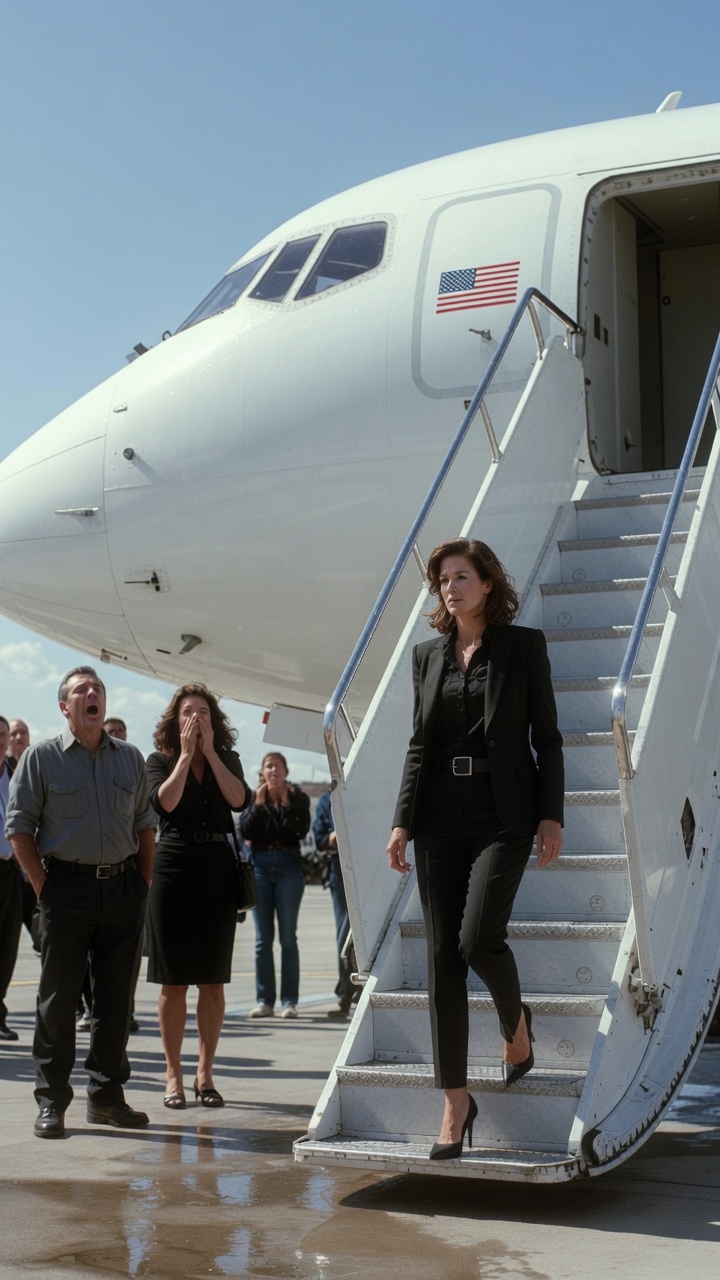
We Were On The Runway. “Get Down!” Stepdad Screamed. “That’s Air Force One!” “They’ll Take You Down!” But The Stairs Dropped. The Colonel Saluted. “We Are Ready For Departure, Director.” Stepdad Froze In Shock.
Part 1
The diner’s sign buzzed like it was trying to speak in Morse code: OPEN, maybe, or RUN. Inside, it smelled like maple syrup soaked into vinyl booths and coffee that had been sitting on a burner since yesterday afternoon. My stepfather, Hank Mercer, loved places like this—somewhere loud enough that his voice didn’t seem as out of place when he decided to fill the whole room with it.
He slid into the booth across from me, knees wide, palms flat on the table like he owned the Formica. His wedding ring flashed under the fluorescent lights. The metal was scratched, the way everything in Hank’s life got scratched eventually—tools, trucks, people.
“You still doing that little airport job?” he asked, not waiting for my answer before flagging the waitress with two fingers like she was a dog.
I swallowed a mouthful of watery eggs. “It’s not little.”
He snorted. “You answer phones. You shuffle paperwork. Don’t dress it up.”
My mom, Denise, sat beside him, stirring creamer into her coffee even though she’d already added two packets. She kept stirring like if she stopped, something might happen. Something might break.
Across the aisle, a kid in a hoodie was hunched over a plate of pancakes, earbuds in. Hank’s eyes tracked him, then slid back to me.
“Your brother,” Hank said, like he was saying the name of a saint, “finally got approved.”
Mason wasn’t my brother by blood, but I’d learned that didn’t matter in this family. Mason was Hank’s son. That made him the center of every story, the hero of every meal.
“Approved for what?” I asked, though I already knew. Denise had texted me twenty exclamation points last night. It had been like getting screamed at by punctuation.
Hank’s chest puffed. “FAA Part One-Oh-Seven. Remote pilot. Commercial. He’s legit now.”
Mason was twenty-eight and had been “almost legit” about six different careers. He’d been one course away from becoming a personal trainer, one interview away from being a firefighter, one crypto investment away from being “set for life.” Now he’d decided drones were the future and Hank had decided to be proud of it.
Denise finally looked at me, eyes hopeful. “We’re going out to Cedar Ridge after breakfast. They’re doing that fly-in thing. Food trucks, old warbirds, all that. Mason’s gonna do a demo.”
My fork paused halfway to my mouth. Cedar Ridge Regional wasn’t exactly a major airport. Two runways, one control tower, an FBO that sold stale beef jerky and souvenir keychains. I’d seen bigger parking lots.
Still, my stomach tightened in a way that had nothing to do with eggs.
“Today?” I said. “I thought this was just a family breakfast.”
“This is family,” Hank said, like I was slow. “Family supports family. You been so… busy.” He let the word drip with judgment. “Figured you could spare a couple hours to watch your brother do something real.”
I stared at the little crack in the ketchup bottle, a red line like a dried cut. Two hours. Cedar Ridge was forty minutes away. Then Mason would want pictures. Hank would want to talk to anyone who looked official. Denise would try to make me smile like everything was normal.
And somewhere under my left wrist, my watch vibrated—one short pulse, then another, then a long one. Not a text. Not a calendar alert.
My whole body went still.
I lifted my wrist like I was checking the time, but I didn’t look at the hands. I looked at the tiny icon that only appeared if a certain app was awake. A plain gray dot. Nothing else. Just a dot.
Hank followed my movement and his eyes narrowed. “You addicted to gadgets now? You can’t even sit through eggs without checking something.”
“It’s work,” I said, keeping my voice low.
Hank laughed loud enough that the kid with earbuds glanced up. “Work. Sure. Your ‘work.’”
Denise’s hand slid onto Hank’s forearm. “Let her be,” she murmured, but she didn’t sound like she meant it. She sounded like she was trying to keep a lid on a pot she knew was boiling.
My watch vibrated again. Three short pulses this time, back-to-back-to-back.
My mouth went dry.
Under the table, my phone was in my bag. Not my normal phone—the one Denise called whenever she wanted me to “come by and look at the sink”—but the other one, the one that stayed off unless it didn’t.
I kept my expression neutral. I’d learned that skill like some people learned to juggle. Hank could spot a flinch the way sharks smelled blood.
The waitress came back with Hank’s coffee refill. He didn’t thank her. He talked right over her shoulder.
“After Cedar Ridge,” he said, “we’re all going back to the house. I got steaks. Thought we could make a day of it.”
I pictured Hank’s backyard: the rusted grill, the wind chimes that never stopped clinking, the sagging porch chair where he held court. I pictured Mason bragging, Denise fluttering, me trapped.
My watch vibrated a fourth time, longer than the others, like a hand squeezing my wrist.
I forced myself to breathe through my nose. I picked up my fork. I put it down again because my hand wasn’t steady enough to pretend.
“Cass,” Denise said softly, using the nickname she only used when she wanted something. “You’re coming, right?”
Hank leaned in. His aftershave hit me—sharp and sweet, like cheap bourbon. “Don’t start with excuses,” he said. “Mason needs you there. He’s doing this for the family. For the business. You could at least show your face.”
Show your face. That phrase made my skin crawl. It was what Hank said when Denise wanted to leave the house but he didn’t want her to. Show your face at church. Show your face at the barbecue. Show your face at the fundraiser. Be the right shape in the right place.
Under the table, I slid my foot forward and nudged my bag closer. My fingers dipped down like I was adjusting my napkin. I found the other phone by touch—flat, matte, no case, no warmth.
I didn’t pull it out. I didn’t dare. Hank watched me like he was waiting to catch me doing something wrong.
Instead, I cleared my throat. “Fine,” I said. “I’ll go.”
Denise’s shoulders dropped with relief. Hank’s mouth curled into a satisfied smile, like he’d won a small war.
“Good,” he said, slapping the table. Silverware jumped. “See? That wasn’t hard.”
My watch vibrated once more. One single pulse.
The code for: Open it now.
I smiled at Hank the way I smiled at customer complaints—pleasant, empty, practiced. “Let me use the restroom first.”
Hank waved his hand like permission was his to give. “Don’t take forever. We got to get out there before the crowd.”
I slid out of the booth and walked toward the back hallway, passing the smell of frying oil and the clatter of dishes. The restroom door stuck, as always, and I had to shoulder it open.
Inside, the light flickered. The air smelled like lemon cleaner and old paper towels. I locked myself in a stall—not because I needed privacy to pee, but because it was the only place in the building Hank couldn’t barge into without consequences.
My hands moved fast. Phone out. Screen on. No passcode—biometric only.
One message. No sender name. Just a line of text that made my stomach drop straight through my body.
ASSET DIVERT LIKELY. STAGING SITE: CEDAR RIDGE REGIONAL.
Below it, a second line popped in as I stared.
DO THEY KNOW YOU’RE THERE?
My throat tightened, heat flooding my face like I’d been caught. Outside the stall, the faucet dripped steadily, one drop at a time, like a countdown.
Because Cedar Ridge wasn’t just where Hank wanted to watch Mason play with a drone.
Cedar Ridge was about to become something else entirely—and I had no idea how many people in that diner were already part of it.
What exactly was headed for that runway, and why did it feel like someone had set the trap around me?
Part 2
Hank drove like he argued—too fast, too close, always convinced the other guy would move first.
His truck was a lifted black Ram with a cracked windshield and a console full of receipts, gum wrappers, and a little plastic cross that swung from the rearview mirror. The cabin smelled like sun-baked rubber and peppermint chew.
I sat in the back because Hank said the front seat was “for family.” Denise rode shotgun, hands folded in her lap, staring straight ahead like she could steer by wishing.
Mason followed us in his own vehicle: a white SUV with a magnetic logo on the door that read MERCER AERIAL MEDIA in bold black letters. Hank had paid for the decals. Hank had also paid for the drone.
That part never got mentioned out loud.
My phone—my normal phone—buzzed with a text from a coworker: Can you cover my shift next Friday?
I didn’t answer. The other phone, the real one, sat heavy in my purse like a stone. I’d powered it down after reading the message, because keeping it on in Hank’s truck felt like walking around with a siren in my pocket.
Still, I couldn’t stop thinking about those words: staging site.
Hank turned up the radio, some talk show host yelling about “government overreach” and “freedom.” Hank nodded along, tapping the steering wheel like he was agreeing with every sentence.
“See?” he said, glancing in the mirror at me. “This is why you don’t trust ‘em. They always got a plan.”
I kept my voice calm. “Who’s ‘they’?”
He laughed. “You know who. Suits. Agencies. People like you.”
People like me. Hank loved saying that. It was his way of putting me in a box without actually admitting I might have any power.
We passed soybean fields and a billboard advertising a fireworks store with a cartoon bald eagle screaming. The sky was bright, the kind of blue that looked fake, like someone had turned up the saturation.
Cedar Ridge appeared the way small airports always did: suddenly, flat and exposed, runways cutting through grass like scars. A control tower rose up like a toy building. A line of cars spilled into the gravel lot, dust hanging in the air like powder.
Hank rolled his window down and inhaled like it was perfume. “Smell that? Jet fuel. That’s honest work.”
Denise smiled faintly, the way she smiled at all of Hank’s opinions. “It is kind of nice.”
We parked near a row of pop-up tents. A food truck sold kettle corn; the air was sweet and buttery, mixing with the sharp tang of fuel and hot asphalt. Somewhere nearby, a prop plane started up and the engine’s stuttering roar made a few kids squeal.
Mason waved when he saw us, aviator sunglasses on, polo shirt tucked too tightly. He looked like he’d built himself out of a catalog.
“You made it!” he called, like we’d shown up to his concert.
Hank clapped him on the shoulder. “Wouldn’t miss it. Where’s your setup?”
Mason jerked his thumb toward a table under a tent. On it sat two hard cases—black, foam-lined, the kind used for camera gear. One case was open, revealing a drone the size of a dinner tray, carbon fiber arms folded like a sleeping insect.
It didn’t look like the hobby drones I saw kids flying in parks. This one had a chunky antenna array on top and a battery pack that looked… overbuilt.
My pulse ticked up.
Mason followed my eyes and grinned. “Isn’t she beautiful? Eight-mile range. Sixteen if you know what you’re doing.”
Hank puffed up like he’d built it himself. “Told you. My boy doesn’t do cheap.”
I stepped closer, pretending casual curiosity. My goal was simple: figure out if what I was seeing was normal, or if it was the kind of “normal” that ended up on a briefing slide.
The conflict: Hank and Mason were right there, watching me, waiting for me to say something that would let them call me clueless.
New information came from a tiny sticker on the case: a barcode label with a vendor name I recognized from work. Not because I ordered from them personally, but because their equipment showed up in incident reports.
I kept my face blank. “Nice,” I said.
Mason beamed. “I’m doing a demo for the county commissioner. He’s over there.” Mason pointed at a man in a blazer standing near the hangar, talking to a woman in a ball cap. Behind them, a few men in matching polo shirts—Pike Protective Services—stood with their hands clasped in front of them like off-duty bouncers.
My stomach tightened.
Pike was Hank’s side business. “Security consulting,” he called it. Mostly it was him hiring guys from his old drinking circles and sending them to stand around at events with earpieces that weren’t plugged into anything.
Seeing that logo here made my skin prickle.
Hank noticed my stare and grinned. “Yeah, I got a contract today. County wanted ‘extra eyes.’ You know, in case of trouble.”
He said it like he was joking, but his eyes were sharp, measuring my reaction. Hank liked being near authority. He also liked pretending he was authority.
Denise tugged at my sleeve. “Honey, go get yourself something to drink. It’s hot.”
She was trying to be kind. Or she was trying to move me away before Hank decided to poke again.
I nodded and walked toward the FBO building, using the crowd as cover. The glass doors whooshed open, blasting me with cold air and the smell of carpet cleaner. Inside, the lobby was full of pilots in ball caps and families buying bottled water.
I headed straight for the vending machines, because that corner had the worst camera angle and the best chance of disappearing for thirty seconds.
My hands were shaking as I dug into my purse. Other phone out. Power on.
The screen lit up with a map pin already loaded. Cedar Ridge. Dead center.
A new message appeared, shorter this time.
EYES UP. YOU ARE NOT THE ONLY ONE WAITING.
My chest went tight, like I’d swallowed a rock. Waiting for what?
I lifted my gaze toward the big windows facing the runway. Outside, a small plane taxied by, sunlight flashing on its wings. Everything looked ordinary.
But then I saw it: on the far side of the tarmac, near a service gate, a black SUV pulled in—no markings, dark tint, moving slow like it didn’t want attention.
It parked. Two men got out. Not pilots. Not families. They moved with the same deliberate calm I’d seen in people who trained for problems.
One of them looked up, straight through the glass, straight at me—like he knew exactly where I’d be standing.
My fingers went numb around the phone.
Because whatever was coming to Cedar Ridge, it wasn’t just coming for the runway.
It was coming for me.
Why would someone set eyes on this airport like it was a target—and why did that stranger look like he recognized me before I recognized him?
Part 3
I didn’t run.
Running is how you make yourself interesting.
Instead, I bought a bottle of water I didn’t want, fed wrinkled bills into the vending machine like I was just another overheated attendee. The bottle dropped with a plastic thud. I picked it up, took a sip, and let the cold water slide down my throat while my brain sprinted.
Goal: get information without tipping Hank.
Conflict: I was in a public place, watched, with no secure room and a stepfamily who treated curiosity like guilt.
New information: the SUV guys weren’t here for funnel cake.
Emotional reversal: the uneasy suspicion that today was “about Mason” flipped into a cold certainty that today was about something bigger—and I was standing in the middle of it.
I walked toward the hallway marked EMPLOYEES ONLY, keeping my pace unhurried. The door had a keypad. I didn’t have a badge on me—at least not visible—but I did have an old laminated access card tucked in the back of my wallet, the kind I never used unless I had to.
I slid it out and flashed it quickly. The keypad beeped green. The door clicked.
Inside, the air changed. The smell was different—printer toner, stale popcorn, and that faint metallic tang of electronics cooling. A narrow corridor led to a small office with a window facing the runway. On the door: OPERATIONS.
I stepped in, closed it behind me, and locked it.
The room had two desks, a radio console, a stack of NOTAM printouts, and an old coffee maker with a crusty pot. A man in a headset turned, startled. He was mid-forties, tired eyes, tower-controller posture.
“Ma’am—this area—”
I held up my palm, calm. “I’m not here to cause trouble. I need a private line. Now.”
He blinked like he wanted to argue, then his gaze flicked to the card in my hand. Recognition flashed—maybe not of me personally, but of what that card meant.
“You’re not—” he started.
“I’m not who you think I am,” I said, which was true in a weird way. “But I’m also not a random person. Please. Give me one minute.”
He hesitated, then nodded toward a phone on the wall. “That line goes out without recording.”
“Perfect.”
I pulled out the other phone, tapped once, and held it near the receiver. The screen showed a code phrase I wasn’t allowed to say out loud. The phone chirped—one tiny sound, like a bird pecking glass.
Then it connected.
A voice came through, low and brisk. “Confirm you are physically at Cedar Ridge.”
“I’m here,” I said. “What’s happening?”
“Diversion order is on the table,” the voice replied. “Primary route compromised. We cannot guarantee comms integrity over the planned corridor.”
My throat tightened. Diversion order for what asset? I already knew, but hearing it said like this made my skin prickle.
“Say it,” I whispered.
A pause—just long enough to remind me someone else was listening to my breath. Then: “Air Force One.”
The words landed like a weight. Outside, the airport noise suddenly sounded far away, muffled behind the locked door and my own pulse.
“Why here?” I asked.
“Nearest runway with acceptable length, controllable perimeter, and a tower staff that can be overridden fast,” the voice said. “Also, because we believe the adversary expects you to be somewhere else.”
My fingers tightened around the receiver. “They’re targeting me?”
“They’re targeting the continuity package,” the voice corrected. “You are the last clean carrier.”
I exhaled slowly, tasting old coffee in the air. Continuity package. That was the polite phrase for something that could not, under any circumstances, fall into the wrong hands.
“I’m not supposed to have it on a weekend,” I said, though I knew the answer.
“Yet you do.”
I swallowed. “Because I never fully unpack.”
“Because you don’t trust your home,” the voice said, like it was reading my mind. “We’ve got a jammer signature forty miles out. Portable, high-end. Not hobbyist. We suspect an inside assist at this airport.”
My eyes flicked to the window. On the tarmac, Pike Protective Services guys stood near the hangar doors, hands clasped, watching.
Inside assist.
“Tell me what you need,” I said.
“Secure the runway. Secure a room. Keep the family out of it.”
I almost laughed—sharp and humorless. “That last part is harder than the first two.”
A crackle of something like sympathy came through the line, then vanished. “Stairs will drop when it’s safe. You will be met. Do not approach until the signal is given.”
I glanced at the controller in the corner of the room. He was pretending to look at paperwork, but his jaw was tight and his eyes kept darting toward me.
“What’s the signal?” I asked.
The voice lowered. “You’ll see it. And Cass—”
No one used my name on that line unless it mattered.
“Yes?”
“Do not underestimate the people closest to you. We have one more thing.”
My stomach clenched. “What?”
“We intercepted a purchase order for the jammer’s battery packs. It was paid with a local business account.”
A pause.
“Mercer.”
The word hit like a slap.
I couldn’t speak for a second. My mind tried to shove the idea away—Hank didn’t know anything about this world. Hank barely knew how to set the microwave clock. Hank was all bluster and barbecue smoke and petty control.
But Hank had a security side hustle. Hank had contacts. Hank loved being near important things.
“Are you sure?” I whispered.
“The paper trail is messy,” the voice said. “But the name isn’t.”
I stared at my reflection in the window glass—my own face, pale, eyes too wide. Behind it, the runway shimmered in heat.
Hank.
I hung up, hands trembling just slightly. I put the phone back in my purse like it was a live wire.
When I turned, the controller’s eyes met mine. “What’s going on?” he asked, voice tight.
I took a breath, forced calm into it. “You’re about to have a ground stop. You’re going to do exactly what you’re told, even if someone screams at you. Understood?”
His throat bobbed as he swallowed. Then he nodded once. “Understood.”
I unlocked the door and stepped back into the hallway, my face resetting into normal. The FBO lobby noise hit me again—kids laughing, soda machine clunking, some guy complaining about the heat.
I walked out into the sun.
Hank spotted me immediately, like a predator with a fixation. “There you are,” he barked. “What’d you do, fall in the toilet?”
I forced a smile. “Just needed water.”
Hank leaned closer, sniffing like he could smell secrets. “You disappear a lot for someone who claims she’s ‘fine.’”
Mason interrupted, waving his controller like a trophy. “Okay, okay—everyone watch. I’m gonna take her up.”
He meant the drone, but the way he said it made my skin crawl.
The Pike guys shifted, subtle, like they were waking up. One of them touched his earpiece.
My phone in my purse vibrated once—hard.
I didn’t need to look.
Something had just been approved.
I lifted my eyes to the eastern horizon, where the sky looked empty and harmless.
And then, far away, I saw a dot—dark against the blue—growing larger, steady, inevitable.
Hank followed my gaze and squinted. “What the hell is that?”
My stomach dropped, cold and heavy, because I knew the answer—and I didn’t know whether Hank knew it too.
Was that dot coming to save me, or to confirm that the trap had already snapped shut?
Part 4
The first sign something had changed wasn’t the dot in the sky.
It was the sound.
A low siren, distant at first, then closer, cutting through the cheerful noise of the fly-in like someone had dragged a knife across a balloon. Heads turned. A few kids stopped chasing each other and stared toward the service road.
Hank straightened, suddenly alert. He loved emergencies the way some people loved sports—something to comment on, something to dominate.
Two airport vehicles rolled by fast, lights flashing. Then a county cruiser. Then another black SUV, the unmarked kind that didn’t belong to the county.
Mason didn’t notice. He was focused on his drone, fingers on the controller sticks, sunglasses tipped down like he was about to perform surgery.
Goal: stop anything from taking off, flying, or escalating.
Conflict: Mason was about to launch a drone into the exact kind of airspace that, in a few minutes, would become the most sensitive airspace in the country.
New information: the response wasn’t theoretical anymore; the airport was already being sealed.
Emotional reversal: my fear shifted into a hard, sharp anger—because the threat was no longer “out there.” It was standing beside me, grinning.
A voice blasted from a loudspeaker near the hangar. “Attention all personnel. Immediate ground stop. All aircraft hold. All drone activity cease now. Repeat: cease now.”
A ripple of confusion ran through the crowd. People laughed nervously. Someone yelled, “Is this part of the show?”
Hank scoffed. “What a joke.”
The Pike guys didn’t laugh. They looked at each other, quick glances, then toward Hank like he was the only person whose reaction mattered.
Mason lifted his drone slightly, ready to set it down on the table for launch. “They can’t stop me,” he muttered. “I’m certified.”
“That’s not how—” Denise started, but Hank cut her off.
“He’s allowed,” Hank said, loud, as if volume was a legal argument. “He’s a commercial operator. They can’t just—”
I stepped closer to Mason, lowering my voice. “Don’t launch.”
Mason blinked at me. “What?”
“Don’t,” I repeated, calm but firm. “Right now.”
Hank snapped his head toward me. “Who asked you?”
Mason’s mouth twisted. “Why do you care? You don’t even like what I do.”
I kept my face neutral, but my heartbeat was pounding in my ears. “This isn’t about liking it. It’s about timing.”
Mason’s eyes narrowed. “You trying to control me now?”
Hank laughed, sharp. “She always does this. She can’t stand when you’re the one getting attention.”
The air tasted like hot metal. Somewhere overhead, the dot had grown. Not just one dot now—two, maybe three. My skin crawled with the sensation of being watched from angles I couldn’t see.
I reached into my pocket, pulled out my normal phone, and tapped it like I was checking the weather. Underneath, my other phone buzzed again inside my purse—two quick pulses. A command without words: Move.
I leaned in toward Hank, keeping my voice low, almost friendly. “Hank, you need to get Denise and Mason away from the tarmac.”
Hank stared at me like I’d asked him to donate a kidney. “Excuse me?”
“Now,” I said.
His face darkened, the familiar storm building. “Don’t tell me what to do.”
A man in a polo shirt—airport staff—ran up, sweaty and wide-eyed. “Sir, we need everyone behind the fence line. Federal order. Please.”
Hank puffed up. “Federal order? Who are you, the FBI? This is a public airport. I got a contract here.”
The staffer’s eyes flicked to the Pike logo on Hank’s chest. His mouth tightened. “Sir, it’s not optional.”
Hank jabbed a finger toward Mason’s drone. “My son is operating legally. You can’t just shut down—”
“Sir,” the staffer said, voice rising, “if you don’t comply, you will be removed.”
Removed. That word made Hank’s eyes flash. He hated being told no more than he hated being ignored.
Mason chose that moment to smirk and lift the drone again. “I’m taking off,” he said, loud enough for the crowd to hear. “They’re not gonna bully me.”
My stomach dropped. If that drone went up now, it wouldn’t just get confiscated. It would trigger a response. And if the response escalated, Hank would scream, Mason would panic, Denise would cry—and Air Force One would be landing into chaos.
I grabbed Mason’s wrist.
He jerked back like I’d slapped him. “Don’t touch me!”
Hank stepped forward, face flushing. “Get your hands off him!”
I forced my voice steady. “Mason, listen to me. You do not want to be airborne when—”
“When what?” Hank barked. “When your little office friends show up? You think you’re special because you answer calls in a tower?”
I almost laughed at the irony, but it came out as a tight breath.
The Pike guys shifted closer. One of them casually moved his hand toward his belt, where a radio sat.
That’s when the tower speakers crackled again, and this time the voice wasn’t the local controller. It was calm, crisp, and carried the kind of authority that made even Hank’s bluster hesitate for half a second.
“All units, security posture one. Clear the runway. Clear all adjacent aprons. This is not a drill.”
The crowd went quiet. Even the kettle corn machine seemed to hush.
Hank’s eyes widened just slightly, like his brain had bumped into something it couldn’t explain.
Mason swallowed. “What’s happening?”
I let go of his wrist and stepped back, palms open, trying to de-escalate without revealing myself. “Just… put it down,” I said. “Please.”
Mason hesitated—then, stubbornly, he set the drone on the table anyway, hands still on the controller.
“I’m not scared,” he muttered, but his voice wasn’t convincing.
A gust of wind hit, sudden and unnatural. It carried the sharp stink of jet exhaust, heavy enough to coat the back of my tongue.
The sky dimmed—not like a cloud passing, but like something massive had slid between us and the sun.
Hank looked up.
His face drained so fast it was almost comical.
“Oh,” he whispered, the first honest sound I’d ever heard from him.
And then he screamed, full volume, like the world was ending. “That’s Air Force One! They’ll take you down!”
I didn’t look at him. I kept my eyes on the growing shadow, the looming shape, the impossible weight descending toward Cedar Ridge.
Because the stairs were going to drop soon—and I still didn’t know whether Hank was panicking out of ignorance…
…or because he recognized his own mistake finally coming back to collect him.
Part 5
You don’t really understand how big Air Force One is until it’s stealing your sky.
It came in low, so low I could see the underside details—panels, seams, the belly curve of a machine built for power. The engines didn’t just roar; they pressed against my chest like invisible hands. The smell of burning rubber hit as the wheels kissed the runway, sharp and gritty, like fireworks smoke.
People stumbled backward. A kid started crying. Someone’s paper plate of nachos flipped and hit the pavement with a wet slap.
Hank dropped to one knee, hands splayed like he might crawl away from the sound.
Mason stood frozen, sunglasses still on, mouth open. The drone on the table rattled as the jet wash swept through, the antenna array vibrating like it was alive.
Black SUVs poured onto the tarmac from two different directions. Not county. Not airport. These moved like they owned the ground they rolled over. Doors flew open mid-stop. Men and women in dark suits spilled out, forming lines, scanning, hands near weapons.
The crowd tried to understand what it was seeing and failed, collectively, like a computer hitting an error.
Hank’s voice cracked into frantic, desperate babble. “Cass! Cass, get down! Whatever you did—whatever you told them—”
“I didn’t—” Denise started, but Hank wasn’t listening.
He grabbed my arm, hard. His fingers dug in through my sleeve.
Goal: get to the staircase without letting Hank turn this into a screaming public disaster.
Conflict: Hank was physically holding me and trying to drag me into his panic.
New information: the security response was not generic; it was centered on a very specific perimeter that included me.
Emotional reversal: my fear drained away, replaced by a cold clarity—Hank wasn’t worried about me. Hank was worried about himself.
“Let go,” I said, low.
Hank’s eyes were wild. “They’re here for you! I knew it. I knew you weren’t just—”
His voice dropped into a hiss. “What are you mixed up in? Drugs? Money? You think you can bring this on my family?”
My family. He always said it that way when he wanted ownership.
A woman in a suit—short hair, sharp posture—moved toward us. Her eyes scanned Hank’s grip on my arm, then flicked to my face. She didn’t look confused. She looked like she’d found what she was looking for.
Her earpiece wire curved behind her jaw. Her hand was open, palm down, a universal gesture: stay calm, I’m in control.
Hank saw her and flinched. “Officer—agent—whatever—listen, I’m not with her,” he blurted. “She’s my step—she’s not—”
There it was. The betrayal, instant and automatic.
Denise made a small sound, like she’d been punched. Mason’s face twitched, uncertain, like he wanted to disappear.
The agent’s gaze didn’t even linger on Hank. It was like he was furniture making noise.
She spoke to me, voice quiet but clear. “Ms. Carter?”
I nodded once.
Hank’s grip tightened in panic. “No, no—don’t talk to her! She’ll get you killed! Cassie, you get down!”
I turned my head slightly, meeting Hank’s eyes. “Get your hands off me.”
He shook his head fast. “I’m trying to save you!”
“No,” I said, voice flat. “You’re trying to save you.”
The agent stepped closer. “Sir, release her.”
Hank barked a laugh that sounded like choking. “Who the hell are you to tell me—”
Two more agents appeared at her flanks like they’d been waiting for the cue. Hank’s bravado folded. His hand loosened.
The moment he let go, the air around me changed, like a vacuum seal breaking. I stepped forward, away from him, and the agents shifted—subtle, protective, bodies angling outward.
Hank’s face contorted. “Cassie, don’t you walk away from me!”
I walked anyway.
The staircase began to unfold from the aircraft—smooth, hydraulic, inevitable. The metal steps gleamed in the sun, and the sight of them made Hank’s knees wobble again.
A figure appeared at the top of the stairs, not the President, but someone in a crisp uniform—Air Force, not Marines. A woman, rank insignia catching the light. She scanned the tarmac, then fixed her gaze directly on me.
She raised a hand—not a wave, not a salute in the flashy sense, but a precise gesture of recognition.
The agents around me parted like a doorway.
I heard Hank behind me, voice cracking. “Cassie! Tell them I didn’t know! Tell them I’m with you!”
My shoes clicked on the pavement as I crossed the open space toward the staircase. Jet fuel and hot asphalt filled my nose. My heart hammered, but my face stayed calm.
Halfway there, I glanced down.
Near Mason’s table, half-hidden under a folding chair, was a handheld controller—different from Mason’s, heavier, with a thick cable leading into a black case.
On the side of the case, a sticker peeled at the corner.
Pike Protective Services.
My stomach turned cold.
Because Pike wasn’t just Hank’s side hustle.
Pike was sitting in the middle of the operational threat zone, like it belonged there.
And then my other phone vibrated inside my purse—one hard pulse that felt like a warning slap.
A message flashed on the screen without me touching it, as if the device had decided I didn’t get to look away anymore:
JAMMER MANIFEST TAGGED TO YOUR NAME. WHO DID THAT?
My throat tightened as the stairs waited in front of me, the aircraft door open like a mouth.
If someone had used my name as cover… what else had they planted—and how deep did Hank’s fingerprints go?
Part 6
Inside Air Force One, the air felt unreal.
Cool, filtered, smelling faintly of leather and fresh coffee—like the world’s cleanest hotel lobby floating above chaos. The roar of the engines softened into a controlled hum the moment the door sealed behind me.
The Air Force officer who met me at the top of the stairs didn’t waste words. “This way,” she said, brisk. Her name tag read LANGLEY. Her eyes were sharp, but not unkind.
My go-bag strap cut into my shoulder. I hadn’t even realized I’d been gripping it like a lifeline.
We moved through the narrow corridor past staff who didn’t stare, didn’t gawk. Everyone here had mastered the art of acting normal around extraordinary things.
Langley opened a door to a compact conference room. A table. A secure screen. Two people already waiting—one in a suit with tired eyes, the other in uniform with a tablet tucked against his chest like it was welded there.
The suited man stood. “Cassie Carter.”
He didn’t say it like a question.
I nodded. “Yes.”
He exhaled like he’d been holding his breath for hours. “Thank you for getting us a runway.”
I almost laughed. I hadn’t “gotten” them anything. I’d been dragged here by Hank and Mason and sheer bad luck. But I understood what he meant: I’d been here when they needed me.
“Tell me about the manifest,” I said. My voice sounded steady in my own ears, which felt like a miracle.
The uniformed man tapped his tablet. A file popped up on the screen—item lists, serial numbers, vendor codes. My name appeared in the header field as “requesting official.”
My skin crawled.
“That’s not mine,” I said. “I didn’t file it.”
“We know,” the suited man said. “But whoever did wanted it to look like you did.”
Goal: clear my name and identify the inside assist before the aircraft lifts.
Conflict: time was collapsing; every minute we stayed on the ground was a risk, but leaving without answers meant carrying the threat with us.
New information: the jammer hardware was local, and the paperwork was layered to implicate me.
Emotional reversal: the shame I’d trained myself to swallow for years—Hank’s favorite weapon—transformed into something cleaner: rage.
Langley’s jaw tightened. “We traced the vendor pickup. It was signed for this morning at Cedar Ridge.”
“By who?” I asked, already bracing.
The suited man hesitated just long enough to make my stomach drop. Then he slid a photo across the table—grainy, from a security camera.
A man in a Pike polo shirt, head down, signing a clipboard.
Hank’s stance. Hank’s shoulders. Hank’s stupid, familiar swagger even in bad footage.
My mouth went dry. “That’s him.”
“Relationship?” the suited man asked.
I swallowed. “Stepfather.”
The word tasted bitter, like metal.
Langley’s eyes sharpened. “We have him detained on the tarmac.”
I pictured Hank on his knees, screaming, trying to shove blame onto me like it was a coat he didn’t want to wear. I pictured Denise’s face—tight, scared, caught between. Mason’s hands hovering over his controller like he still thought he could fly his way out of consequences.
“Detained isn’t enough,” I said quietly.
The suited man studied me. “What do you mean?”
I took a breath, pulling my thoughts into order the way I did when an incident report turned into something worse. “Hank doesn’t buy equipment like that without a reason. He’s cheap. He’s loud, not brave. If he signed for jammer hardware, someone convinced him it would benefit him.”
“Benefit how?” Langley asked.
I almost laughed again, but it would’ve come out ugly. “Status. Contracts. Being close to power. Hank collects proximity like other people collect coins.”
The suited man nodded slowly. “We also have a second name on the paperwork.”
He tapped the screen. Another line appeared. Another signature.
MERCER AERIAL MEDIA.
My vision narrowed.
“Mason,” I whispered.
Langley’s expression didn’t change, but something in her posture tightened. “We need your confirmation. Is he capable?”
“Capable?” I repeated, and my voice almost cracked. “He’s capable of lying. He’s capable of taking credit. He’s capable of whatever Hank tells him will make him look important.”
The suited man leaned forward. “We’re going wheels-up in twelve minutes. Before that, we need to know one thing.”
He pointed to a highlighted section of the file. “Continuity package. You’re carrying it.”
My throat tightened again. I nodded.
“Then we need to know if anyone in your family has had access to your personal belongings in the last seventy-two hours.”
The question hit like a fist.
I remembered Hank’s truck. The way he watched me. The way he’d always had a habit of “tidying” things that weren’t his. The way Denise would say, He’s just trying to help.
I forced myself to answer honestly. “Yes.”
Langley’s gaze held mine, steady as a runway line. “Then we treat this as compromised until proven otherwise.”
The suited man stood. “We’ll handle the tarmac. You stay here.”
He paused at the door. “Do you want us to release your family once we clear the scene?”
The question felt like a trap disguised as kindness.
For a heartbeat, I saw Denise’s face when I was thirteen, whispering in the kitchen, Don’t make him mad. I saw Mason’s smirk when I’d worked two jobs in college and he’d called me “uptight.” I saw Hank’s fingers digging into my arm, his voice saying my family like he owned my existence.
“No,” I said, calm. “Do your job.”
The suited man nodded once, not judging, just accepting. He left.
Langley stayed, watching me with something like respect. “You okay?”
I stared at the screen where Hank’s signature sat like a stain. “No,” I said. “But I will be.”
Outside, the engines began to spool. The hum deepened, vibrating through the floor.
I reached into my purse and pulled out my other phone, thumb hovering over the secure directory. My hands weren’t shaking anymore.
I wasn’t thinking like Hank’s stepdaughter.
I was thinking like someone who’d been used as cover—someone who didn’t intend to stay convenient.
And then, as if the universe wanted to twist the knife one more time, another notification popped up on the screen—financial, not operational.
A bank alert.
Transfer scheduled: $7,500. From: Denise Carter. To: Pike Protective Services LLC.
My stomach turned cold.
Because that meant my mother hadn’t just stood by.
She’d been paying into it.
What exactly had Denise agreed to—and how long had Hank been using her to fund the trap around me?
Part 7
When we lifted off, Cedar Ridge shrank into a patch of gray surrounded by green, like a scab on the earth.
I didn’t go to the window again after the first glance. I didn’t want the last image in my head to be Hank’s face—pale, shocked, betrayed by reality.
In the air, the world always felt simpler. Lines on maps. Decisions with consequences. People either complied or they didn’t.
But family didn’t follow the same rules.
By the time we landed at a secure field outside D.C., my phone had three missed calls from Denise and six from Hank. Mason had texted, u okay?? like he hadn’t spent the morning helping hang a noose around my name.
I didn’t answer any of them.
Goal: protect the continuity package, protect my clearance, protect my life.
Conflict: Hank wasn’t going to let go of a lever he thought he could pull.
New information: Denise had been transferring money to Pike Protective Services in amounts too large to be “normal.”
Emotional reversal: the guilt I’d carried for years—because Denise had trained me to carry it—curdled into something harder: disgust.
That night, back in my apartment, the silence felt sharp. My place smelled like laundry detergent and the lavender candle I never actually lit. I dropped my keys into the bowl by the door and stood there for a second, listening.
No footsteps. No voices. No Hank.
I should’ve felt relief.
Instead, I felt exposed.
I locked the deadbolt, then the second lock. I set my purse on the counter and pulled out the other phone. Messages waited.
One from Langley: Pike tech seized. Working leads.
One from the suited man: Your name cleared internally for now. Stay available.
Then, a new one from an unknown number.
You embarrassed me. Call now.
No signature needed.
My throat tightened anyway.
I stared at the text until the screen dimmed. Then I turned it back on and opened my contacts. Hank’s number sat there, bold and easy, like it belonged.
I didn’t block him yet. Not because I was hoping for an apology.
Because part of my job—part of my survival—was documentation.
I called.
He answered on the first ring, breathless like he’d been waiting with the phone pressed to his ear.
“Cassie,” he said, voice syrupy-sweet, like we were back at the diner and he hadn’t just handed my name to a federal crime. “There you are. About time.”
I kept my voice flat. “Why did you sign for jammer hardware?”
Silence—half a beat.
Then Hank laughed, small and nervous. “Jammer? What are you talking about?”
“You know exactly what I’m talking about.”
His tone sharpened. “You come into my life, you hide things, you get planes landing on top of my head, and now you’re accusing me—”
“Hank,” I cut in, and even I heard the change in my voice. The voice that didn’t flinch. “I saw the footage.”
Another pause. I could hear background noise—TV, maybe, or Mason’s voice muttering in the distance.
Then Hank sighed, dramatic. “Fine. I signed a pickup. It was equipment. For security. County asked.”
“County doesn’t buy military-grade jammers,” I said.
Hank’s voice dropped, lower, intimate, like he was sharing a secret between friends. “You don’t understand contracts. People make requests. You fulfill them. That’s how business works.”
My fingers tightened around the phone. “Denise transferred you money.”
“Don’t drag your mother into this,” Hank snapped, and the speed of his anger told me I’d hit something real.
“She’s already in it,” I said.
Hank exhaled hard. “Listen. We can fix this. You got connections. You can make this go away.”
There it was. Not apology. Not concern. A transaction.
“What do you want?” I asked.
Hank didn’t hesitate. “I want you to tell whoever you told on me that it was a misunderstanding. I want you to clear my name. And I want you to do something for Mason.”
I closed my eyes. The kitchen light buzzed faintly overhead. Somewhere outside, a siren wailed and faded.
“Mason’s not your problem,” Hank continued. “But he’s your brother. He’s got a record—stupid stuff. You can erase it. You can get him licensed for bigger work. Government contracts. You owe us, Cassie.”
I laughed once, short and cold. “I owe you?”
“You wouldn’t be where you are without me,” Hank said, voice rising. “I made you tough. I pushed you. You think you can just—”
“You stole my name,” I said, cutting through. “You tried to use me as cover.”
Hank’s breathing sounded louder. “Cover? Don’t be dramatic.”
I stared at the counter, at the faint ring from a coffee mug, at the ordinary life Hank had always claimed I was too uptight to enjoy. My hands didn’t shake.
“I’m going to say this once,” I said. “Do not contact me again. Do not show up here. Do not call my office. Do not use my name.”
Hank barked a laugh, then lowered his voice into something cruel. “Or what? You’ll send your little suit friends after me? You think you scare me now because a plane landed?”
My mouth went dry, but my voice stayed even. “Because you’re already under investigation.”
Silence slammed down, heavy.
Then Hank spoke, slower. “You wouldn’t.”
“I would,” I said. “And I am.”
His voice turned sharp, desperate. “If you do this, I’ll tell people who you really are. You think I didn’t notice things? Your little trips. Your ‘work phone.’ I got photos. I got your badge number.”
My skin prickled. “How?”
Hank’s laugh was ugly. “You leave your bag around. You always did. Your mother gave me your spare key years ago. In case of emergencies.”
The room felt suddenly colder.
“My spare key?” I whispered.
“Don’t act shocked,” Hank said. “We’re family.”
I hung up.
For a second, I just stood there, phone in my hand, hearing my own breathing.
Then I walked to my bedroom door and froze.
The chain lock—normally dangling loose—was stretched, broken, hanging by one screw like a snapped bone.
My stomach dropped.
I crossed the living room fast, pulse roaring. The hallway closet door was slightly ajar. I didn’t remember leaving it that way.
I grabbed the nearest heavy thing—cast iron pan from the kitchen—and eased the closet open.
Inside: coats, shoes, vacuum. No person.
I moved to my bedroom. The dresser drawer was open an inch. My nightstand drawer too.
Then I saw it: my small safe, tucked behind a stack of books in the closet, door cracked open.
Cold flooded my veins.
I knelt, set the pan down, and pulled the safe door wide.
Empty.
Except for a single yellow sticky note, slapped inside like an insult.
Come home alone.
My throat tightened, anger flaring so bright it made my vision pulse.
Because Hank hadn’t just threatened me.
He’d already crossed the line into my space—into my life—like he believed he still owned the right.
And now the only question was: what exactly had he taken, and what was he planning to trade it for?
Part 8
I didn’t go home.
Not to Hank’s house. Not to Cedar Ridge. Not to the place where he’d trained Denise to shrink and Mason to smirk.
Home, tonight, was wherever Hank couldn’t reach me first.
I called Langley. She answered like she’d been awake the whole time.
“Say it,” she said.
“My apartment was breached,” I replied. “Safe is empty. Note left.”
A pause. “You didn’t touch anything else?”
“I touched air,” I said, voice tight. “That’s it.”
“Good,” she said. “Leave. Go to a hotel. Do not drive directly. We’ll meet you.”
Goal: stay alive and keep the continuity package from becoming leverage.
Conflict: Hank had physical access to my life through my mother’s compliance.
New information: he wasn’t bluffing; he’d already escalated into burglary and coercion.
Emotional reversal: the last thin thread of “maybe Denise didn’t know” snapped clean in my chest.
I packed fast—only what mattered. No sentimental items. No photos. No “maybe I’ll need this.” Just essentials and the kind of gear you keep when your life is built on contingency.
Before I left, I stood in the doorway and looked at my apartment like it was already someone else’s. The lavender candle, the folded throw blanket, the little plant I kept forgetting to water. All of it felt naïve.
Outside, the night air smelled like rain on concrete. Streetlights hummed. I took a different route to my car, scanning reflections in windows like I’d been taught.
At the hotel, Langley met me in the lobby with two agents I didn’t recognize. She looked exactly the same as she had on the plane—steady, contained.
“Tell me everything,” she said.
I did. The call. The threat. The spare key. The transfer from Denise to Pike.
Langley’s mouth tightened at the mention of the sticky note. “He wants you to come to him.”
“Yeah,” I said. “And he thinks I’ll do it because he’s trained me to fix things.”
Langley’s eyes held mine. “Will you?”
I thought of Denise’s hands stirring creamer endlessly. I thought of her voice saying, Don’t make him mad. I thought of the bank transfer. Of the spare key.
“No,” I said. “But I will end this.”
Langley nodded once. “Good. Because we traced the seized controller from Cedar Ridge.”
She pulled out a tablet and turned it toward me. A photo: the heavy controller I’d spotted under the chair, now bagged as evidence. Another photo: the inside of the black case—foam cutouts, wiring, a compartment for something that had been removed recently.
“Missing component?” I asked.
Langley’s eyes didn’t blink. “Storage module.”
My throat tightened. “He took it.”
“And if he took it,” Langley said, “he thinks he has leverage.”
A flash of anger heated my chest. “He doesn’t understand what he stole.”
“He understands enough,” Langley replied. “He left you a note. He wants a meeting.”
I stared at the hotel carpet—swirls of brown and gold, the kind designed to hide stains. Hank always liked things that hid messes.
“He said come alone,” I murmured.
Langley’s voice was calm. “You won’t.”
I looked up. “No.”
One of the agents—tall, quiet—spoke for the first time. “We can set a controlled meet. Cedar Ridge. Same hangar. He thinks it’s his territory.”
My stomach clenched at the thought of that runway again, the way the sky had darkened, the way Hank had screamed.
“Denise?” I asked, because the question hurt but I needed the answer. “Where is she?”
Langley hesitated. “She’s at the house. So is Mason. We have eyes on the property.”
“Are they safe?” I asked, and the word safe tasted strange. Denise had never made me safe. She’d made me quiet.
“For now,” Langley said.
I exhaled slowly. “He’s going to use her.”
Langley nodded. “Likely.”
I stared at my hands, at the faint marks on my arm where Hank had gripped me earlier. Anger wasn’t enough. Anger was a spark. I needed something cleaner.
Decision.
I lifted my eyes to Langley. “Set the meet.”
Langley studied me. “You sure?”
“Yes,” I said. “But I’m not coming to make peace.”
Langley’s expression didn’t soften. It sharpened. “Good.”
Later, alone in the hotel room, I sat on the edge of the bed and stared at my normal phone. Denise’s name glowed on the screen with fifteen missed calls stacked beneath it.
I didn’t call her back.
Instead, I opened my banking app and looked at the recurring transfers I’d never paid attention to closely enough—small amounts at first, then bigger. Denise to Pike. Denise to a second account I didn’t recognize. Denise’s signature on the financial trail like fingerprints on glass.
My stomach turned.
All those times she’d said she was “short this month,” all those little emergencies, all those sighs.
She hadn’t been trapped the way I believed.
She’d been participating.
I set the phone down and felt something shift inside me, like a door locking from the inside.
I wasn’t going to save Denise from Hank by sacrificing myself again.
I was going to save myself, even if it meant Denise finally had to face what she’d helped build.
And as I lay back on the stiff hotel pillows, staring at the ceiling’s faint water stain, my other phone buzzed with a new update from Langley:
MEET CONFIRMED. HANGAR 3. 0400.
My pulse kicked up, sharp with adrenaline and dread.
Because in four hours, I was going to walk back onto the ground where Hank thought he could control me…
…and I still didn’t know what he’d threatened Denise with to keep her in place.
Part 9
Cedar Ridge at 3:57 a.m. didn’t look like an airport.
It looked like the bones of one—runways washed in pale floodlight, hangars hunched like sleeping animals, the control tower dark except for one window glowing faintly. The air smelled of wet grass and leftover jet fuel, like yesterday’s power still clung to the asphalt.
I rode in the back of an unmarked SUV with Langley beside me. The interior smelled like clean vinyl and coffee. No chatter. No radio music. Just the soft hiss of tires on pavement.
“Remember,” Langley said quietly, “you speak when you choose. You don’t take bait.”
“I know,” I said, though my mouth was dry.
Hangar 3 sat at the edge of the field, partly hidden by a line of service buildings. A single security light buzzed above its door, casting a cone of harsh white.
The SUV rolled to a stop.
Langley touched my elbow. “We’re here.”
Goal: recover the stolen module and end Hank’s leverage.
Conflict: Hank believed he could corner me using family and fear.
New information: the meet was staged like a performance—Hank wanted control of the scene.
Emotional reversal: stepping out of the SUV, I didn’t feel small. I felt furious—and that fury steadied me.
I walked toward the hangar alone, as agreed. My footsteps echoed on the concrete. Each sound felt too loud in the quiet.
The hangar door was cracked open. Light spilled out—yellow, dim, like an old workshop bulb.
Inside, Hank sat on a folding chair like a king on a cheap throne. Mason stood behind him, arms crossed, jaw tight. Denise hovered near a workbench, hands clasped, eyes red-rimmed.
Hank smiled when he saw me. It was the same smile he’d used in the diner when he thought he’d won. The same smile that never reached his eyes.
“Cassie,” he said, soft and triumphant. “There she is.”
I stopped just inside the doorway. The hangar smelled like oil, dust, and cold metal. A small drone sat on the workbench, disassembled, guts exposed like a trophy.
Denise’s eyes met mine, pleading. “Honey—”
I held up a hand, stopping her. Not harsh, just final.
Hank leaned forward. “See? I knew you’d come.”
“I came for my property,” I said.
Hank chuckled. “Always with the paperwork. You really are your job.”
Mason shifted, eyes flicking toward the doorway as if he expected agents to burst in.
Hank followed his gaze and smirked. “Told you—alone.”
I didn’t respond. I let silence stretch, letting Hank fill it, because Hank always did.
He reached under the workbench and pulled out the storage module—small, black, unremarkable. He held it up between two fingers like it was a diamond.
“There it is,” he said. “Your little magic brick.”
My stomach tightened, but I didn’t move. “Put it down.”
Hank’s smile sharpened. “Not yet. First, we talk.”
Denise took a step forward. “Hank, please—just—”
He snapped his head at her. “Quiet.”
Denise flinched like she’d been hit. My chest tightened—not with sympathy, but with a bitter recognition. This was the choreography of their life. Hank barked. Denise shrank. Mason watched.
Hank turned back to me. “You got people,” he said. “Powerful people. You can make this whole mess disappear.”
“You committed a federal crime,” I said.
Hank shrugged. “People commit crimes every day. The only difference is who gets caught.”
Mason’s face twitched. “Dad—”
Hank lifted a hand without looking. “Shut up.”
Mason went quiet.
I stared at Hank, at the familiar lines in his face, the same face that had looked terrified under the shadow of Air Force One. Now he looked energized. Like he’d found a way back into control.
“What do you want?” I asked again.
Hank leaned back, chair creaking. “Simple. You call your suit friends. You tell them this was a misunderstanding. You get me cleared. You get Mason a contract—something real. You let him work. And you keep your mouth shut about your mother’s payments.”
Denise sucked in a breath, eyes wide. She stared at Hank like she hadn’t realized he’d say it out loud.
My voice stayed calm. “So you admit she paid you.”
Hank smiled. “She supported the family.”
Denise’s lips trembled. “Hank—”
“Quiet,” he repeated, slower, and Denise’s shoulders collapsed.
I felt something inside me go cold and clean. “You used her.”
Hank shrugged again. “She’s a grown woman. She chose.”
I looked at Denise. She couldn’t meet my eyes.
That was the real betrayal, sharp as a blade.
I turned back to Hank. “Give me the module.”
Hank’s smile faded slightly. “Or what?”
I didn’t answer him.
I just lifted my hand and snapped my fingers once.
The hangar lights flared brighter as the overhead door slid up behind me with a metallic scream. Floodlights from outside poured in.
Agents moved in like shadows turning solid—quiet, fast, precise.
Hank’s face drained.
“What—” he started, rising halfway out of his chair.
Langley stepped into the doorway, weapon low but ready. “Hank Mercer,” she said, voice flat. “You are under arrest.”
Hank’s mouth opened and closed like a fish. “She said—she said she was alone—”
“She is,” Langley replied. “You’re not.”
Mason backed up a step, panic flashing. “Dad—”
Two agents grabbed Mason’s arms. He struggled for half a second, then sagged like a puppet with cut strings.
Denise let out a broken sound and covered her mouth.
Hank swung the module toward me, desperate. “Cassie! Tell them! Tell them it was a mistake!”
I met his eyes, steady. “No.”
It wasn’t a dramatic word. It was a quiet one. The kind that ends things.
Hank’s face twisted. “After everything I did for you—”
“You did it for you,” I said.
Langley nodded at an agent. The agent stepped forward, took the module from Hank’s hand, sealed it in a bag.
Hank’s shoulders shook as cuffs clicked onto his wrists. He lunged toward me, but the agents held him back.
Denise sobbed, stepping forward. “Cassie—please—”
I looked at her, really looked. Her swollen eyes. Her trembling hands. Her silence that had lasted years.
“I’m done,” I said softly. “With all of this.”
Hank was dragged toward the door, still shouting, still trying to turn the story into something where he was the victim.
As he passed me, he leaned in, voice low, venomous. “I still know where your father’s letters are.”
My body went still.
He smiled through his fear. “Want them, Cassie?”
My throat tightened, a sudden ache blooming in my chest—because my father’s letters weren’t supposed to exist anymore.
And Hank’s grin told me he’d been hiding more than just a stolen module.
What else had he kept from me all these years—and what was he planning to trade next when the cuffs didn’t stop his mouth?
Part 10
Hank’s threat sat in my brain like a splinter.
Your father’s letters.
My dad had died when I was nine—at least, that’s what Denise had always told me. Heart attack. Sudden. Tragic. The kind of story that gets repeated so many times it turns into a wall you stop trying to climb.
But letters meant he’d had time. Letters meant intention. Letters meant a version of my father that wasn’t just a framed photo on Denise’s dresser.
I didn’t chase Hank for answers. That would’ve been what he wanted: me scrambling, desperate, back in the role of the kid he could control with scraps.
Instead, I did what I always did when a problem tried to turn emotional.
I went for paper.
Langley met me two days later in a bland conference room that smelled like copier toner and lemon cleaner. She slid a file across the table.
“Hank’s devices,” she said. “We pulled everything we could.”
I flipped through inventory lists, screenshots, bank records. Then I saw it: a scanned image of an envelope, addressed in familiar handwriting.
My chest tightened.
“Where did you find this?” I asked, voice thin.
“In a lockbox at his house,” Langley replied. “Along with other… items.”
I stared at the envelope until the ink blurred. The handwriting looked like the notes I’d seen in old birthday cards tucked into Denise’s photo albums.
My father’s.
Langley’s voice softened slightly. “Do you want to open it here?”
I shook my head. “No.”
Because if I opened it here, in a room with fluorescent lights and federal folders, it would feel like evidence, not like the thing it actually was: my life, withheld.
Goal: reclaim what was mine without letting Hank turn it into a hook.
Conflict: the truth about my past threatened to yank me back into old grief and old roles.
New information: Hank hadn’t just exploited my present—he’d been hoarding pieces of my history.
Emotional reversal: instead of collapsing into sadness, I felt something steadier—ownership.
That night, alone in my apartment—new locks, new security—I sat at my kitchen table with the envelope. The city outside hummed. A distant siren. A neighbor’s TV through the wall. Ordinary sounds in a life that no longer belonged to Hank.
My hands were calm as I slid a finger under the flap.
Inside was a single letter and a smaller folded note. My father’s handwriting curved across the page, imperfect and human.
He wrote about me. About missing me. About hoping Denise would let him see me again. About not being strong enough to fight the way he should’ve. About being sorry.
The words hit hard, but not like a punch.
More like a door opening.
I read it twice, then folded it carefully and set it down. My throat ached, but I didn’t cry the way I used to cry—quietly, ashamed, trying not to be “dramatic.”
I cried like someone finally allowed to feel.
The next morning, Denise called.
I stared at her name until the screen dimmed. Then I picked up—not because I owed her comfort, but because I owed myself a clean ending.
Her voice came through strained and small. “Cassie… please. I didn’t know about the letters. I swear I didn’t.”
I leaned back against the counter, looking at the sunlight on my floor. “You gave him my spare key.”
A pause. A shaky breath. “He said it was for emergencies.”
“And the money?” I asked.
Silence again—longer.
“Cassie,” she whispered, “I was trying to keep the peace.”
That phrase. The anthem of my childhood. Keep the peace, even if it costs you everything.
“I’m not your peacekeeping tool anymore,” I said.
“I’m your mother,” she pleaded. “I made mistakes—”
“You made choices,” I corrected, voice steady. “And now I’m making mine.”
Her breathing turned ragged. “What does that mean?”
“It means no contact,” I said. “It means you don’t call. You don’t come by. You don’t use other people to reach me.”
“Cassie—”
“I’m not forgiving him,” I added, because she would’ve tried to smuggle that expectation in eventually. “And I’m not pretending you weren’t part of it.”
Her sob broke through the line. “I love you.”
I let the words hang there, not because I doubted she felt something, but because love that demands your silence isn’t love that saves you.
“I’m glad you believe that,” I said softly. “Goodbye, Denise.”
I hung up.
Then I did the practical things Hank had always relied on me to avoid: I removed my name from anything tied to Pike. I froze any shared accounts Denise had access to. I filed for a restraining order with documentation so thick it didn’t leave room for Hank’s version of the story.
Mason tried next—texts, apologies, excuses about being “caught up.” I didn’t answer. He could grow up without me tutoring him through consequences.
Weeks later, I stood at a different airport—not Cedar Ridge, not the place where Hank had screamed and the sky had collapsed.
This one was quiet, clean, orderly. I watched a plane lift off, wheels tucking in, climbing smoothly into open air. The sound was steady, not violent. Controlled.
Langley walked up beside me, hands in her pockets. “You okay?” she asked.
I watched the aircraft shrink into the blue. “Yeah,” I said. “I think I finally am.”
She nodded once, like she understood what that cost.
I didn’t get a neat family reunion. I didn’t get a tearful apology that fixed the past. I got something better: a life that didn’t require permission.
As I turned away from the runway, my phone buzzed—not with a threat, not with a plea, but with a simple calendar reminder for tomorrow: annual leave request approved.
For the first time, I smiled without checking over my shoulder.
Because the stairs had dropped, the door had opened, and I’d walked through—and I wasn’t going back.
Now that the sky was finally mine, what would I build with all that space?
Part 11
The first thing that hit me when I walked back into my office was the smell—cold air conditioning, burnt dust from old vents, and that faint plastic-warm scent that always came off secure electronics. It was the smell of systems that never truly slept.
I set my bag down and stared at the empty corner where my small personal safe used to sit in my head, like a phantom limb. My apartment had been violated. My name had been used. My stepfather had touched something that should’ve never been within ten miles of his grubby hands.
I kept thinking about the way Hank said it—Your little magic brick—as if it was a toy he could wave around to make the adults listen.
Langley met me in a conference room that looked like every government room ever: beige walls, a table that had seen too many elbows, a cheap clock ticking too loud. The air smelled like stale coffee and printer paper.
She slid a sealed evidence bag across the table. Inside, the storage module sat inert, black and boring. Like a thumb drive from an office supply store. Like it hadn’t almost turned my life into a headline.
“We ran it through isolation,” Langley said. Her voice had the calm of someone who’d already had the emotional reaction in private and was done with it now. “No live connection. No active broadcast. But…”
“But,” I repeated, because the word always mattered.
Langley nodded once. “It was opened.”
My stomach tightened. “Opened how?”
She tapped the table with one finger, like she was marking a beat. “Not physically cracked. Logically accessed. Someone powered it for thirty-six seconds.”
Thirty-six seconds wasn’t long for anything human, but it was an eternity for a device like that. Enough time to copy. Enough time to photograph. Enough time to transmit a handshake.
“Where?” I asked.
Langley didn’t answer with words at first. She slid another photo toward me. A grainy still from a camera feed: Hank’s garage, recognizable by the clutter—rakes, a sagging shelf, the same dented cooler he always dragged to cookouts. Hank was hunched over a workbench. Next to him, Mason stood with his drone case open, one hand on a cable.
My mouth went dry.
“Mason powered it,” I said, but it came out like a question I didn’t want answered.
Langley’s face stayed unreadable. “He did what he was told.”
I leaned back, staring at the photo until it blurred. Mason had always been good at doing what he was told, as long as it made him look important. Hank had raised him like a reflection—something to polish and show off.
“Did he copy it?” I asked.
Langley’s eyes held mine. “We don’t know yet. The device was recovered before it could be fully audited. That’s why we’re treating it as potentially compromised.”
Potentially compromised. Two words that could trigger a chain of ugly procedures and sleepless weeks.
“What else did you pull?” I asked.
Langley slid a second bag forward. A burner phone, screen cracked, plastic case smeared with fingerprints. “This was in Hank’s truck. Wiped, but not clean.”
I leaned in, my pulse steady in a way that surprised me. Rage had a strange focusing effect.
Langley flipped a page in her folder. “He got instructions. Times. Locations. A contact saved as M.”
“Mason,” I said automatically.
Langley shook her head. “Different. This M used burner-to-burner. Message style is… professional. Short. Command phrasing.”
I pictured Hank reading a text like that, trying to mimic the tone later, trying to sound like a man who belonged in serious rooms.
“What did they tell him?” I asked.
Langley’s mouth tightened. “They told him you were carrying something worth more than money. They told him if he helped, Pike would get federal contracts. Real ones.”
Of course. Hank didn’t want ideology. Hank wanted bragging rights. Hank wanted to tell people at the diner he was “involved” with something big.
Langley turned another page. “We also pulled a location ping from the burner. After the hangar meet. Someone else picked something up.”
My skin prickled. “A copy.”
“Possibly,” Langley said. “Or the physical module before he handed it back off. Hank made a move after he left your apartment.”
I stared at the evidence bag like I could will it to confess. My goal was simple: make sure nothing Hank touched could ever touch me again. The conflict was that Hank wasn’t the end of this story—he’d been a tool, a loud, pathetic tool, but still a tool.
“What’s the location?” I asked.
Langley slid a map printout toward me. A red circle around a marina on the Potomac, the kind with sun-faded “NO WAKE” signs and gas docks that smelled like diesel and fish guts.
“Tonight,” she said. “01:20. We think someone is coming to collect what Hank couldn’t keep.”
My chest tightened, not with fear, but with that sharp, familiar pre-action energy. Like standing on a diving board and realizing the water is cold but you’re jumping anyway.
“Do you need me?” I asked.
Langley didn’t hesitate. “No. We need you alive.”
I almost smiled. “So that’s a yes.”
She held my gaze for a beat, then nodded once. “You’ll be positioned. Not in the line. But close enough to confirm identity if you recognize anyone.”
I thought about Hank’s grin in the hangar. About Denise’s tears. About Mason’s quiet panic. About my father’s letter on my kitchen table like a wound.
Someone had aimed all of this at me—and Hank had happily held the door open.
Langley stood, gathering her folder. “Get some sleep. You’ll want a clear head.”
Sleep felt like a joke, but I nodded anyway.
As she walked out, my phone buzzed with a new encrypted message—one line, no greeting:
SUBJECT MOVING EARLY. HANDOFF WINDOW SHIFTED.
My stomach dropped, cold and fast.
If the buyer was changing plans, what else were they changing—and were we already too late to stop them?
Part 12
The marina at night looked like a mouth full of broken teeth—docks jutting out at odd angles, boats rocking in dark water, lights flickering like they didn’t trust the electricity. The air smelled like algae and gasoline, and the wind carried a wet chill that cut through my jacket.
I sat in the backseat of an unmarked car, windows cracked just enough to keep fog from forming. The glass was cold against my knuckles when I rested my hand there. Across the lot, a single sodium lamp buzzed, turning everything a sickly orange.
Langley wasn’t with me this time. She was running the perimeter. I had two agents up front, both quiet, both wearing the kind of calm faces people practiced until it became real.
Goal: confirm who Hank was dealing with.
Conflict: stay invisible while watching the exchange.
New information: the handoff wasn’t just happening—it was happening faster than planned, like someone had been spooked.
Emotional reversal: the dread in my chest shifted into anger as soon as I realized the spook might be me.
A dark pickup rolled into the lot, slow. It parked far from the office building, away from cameras. My jaw tightened.
The driver got out—one of Hank’s Pike guys. Thick neck, short haircut, the same posture you see in men who like standing with arms crossed and pretending that’s a personality. His name had come up in earlier paperwork: Rico Salazar.
He didn’t look like a mastermind. He looked like muscle.
Rico walked to the edge of the dock and waited.
Three minutes later, a second vehicle arrived—an older sedan, clean, forgettable. It parked closer to the dock than Rico’s truck, as if the driver didn’t care about being seen. That alone made my skin prickle.
The driver stepped out. Medium height. Baseball cap. Hands in pockets. He moved like he’d done this before, like he knew exactly how long it took for a human brain to decide something looked wrong.
He stopped in front of Rico. No handshake. No small talk.
Rico pulled something from his jacket pocket. A small black case.
My breath caught.
The cap guy took it, weighed it in his hand, then opened it just enough to peek inside. Even from my distance, I saw the flash of a metal connector. A storage module, or something close enough.
Cap guy nodded once. Rico’s shoulders loosened, like he’d been holding tension in his neck.
Then cap guy reached into his pocket and pulled out an envelope. Thick. Cash.
Rico took it with both hands like it was holy.
I felt my stomach turn. Hank hadn’t been dreaming of “contracts.” He’d been taking payment like a thief. And Rico—Rico was the kind of guy who’d happily be a thief as long as he could tell himself it was “work.”
Cap guy turned, heading back to his car.
That’s when the wind shifted, and something metallic clinked on the dock.
Cap guy’s head snapped up.
He looked around, sharp and fast, eyes scanning the lot.
My pulse spiked.
One of the agents in the front seat whispered, “He’s clocked something.”
I didn’t move. I didn’t breathe deeper. I kept my face still and stared through the glass like I was a statue.
Cap guy’s gaze slid across the lot—over the lamp, over the office, over the empty spaces where surveillance teams hid in shadows.
Then his eyes landed on our car.
Not directly. Not like a cartoon villain pointing. But close enough that my skin went cold.
He paused, hand on his car door.
Rico looked back too, confused, following cap guy’s attention.
The next ten seconds felt like someone pulled the sound out of the world. Even the water seemed to stop moving.
Then cap guy did something small, almost casual. He slid the envelope back out, as if reconsidering, and tossed it at Rico’s chest.
Rico fumbled it, startled.
Cap guy raised his other hand, palm open, like a warning: Don’t follow.
Then he got in his car and drove.
Not fast. Not panicked. Just gone.
The radio in the front seat crackled. “Move.”
Doors opened all around the lot. Agents stepped out from behind trucks, from the marina office, from the dark edge of the boat storage building.
Rico’s face went slack with shock. He turned to run.
He made it three steps before two agents hit him, driving him face-first onto the gravel. The sound—meat against stone—made my teeth ache.
“Where is it?” someone barked.
Rico sputtered, spitting grit. “I don’t know! I don’t know!”
But the case was gone. Cap guy had it.
I stared at the sedan’s taillights disappearing down the road, a dull red smear in the night.
One of the agents in front turned halfway toward me. “Did you recognize him?”
I shook my head. My voice came out thin. “No.”
And that was the worst answer possible, because it meant this wasn’t just Hank’s mess. It was someone else’s plan.
My phone buzzed in my pocket with a new ping. A short audio clip attached. No text.
I tapped it before I could talk myself out of it.
Denise’s voice filled my ear—quiet, shaky, but unmistakable:
“Please… just tell me what you need me to sign.”
My stomach dropped so hard it felt like falling.
Because if my mother was signing anything for them, how deep into this had she gone—and what had they convinced her she was buying?
Part 13
Denise sat across from me in an interview room that smelled like old carpet and stress. The overhead lights were too bright, washing her face into something paler than I remembered. Her hands were clasped so tight her knuckles looked bone-white, and she kept rubbing her thumb over her wedding ring like she could erase it.
She hadn’t asked for a lawyer. That was either guilt or naïveté, and with Denise it could be both.
Langley stood by the door, arms folded, letting me take the lead. The agents who’d brought Denise in stayed outside. The room was quiet except for the faint hum of the air vent and Denise’s uneven breathing.
Goal: get the truth from Denise without getting pulled into her emotional gravity.
Conflict: Denise’s tears had always been my leash.
New information: she hadn’t just been passive—she’d been used as a signature machine.
Emotional reversal: the pity I expected to feel never arrived; all I felt was tired.
Denise’s eyes flicked up to me, then down to the table. “Cassie,” she whispered, like saying my name might soften me.
“It won’t,” I said quietly.
She flinched. “I didn’t know about the… the airport thing. Not really. Hank just said—”
“Don’t,” I cut in. My voice stayed calm, but it had edges now. “Don’t start with what Hank said. I want what you did.”
Denise swallowed, throat bobbing. “He needed help. He said it was paperwork for Pike. That it would keep the business afloat.”
“And the money?” I asked.
Her eyes filled. “The bills were—Hank said—”
I leaned forward slightly. “Denise. You transferred thousands. Regularly. You signed forms. You handed out keys. That’s not a misunderstanding. That’s participation.”
She pressed her lips together, trembling. A tear slipped down her cheek and she wiped it away fast, like she was embarrassed to be caught feeling.
“He scares me,” she said finally, voice thin.
I stared at her. The room felt suddenly smaller, like the walls had leaned in to listen.
“He scared you,” I repeated. “So you let him use me.”
Denise’s shoulders shook. “I didn’t mean to.”
Meaning didn’t matter. Not anymore.
Langley’s voice was quiet behind me. “Denise, we have your voice on an audio clip asking what you needed to sign. Who were you talking to?”
Denise’s eyes darted toward Langley, then back to me, as if I was the only person who could punish her.
“A man,” she whispered. “He said he was with procurement. He had a badge.”
“A name,” I said.
Denise hesitated. Then: “Ward. Eli Ward.”
Langley’s posture tightened. I felt it, like air pressure changing.
“Eli Ward works out of the county commissioner’s office,” Langley said. “We’ve seen his name around Pike bids.”
Denise nodded quickly, as if agreeing might save her. “He said Hank could get federal work. Real work. He said it would change everything.”
I almost laughed, but it would’ve been ugly. Change everything. Denise always wanted change that didn’t require conflict. Change delivered like a package, no messy confrontation required.
“And you believed him,” I said.
Denise’s voice cracked. “I wanted Hank to stop being angry all the time.”
I stared at her hands. That ring. That nervous rubbing. She’d spent years trying to soothe Hank’s anger by feeding it, like a dog that bit harder every time you handed it meat.
“You gave him my spare key,” I said. “Why?”
Denise’s face crumpled. “He asked. He said he worried about you. He said you were distant, that you were hiding—”
My jaw clenched. “You let him into my home.”
Denise wiped her nose with the back of her hand, small and ashamed. “I thought… I thought it would make him feel included.”
Included. Like Hank was a child at a birthday party and all he needed was a balloon.
I sat back, exhaling slow. “You didn’t just let him in. You handed him the door.”
Denise whispered, “Cassie, please.”
I looked at her and realized something cold and final: she wasn’t asking for forgiveness. She was asking for relief. For me to absorb the consequences the way I always had.
“No,” I said softly.
Denise’s eyes widened. “No?”
“No,” I repeated. “You don’t get to dump this into my lap and cry until I carry it.”
Her mouth opened, then closed. Her face looked stunned, like she’d never seen me refuse her before.
Langley stepped forward. “Denise, we need one more thing. Hank told Cassie he had her father’s letters. Where did he get them?”
Denise froze. The air in the room went sharp.
“My… my what?” I said, because my chest suddenly felt too tight.
Denise’s eyes flicked to mine, panicked.
Langley’s voice stayed steady. “The letters. From Cassie’s father. Hank claimed he had them. Did you know?”
Denise’s face went gray. She whispered, “Oh my God.”
I stared at her, my pulse pounding hard enough to make my vision throb. “Denise,” I said, slow. “Tell me the truth.”
Her lips trembled. “Hank didn’t get them from me.”
My skin prickled. “Then from where?”
Denise swallowed hard. “From the storage unit.”
I went still. “What storage unit?”
Denise’s voice broke. “Your father’s things. I—after he—after he left—I put everything in a unit. I didn’t want… I didn’t want reminders.”
Left.
Not died.
The word landed like a gunshot in my head.
“What do you mean left?” I whispered.
Denise started crying, fast, messy. “I told you he died because—I thought it was better. I thought it would—”
My hands curled into fists under the table. “Denise,” I said, voice low and dangerous. “Where is he?”
Denise sobbed harder, shaking her head. “I don’t know. I didn’t—he was gone. He—”
Langley stepped in, sharp. “Denise. Answer.”
Denise sucked in a breath and choked out, “I got a postcard once. Two years ago. No return address. Just… just a picture of a lighthouse.”
My throat tightened. “Do you still have it?”
Denise nodded, eyes wide with fear now. “It’s at the house. In my jewelry box.”
Langley looked at me. “We can retrieve it.”
I couldn’t speak. My world felt like it had shifted half an inch off its axis.
Because Denise hadn’t just betrayed me with Hank.
She’d stolen my father from me with a lie.
And if there was a lighthouse postcard from two years ago, that meant my father might be alive—out there somewhere—while I spent decades grieving a man who never got a funeral.
My phone buzzed with a new image from Langley’s team: a photograph of a postcard on Denise’s dresser—lighthouse, faded ink, three words scrawled on the back.
I’m still here.
My chest squeezed so hard it hurt.
If he was still here… why had he stayed gone, and what would I even say to a father who’d been alive this whole time?
Part 14
The lighthouse on the postcard was from Cape May, New Jersey. I recognized it because I’d once booked a coastal training facility nearby for a team that needed quiet and ocean air and a place no one would think to look. The irony sat in my throat like salt.
It was early morning when I drove—alone, despite Langley’s protests, though I knew I wasn’t truly alone. I could feel the invisible net around me: a tail car a few lengths back, a check-in protocol, a phone that could turn into an emergency line with one button.
The highway smelled like wet asphalt after a night rain. My hands gripped the steering wheel like it might float away.
I kept thinking about Denise saying left. Not died. Left.
I stopped at a gas station off the Turnpike and the air smelled like coffee and diesel and sweet powdered donuts. I bought a bad cup of coffee anyway, because holding something warm helped anchor me.
Goal: find the man who should’ve been a memory.
Conflict: every mile closer felt like stepping into a story that could rewrite my whole life.
New information: the postcard wasn’t a goodbye—it was a breadcrumb.
Emotional reversal: I expected hope; what I felt instead was anger, sharp and old.
Cape May was quiet in the off-season. Gray sky. Wind that smelled like seaweed and cold. The town had that sleepy, postcard charm—white porches, clapboard houses, flags snapping in the wind.
I parked near the lighthouse, paid for a ticket I didn’t need, and walked toward the base, my shoes crunching on gravel. The sound of the ocean came in low and constant, like breath.
I didn’t know what I was looking for. A face from a photo? A man staring too long? A coincidence that felt like fate?
Then I heard it—a voice behind me, hesitant.
“Cass?”
I turned so fast my neck hurt.
A man stood ten feet away, hands shoved into the pockets of a faded jacket. He was older than the photo on Denise’s dresser—more lines, more gray—but the shape of his face was the same. The same eyes.
My father.
My throat closed. For a second I couldn’t breathe, like my body forgot how.
He took a step forward, then stopped, like he was afraid of crossing an invisible line. “It is you,” he said, voice rough. “You got taller.”
That almost broke me. Not because it was funny, but because it was such a dad thing to say, like he had the right to measure time by my height.
“I’m thirty-one,” I managed, my voice thin.
He flinched, as if the number hit him like a slap. “Yeah,” he whispered. “Yeah. I know.”
I stared at him. The wind whipped my hair into my face and I didn’t brush it away. I didn’t want to do anything soft or normal that might make this feel less real.
“What are you doing here?” I asked.
He swallowed. “Waiting.”
“For two years?” My voice cracked. “Or for twenty-two?”
His eyes went wet fast, but he blinked hard, trying to hold it. “I didn’t know how to reach you. Not safely.”
“Safely,” I repeated, bitter. “So you let my mother tell me you were dead.”
My father’s face tightened with pain. “I didn’t know she did that.”
I laughed once, sharp. “Of course you didn’t.”
He stepped closer again, hands lifting slightly like he wanted to touch my shoulder but didn’t dare. “Cass, please. Let me explain.”
“Explain,” I said, tasting the word like poison. “Explain why I cried myself to sleep as a kid because I thought you were gone forever.”
He closed his eyes for a moment, breathing like it hurt. When he opened them, his gaze was steady, honest in a way Hank never was.
“I was involved in something,” he said quietly. “Something that went bad. I tried to do the right thing, and it put you in danger.”
My spine stiffened. “What kind of something?”
He glanced around, as if the lighthouse might be listening. “I was a contractor. Security. The kind that thinks it’s helping. Then I saw a deal I couldn’t ignore. Money moving through county channels, private firms—Pike-level firms—feeding information up to people who weren’t supposed to have it.”
My stomach turned. “Pike?”
He nodded once, slow. “It wasn’t called Pike back then. Different name. Same men. Same games.”
The wind snapped hard, carrying a salt spray that stung my cheeks. My father’s words felt like a net tightening around everything I’d just lived through.
“I reported it,” he continued. “Thought the system would protect me. It didn’t. I got threatened. Denise got scared.”
I pictured Denise’s trembling hands, her constant soothing. Fear wasn’t foreign to her—it was home.
“So you left,” I said.
My father’s mouth tightened. “I disappeared. I was told if I stayed, you’d be the leverage. If I vanished, you’d be safer.”
“And you believed that,” I said, voice flat.
He looked down at the gravel, jaw clenched. “I didn’t have good options.”
“You always have options,” I snapped, and the anger finally spilled. “You just choose which pain you can live with. You chose yours over mine.”
He flinched like I’d struck him. The silence after that was filled with ocean roar and gull cries.
Then he nodded once. “You’re right.”
No excuses. No twisting. Just that.
It disarmed me in the worst way—because I wanted him to be wrong so I could hate him cleanly, the way I hated Hank.
I stared at him, breathing hard. “Why now?” I asked. “Why the postcard?”
My father’s eyes flicked up. “Because I saw your name.”
My stomach dropped. “Where?”
“News,” he said. “Not on TV. Not public. A whisper. A friend still in the old circles said… said someone tried to drag a plane where it wasn’t supposed to be.”
My skin went cold. “You knew.”
He nodded. “And I knew it wasn’t random. It never is.”
I swallowed, my throat raw. “You could’ve reached out sooner.”
He exhaled, breath visible in the cold air. “I didn’t deserve sooner.”
I stared at him, and my anger shifted—still there, but tempered by something unfamiliar. Not forgiveness. Not even close.
Maybe just the grim clarity that the world had more cowards than monsters, and sometimes your parent was both.
“I’m not going to forgive you,” I said quietly.
He nodded again, eyes wet. “I’m not asking you to.”
The honesty hit harder than any apology. I looked at the lighthouse rising behind him—white, stubborn, built to warn ships away from rocks.
My father reached into his jacket and pulled out a folded paper, edges worn. He handed it to me without touching my hand.
“A name,” he said. “The man who recruited Hank. The one who feeds Ward. The one who keeps changing masks.”
I unfolded it. One name, written in block letters:
HOLLIS KANE.
My pulse spiked.
Because I’d heard that name before—not in family context, not in county paperwork, but in a briefing room, whispered like something you didn’t say too loud.
If Hollis Kane was connected to Pike and Hank, how high did this go—and how much of my life had been shaped by a network I didn’t even know was watching?
Part 15
Back in the city, everything felt louder. Sirens. Traffic. The constant hum of urgency in the air like D.C. had its own nervous system.
Langley met me in a secure office that smelled like dry erase markers and stale energy bars. When I said Hollis Kane, her face didn’t change much—but her eyes sharpened.
“You’re sure?” she asked.
“I’m reading it off paper my father kept like a relic,” I said. “So yes.”
Langley exhaled slowly. “Kane’s been a ghost name in our files for years. Consulting. Influence. Procurement. He doesn’t sign anything directly.”
“Then Hank was bait,” I said, my voice tight.
Langley nodded. “And you were the prize.”
The words sat heavy. Not flattering. Not empowering. Just the cold truth: I’d been targeted because I was useful to someone else’s plan.
Goal: cut the chain above Hank, not just the loud link at the bottom.
Conflict: Kane didn’t exist on paper, and you can’t arrest a ghost with a hunch.
New information: Hank’s stupidity was a doorway into a bigger network.
Emotional reversal: instead of feeling hunted, I felt something steadier—purpose.
Over the next week, my life became a blur of controlled motion. Meetings where my name wasn’t spoken out loud. Phones that never came near windows. Coffee that tasted like ash because I forgot to drink it until it was cold.
They built the case the way you build a trap: patient, precise, quiet.
Ward—the county procurement guy—broke first. Not because he was noble, but because he was scared. When agents showed him bank transfers and voice clips, he started sweating through his shirt and asking for deals before anyone offered.
He gave them emails. Vendor lists. A calendar invite that made my stomach turn: “Cedar Ridge Contingency.”
And then, one afternoon, Langley walked into my office and set a folder down with a soft thud.
“They’re moving,” she said.
My pulse kicked. “Kane?”
“Not personally,” Langley said. “But one of his couriers. There’s a drop scheduled tonight. A storage module copy, if it exists.”
My jaw clenched. “Where?”
Langley tapped the folder. A warehouse in Virginia. The kind of place that smelled like dust and old cardboard and had no reason to be open at midnight.
“Do we know who’s receiving it?” I asked.
Langley’s gaze held mine. “Someone with access. Someone with clearance-adjacent credentials.”
My skin prickled. “Not me.”
“No,” she agreed. “But someone who’s been trying to look like you on paper.”
Denise.
The thought hit like a punch, even though I’d told myself I was done letting her hurt me.
That night, I sat in the back of another unmarked vehicle, watching the warehouse through binoculars. The air smelled like wet concrete and exhaust. My hands were steady.
A van rolled up. Side door opened. A man stepped out—tall, wearing a reflective vest like he belonged. He carried a small case.
Then another figure emerged from the shadows near the loading dock.
A woman.
My throat tightened.
Even from a distance, I recognized the shape of her shoulders, the way she held her hands close to her body like she was always apologizing for existing.
Denise.
She walked toward the man with the case. Her hair was pulled back messily, and she looked smaller than I remembered. But she was there. She was participating. Again.
The man handed her the case. She took it with both hands, nodding rapidly like she was being coached through the moment.
Then she turned, walking back toward a car parked at the far end of the lot.
Langley’s voice crackled in my earpiece. “Confirm identity.”
My throat felt raw. “It’s her.”
A pause. Then: “Move.”
Agents poured out, fast and silent. Denise’s head snapped up at the sound of footsteps. She froze, clutching the case to her chest.
When an agent called her name, she startled like a rabbit, eyes wide with terror.
She didn’t run. She couldn’t. Her feet stayed glued to the ground, and her mouth opened in a soundless gasp.
They surrounded her quickly, gentle but firm, taking the case, guiding her hands behind her back for cuffs. Denise started sobbing immediately, shoulders shaking.
I watched through the binoculars, feeling nothing soft. Just the hard confirmation that my mother had become a tool, willingly or not.
Langley’s voice came through again. “We got the case. We got Denise. But…”
“But,” I said, because the word always mattered.
Langley exhaled. “Courier slipped. Another vehicle picked him up before we could close the net.”
My stomach dropped. “Kane’s people.”
“Likely,” she said. “And Cass—there’s one more thing.”
I waited, breath held.
“Hank requested a meeting,” Langley said. “Through his lawyer. He’s offering information on Kane.”
My jaw clenched. “For what?”
“For you,” Langley replied. “He specifically demanded to speak to you.”
Cold anger flooded my chest.
Because Hank didn’t want justice. He wanted access.
And if he was offering Kane’s name now, it meant he still believed he could bargain with my life like it was his property.
What did Hank think he still had over me—and what was he willing to say in a room with no witnesses to try to get it back?
Part 16
The detention center visitation room smelled like bleach and cheap floor polish. The air was too cold. The chairs were bolted to the ground like the building didn’t trust anyone not to run.
Hank sat on the other side of the glass, orange jumpsuit making him look smaller than he ever had in his own house. His hair was uncombed. His eyes were still sharp.
He picked up the phone receiver with a grin that didn’t fit the room.
“There she is,” he said, voice crackling through the line.
I picked up my receiver slowly. My hand didn’t shake.
“Talk,” I said.
Hank laughed softly. “Still bossy.”
I stared at him. His face had new lines now—stress cracks in the mask.
“You wanted a meeting,” I said. “Say what you’re offering.”
Hank leaned in, lowering his voice. “Kane.”
My chest tightened, but I kept my expression flat. “What about him?”
Hank’s eyes glittered with a smugness that made my skin crawl. “You think you found him because of your little lighthouse trip? You think you’re the first person to chase his name?”
I said nothing. Silence always made Hank fidget eventually.
He smiled wider. “I know where he’s going to be.”
My pulse ticked up. “How?”
Hank shrugged, like it was casual. “People talk. I’m connected.”
“You were used,” I said bluntly.
Hank’s smile twitched. “Everyone uses everyone. The difference is whether you get paid.”
I stared at him through the glass. “You didn’t get paid. You got arrested.”
Hank’s eyes flashed. He recovered fast. “Temporary setback.”
Goal: extract usable intel without giving Hank emotional leverage.
Conflict: Hank wanted the meeting to feel like control.
New information: he might actually have a lead on Kane, but his price would be personal.
Emotional reversal: the disgust in my chest turned into something almost peaceful—because I could finally see him clearly, stripped of the role he forced me to play.
Hank tapped the phone against his cheek, feigning thought. “I’ll tell you where Kane is… if you do something for me.”
I didn’t blink. “No.”
His grin froze. “No?”
“No,” I repeated, calm. “You don’t get favors.”
Hank’s jaw tightened. “Cassie, you’re being stubborn. This is bigger than you.”
“It’s not bigger than what you did,” I said.
Hank’s eyes narrowed. He leaned closer, voice turning sharp. “You think you’re so righteous. But you’re the one who brought the plane. You’re the one who turned my life upside down.”
I almost laughed. “You stole from me.”
Hank’s mouth twisted. “Your mother—”
“Don’t,” I cut in, and my tone made even him pause. “You don’t get to use her as a shield now.”
Hank’s lips pressed thin. He stared at me for a long beat, then shifted tactics the way he always did—like a man cycling through a familiar toolbox.
He softened his voice, fake gentle. “Cass. Listen. I made mistakes. But I’m still family.”
The word family hit my chest like something sour.
I leaned forward slightly. “Family doesn’t sell you out on a runway. Family doesn’t break into your home. Family doesn’t lie for decades and call it peace.”
Hank’s eyes flashed with anger again. “You always were dramatic.”
I smiled faintly, and it wasn’t kind. “And you always were small.”
The insult landed. Hank’s face reddened, real rage breaking through the charm. “You think you can talk to me like—”
“I can,” I said. “Because you have nothing.”
He stared at me, breathing hard, then made one last play. “Fine,” he snapped. “No favors. Here’s your gift.”
He leaned in, voice low and venomous. “Kane’s meeting a buyer in Baltimore. Pier 7. Friday. 9 p.m. You show up, you’ll see him. You’ll get your hero moment.”
My pulse jumped. It sounded specific enough to be real. It also sounded like bait.
I held his gaze. “Why tell me?”
Hank smiled, slow and ugly. “Because if you walk into that, you’ll finally understand what it feels like to be trapped.”
I felt cold spread through my stomach.
He wanted me in danger. Even now.
I set the phone down gently. Hank’s smile faltered when he realized I wasn’t saying goodbye, wasn’t giving him anything emotional to chew on.
I stood and walked out without looking back.
In the hallway outside, Langley waited. Her eyes searched my face. “Well?”
I exhaled slowly. “He gave a location. Pier 7. Friday. But he wants it to be a trap.”
Langley nodded once. “Then we treat it like one.”
As we walked toward the exit, my phone buzzed with a message from an unknown number—no encryption, plain text, like someone daring me to notice.
Stop digging. You already got what you wanted.
My stomach dropped.
Because Hank wasn’t the only one watching me through glass anymore.
If Kane’s people had my number, how close were they—and what did they think I’d already found that made them nervous?
Part 17
Baltimore smelled like brine, diesel, and old brick that had soaked up a century of smoke. The harbor lights glittered on black water, and the wind cut through my coat like it had teeth.
Pier 7 was busy in a lazy way—tourists near the restaurants, couples walking with hands in pockets, a street musician playing something mournful that echoed under the concrete overhang.
Langley had teams posted everywhere I couldn’t see. I knew they were there because my earpiece hummed softly with occasional murmurs, clipped and professional. Still, my skin prickled like I was alone.
Goal: identify Kane without becoming the headline Hank wanted.
Conflict: Kane was a ghost; ghosts don’t show up under bright lights unless they’re controlling the room.
New information: Hank’s “gift” might be real, but the danger was real too.
Emotional reversal: the fear in my chest shifted into something steadier when I realized I wasn’t bait—I was the observer, and the trap wasn’t mine to fall into.
At 8:58, a black town car rolled up to the curb near the end of the pier. No rush. No flash. It moved like it belonged.
A man stepped out. Mid-fifties. Nice coat. Ordinary face in a way that felt deliberate. He looked like someone you’d forget five seconds after you saw him.
He walked toward the water, pausing by the railing like he was admiring the view.
Another man approached him from the opposite direction—shorter, wearing a knit cap, hands in pockets. They didn’t greet each other. They just stood side by side, watching the harbor like two strangers sharing a moment.
My earpiece crackled. “Possible contact.”
I watched, heart steady.
The shorter man reached into his pocket and slid something into the taller man’s hand. Not a handshake, not obvious. Just a transfer disguised as a shared gesture.
The taller man nodded once.
Then he turned his head slightly, eyes scanning—not panicked, not sharp. Smooth. Like he was checking the room the way a pilot checks instruments.
His gaze passed over me—and didn’t stop.
That told me more than any stare could. He wasn’t looking for me. He wasn’t worried about me. He was worried about the net he couldn’t see.
My earpiece murmured: “Do we move?”
Langley’s voice came through calm. “Hold. Confirm identity.”
I stared at the man’s face, trying to match it to anything in my memory—briefing slides, whispered names, shadow files.
Nothing.
Then the taller man lifted his hand to adjust his cuff.
A ring flashed under the pier lights. Not a wedding ring. A signet—simple, dark, with a small engraved symbol.
My stomach tightened.
The symbol was the same one stamped faintly on the inside of the black case recovered at the marina. I’d seen it in photos, a mark so subtle it barely registered unless you were trained to look.
I breathed out slowly. “That’s him,” I whispered.
Langley’s voice sharpened. “Confirm. You’re sure?”
I watched the man’s posture, his controlled movements, the way he didn’t act like he was hiding—he acted like hiding was a tool he’d mastered.
“I’m sure,” I said, and my voice surprised me with how steady it was.
“Move,” Langley said.
Everything happened fast after that, like a camera shutter snapping.
Agents converged from three directions. The shorter man bolted immediately, sprinting toward the parking lot. Two agents chased.
The taller man didn’t run.
He turned calmly, eyes scanning, then lifted his hands slightly—palms open, like a man who understood optics.
One agent grabbed his arm anyway.
The taller man leaned toward him and said something I couldn’t hear over the wind.
Then—like a trick—the taller man’s body went slack, and the agent staggered, startled, as if he’d been hit.
Langley’s voice snapped in my ear: “Needle. He’s got a device.”
My pulse spiked.
The taller man stepped back into the crowd, moving like water slipping through fingers. People screamed, confused, scattering. The musician stopped playing mid-note. A couple dropped their food tray. Fries hit the pavement.
Agents shoved through, but the crowd was suddenly a maze of bodies and panic.
I moved backward instinctively, trying to keep sightlines. My heel caught on a curb. I stumbled, heart hammering.
A hand grabbed my elbow.
Not an agent’s grip. Not Langley’s.
A stranger’s.
I yanked free, spinning, adrenaline burning.
A woman stood close—early thirties, dark hair, plain coat. Her eyes were sharp and tired.
She leaned in, mouth near my ear, voice low and steady like she was reading weather.
“You should’ve taken the leave and disappeared,” she whispered.
My blood went cold.
I stared at her, mouth dry. “Who are you?”
She didn’t answer. She slipped something into my coat pocket with two fingers—light, cold—then stepped back into the moving crowd and vanished between two screaming tourists like she’d never been there.
My hand went to my pocket immediately. I felt a small object—metal.
A key.
And taped to it, a tiny folded slip of paper.
I unfolded it with shaking fingers and read three words:
YOUR SAFE WASN’T EMPTY.
My stomach dropped.
Because if my safe wasn’t empty, that meant Hank hadn’t taken what I thought he took—and someone else had already been inside my life, deciding what I deserved to find.
What exactly had been hidden from me in my own home, and why was Kane’s network suddenly feeding me breadcrumbs instead of threats?
Part 18
The key fit a lock I didn’t remember owning.
That was the first thought that hit me as I sat on the edge of my bed in the hotel Langley insisted on, the air smelling faintly like detergent and someone else’s perfume. My hands turned the key over and over, metal cold against my skin.
I didn’t tell Langley about the woman on the pier immediately. Not because I didn’t trust Langley, but because I didn’t trust the situation. If Kane’s network was placing people close enough to touch me, then we were past the stage where information was clean.
I waited until morning, until I could breathe without tasting panic.
Then I drove to my apartment.
Daylight made the building look normal again—brick, potted plants, a neighbor’s doormat that said HELLO in cheerful letters. But my stomach still tightened as I walked the hallway. The air smelled like someone’s fried onions and cleaning spray.
Inside, everything looked the same as I’d left it after the breach: new locks, repaired chain, drawers re-closed. It was almost worse that it looked normal. Like the place was pretending.
I went straight to the closet where the safe had been. I pulled the books aside and stared at the empty space behind them.
Then I saw it—something I hadn’t noticed before because my brain had been screaming too loud.
A thin seam in the drywall behind the shelf. Not a crack. A seam.
My pulse ticked up.
I ran my fingers along it. The edge gave slightly under pressure.
A false panel.
The key in my hand suddenly made sense in a way that made my skin go cold.
I slid the key into a tiny hidden lock at the bottom of the panel and turned.
The drywall section popped loose with a soft click.
Behind it was a narrow cavity, like someone had carved a secret into my home and sealed it up with paint and patience.
Inside sat a slim, sealed envelope and a small plastic case.
My hands went still.
The envelope had my name on it, written in neat block letters I didn’t recognize.
The plastic case held something smaller than the continuity module—an ordinary memory card, the kind you’d find in a camera.
I stared at it, breathing hard, my mind trying to map what this meant.
Goal: reclaim what was hidden without letting it become another hook.
Conflict: every “gift” from Kane’s orbit could be poison.
New information: someone else had been inside my home long before Hank’s sloppy break-in, and they’d left something specifically for me.
Emotional reversal: fear flickered—then burned out—replaced by a quiet certainty that I was done being surprised in my own life.
I opened the envelope first.
Inside was a single page.
Cassie,
If you’re reading this, Hank already did what he always does: break things he doesn’t understand. He wasn’t the point. He was the lever.
You don’t owe him anything. You don’t owe Denise anything. You don’t owe the past your future.
The card is for your eyes only. When you’re ready, you’ll know what to do with it.
—A friend who also got tired of ghosts.
My throat tightened. The words felt like they’d been written by someone who knew exactly how it felt to be raised on obligation.
I set the letter down and stared at the memory card.
I had a reader in my go-bag. Of course I did. I never fully unpacked.
I hesitated for one beat—then inserted it into an isolated laptop that wasn’t connected to anything.
The file on the card was a short video. No title.
I clicked play.
The screen filled with shaky footage—warehouse lighting, harsh and yellow. A man’s voice in the background, calm and low. Hollis Kane’s voice, I realized, even though I’d never heard it before. Some instinct recognized the cadence of someone used to control.
The camera panned, and my stomach dropped.
Hank was in the frame—weeks ago, before Cedar Ridge—sitting at a folding table like he was being briefed. Mason stood behind him, nodding like a student. And across from them sat Eli Ward, the procurement guy, smiling too hard.
Kane’s voice said, “She’ll come if you take what matters. She’s trained to fix things.”
Ward laughed quietly. “And if she doesn’t?”
Kane’s voice didn’t change. “Then you take her name. It will move what we need moved.”
The video ended abruptly.
I sat back, breath shallow, anger blooming like heat under my ribs. Not because it was shocking—because it confirmed what I already knew in my bones.
They’d studied me. They’d profiled my kindness as weakness. They’d turned my family into weapons because they knew my family would be easy to buy.
I copied the video to a secure drive, hands steady.
Then I did the most satisfying thing I’d done in months: I handed the entire file to Langley, unfiltered, unsoftened, and watched her face tighten into something like quiet fury.
Within forty-eight hours, Ward’s “deal” collapsed. Kane’s courier network started dropping like dominoes. Not because Kane was caught—ghosts rarely are at first—but because ghosts hate sunlight, and that video was a floodlight.
Hank’s lawyer tried to negotiate. Hank tried to send messages through Denise. Denise tried to call from an unknown number, crying, begging, promising therapy, promising change.
I blocked them all.
No dramatic confrontation. No last hug. No tearful forgiveness scene where everyone learns a lesson. Hank didn’t get redemption. Denise didn’t get my comfort. Mason didn’t get my guidance.
They got consequences and silence.
Three months later, I met my father again—not at a lighthouse, not in a place that felt like a movie, but at a quiet diner off a back road where the coffee tasted burnt and the waitress called everyone honey.
He looked older than I remembered, and I looked different too—less tight around the eyes, less braced for impact.
“I’m not forgiving you,” I told him, because the truth mattered.
He nodded. “I know.”
“But,” I added, voice steady, “I’ll have breakfast with you.”
His eyes went wet. He didn’t reach for my hand. He didn’t ask for more than I offered.
That’s what made it possible.
After breakfast, I walked outside and the air smelled like spring rain and car exhaust. The sky was wide and ordinary.
For years, my life had been a small room where other people demanded I be quiet. Hank shouted to feel big. Denise cried to avoid conflict. Mason performed to feel important.
I didn’t hate them anymore.
I just didn’t let them touch my life.
I got a new apartment with sunlight and locks no one else had keys to. I took my approved leave and drove the coast alone, stopping when I wanted, eating when I was hungry, sleeping without listening for someone else’s anger.
One night, parked near the ocean, I sat on the hood of my car and watched the horizon go dark. The air smelled like salt and freedom.
My phone stayed silent.
No threats. No demands. No family emergencies designed to reel me back in.
Just the sound of waves and the quiet fact that the rest of my life belonged to me.
And when I finally stood up and turned toward the road, I didn’t ask who would forgive me for leaving—because I wasn’t leaving anymore.
I was arriving.
THE END!