Signature: CUadxPXHAUIloHhlhQsN9tcH3xYFvvTUgpdlkg5WhXpCw794QCmk4FnfatoIOLr+QWWw+GTWp8YRg8VdB6M8SW6Bxr/qd0DHi57Suivg9+g0KA9HV77znccSXX/kRAsAty5rz1iZZ3EYZxF1onZx9/68RfoIkwUAqYKXr2IgsAFhEpShiktn4hrflpBI22Q7sxWCRWg6tTZr9H69DM7OPFNUjiI1+/wRFqQAuGhqeOtB8HC04t5K5Vg5bFCxvFos/zUkTDIP51K9/KJdILHK+ZghQ9JHOyj2ZKADztw7cik=
The Admiral Asked the Janitor for Her Call Sign as a Joke—Then “Night Fox” Froze the Entire SEAL Command…
The admiral thought the mop made me harmless.
That was his first mistake.
His second was asking my call sign in front of forty SEALs, three officers, and a security camera that caught every word.
By the time he learned the answer, half the base had stopped laughing.
And he had already ruined himself.
PART 1 — THE JOKE THAT SHOULD HAVE STAYED IN HIS MOUTH
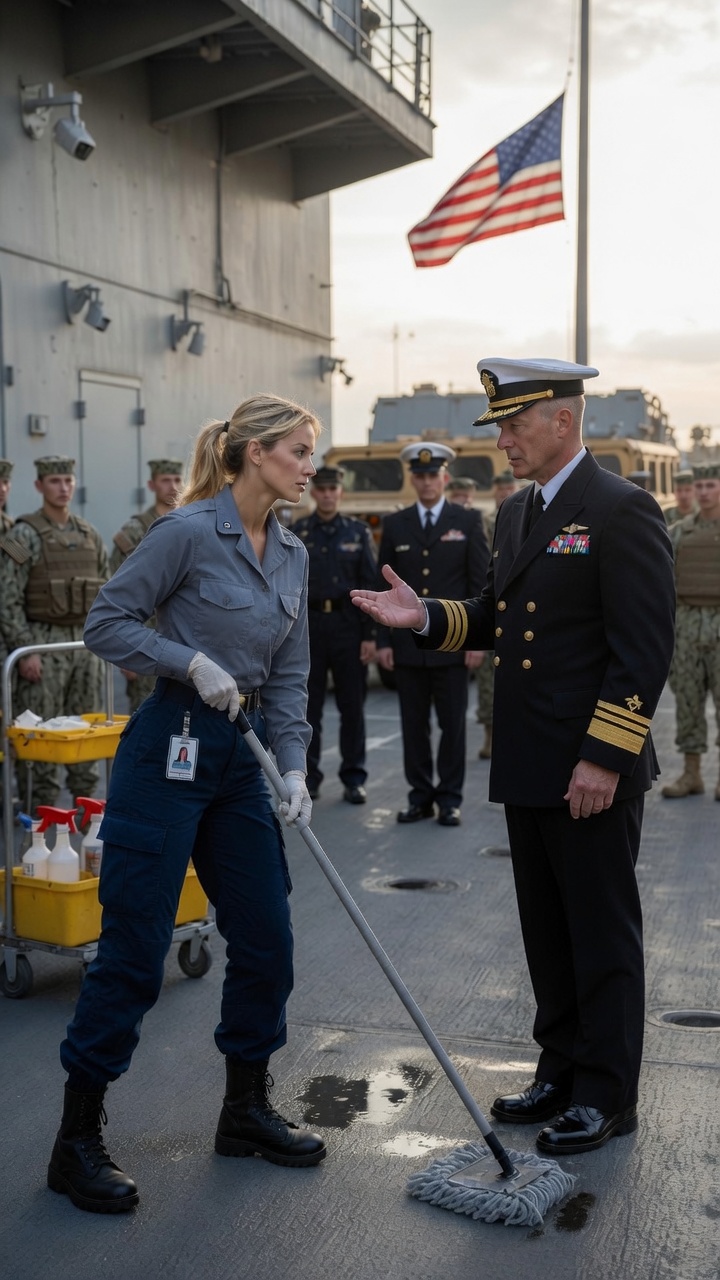
“Hey, sweetheart, what’s your call sign—Mop Bucket?”
Admiral Paul Hendricks said it loud enough for the whole corridor to hear.
Then he laughed like he had just dropped the best line in military history.
I kept the mop moving.
Left stroke.
Right stroke.
Pull back.
Check reflection in the polished floor.
Two officers behind him. One senior chief near the armory window. Three junior SEAL candidates trying not to laugh too hard because they still wanted promotions someday.
And one maintenance bucket sitting too close to my left boot.
Bad placement.
Lazy placement.
The kind of thing I noticed even when I was trying very hard to be nobody.
Hendricks stepped closer, his dress shoes stopping just outside the wet section.
He was broad, silver-haired, expensive-watch confident. A man who had spent so many years being obeyed that silence sounded like agreement to him.
“Come on,” he said. “Everybody here has a call sign. What’s yours?”
Commander Victoria Hayes smiled beside him.
Not a warm smile.
A career smile.
The kind a woman learns in male rooms when she decides survival means becoming sharper than the men who cut her.
“Maybe hers is Floor Wax,” Hayes said.
Lieutenant Park snorted.
Chief Rodriguez laughed the loudest.
The corridor gave them what they wanted.
Noise.
Attention.
A clean little public humiliation before lunch.
I dipped the mop into the gray water and wrung it out.
“Careful, Admiral,” someone said from near equipment checkout.
Master Sergeant Tommy Walsh.
Older. Quiet. Watching too closely.
I had noticed Walsh my first week at Little Creek. Not because he spoke much. Because he didn’t.
Men who had seen real combat didn’t waste oxygen trying to sound dangerous.
Hendricks glanced at him.
“Something you want to add, Sergeant?”
Walsh’s jaw shifted.
“No, sir.”
“Good.”
Hendricks turned back to me.
“Maintenance lady. You deaf?”
“No, sir,” I said.
My voice was flat.
Not scared.
Not angry.
Just there.
That seemed to disappoint him.
He wanted a reaction. A flinch. A cracked voice. Maybe tears he could later call “overly emotional.”
He wasn’t getting any of that.
Park pushed off the wall and pointed through the armory glass.
“Since you clean around our toys, maybe you can name them.”
He tapped the glass.
“Start there.”
I looked where he pointed.
“M4 carbine with ACOG optic. M16A4 with iron sights. HK416 with EOTech holographic sight.”
Park’s mouth stayed half open for a second too long.
Then he recovered.
“Lucky.”
“Sure,” I said.
Rodriguez stepped toward my bucket.
He was thick-necked and red-faced, the kind of man who used his body like punctuation.
“Let me guess,” he said. “You dated a Marine once and now you think you’re special.”
Then he kicked the bucket over.
Gray water spread across the floor.
A clipboard slid off the nearby counter, tipping toward the spill.
I moved without thinking.
My hand caught it six inches above the water.
Not grabbed.
Caught.
Clean.
Quiet.
The corridor stopped breathing.
The mistake was small.
Mine, I mean.
I had spent six months being invisible. Six months clocking in, mopping floors, cleaning training rooms, wiping down coffee spills from men who didn’t know what I had done in countries they could barely pronounce.
Six months of being Sarah Chen, civilian contractor, maintenance division.
And in one second, my hand told the truth.
Walsh saw it.
So did Commander Brooks, who had just walked in from the west entrance and frozen near the door.
Hendricks forced another laugh.
“Nice catch. Maybe we’ll put you on the softball team.”
I set the clipboard on the counter.
“Wouldn’t recommend it.”
Park narrowed his eyes.
“What does that mean?”
“It means I don’t play softball.”
Hayes’s smile tightened.
“Listen to that attitude.”
I picked up the fallen bucket.
Rodriguez’s boot had left a dirty smear on the side.
I looked at it.
Then at him.
Then back at the bucket.
That was all.
For some reason, he stepped back.
Admiral Hendricks noticed.
His pride did not like that.
“You have all-access clearance,” he said suddenly. “I saw your badge yesterday. Level Five.”
He held out his hand.
“Show me.”
I reached into my pocket and handed him the badge.
He didn’t look at the name first.
Men like that never did.
They looked for status.
Access.
Permission.
Proof that their instincts were right.
His thumb rubbed the magnetic strip.
“How does a janitor get Level Five?”
“Background check cleared.”
“That wasn’t my question.”
“It was my answer.”
A few junior sailors lowered their eyes.
Somebody muttered, “Damn.”
Hayes took the badge from Hendricks and studied it.
“Sarah Chen,” she read. “Maintenance contractor. Six months.”
She looked me up and down.
“Before that?”
“Previous employment.”
“What kind?”
“The previous kind.”
Park laughed once.
Not amused.
Annoyed.
Hendricks pointed toward the armory.
“All right, Miss Previous Employment. Since you know the names, explain the maintenance procedure for that M4.”
“You want the manual answer or the answer people use when sand gets into everything and the nearest clean table is a broken door?”
That killed the last of the laughter.
Hendricks blinked.
“Manual.”
“Barrel cleaned every two to three hundred rounds, more often in desert conditions. Bolt carrier group cleaned and lubricated at five hundred minimum. Inspect gas tube, don’t clean unless there’s malfunction. Buffer spring replacement around five thousand rounds or failure to return to battery. Magazine springs fail first. Rotate them before they embarrass you.”
Park’s face changed.
He knew those weren’t YouTube words.
He knew exactly where they came from.
Hendricks didn’t like losing the room.
So he did what arrogant men do when the floor moves under them.
He doubled down.
“Bring out the weapon.”
The armory sergeant hesitated.
“Sir, regulations—”
“I know the regulations.”
No, he didn’t.
He knew authority.
Different thing.
The sergeant cleared the M4, checked it twice, and placed it on the counter.
Hendricks turned to me.
“Let’s see what the help knows.”
I should have walked away.
I could have.
Civilian contractor. Not active duty. No obligation to perform circus tricks for insecure brass.
But Rodriguez was still smiling.
Park was still waiting for me to fail.
Hayes was looking at me like I represented every woman she had decided she was better than.
And Hendricks had called me sweetheart four times.
So I stepped forward.
The rifle came apart in my hands.
Upper.
Lower.
Bolt carrier group.
Firing pin.
Bolt.
Charging handle.
Buffer spring.
Everything laid out in order.
No wasted movement.
No drama.
Just muscle memory from places where slow hands got people killed.
Walsh checked his watch.
I saw him do it.
Then I reassembled the rifle.
Ten seconds and change.
The armory sergeant stared at the counter.
Park whispered, “That’s not possible.”
“It is,” I said. “You just don’t teach it that way.”
Hendricks’s face hardened.
He had gone too far to retreat and not far enough to win.
That is a dangerous place for a proud man.
Colonel Marcus Davidson arrived with three Pentagon observers behind him.
He took one look at the wet floor, the crowd, the weapon, and me in maintenance coveralls.
His expression went dead flat.
“What exactly is happening here?”
Hendricks straightened.
“Just a little professional development, Colonel.”
Davidson looked at the spilled water.
Then at Rodriguez.
Then at my badge in Hayes’s hand.
“Interesting. It looks like harassment with witnesses.”
No one laughed.
Hendricks’s jaw worked.
“Miss Chen here has unusual qualifications.”
Davidson turned to me.
“Name and position.”
“Sarah Chen. Maintenance crew. Six months on base.”
“And the weapons handling?”
“Previous employment, sir.”
“What previous employment?”
“I’d prefer not to discuss it.”
Rodriguez seized his chance.
“Sounds like stolen valor to me.”
The words landed harder than sweetheart.
I looked at him.
This time, I let him see a little.
Not much.
Just enough.
His throat moved when he swallowed.
Davidson folded his arms.
“Call security. Pull her file.”
Hendricks smiled again.
He thought the room was coming back to him.
He thought paperwork would do what mockery hadn’t.
He thought my silence meant I had something to hide.
He was right about that.
But not in the way he wanted.
Security arrived ten minutes later with a tablet and a confused senior chief.
“Sir,” the senior chief said, scrolling. “Her certifications are current.”
Hendricks frowned.
“What certifications?”
“Weapons handling. Tactical medical. Combat driving. Close-quarters combat. SERE. Advanced survival. Language clearance. Restricted area access.”
Park stared at me.
Hayes stopped smiling.
Davidson took the tablet.
“This is an operator qualification sheet.”
Rodriguez snapped, “Then where’s the service record?”
The senior chief scrolled again.
“Not listed, Chief.”
“Convenient.”
“Not convenient,” I said. “Classified.”
That word changed the temperature in the corridor.
Hendricks heard it too.
For half a second, some intelligent part of him tried to save him.
He ignored it.
“Combat simulation range,” he said.
Davidson looked at him.
“Admiral.”
“If her file says she’s qualified, she can demonstrate. If she can’t, we file a report.”
“And if she can?”
Hendricks smiled without humor.
“Then I’ll be impressed.”
I looked at the floor.
At the mop.
At the dirty water drying under fluorescent lights.
Then I looked at him.
“Sure.”
Walsh closed his eyes like he had just heard a grenade pin drop.
PART 2 — THE RANGE WENT QUIET FIRST
“They brought me to the range to embarrass me, and within three minutes, the men recording on their phones stopped recording.”
That was the first smart thing any of them did all morning.
The observation gallery filled fast.
SEAL candidates.
Instructors.
Admin staff.
Contractors pretending they had walked in by accident.
Word travels fast on a military base when an admiral decides to turn a maintenance worker into entertainment.
The range master, Senior Chief Kowalski, looked at me once and stopped treating me like a joke.
Good.
At least one man in the building had working eyes.
Hendricks waved toward the weapons table.
“Choose.”
I walked past the M4s.
Past the pistols.
Past the rifles selected for normal demonstrations.
Then I stopped at the secure locker.
Kowalski raised one eyebrow.
“Ma’am?”
“May I?”
He opened it.
I lifted the Barrett M82A1.
Twenty-nine pounds unloaded.
Park laughed.
“That thing weighs more than you do.”
“Then it should feel motivated.”
A few people in the gallery made noises they tried to hide as coughs.
I went prone.
Shoulder set.
Cheek weld.
Breath slow.
The rifle settled into my body like an old argument.
“Eight hundred meters,” Hendricks said.
Generous, he thought.
Cruel, he meant.
I waited for the wind to tell the truth.
Then I fired.
The target center blew open.
Kowalski checked the scope.
“Dead center.”
No one moved.
Hendricks said, “Twelve hundred.”
Three more rounds.
Three more hits.
By the third shot, Hayes had gone pale.
Park looked angry, which was better than smug.
Rodriguez looked like he had just realized the animal he poked had teeth.
“Pistol drill,” Hendricks snapped.
Kowalski set three targets.
Mozambique pattern.
Two center mass.
One head.
SEAL standard: three seconds.
I picked up the M9.
Checked it.
Loaded.
Waited.
“Go.”
Nine shots cracked so fast they sounded stitched together.
Timer: 0.9 seconds.
Someone whispered, “No way.”
I set the pistol down.
“Your timer works.”
Then came the kill house.
Room clearing.
Civilian targets.
Hostile targets.
Bad angles.
Tight corners.
Their little box of plywood and sensors.
I cleared it in forty-one seconds.
The base record was fifty-seven.
But the time wasn’t what scared them.
It was the movement.
Because I didn’t move like a SEAL.
I didn’t move like Army.
I moved like the kind of unit people mentioned once, then checked the door.
Davidson watched the replay three times.
“Who are you?” Hayes asked.
I wiped carbon off my thumb with a paper towel.
“Still Sarah.”
The PA system crackled.
“Medical emergency. CQB training area. All qualified personnel respond.”
Rodriguez looked almost pleased.
Too pleased.
That told me everything.
PART 3 — THE FAKE EMERGENCY EXPOSED THE REAL COWARD
“Chief Rodriguez staged a medical emergency because humiliating me once wasn’t enough.”
The fake patient was on the floor when we arrived.
Young SEAL candidate.
Sweating too much.
Breathing too loud.
Clutching his chest like he had learned trauma symptoms from a bad network drama.
“Possible tension pneumothorax,” Rodriguez barked.
He looked at me.
“Since you’re qualified, fix him.”
Dr. Emily Bradford rushed in with a trauma kit.
I knelt beside the candidate.
His name tape said COLLINS.
His eyes flicked to Rodriguez.
There it was.
Fear.
Not pain.
I checked his chest rise.
Symmetrical.
Trachea midline.
Pupils normal.
Skin warm.
Pulse elevated, but not shock elevated.
Guilty elevated.
Bradford handed me a needle.
“Fourteen gauge.”
I took it.
Rodriguez leaned forward.
So did Park.
So did Hendricks.
They wanted me to perform an invasive procedure on a healthy man.
Then they could call it assault.
Fraud.
Reckless endangerment.
Maybe even criminal conduct.
It was ugly.
It was also sloppy.
I looked at Collins.
“Stand up.”
He kept panting.
“I can’t.”
“Stand up.”
My voice changed.
Not louder.
Lower.
Command voice.
The one that moves people before they decide to move.
Collins stood.
Perfectly healthy.
The room stared at him.
I handed the needle back to Bradford.
“Bad acting.”
Rodriguez’s face flushed.
“I don’t know what you think—”
“Real tension pneumothorax presents with tracheal deviation. He doesn’t have it. Real patients don’t clutch both sides of their chest like they’re posing for a CPR poster. His pupils are normal. His breathing is staged. He looked at you before answering me.”
Collins stared at the floor.
Bradford turned on Rodriguez.
“You created a false medical emergency?”
Rodriguez said nothing.
That was the first honest thing he had done all day.
Before anyone could bury him properly, the radio on Davidson’s shoulder came alive.
“All section heads report to main briefing room. General Robert Thornton arriving for surprise inspection.”
Hendricks cursed under his breath.
Perfect timing.
Or terrible timing.
Depends who you ask.
He pointed at me.
“My office. Fifteen hundred. You’ll explain everything.”
“With respect, Admiral, I don’t report to you.”
His nostrils flared.
“Then consider it a request from the man who can end your contract.”
I nodded once.
“Fifteen hundred.”
Walsh caught me near the corridor.
“Ma’am.”
I stopped.
“You might want JAG present.”
“I’m civilian.”
“That won’t stop them from trying something stupid.”
I looked at him properly for the first time.
His face had old war carved into it.
“Thank you, Sergeant.”
He lowered his voice.
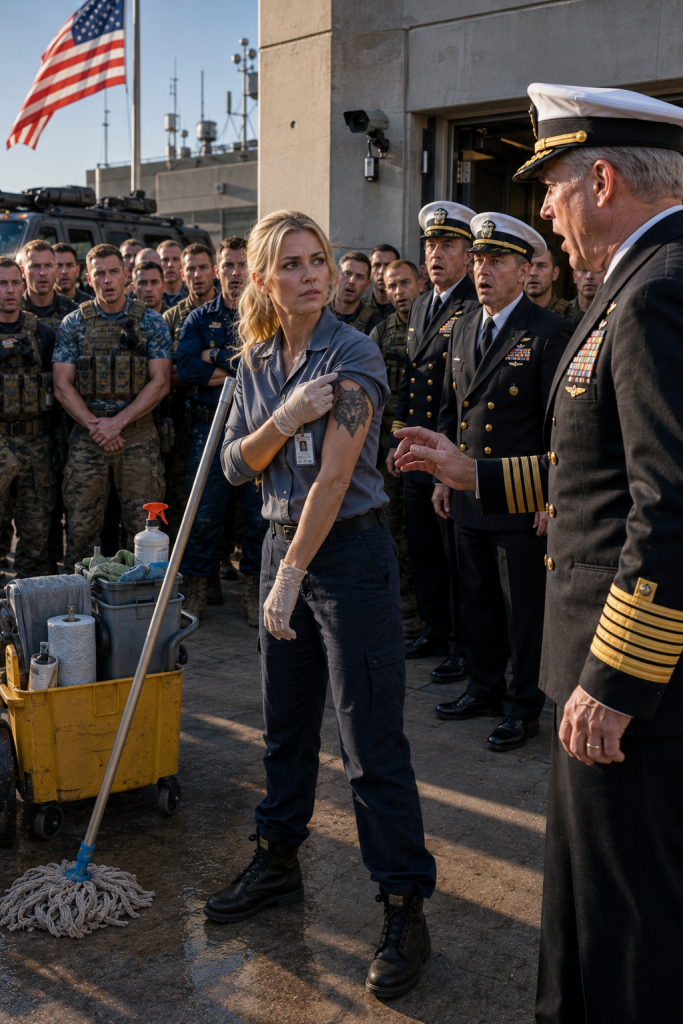
“That tattoo near your shoulder. Saw it when your collar shifted. That’s not random, is it?”
I held his eyes.
“I need to get back to work.”
At fifteen hundred, I walked into Hendricks’s office in clean maintenance coveralls.
He sat behind a desk big enough to land a helicopter on.
Hayes stood beside him.
Davidson was near the window.
Park by the door.
Rodriguez in the corner, pretending he still had power.
“Sit,” Hendricks said.
“I’ll stand.”
“That wasn’t a request.”
“I’m not active duty.”
His mouth tightened.
He hated being reminded of limits.
“All right, Miss Chen. Let’s make this simple. Who trained you?”
“Previous employment.”
Hayes folded her arms.
“That answer is getting old.”
“So is this meeting.”
Park looked away fast.
Hendricks leaned forward.
“I think you washed out of something. Maybe couldn’t handle pressure. Maybe got kicked loose and now you mop floors on a base so you can feel close to real operators.”
There it was.
The cheap theory.
Men like him always needed your life to fit inside their contempt.
Rodriguez added, “Stolen valor is a crime.”
“Then call legal.”
My phone buzzed.
I glanced down.
Papa: Proud of you.
Three words.
That almost broke my control more than any insult had.
Almost.
Chief Warrant Officer Kim burst in before Hendricks could speak.
“Sir. I ran the deep background check.”
Hendricks snapped, “And?”
Kim’s face had no color.
“There’s a problem.”
“What problem?”
“The file is classified. Above my access. General Thornton authorized a partial pull when he heard what was happening.”
Davidson straightened.
“I have clearance. Give it here.”
Kim handed him the tablet.
Davidson read.
His face changed once.
Then again.
Then the hand holding the tablet started shaking.
Hendricks stood.
“What does it say?”
Davidson didn’t answer him.
He looked at me.
“Your father was Richard Chen.”
I stayed still.
Davidson’s voice dropped.
“Fallujah. November 2004. He was my platoon sergeant.”
That hit harder than the rifle recoil.
Papa never mentioned Davidson.
Or maybe he had, on a day his memory held.
Hayes stepped closer.
“Colonel, what is it?”
Davidson turned the tablet.
The red classification banner filled the top of the screen.
Below it:
CHEN, SARAH.
CAPTAIN, UNITED STATES MARINE CORPS.
FORCE RECONNAISSANCE.
The office went silent.
Park whispered, “Captain?”
Rodriguez backed into the wall.
Hendricks stared at the file like it had insulted his mother.
“That’s impossible.”
I looked at him.
“Which part?”
He didn’t answer.
Hayes read down the page.
Mission history.
Twelve years.
Seventy-three successful operations.
Locations redacted.
Commendations stacked so deep the scroll bar looked ridiculous.
Navy Cross.
Bronze Star.
Purple Hearts.
Citations most people in that office didn’t have clearance to pronounce.
Then the line that always made rooms go quiet.
STATUS: KIA PRESUMED, HELMAND PROVINCE, AUGUST 2019.
Park said, “It says you’re dead.”
“Presumed dead.”
“That’s different?”
“Very.”
I kept my voice even.
“They didn’t find my body. I spent forty-seven days behind enemy lines before I made it to friendly forces.”
No one spoke.
Outside the office window, a group of sailors crossed the parking lot carrying Starbucks cups and laughing about something normal.
Inside, five people had just learned they had spent the day mocking a classified operator declared dead by the Marine Corps.
Davidson scrolled lower.
His jaw clenched.
“Voluntary retirement. Compassionate grounds.”
Kim nodded quietly.
“Her father suffered traumatic brain injury complications in 2020. Captain Chen requested retirement to become his full-time caregiver. Current employment selected due to proximity to Portsmouth Naval Medical Center.”
Now they understood.
I wasn’t hiding because I was ashamed.
I wasn’t hiding because I was fake.
I was mopping floors because the base was twelve minutes from my father’s hospital and fifteen minutes from our apartment.
Because his specialist appointments were twice a week.
Because on bad days, he forgot I was his daughter.
Because on good days, he remembered everything and apologized for needing help.
Hendricks sat down slowly.
“Captain Chen, I—”
A knock cut him off.
A junior officer stepped in.
“General Thornton requests Admiral Hendricks, Colonel Davidson, and Captain Chen in the main briefing room immediately.”
Hendricks flinched at my rank.
Good.
He needed to hear it a few more times.
The walk to the briefing room was worse than the office.
Word had spread.
Of course it had.
The maintenance woman was Force Recon.
The joke had a Navy Cross.
The mop lady was Night Fox.
I hated that last part.
That name had been buried for a reason.
At the briefing room entrance, personnel stopped talking when they saw me.
Some stood at attention.
Some saluted.
Some looked ashamed enough to be useful later.
General Robert Thornton stood at the head of the table.
Two-star.
Weathered face.
Combat eyes.
When I entered, he came to attention and saluted first.
That gesture landed like a rifle shot.
I returned it.
“Captain Chen,” he said. “It’s an honor.”
“Sir.”
He turned to Hendricks.
The temperature dropped.
“I reviewed the reports. Witness statements. Range footage. Security video. The staged medical incident.”
Rodriguez’s face went gray.
Thornton continued.
“Admiral, you publicly mocked a civilian employee doing her job. You questioned her credentials without cause. You forced demonstrations that exposed classified capabilities in front of dozens of personnel, several of whom recorded the event.”
Hendricks swallowed.
“Sir, I didn’t know—”
“No. You didn’t care.”
That one landed.
Thornton looked around the room.
“Captain Chen’s identity was protected for operational reasons. Operators at her level have enemies with money, patience, and intelligence networks. Her real name, face, and location should not have been turned into base gossip because an admiral wanted a laugh.”
Hendricks stared at the table.
Thornton clicked a remote.
My file appeared on the secure screen.
More redactions than text.
“Call sign remains classified.”
Too late.
Someone had already said it in the hall.
Someone always does.
Thornton’s voice sharpened.
“Chief Rodriguez, you staged a fake medical emergency designed to trap Captain Chen into performing an invasive procedure on a healthy candidate. You physically harassed her earlier. You conducted unauthorized background inquiries. Security will escort you to quarters pending formal proceedings.”
Rodriguez looked at me.
“I didn’t know.”
I said, “You didn’t care.”
Security took him out.
No speech.
No forgiveness theater.
Just consequences.
Thornton turned back to the table.
“Admiral Hendricks. Base-wide apology tomorrow at zero eight hundred. Formal leadership review. Mandatory respectful command training. Your promotion file will be flagged pending investigation.”
Hendricks looked like his expensive watch had stopped ticking.
“Commander Hayes. Same formation. Written apology. Personnel file entry.”
Hayes nodded, pale.
“Yes, sir.”
“Lieutenant Park. You will assist Captain Chen if she accepts an instructor position. Consider it remedial education.”
Park nodded.
“Yes, sir.”
Then Thornton turned to me.
“We need to discuss your future, Captain.”
“My father comes first.”
“I know.”
“Then there’s nothing to discuss.”
“There may be one option.”
I waited.
“Advanced tactics instructor. Here. Flexible hours. Official status. Proper pay. Your father’s care remains priority. Your presence becomes normalized instead of suspicious. You teach. You don’t deploy.”
For the first time that day, I had no immediate answer.
Teaching meant visibility.
Visibility meant risk.
But hiding was already over.
And maybe the next kid in a kill house could learn something that kept him alive.
Thornton said, “Take twenty-four hours.”
I said, “I’ll take twelve.”
He almost smiled.
“Of course you will.”
PART 4 — THE APOLOGY COST HIM MORE THAN HIS PRIDE
“The next morning, the admiral had to apologize to me in front of eight hundred people, and not one of them laughed.”
The parade ground was bright under the Virginia sun.
Rows of uniforms.
Boots aligned.
Faces forward.
The kind of formation that makes a base feel larger than itself.
I stood off to the side in Marine Corps utilities for the first time in over a year.
Captain bars on my collar.
Name tape: CHEN.
It felt strange.
Not wrong.
Just heavy.
Hendricks stepped to the podium.
He looked like a man walking into his own court hearing.
“Yesterday,” he began, “I failed as a leader.”
Good start.
Short.
Useful.
“I mocked a civilian employee based on her job and appearance. I made assumptions. I created a hostile environment. I pressured her to prove credentials she had no obligation to prove.”
His voice tightened.
“That employee is Captain Sarah Chen, United States Marine Corps, retired. Force Reconnaissance. Twelve years of distinguished service. Seventy-three successful operations. Multiple combat decorations.”
The formation did not move.
But the silence changed.
It gained weight.
“Captain Chen took a maintenance job here to remain near her father, retired Master Sergeant Richard Chen, who requires specialized medical care. She owed me nothing. I owed her basic respect. I failed to give it.”
He turned toward me.
“Captain Chen, I offer my sincere apology. My conduct was inexcusable.”
I saluted.
He returned it.
His hand shook slightly.
Hayes took the podium next.
She looked smaller than she had yesterday.
Not weak.
Just stripped of performance.
“I spent my career fighting to be taken seriously in rooms where men assumed I didn’t belong,” she said. “Yesterday, the moment I had authority, I used it against another woman.”
That line moved through the ranks without sound.
“I questioned Captain Chen’s legitimacy. I joined the mockery. I became the kind of officer I used to hate.”
She faced me.
“I’m sorry.”
I returned her salute too.
Not because she deserved comfort.
Because accountability should be met cleanly when it finally shows up.
Thornton stepped forward.
“Captain Chen has accepted an advanced tactics instructor position at Little Creek.”
That got a reaction.
Not disorder.
Energy.
A shift in posture.
Young operators standing a little straighter.
Old instructors exchanging looks.
Thornton continued.
“Those selected for her courses will receive training from someone whose experience cannot be simulated, purchased, or faked. Consider it an honor. Also, consider it a warning.”
A ripple of restrained laughter moved through the formation.
I took the podium.
Eight hundred faces looked back.
Some curious.
Some ashamed.
Some already building a legend in their heads.
I shut that down.
“Forget what you heard about me.”
That got their attention.
“Legends get people killed. Ego gets people killed faster. I’m not here to entertain you, impress you, or tell war stories over burnt coffee.”
A few people smiled.
“I’m here to teach survival when the plan fails. And it will fail. Equipment breaks. Intel lies. Weather changes. Good people bleed. When that happens, your rank will not save you. Your favorite motivational quote will not save you. Training might.”
I looked toward the instructors.
“All personnel matter. Maintenance. Medical. Admin. Security. Operators. The person you ignore may be the person who saves your life.”
I stepped back.
No big finish.
No swelling speech.
Just the truth.
Three weeks later, I stood in a training facility facing twenty candidates who looked at me like I might make them run through a wall.
I did not.
Walls are expensive.
“First rule,” I said. “Stop trying to look dangerous.”
A few blinked.
“If you need strangers to know you’re dangerous, you’re not disciplined. You’re advertising.”
Morrison, one of the new SEAL graduates, raised his hand.
“Ma’am, is it true you survived forty-seven days alone in Helmand?”
“Yes.”
The room tightened.
He hesitated.
“How?”
“By not doing anything stupid for forty-seven days.”
That got a laugh.
Good.
Fear blocks learning.
A little humor opens the door.
I pulled up a terrain map.
“Bad intel. Ambush. Team down. I was mobile. I had two choices: die trying to make a heroic mess, or survive long enough to report what happened and get names back to families.”
No one smiled now.
“I chose survival.”
I showed them the valley.
The dry riverbed.
The patrol routes.
The terrain that cut boots apart.
“Week one, I moved only at night. Week three, I had an infected shrapnel wound. No antibiotics. Used honey and cloth. Old field medicine. Ugly but effective.”
A candidate whispered, “Jesus.”
“Not part of the kit,” I said. “Don’t rely on him for wound care.”
That broke the tension again.
Then I let it settle.
“I survived because I kept thinking. Panic kills. Ego kills. Shame kills. Training gives you a second thought when your first one is fear.”
Park stood at the back of the room.
My assistant instructor.
He had changed since the corridor.
Less mouth.
More notebook.
Humility looked decent on him.
After class, he stayed behind.
“Captain.”
“Lieutenant.”
“I wanted to say again—”
“Don’t.”
He stopped.
“I was wrong.”
“Yes.”
“I was cruel.”
“Yes.”
“I’m trying to be better.”
“Good. Keep doing that. Quietly.”
He nodded.
That became our rhythm.
He learned.
I taught.
Hayes coordinated schedules, security, and medical flexibility for my father.
At first, every conversation between us was made of broken glass.
Then one afternoon she showed up with black coffee, no sugar, and my father’s updated appointment packet already printed.
“I checked with Portsmouth,” she said. “They moved his therapy to Tuesday. Your Thursday class stays intact.”
I took the folder.
“Thank you.”
She nodded.
No speech.
Better.
Rodriguez went to court-martial.
Dishonorable discharge.
Loss of rank.
Loss of pension eligibility.
His career ended in a room with beige walls and no applause.
He apologized again before they escorted him out.
“I really didn’t know who you were,” he said.
I looked at his civilian clothes.
“That was never the charge.”
Davidson visited my father every week.
On good days, Papa remembered Fallujah.
On bad days, he thought Davidson was still a young lieutenant and told him to clean his rifle.
Davidson always said, “Yes, Sergeant.”
No correction.
No pride.
Just respect.
Five months after the corridor, I got the call.
Encrypted phone.
Unknown operator.
Priority Alpha.
I stepped into an empty office.
“Chen.”
A distorted voice answered.
“Night Fox, this is Phantom Actual. We have three operators missing in hostile territory. We know you’re retired. We’re asking.”
“No.”
A pause.
“You haven’t heard the details.”
“I heard enough.”
“One of them is Park.”
My hand tightened around the phone.
The office seemed to shrink.
“Say again.”
“Lieutenant James Park. Syria. Wounded, mobile, trapped inside a converted monastery. Hostile forces closing. He has intelligence that cannot be captured.”
Park.
The arrogant lieutenant from the corridor.
The assistant instructor who had stayed late for three months relearning things he thought he already knew.
The student who had become useful.
The man who had apologized with actions instead of speeches.
“What do you need from me?”
“You infiltrated that compound in 2017. There’s a cliff route only you know. No active operator fits the physical profile or has the route knowledge.”
“I’m not available for field deployment.”
“Extraction probability without you is nineteen percent. With you, sixty-eight.”
I looked through the glass wall at the training mats.
Morrison was correcting a candidate’s footwork.
Walsh stood nearby with coffee.
Hayes was arguing into a phone, probably making some bureaucrat regret waking up.
My new life.
Hard-earned.
Fragile.
Mine.
Then I thought of Park in the dark with a wound and a clock running down.
“I’ll provide tactical briefing,” I said. “Remote support. Full route analysis. Candidate recommendations.”
“We need you on site.”
“No. You need the route. You need the plan. You need people I trained.”
The silence stretched.
“Are you refusing recall?”
“I’m refusing panic disguised as strategy.”
Another pause.
Then the voice changed.
Less machine.
More human.
“Who do you recommend?”
“Morrison. Walsh if cleared. Chen from Force Recon, no relation. Rodriguez from SEAL Team Three, no relation to the idiot.”
“Risk assessment?”
“High. Viable. Better than sending me cold after a year off technical climbing.”
“You’re sure?”
“I’m not guessing.”
The order came down two hours later.
Consultation approved.
No forced deployment.
My team flew without me.
I spent thirty-six hours in a secure room walking them through stone cracks, drainage cuts, blind angles, old guard habits, and the part of the cliff face that looked impossible until you put your left hand where the rock dipped inward.
Morrison called before wheels up.
“Ma’am.”
“Don’t make a speech.”
“Yes, ma’am.”
“Bring him home.”
“Yes, ma’am.”
They did.
Park came back with a leg wound, two cracked ribs, and the intelligence drive taped under his body armor.
When he saw me at Walter Reed, he tried to stand.
I pointed at him.
“Do that and I’ll break the other leg.”
He sank back.
“Yes, ma’am.”
He looked thinner.
Older.
Alive.
“I heard you refused to come get me personally,” he said.
“I sent better climbers.”
He laughed once, then winced.
“Fair.”
His face shifted.
“Thank you.”
“Get better. Your paperwork is ugly.”
Two weeks later, Papa died in his sleep.
I was beside him.
His hand in mine.
No dramatic final sentence.
No movie moment.
Just one breath.
Then no next one.
The funeral at Arlington was full military honors.
General Thornton spoke.
Davidson stood stiff beside me.
Walsh, Morrison, Hayes, Park, Bradford, and half my class came in dress uniforms.
The folded flag was placed in my hands.
Heavy.
Precise.
Final.
After everyone left, I stayed by the headstone until the sun dropped behind rows of white marble.
Walsh found me there.
He didn’t say anything.
That helped.
Eventually, I said, “He was proud, right?”
Walsh looked at the grave.
“He bored me for two hours telling me you were the best Marine he ever knew.”
I almost smiled.
“That sounds like him.”
“He was wrong about one thing, though.”
I glanced over.
“He said you didn’t know how to rest.”
“Still true.”
“Then learn it like a skill.”
For once, I had no comeback.
PART 5 — NIGHT FOX DID NOT DISAPPEAR
“Six months after the admiral called me Mop Bucket, his name was gone from command, and mine was on the toughest course at Little Creek.”
Hendricks was reassigned pending retirement.
Not promoted.
Not celebrated.
Just quietly removed from the kind of authority he had mistaken for character.
Hayes stayed.
Better than that, she changed.
Park returned to training with a limp and no arrogance left to spare.
Rodriguez, the chief who staged the fake emergency, left the Navy with nothing but a cheap suit and a lesson he learned too late.
As for me, I kept teaching.
Not because I needed applause.
Not because I missed war.
Because knowledge sitting unused is just another kind of waste.
Every morning, I walked past the same corridor where it started.
The floor stayed clean.
The mop bucket was gone.
Someone had replaced the old security camera too.
Good.
The new one had better resolution.
One Friday, a young candidate asked, “Captain Chen, what does Night Fox mean?”
The room went still.
I looked at him.
“It means somebody once asked a stupid question and lived long enough to regret it.”
The class laughed.
I didn’t.
Not at first.
Then I let myself smile.
Small.
Real.
Mine.
That night, I drove to Arlington with a black coffee and no flowers because Papa hated flowers at military graves.
“Waste of money,” he used to say. “Bring coffee. At least coffee has a mission.”
I sat beside his headstone and told him about class.
About Park walking again.
About Morrison earning top marks.
About Hayes becoming the kind of officer younger women could actually trust.
Then I told him the truth.
“I’m not hiding anymore.”
The wind moved over the rows of marble.
No answer.
I didn’t need one.
I stood, brushed grass from my pants, and walked back to my truck.
Behind me was the past.
Ahead was the base, the students, the work, the life I had chosen.
Not quiet.
Not easy.
Mine.
And if some powerful man ever mistook silence for weakness again, that was his problem.
Not mine.