Signature: Cqv63GnbyfUBu6vRfSvdXhWPrACxhPvo7ey54eKfVa23Nv3qOmHVFY6sGVn6YTlwc3n2pQp9d7afNhFt0sDImSOyuRgdfWkuKmeg8cOPKVOhokgZUPvIqqmSBVlfbDr2pcIkRIzbflCqn+ceo5DB30iA2cj8pw9BfZt7gFHeUclqR1OCxQ928j8t6R6lBviETf6Sf8DQopGyJthRbnqNmQ==
PART 2
I did not make the call right away.
For a long moment, I stood in the upstairs bedroom with my phone in my hand, listening to my parents’ laughter drift up through the floorboards.
That laughter was the sound of my childhood.
It had followed me through birthdays where my father corrected the way I held a fork, through dinners where my mother smiled at guests and criticized me once they left, through every moment I had mistaken control for love.
But downstairs, they were not laughing because they were happy.
They were laughing because they believed they had won.
I looked toward the empty crib beside the bed. Giselle had painted small yellow stars around its wooden frame while I was overseas. She had sent me pictures, one star at a time, saying she wanted Hazel to sleep beneath a sky her father could still see.
Now the crib was empty.
My wife and daughter were in an ambulance because the people who raised me had decided pride mattered more than a baby’s life.
My thumb hovered over the investigator’s number.
Then I heard footsteps.
My father appeared in the doorway without knocking.
“You always did like dramatic entrances,” he said.
I slid the folder closed.
His eyes flicked toward it.
“What’s that?”
“Insurance.”
He smiled thinly. “Against what?”
“People who mistake silence for weakness.”
For the first time that night, his expression shifted.
Not fear. Not yet.
Recognition.
He stepped into the room and lowered his voice. “Whatever she told you, she’s lying.”
“Giselle barely had the strength to speak.”
“She’s clever. Women like her always are.”
I stood slowly.
He stopped talking.
The man who had seemed enormous when I was a boy suddenly looked old in the yellow bedroom light. His hair was thinner than I remembered. His shoulders curved inward. But his eyes were the same: cold, calculating, always measuring the room for advantage.
“You forged my signature,” I said.
His jaw tightened.
“You moved money from my deployment account. You transferred shares from the company trust. You changed the locks on a house my grandfather left in my name.”
He stared at me.
Downstairs, my mother called, “Robert?”
Neither of us answered.
My father swallowed, then forced a laugh. “You don’t understand how family business works.”
“No,” I said quietly. “I understand exactly how yours works.”
He moved toward the folder.
I picked it up first.
“You should go downstairs.”
“You think paperwork makes you powerful?”
“No,” I said. “Truth does.”
His face hardened.
Then the doorbell rang.
Once.
Sharp and clear beneath the noise of the storm.
My mother’s voice rose with annoyance. “Who in the world is that?”
I walked past my father and down the stairs.
Two sheriff’s deputies stood on the porch, snow collecting on their hats. Behind them, red and blue lights pulsed across the white driveway.
“Staff Sergeant Mercer?” one asked.
“Yes.”
“We received the hospital report. We need to ask a few questions.”
My mother appeared behind me. “This is a family misunderstanding.”
The deputy looked past her at the warm house, then at the suitcases still half-buried near the porch.
His expression changed.
“Ma’am,” he said, “please step back.”
My father came down slowly.
For once, he said nothing.
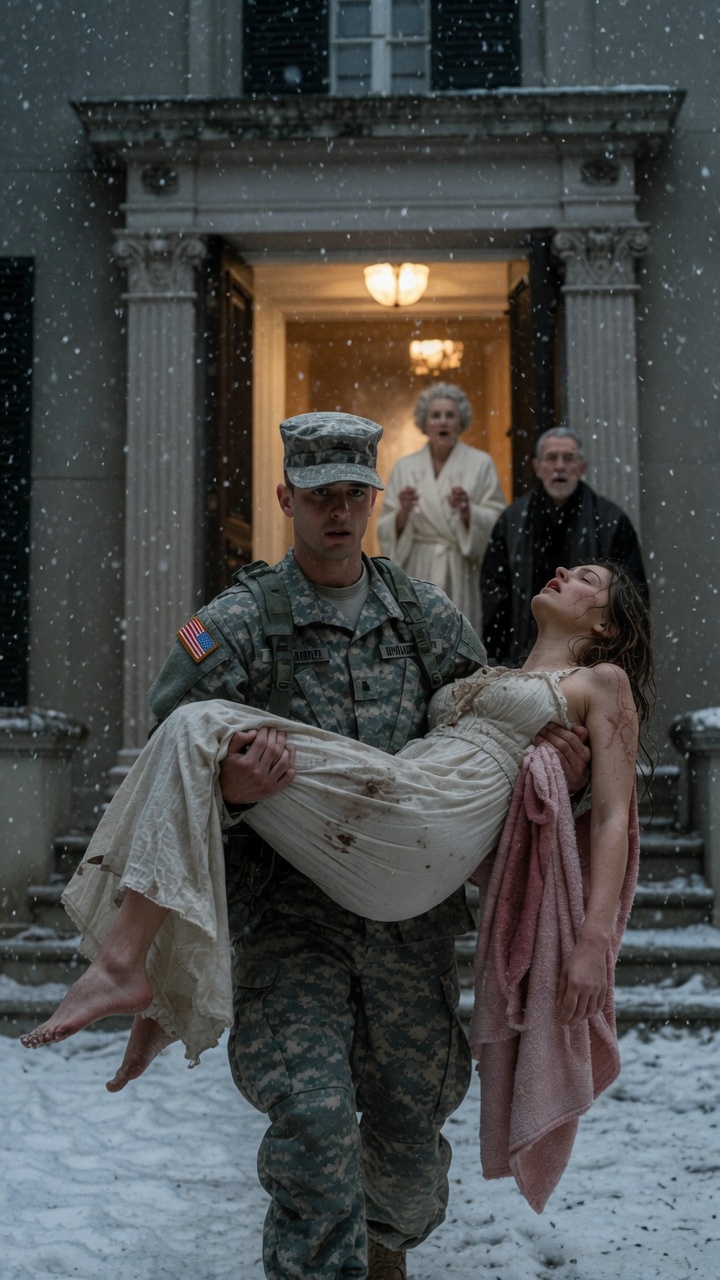
I gave the deputies the basic facts. I kept my voice steady. I told them when I arrived, where I found Giselle, how Hazel had been wrapped beneath her coat. I said I wanted to go to the hospital as soon as possible.
The younger deputy asked my parents why Giselle and the baby had been outside.
Mother pressed her lips together. “She chose to leave.”
“In a blizzard?” he asked.
“She was being dramatic.”
The deputy glanced toward the suitcases. “With an infant?”
My father finally spoke. “Officer, my daughter-in-law has emotional episodes. My son has been overseas and doesn’t know what she’s been like.”
I turned to him.
He looked satisfied, as if he had placed the first brick of a wall.
But walls built on lies crack quickly.
I reached into the folder and removed a small envelope. Inside was a printed copy of a message my mother had sent Giselle three days earlier.
I handed it to the deputy.
He read it silently.
Then he read aloud, “Pack whatever belongs to you. When Dylan returns, he can decide whether he wants a real family or the mistake he married.”
My mother’s face paled.
“That was private.”
“So was our bank account,” I said.
The deputies exchanged a glance.
The older one asked, “Do you have somewhere to go tonight?”
“The hospital,” I said. “After that, a hotel.”
“No need.” A voice came from the porch.
A woman stepped into the light, pulling back the hood of a navy parka.
She was in her sixties, with silver hair tucked beneath a knit cap and eyes sharp enough to cut through weather.
“Evelyn?” my father said.
My aunt Evelyn, my father’s older sister, looked at him as though she had waited years for this moment and still found it disappointing.
“I got Dylan’s message,” she said. “And the investigator’s.”
My father went still.
My mother whispered, “You involved her?”
“I involved anyone who still remembered the truth,” I replied.
Evelyn looked at the deputies. “The house belongs to Dylan. I have copies of the original deed, trust documents, and my father’s will.”
My father’s face turned gray.
“You had no right,” he said.
Evelyn stepped inside, snow melting from her boots onto my mother’s polished floor.
“I had every right. Dad gave me the second set of records because he never trusted you.”
The room seemed to shrink.
All my life, my father had told me my grandfather left everything to him because he was the responsible son. He told me Evelyn had been bitter, jealous, unstable. I had believed him because children believe the person who controls the story.
Evelyn reached into her bag and handed me a folder.
“I’m sorry I didn’t come sooner,” she said. “I thought you knew more than you did.”
I wanted to answer, but my throat tightened.
For years, I had thought I was alone in noticing the strange gaps in our family history. The missing photographs. The arguments that ended when I entered the room. My father’s anger whenever Grandpa’s name came up.
Now every silence had a shape.
The deputies took statements. My parents answered less and less. My mother sat on the sofa with her wine untouched. My father stood near the fireplace, staring at nothing.
Then my phone rang.
The hospital.
I answered before the second ring.
A nurse told me Giselle and Hazel were stable. Cold, exhausted, frightened, but stable. They wanted me there.
Those words nearly broke me.
I thanked her, ended the call, and faced the room.
“I’m going to my family.”
Mother looked up sharply. “Dylan, wait.”
I paused.
Her voice softened, the way it used to when she wanted forgiveness without apology.
“You don’t understand how lonely it was while you were gone. Giselle shut us out. She kept the baby from us.”
“She sent pictures every week.”
“She made us feel like strangers.”
“You made her feel unsafe.”
Mother’s eyes filled with tears. Once, that would have pulled me back. I would have stepped toward her, offered comfort, tried to repair what she had broken.
This time I only said, “You left Hazel outside.”
Her tears stopped.
Not because the truth hurt.
Because she realized it still mattered.
Evelyn drove me to the hospital because my hands were shaking too badly to hold the wheel. The storm swallowed the road in white sheets. Neither of us spoke for several miles.
Finally, she said, “Your grandfather knew Robert would try something someday.”
“Why didn’t he tell me?”
“You were eighteen when he died. He thought protecting you meant keeping you out of the fight.” She sighed. “Sometimes love hides the truth and calls it mercy.”
I looked out at the dark trees bending beneath snow.
“What else did he hide?”
Evelyn tightened her grip on the steering wheel.
“That’s a longer story.”
At the hospital, Giselle was asleep when I entered the room. Hazel lay in a clear bassinet beside her, wrapped in warm blankets, her cheeks pink again.
I touched the edge of the bassinet.
My daughter opened her eyes.
They were wide and dark, solemn in the way babies sometimes look, as if they remember something adults have forgotten. Her tiny hand curled around my finger.
Everything inside me went quiet.
“Hi, Hazel,” I whispered. “I’m home.”
Giselle stirred.
When she saw me, tears filled her eyes.
“I tried to keep her warm,” she whispered.
“I know.”
“I called you, but the phone died.”
“I know.”
“I didn’t think you would get there in time.”
I bent and kissed her forehead.
“I should’ve been there sooner.”
“No.” Her voice grew firmer. “Don’t do that. They did this, not you.”
I sat beside her and held her hand.
For a while, we simply breathed together. The room smelled of antiseptic and warmed blankets. Outside the window, snow struck the glass and dissolved into water.
Giselle told me what happened.
It had started weeks earlier with small things. My mother criticizing Hazel’s name. My father asking for access to accounts “for emergencies.” A contractor arriving to change locks on the side entrance. Letters from banks Giselle had never contacted. Then, that afternoon, my parents came over while she was packing Hazel’s diaper bag.
They said the house was being “reorganized.”
They said I had authorized changes.
They said a wife should know her place in a family she married into.
When Giselle demanded proof, my father showed her a document with my signature.
Forged, but close.
“He said you wanted us gone before you came home,” she whispered. “I didn’t believe him. But for one second…”
Her voice broke.
I closed my eyes.
That was the wound they had aimed for.
Not money.
Not property.
Trust.
“I never wrote that,” I said.
“I know. I knew. But he sounded so certain.”
“He always does.”
A faint smile touched her mouth, then disappeared.
“What happens now?”
I looked at Hazel.
“Now we tell the truth carefully. Fully. No shortcuts.”
Giselle studied me. “And after that?”
I did not answer right away.
Because the honest answer frightened me.
After that, I did not know who I was without the old need to be accepted by people who only loved me when I obeyed.
“I think,” I said, “after that we build something they can’t enter.”
She squeezed my hand.
Near dawn, a federal investigator named Maren Cole arrived at the hospital. She wore no dramatic expression, only a tired calm that made me trust her immediately.
She spoke with Giselle gently, then with me in the hallway.
“Your parents were served at 5:42 this morning,” she said. “Search warrants were executed at the residence and at Mercer Development’s office.”
I leaned against the wall.
“And?”
“We recovered financial records, external drives, and several notarized documents under review for fraud.”
“Were they arrested?”
“Not yet.” She met my eyes. “This is a financial case with family complications. We proceed carefully.”
Part of me wanted speed. Consequences. A clean ending.
But life rarely gives clean endings.
“What do you need from me?”
“Consistency. Patience. And honesty about your own role in the company.”
“I barely had one.”
“On paper, you had many.”
That sentence settled heavily between us.
Maren opened her folder. “Your name appears on contracts signed while you were overseas.”
“My signatures?”
“Some forged. Some digital. Some may have used credentials issued to you years ago.”
I frowned.
“I never authorized any of it.”
“I believe you. But belief and proof are cousins, not twins.”
For the next hour, she walked me through pieces of a life I had supposedly lived while stationed thousands of miles away. Loans I had guaranteed. Properties I had approved. Transfers I had requested.
Each page felt like meeting a stranger wearing my face.
Then she placed one document on top.
“This is different.”
It was an old trust amendment dated twelve years earlier.
I recognized my grandfather’s name.
Beneath it was my father’s signature.
And another name I had not seen in years.
Samuel Reed.
My mother’s brother.
Uncle Sam had disappeared from our family when I was fourteen. The official story was that he had borrowed money, betrayed everyone, and run. His name was never spoken again.
“What does he have to do with this?” I asked.
Maren watched me carefully.
“That’s what we’re trying to determine.”
“Is he alive?”
“We found recent activity under an alias.”
My pulse quickened.
“Where?”
“Denver.”
I looked back toward Giselle’s room. She was asleep again, one hand resting near Hazel’s bassinet.
Maren lowered her voice.
“Dylan, there may be more to this than your parents taking money. Your grandfather’s trust was altered after his death, but the earliest irregularities begin before he died.”
I stared at her.
“You’re saying this started years ago.”
“I’m saying your father may not have acted alone.”
By midmorning, the storm had passed, leaving the world outside painfully bright. Snow covered the hospital parking lot in smooth drifts, hiding every tire mark, every stain, every sign of the night before.
Evelyn returned with coffee and a bag of clothes for Giselle.
She stood beside Hazel’s bassinet and smiled sadly.
“She has your grandfather’s eyes,” she said.
I had never heard anyone say that.
“My father said I looked like him.”
“You do.” Evelyn glanced at me. “That’s part of why Robert resented you.”
“Because I looked like Grandpa?”
“Because Dad trusted you.”
I sat down slowly.
“I was a kid.”
“Sometimes people resent children for receiving love they believe belonged to them.”
Giselle woke and listened as Evelyn told us about my grandfather’s final years. He had begun transferring assets into a trust for me after discovering questionable deals in the company. He suspected my father was using business accounts to cover personal debts. He asked Evelyn to hold copies of everything.
“Then he got sick,” she said. “Fast. Too fast for him to finish what he started.”
My stomach tightened.
“What does that mean?”
Evelyn looked down.
“It means I had questions I was too afraid to ask.”
The room fell silent except for Hazel’s soft breathing.
Giselle reached for me.
By afternoon, we left the hospital. Hazel was cleared with instructions for monitoring, Giselle with exhaustion and mild exposure. Evelyn insisted we stay at her cabin outside town.
The cabin sat near a ridge lined with pine trees, modest and warm, with quilts over the chairs and wind chimes frozen into silence on the porch.
For the first time since coming home, I felt the edge of safety.
Giselle slept with Hazel against her chest. I sat near the window and watched sunlight fade across the snow.
My phone kept buzzing.
Messages from old family friends.
Some confused.
Some cautious.
Some already choosing sides without knowing the truth.
Then one message arrived from an unknown number.
Do not trust Evelyn.
I stared at the screen.
A second message followed.
Ask her why she kept the blue ledger.
My mouth went dry.
Across the room, Evelyn was making tea.
She looked ordinary. Kind. Tired.
A woman who had driven through a blizzard to help me.
A woman who had brought documents my father feared.
A woman who, according to a stranger, had kept something hidden.
I turned the phone face down.
Not because I dismissed it.
Because I suddenly understood that every person in my family had been living beside locked doors, and I had only opened the first one.
That night, after Giselle and Hazel fell asleep, I found Evelyn in the kitchen.
The cabin smelled like cedar and chamomile. Snow slid from the roof in soft thumps.
I held the phone out.
“Do you know what this means?”
She read the message.
The color drained from her face.
For a moment, she looked older than she had that morning.
“Who sent this?” she asked.
“I don’t know.”
She sat at the table.
“Evelyn.”
Her hands trembled around her mug.
“The blue ledger was your grandfather’s private record. Names. Payments. Deals he didn’t trust to company files.”
“Why didn’t you give it to Maren?”
“Because I don’t have it.”
“But you did.”
She closed her eyes.
“Yes.”
The answer struck harder than I expected.
Giselle appeared in the doorway, wrapped in a blanket. “What’s going on?”
Evelyn looked from her to me.
“I kept it because your grandfather asked me to. After he died, I hid it. Then someone broke into my old house and took it.”
“When?”
“Two weeks before you deployed.”
I remembered that week. My father had insisted I sign estate paperwork before leaving. He said it was routine. He said it would protect Giselle.
My chest tightened.
“Did my father take it?”
“I thought so.” Evelyn’s voice lowered. “But now I’m not sure.”
My phone buzzed again.
Unknown number.
This time, it was a photo.
A blue leather-bound ledger lay open on a table. Beside it sat a brass compass I recognized instantly.
My grandfather’s compass.
The one buried with him.
Giselle covered her mouth.
Evelyn whispered, “That’s impossible.”
Below the photo was one line.
Your grandfather did not die the way they told you.
END OF PART 2 – LIKE, SHARE AND COMMENT “THE ENTIRE STORY” IF YOU WANT TO READ THE FULL STORY