I did not answer immediately.
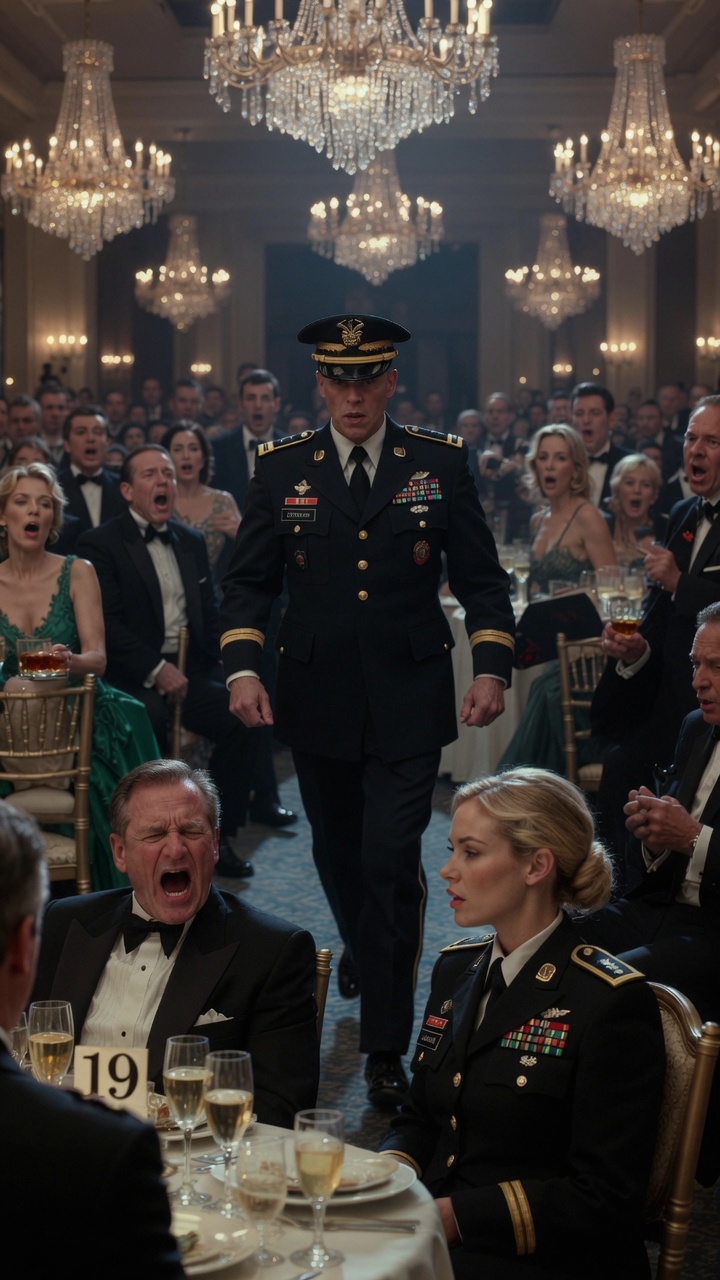
The folder in Colonel Hayes’s hand seemed to weigh more than paper ever should. Its red classification strip caught the chandelier light, flashing like a warning. Around me, no one moved. The ballroom had become a portrait of interrupted pride: champagne glasses paused halfway to mouths, forks resting untouched, smiles stiffened into confusion.
My father stood near the microphone, still holding his whiskey. His face had changed in a way I had never seen before. Not anger. Not disappointment.
Uncertainty.
“General Dawson?” Colonel Hayes prompted quietly.
I took the folder. “Give me thirty seconds.”
“Yes, ma’am.”
The words carried across the ballroom with impossible clarity.
Ma’am.
Not Alyssa.
Not “my daughter.”
Not the punchline.
My fingers closed around the folder’s edge. Years of command taught a person how to stand inside silence without flinching. But nothing in my career had prepared me for standing in front of my family while their version of me collapsed in real time.
My mother’s eyes moved from my face to my uniform pin hidden beneath my blazer, then back again. Ethan took one step forward, then stopped.
“Alyssa,” he said softly.
I looked at him. In his expression, I saw shock, but not cruelty. That mattered more than I expected.
“I need a private space,” I told Colonel Hayes.
“The hotel manager has opened a conference room on the second floor.”
I nodded, then turned to Mara. She still sat beside my table, phone clutched against her chest, guilt and concern written all over her face.
“Thank you,” I said.
Her eyes glistened. “I should have told you years ago.”
“You told me tonight.”
That was all I had time to give her.
As I moved toward the ballroom doors, the crowd parted without being asked. Nobody laughed now. Nobody whispered loudly enough for me to hear. But I felt every stare. Some were embarrassed. Some curious. Some already rewriting the story they planned to tell later.
My father stepped into my path.
“Alyssa.”
His voice was careful, too careful.
I paused.
“Is this some kind of presentation?” he asked. “Part of the gala?”
The question might have hurt if it had surprised me.
“No,” I said.
His throat moved as he swallowed. “Then what is happening?”
“Duty.”
I walked past him.
For sixteen years, he had removed my name from programs, awards, alumni newsletters, and family conversations. But no one could remove me from the path I had chosen. Not anymore.
The hallway outside the ballroom was cooler and dimmer. Hotel staff stood pressed against the walls, wide-eyed but professional. Colonel Hayes walked beside me, his jaw tight.
“What do we have?” I asked.
He lowered his voice. “A data courier connected to the Lake Meridian systems review failed to arrive at the operations center. Package was recovered ten minutes ago by local federal liaison. No breach confirmed, but Washington wants your authorization before analysis proceeds.”
“Why here?”
“The courier’s last confirmed location was inside this hotel.”
I stopped walking.
Behind me, the muffled sounds of the ballroom faded into a dull murmur.
“This hotel?”
“Yes, ma’am.”
“During this gala?”
His silence was answer enough.
The conference room upstairs smelled of polished wood and coffee. A laptop waited on the table beside a secure communications device. Two officers moved efficiently, checking connections, sealing blinds, confirming the room was clear.
I opened the folder.
Inside were pages I could not fully discuss with anyone outside that room, but one photograph made my chest tighten.
A hotel service corridor.
A man in a gray suit.
And behind him, partially visible near a catering cart, was my brother Ethan.
Not speaking to the man.
Not touching the package.
Just there.
I studied the image too long.
Colonel Hayes noticed. “You recognize someone?”
“My brother.”
The room went very still.
He did not ask the obvious question. Good officers rarely did.
“Does Washington know?” I asked.
“Not yet. We wanted your eyes first.”
I looked again. Ethan’s posture in the photo was tense, shoulders raised, head turned as if he had heard his name. He looked less like a conspirator than a man who had stumbled into the wrong hallway at the wrong second.
Still, facts did not bend for family.
“Find out why he was there,” I said.
“Yes, ma’am.”
“And quietly.”
Colonel Hayes nodded.
For the next twenty minutes, the world shrank to procedure. I gave authorization, reviewed the initial timeline, asked questions, rejected assumptions, demanded confirmation. My voice sounded steady. My hands did not shake. That was another thing service had taught me: emotion could wait in the hall if lives depended on it.
But when the first secure review ended, emotion came back and took its seat beside me.
“General,” Colonel Hayes said, “there is another matter.”
I looked up.
He placed a small evidence bag on the table. Inside was a folded hotel notecard. On it, written in dark blue ink, were five words.
Table 19. She was erased.
I read it twice.
The room seemed to tilt.
“Where was this found?”
“Inside the recovered courier envelope.”
My mouth went dry. “That message was included with the security package?”
“Yes, ma’am.”
“Who wrote it?”
“We don’t know.”
For a moment, I heard my father’s laughter again. Then the shattering glass. Then Mara’s apology.
Table 19. She was erased.
This was no longer only about a misplaced courier.
Someone had used a classified concern to point directly at my private wound.
That made it personal.
And personal things were dangerous when mixed with national ones.
“I need to return to the ballroom,” I said.
Colonel Hayes hesitated. “Ma’am, your family may be connected to—”
“I know exactly what they may be connected to. That’s why I need to see their faces before someone else questions them.”
He studied me, then gave a single nod. “Two officers will remain near you.”
“No visible pressure. This is still a civilian event.”
“Yes, ma’am.”
When I reentered the ballroom, conversation died again, but this time it did not vanish completely. It thinned into uneasy fragments. People looked down at plates, at programs, at each other.
My father had left the stage. My mother sat alone at a front table, one hand over her necklace. Ethan stood near a window, staring out over Chicago’s lights.
I went to him first.
He turned before I reached him.
“Alyssa,” he said, and then stopped, as though my name had become unfamiliar.
“Why were you in the service corridor at 8:41 tonight?”
His eyes widened. Not with guilt. Recognition.
“You know about that?”
“Yes.”
He looked past me toward the officers near the door. “I got a text.”
“From whom?”
“I thought it was from Dad.”
My breath caught, but I kept my face still.
“Show me.”
He pulled out his phone with clumsy fingers and opened the message. The sender was labeled Dad, but the number was not my father’s.
Ethan read it aloud, voice low. “Need you by the service corridor. Private matter about Alyssa. Don’t tell your mother.”
A cold line moved down my spine.
“What happened when you got there?”
“Nothing. I waited maybe two minutes. A man came through carrying an envelope. He looked at me like he expected me to say something, but I didn’t know him. Then a waiter dropped a tray nearby. When I turned back, the man was gone.” Ethan’s face tightened. “Alyssa, am I in trouble?”
“That depends on whether you’re telling me everything.”
Hurt flickered in his eyes. “I am.”
I wanted to believe him. That was the problem.
“Did Dad send this?”
“I don’t know.”
“Did you ask him?”
“No. After what happened in there, I didn’t know what to ask anyone.”
We stood side by side by the window. Beyond the glass, traffic moved along Michigan Avenue in streams of white and red light. The city carried on, indifferent to every family secret unfolding above it.
Ethan looked down at his shoes. “I didn’t know.”
“About what?”
“Your rank. Your career. Any of it. Mom and Dad always said you preferred privacy. They said you didn’t come home because you looked down on us.”
I closed my eyes for a second.
There were lies that shouted.
Then there were lies that moved into a house, sat at the dinner table, and learned everyone’s favorite songs.
“I wrote,” I said.
Ethan stared at me.
“I sent birthday cards. Graduation gifts. Letters when you got your first job. I never heard back.”
His face drained slowly. “I never got them.”
The words landed between us with the force of something breaking.
Across the ballroom, my father watched us.
Ethan followed my gaze. “Alyssa…”
“Not now,” I said gently.
But my voice was not cold.
That surprised both of us.
My mother approached next. Her emerald gown shimmered, but her face looked pale and small.
“Alyssa, sweetheart,” she began.
The old endearment nearly undid me. She had not called me sweetheart in fifteen years.
“Did you know?” I asked.
Her lips parted.
I did not explain. I did not need to.
She glanced toward my father before answering. That glance told me too much.
“I knew there were disagreements,” she said.
“Disagreements?”
Her eyes filled. “Your father believed military life would change you.”
“It did.”
She flinched.
“It made me disciplined. It made me capable. It made me understand responsibility in ways I never imagined.”
“I know that now.”
“No,” I said quietly. “You know it because officers walked into a ballroom and saluted me. That isn’t the same thing.”
Her tears slipped free, silent and polished beneath the chandelier light.
“I missed you,” she whispered.
The words should have warmed me. Instead, they opened a door to a room full of years.
“Then why didn’t you call?”
She pressed a hand over her mouth.
Behind her, my father was coming toward us.
“Because I asked her not to.”
His voice was steady, but the confidence had thinned.
My mother turned away as if struck by shame. Ethan stared at him.
I faced my father.
There he was: Richard Dawson, respected donor, former school board president, man of firm handshakes and clean speeches. A man who had convinced half a city he valued excellence, while making an exception for the daughter who chose the wrong kind.
“Why?” I asked.
He lifted his chin. “You left.”
“I enlisted.”
“You walked away from the future we built for you.”
“The future you chose.”
“You were brilliant,” he said, frustration sharpening his voice. “Medical school, research, hospital leadership—any of it could have been yours. Instead you disappeared into a system that sends orders and expects obedience.”
“I became a commander.”
He looked at the officers near the door, then back at me. “Apparently.”
Apparently.
Even now, he could not give the word room to stand.
Ethan stepped forward. “Dad, did you keep her letters from me?”
My father’s jaw tightened.
“Answer him,” I said.
People nearby were pretending not to listen and failing.
My father lowered his voice. “This is not the place.”
“You chose the place,” I said. “You chose the microphone.”
A tremor passed across his face.
“Yes,” he said at last. “Some letters came. I thought distance would help everyone move on.”
Ethan recoiled. My mother closed her eyes.
I had imagined this moment in airports, barracks, field hospitals, command centers, and lonely hotel rooms across the world. In those imagined scenes, I had shouted. I had demanded apologies. Sometimes I had walked away without a word.
But real pain was quieter.
“You stole years,” I said.
My father looked older suddenly. Not forgiven. Not ruined. Just old.
“I thought I was protecting the family.”
“No,” I said. “You were protecting a story.”
His eyes flickered.
That struck closer than anger would have.
Before he could answer, Colonel Hayes entered the ballroom and approached with controlled urgency.
“General Dawson.”
My family turned at the title again, as though each time it rearranged the furniture of reality.
“What is it?” I asked.
“The recovered envelope contained more than the package. We found copies of old correspondence addressed to you. Personal letters. Some opened, some never delivered.”
My mother gasped.
My father went still.
I felt the room recede.
“Where are they?”
“Upstairs.”
I looked at my father. “Did you send anything to me?”
His face gave me the answer before his mouth did.
“No.”
Ethan whispered, “Then who did?”
The question moved through me like a draft under a locked door.
I followed Colonel Hayes back upstairs. Ethan came with me without asking. My mother remained behind, crying softly at the table. My father did not move.
In the conference room, the evidence was arranged neatly on a side table.
My breath caught.
There were envelopes with my name written in different hands. Some old and yellowed at the edges. Some newer. A few bore military forwarding marks. One had childish handwriting, the letters uneven and enthusiastic.
To Alyssa. From Ethan.
He saw it at the same time I did.
“I was ten,” he whispered.
The envelope had been opened.
Inside was a drawing of two stick figures standing beside a crooked house. One figure wore a helmet. The other held a sign that read COME HOME SOON.
On the back, in pencil, was a message.
Mom says you are busy saving people. Dad says you forgot us but I don’t think you did. I got an A in science. I hope you are not lonely.
Ethan sat down hard in the nearest chair.
I could not speak.
For years, I had believed silence meant indifference. He had believed silence meant abandonment. Between us stood a man sorting mail like fate.
Colonel Hayes gave us a respectful distance.
There were other letters. One from my mother, never mailed, apologizing for a Thanksgiving argument I barely remembered. Another from my grandmother, who had died while I was overseas. Her handwriting wavered badly near the end.
Your father is stubborn, but blood has a way of finding its road back.
I pressed my fingers to my eyes.
Ethan’s voice broke. “I thought you didn’t want me.”
I lowered my hand.
He looked younger than his thirty-two years. The polished executive, the golden son, the man under the spotlight—gone. In his place was a little boy holding an unanswered drawing.
“I thought you didn’t need me,” I said.
He shook his head. “I needed you all the time.”
The conference room door opened slightly. My father stood there.
No one invited him in.
He entered anyway, slowly, as if each step cost him something.
“I didn’t know those were in the package,” he said.
“That is not the first sentence you should have chosen,” Ethan said.
My father absorbed that.
Then he looked at me. “I made mistakes.”
I almost laughed, but there was no humor left in me.
“Mistakes are missed birthdays,” I said. “Mistakes are words said in anger. This was a system.”
His eyes reddened. “I was afraid.”
That stopped me.
He looked away, toward the dark window. His reflection stood beside mine, similar in the shape of the brow, the stubborn line of the mouth.
“My father served,” he said. “He came home different. Quiet. Angry. Lost in rooms where the rest of us could not reach him. I promised myself my children would have stable lives. Safe lives.”
“You never told me that.”
“You were eighteen. You thought courage solved everything.”
“No,” I said. “I thought honesty mattered.”
He nodded once, as if the blow had been deserved.
“I saw your choice as a rejection,” he said. “Of me. Of your mother. Of everything I built. Then, after a while, admitting I was wrong meant admitting how much damage I had done.”
“So you kept doing it.”
“Yes.”
There was no defense in the word.
Ethan stood. “And tonight? The joke? The email to remove her from recognition?”
My father’s mouth tightened. “Pride becomes habit.”
The answer was ugly because it was true.
Colonel Hayes cleared his throat. “General, we need to address the unknown sender. Whoever placed these letters with the courier had access to personal family material and restricted movement inside the hotel.”
My father stiffened. “Restricted?”
“Yes.”
I turned to him. “Did anyone else know about the letters?”
He hesitated.
“Dad,” Ethan said.
My father’s gaze dropped. “I kept them in a locked storage room at the house.”
“Who had access?”
“Your mother. The house manager. And… Clara.”
The name struck me softly, unexpectedly.
Clara Dawson.
My father’s older sister.
My aunt.
She had sent me care packages during my first deployment until they suddenly stopped. I had assumed, as I assumed so much, that family loyalty had shifted without ceremony.
“Aunt Clara is in Arizona,” Ethan said.
My father shook his head. “She came back last month. She wanted to attend tonight. I told her it would be complicated.”
A memory surfaced: a silver-haired woman near the ballroom entrance when I arrived, turning away before I could see her face.
“Where is she now?” I asked.
My father looked genuinely confused. “I don’t know.”
Colonel Hayes’s phone vibrated. He glanced at it, then handed it to me.
A security still from the hotel lobby filled the screen.
There was Clara Dawson, older and thinner than I remembered, standing beside the missing courier in the gray suit. She was not frightened. She was not hiding.
She was handing him something.
My pulse slowed, the way it always did when a situation sharpened.
“Find her,” I said.
But before Colonel Hayes could move, the secure device on the conference table rang.
Everyone looked at it.
Only three groups had that number.
Colonel Hayes answered and put it on speaker. “Hayes.”
A woman’s voice came through, calm and familiar despite the years.
“Hello, Colonel. I imagine Alyssa is standing beside you.”
My father gripped the back of a chair.
“Aunt Clara,” I said.
There was a pause. Then a soft exhale.
“You sound exactly like your grandmother when you are angry.”
“Where are you?”
“Somewhere close enough to know Richard finally ran out of speeches.”
My father’s face hardened. “Clara, what have you done?”
“What you should have done years ago,” she replied. “I returned what did not belong to you.”
“The courier package?” I asked.
“That was never in danger, Alyssa. Not from me.”
Colonel Hayes leaned toward the device. “Ma’am, you interfered with a secure transfer.”
“No,” Clara said. “I exposed one.”
The room stilled.
“What does that mean?” I asked.
Her voice softened. “The man carrying that envelope was not the assigned courier.”
Colonel Hayes froze.
I looked at him. “Confirm.”
His expression changed as he checked his phone, then another officer’s message. “We’re verifying now.”
Clara continued, “I recognized him because I saw him two nights ago speaking with someone from the alumni committee. I followed him tonight because I knew he was not hotel staff. When he dropped the envelope, I put something inside that would make sure Alyssa looked closely.”
“My letters,” I said.
“Your history,” Clara corrected. “There is a difference.”
Ethan gripped the table edge. “Why didn’t you just tell us?”
“Because your father has spent years making truth sound unreasonable.”
My father flinched.
Colonel Hayes received another message. His face went pale in a way I had rarely seen in trained officers.
“General,” he said, “the assigned courier has been located.”
“Alive?”
“Yes, ma’am. Disoriented but safe in a service elevator maintenance area.”
“And the man in the gray suit?”
“Unknown. Not on the approved transfer list.”
The air in the room tightened.
Clara’s voice lowered. “Alyssa, listen carefully. The gray-suited man did not come for your military file. He came because someone told him your family would distract you tonight.”
“Who?”
Another pause.
Then Clara said, “That is why I called. I found his discarded badge.”
“Name?”
“No name. Just an access code.”
Colonel Hayes lifted his head sharply. “Read it.”
Clara recited the numbers.
An officer typed quickly. The room waited.
The result appeared.
Colonel Hayes looked at me, and for the first time that night, I saw alarm break through his discipline.
“The code belongs to a temporary event credential,” he said.
“Whose?” I asked.
He turned the screen toward me.
The credential photo showed a familiar woman with careful makeup, pearl earrings, and an emerald gown.
My mother.
END OF PART 2 – LIKE, SHARE AND COMMENT “THE ENTIRE STORY” IF YOU WANT TO READ THE FULL STORY