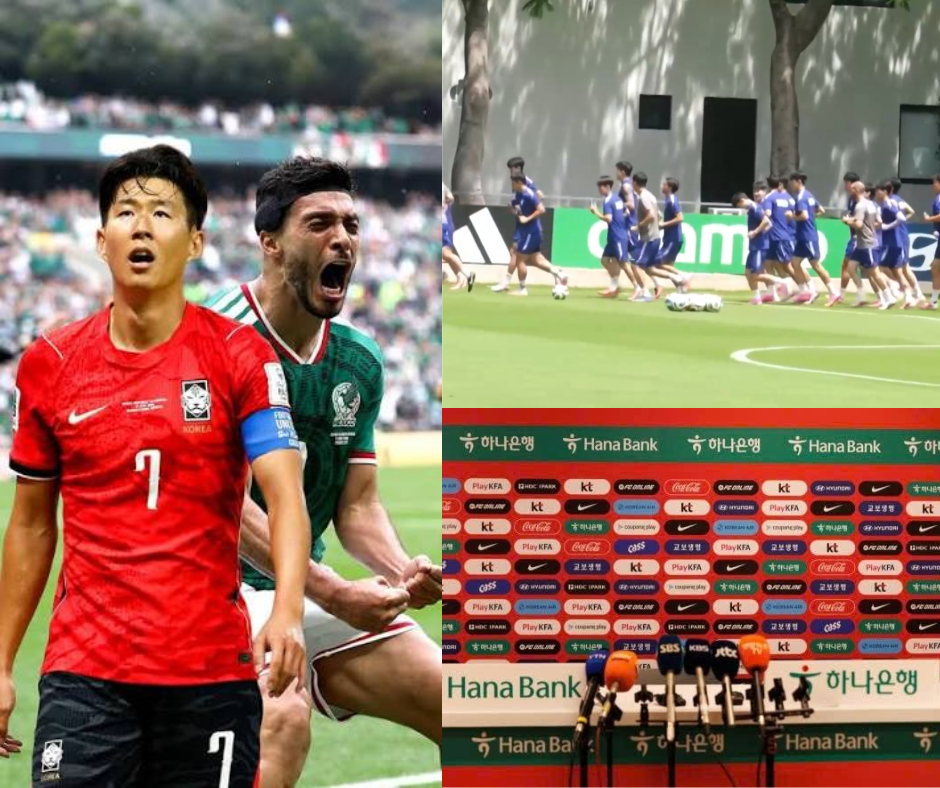
In the high-stakes pressure cooker of the 2026 FIFA World Cup, where every tactical shift is dissected and every movement is tracked, the South Korean national team has found itself fighting a battle not on the grass of Guadalajara, but in the halls of their own base camp. As the squad prepares for a massive showdown against host nation Mexico this Thursday, a simmering, deep-seated “civil war” between players and the domestic media has boiled over into a full-scale blackout that has shocked the international football community.
This is not a story about offside traps or defensive lapses. It is a story about contempt, the crumbling of institutional trust, and a “hot mic” moment that has irrevocably altered the dynamic between a nation’s icons and the reporters sent to cover them.
The Spark: A Contempt Caught on Tape
The rupture originated on June 7 during a routine, light-hearted pre-training jog at the team’s Guadalajara camp. It was supposed to be a mundane moment—a glimpse into the life of the squad ahead of their opening Group A clash. However, a live broadcast by JTBC, the domestic rights holder for the tournament, captured more than just the players’ warm-up.
In the background, microphones picked up the voices of domestic media personnel. The conversation wasn’t about tactics or form; it was laced with vitriol. The subjects of the ridicule were the players themselves, including team captain and global icon Son Heung-min.
The sneers were specifically aimed at the players’ military service status—a deeply sensitive cultural nerve in South Korea. One remark, mocking Son’s exemption, hit particularly hard: “He didn’t even properly serve in the military,” the voice scoffed, dismissing the grueling three-week basic training stint Son completed in 2020 after securing his exemption through a gold-medal performance at the 2018 Asian Games.
For a captain who has carried the weight of a nation’s expectations for a decade, the blatant disrespect from his own countrymen was a breaking point.
A Team at War
The reaction from the Korea Football Association (KFA) was swift but, in the eyes of the squad, insufficient. Behind closed doors, the governing body reprimanded the involved journalists, but the absence of an immediate, public apology only fueled the fire.
As the team moved toward their opening match—a gritty, comeback 2-1 victory over the Czech Republic—the atmosphere turned toxic. The team began to tighten its borders. When an impromptu interview with a player was published, the KFA demanded its deletion. A scheduled media availability with midfielder Hwang In-beom was scrapped entirely.
By Monday, the KFA had issued a formal statement expressing “regret” over the “inappropriate remarks,” but the damage was done. When journalists finally offered a direct apology to Son—nearly 10 days after the initial incident—the squad was already firmly entrenched behind a wall of silence. Contact with Korean outlets has been slashed to the bare minimum, transforming the team’s relationship with the press into a standoff that has drawn the eyes of global outlets like The Athletic and Telegraph Football.
Cultural Fault Lines and the Death of “Legacy Media”
This incident reveals a deeper, structural failure. In the modern South Korean media landscape, the traditional “press pack” is increasingly viewed by fans—and now, apparently, players—with skepticism.
The media’s attempt to frame Son’s post-match silence as a sign of “captaincy incompetence” backfired spectacularly. Fans, now hyper-aware and equipped with real-time fact-checking capabilities, saw through the narrative. They didn’t see a leader avoiding accountability; they saw a group of professionals protecting their own dignity from a “protective cartel” of journalists who have long enjoyed the privileges of exclusive access.
The remarks regarding military service are a symptom of a wider, uglier culture war within Korea. By weaponizing mandatory service against a man who has brought immense pride to the nation on the world stage, these journalists didn’t just insult a player; they echoed the same toxic sentiments that have fueled polarized debates surrounding figures like BTS and other high-profile athletes.
A Siege Mentality
The situation reached a bizarre crescendo on June 17, when the team reported an illegal drone hovering over their private, closed-door tactical session. Security forces were forced to jam the device, causing it to crash before its mysterious operators—who vanished into the Mexican landscape—could recover it.
While the KFA maintains that the drone incident did not compromise their tactical plans for the Mexico match, it has created a “siege mentality” within the camp. Between the perceived betrayal by domestic reporters and the literal surveillance from above, Coach Hong Myung-bo’s side is operating in a state of high tension.
The Road Ahead
As the team looks toward Thursday’s matchup with Mexico, the question is not just whether they can perform on the pitch, but whether the rift can be mended. For the fans, the “watchdogs” of the press have failed to perform their duty, and it is now the independent, digital voices—the YouTubers and the fans themselves—who are reconstructing the narrative.
South Korea’s World Cup journey is currently being played out on two fronts. One is for the trophy; the other is for the integrity of their own camp. Whether the national team will ever trust its domestic press again remains a question without an answer. But one thing is clear: the era where journalists could operate with impunity under the banner of “access” is effectively over. In the digital age, respect is not a privilege of the press; it is a currency that must be earned.