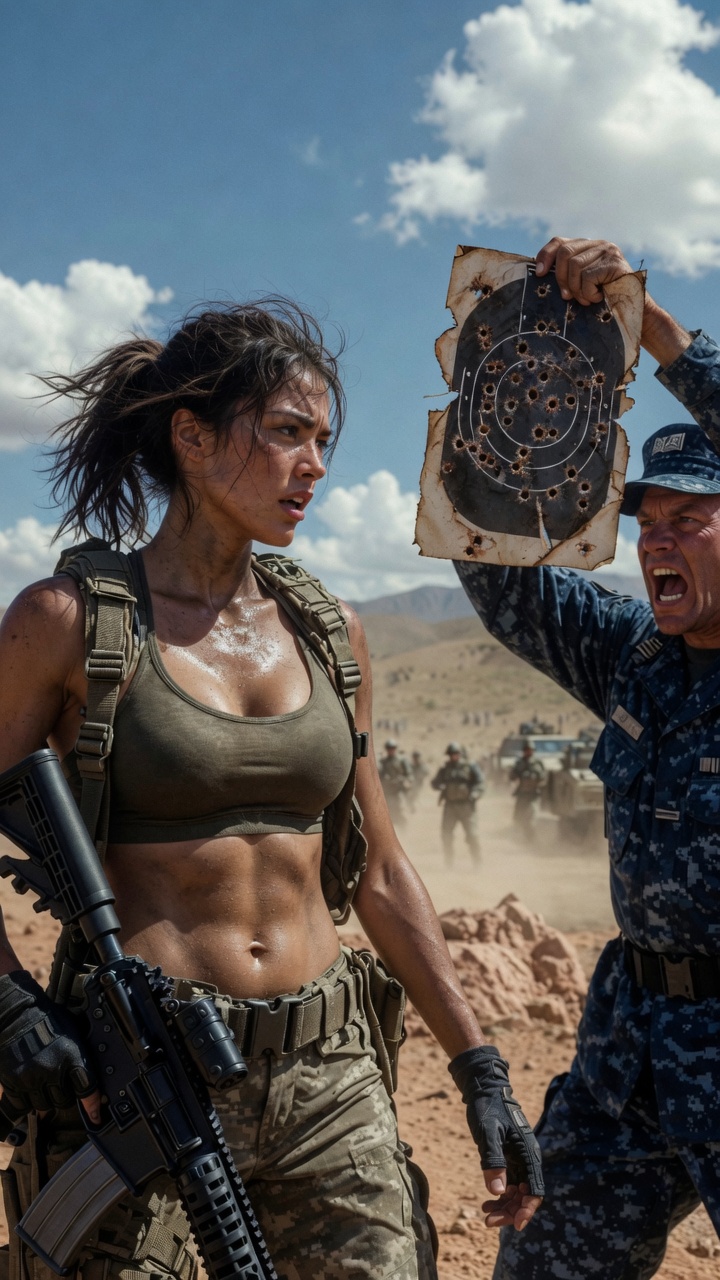
Signature: Au1rFnBbiONUiZGzT4ap27mTkZBCLqclHmJKZV1c1F2j3WCtVJL1nShrGmR9X1dEe4Pn3FczfPQ/AgNhQsS8HomGnRTo85ALde92tA5NPS4Dr0BWv20JOHEIDSG3QboVIkhuoogxBPElKqKKRnYwgY9GGIuQoj4N3x0QgH/9wruQBAzNUP+9aYWg1MtGZzN5ZKL9qAsv/ZYmm54KHlrqew==
Commander Ripped My Target Sheet—Then Forty Hidden Snipers Racked Their Rifles…
Commander Kincaid didn’t come to Nevada to inspect me.
He came to erase me.
By 0800, he had already picked the range, rewritten the test, and invited witnesses for my public failure.
By 0837, he was on the ground in the dirt.
And forty rifles were pointed at the truth.
PART 1
The commander ripped my target sheet in half before the bullet hole even stopped smoking.
That was the first mistake he made in front of federal agents.
The second was assuming the men in the hills belonged to him.
I was lying in Nevada dirt with my cheek welded to the stock of a Mark 13 Mod 7, eating grit every time the wind shifted. Fallon Naval Air Station sat somewhere behind us, all fences, warning signs, and heat waves. Out here, on the classified auxiliary range the teams called the Anvil, there was no shade, no mercy, and no room for excuses.
The temperature had already climbed past 105 before breakfast.
My Starbucks iced coffee was melting inside a Humvee cupholder twenty yards behind me. My combat shirt was soaked through. My rifle was clean, my data book was open, and the desert was doing what the desert always did—turning every easy shot into a math problem with teeth.
“Wind full value, right to left,” Master Chief John Garrison said beside me.
His voice came low through my headset.
“Call it ten, gusting twelve.”
I adjusted my optic without answering.
Garrison had spotted for me through Afghanistan dust, Pacific rain, and one miserable training block in Alaska where our bolt handles froze if we breathed wrong. He knew I didn’t talk when I was reading wind.
Talking was for officers with clean boots.
Shooting was for people who had to be right.
The first target sat at 800 meters, a black steel silhouette shimmering like it was underwater. I let the reticle settle, exhaled, and pressed.
The rifle cracked.
A second later, steel rang.
Garrison didn’t praise me.
“Impact.”
That was our love language.
I cycled the bolt and reached for the next round when I heard tires on hardpan. Not range tires. Not our Humvees.
Something heavier.
Something polished.
I lifted my eye from the optic.
Two black government Suburbans rolled toward the firing line, their tires throwing pale Nevada dust into the morning light. They stopped too close, like whoever was inside wanted everyone to turn and watch.
The rear door opened.
Commander Richard Kincaid stepped out wearing pressed cammies, mirrored sunglasses, and the kind of expression men get when they’ve already written the report in their heads.
Behind him came Captain Thomas Miller, two D.C. liaisons, and a pair of civilian contractors in khaki pants and tactical vests that looked brand new. One of them carried a paper Starbucks cup with a green straw and a Pentagon visitor badge clipped to his vest.
Kincaid scanned the range like he owned the sun.
Then he looked at me.
“Chief Brooks,” he called. “I see you’re enjoying arts and crafts in the dirt.”
Garrison went still.
Every man on the line heard it.
I cleared my rifle, locked the bolt to the rear, stood, and saluted.
“Commander Kincaid. Welcome to the Anvil.”
He waited two seconds too long before returning the salute.
That was the third mistake.
On a normal base, maybe nobody cared. Out here, with Task Force Echo hidden across the ridgelines, every pause had an audience. Forty of the best shooters in the military were dug into scrub, rock, and derelict vehicle shells, listening through encrypted comms.
Delta.
Marine Scout Snipers.
Naval Special Warfare veterans.
Men who didn’t care about headlines, politics, or whether someone’s father had worn stars.
They cared about one thing.
Could you make the shot?
I had.
Repeatedly.
That was why Kincaid hated me.
He wasn’t subtle about it. Men like him never are. They hide bias under “standards,” “heritage,” and “unit cohesion,” then act shocked when everybody in the room can smell the rot.
I was Chief Petty Officer Valerie Brooks, the first woman to earn a place in our covert sniper cell. To Navy public affairs, I was a press release they could trot out for recruiting posters.
To Kincaid, I was a clerical error with a trident.
To Echo, I was Chief.
That was the only title I cared about.
Kincaid removed his sunglasses and tucked them into his collar.
“I’m here for an unscheduled operational readiness inspection.”
“Understood, sir.”
He smiled.
It was the kind of smile a lawyer gives before showing you the document he thinks you forgot to read.
“SOCOM wants assurance that certain unique personnel are still maintaining Tier One standards.”
Garrison shifted beside me.
I didn’t.
“Standards are maintained daily,” I said.
“Good. Then this should be painless.”
The civilian contractor with the Starbucks cup took one small sip. His eyes moved from me to Kincaid, then to the firing line. He looked bored, but not relaxed.
Kincaid opened a folder and pulled out a laminated sheet.
“I’ve authorized a revised qualification scenario. Hostage rescue overwatch. Three shots. Eight hundred meters. Twelve hundred meters. Final cold bore correction at eighteen hundred meters. Ten seconds between the second and third shot.”
Captain Miller looked down.
That told me plenty.
Garrison took one step forward.
“Sir, with respect, eighteen hundred meters with a three-inch noncombatant margin in this wind isn’t a qualification. It’s a Vegas magic trick.”
Kincaid snapped his head toward him.
“Master Chief, I didn’t drive three hours from Fallon to be lectured by an enlisted man with a weather hobby.”
A few men on the firing line stared straight ahead.
Nobody laughed.
Kincaid’s jaw tightened. He liked rooms where people laughed when he wanted them to.
Out here, he had brought the wrong audience.
“The standard stands,” he said. “Unless Chief Brooks believes the standards should be softened for her comfort.”
There it was.
Not even wrapped.
Just dropped on the ground like trash.
I looked at the laminated sheet in his hand. Then at his polished boots. There wasn’t a scuff on them.
“Are these parameters documented, sir?”
“They are now.”
“Witnessed?”
He glanced toward Captain Miller and the contractors.
“Oh, very much so.”
“Good,” I said.
That annoyed him.
He wanted anger. He wanted a speech. He wanted me to give him something emotional enough to label unstable.
Instead, I picked up my rifle.
“I accept the parameters.”
Garrison turned his head slightly.
Only enough for me to hear.
“Val.”
“I said I accept.”
Kincaid’s grin widened.
“Outstanding. Let’s see what the Navy bought.”
I lowered myself back into the dirt.
The desert pressed hot against my elbows. Sweat ran down my neck. Somewhere behind me, one of the D.C. liaisons whispered something into his phone.
I blocked it out.
Target one.
Eight hundred meters.
Easy on paper.
Nothing is easy when a man wants your career dead.
Garrison settled behind the spotting scope.
“Wind still right to left. Ten. Hold left edge.”
I made the correction.
Breath.
Pause.
Press.
Crack.
Ping.
“Impact,” Garrison said.
Kincaid didn’t move.
“Target two,” he called. “Clock is running.”
The twelve-hundred-meter silhouette wavered in the glass. Heat shimmer rolled up from the desert floor, bending the target like cheap plastic.
“Wind picking up,” Garrison said. “Fourteen. Gusts at sixteen. Mirage boiling.”
“Copy.”
“Hold two mils right. Wait for the dip.”
I watched dust curl near a patch of scrub halfway downrange. Then another farther out. The wind wasn’t one thing. It was three arguments happening at once.
I waited.
Kincaid looked at his watch.
“You planning to shoot today, Chief?”
I pressed the trigger.
The rifle punched my shoulder.
Two seconds.
Three.
Steel answered.
Ping.
Garrison’s mouth twitched.
“Impact. Dead center.”
Behind us, someone exhaled.
Kincaid’s smile thinned.
“Ten seconds for the final shot,” he said. “Starting now.”
The last target wasn’t steel.
It was paper.
No sound. No easy confirmation. Just a hostage face printed in black and gray, with a hostile’s head exposed beside it and three inches between success and a funeral.
Eighteen hundred meters.
Over a mile.
In shifting desert wind.
With my career parked under a microscope.
“Wind is ugly,” Garrison said. “Downdraft near the wash. Left to right at the target. Right to left at us. Val, you need to read the dirt.”
I didn’t answer.
Six seconds.
The target swam in the optic.
Five.
I adjusted parallax.
Four.
Kincaid stepped closer behind me.
Of course he did.
Three.
“You miss this,” he said softly, “and we can all stop pretending.”
Two.
Garrison whispered, “Send it.”
I pressed.
The rifle fired.
The bullet left the barrel, climbed into hot air, and disappeared into a mile of bad decisions.
No ping came back.
Paper never claps for you.
Garrison stayed buried in the scope.
“Stand by.”
Kincaid folded his arms.
“Well?”
“Mirage is too thick,” Garrison said. “I can’t confirm the hole from here.”
Kincaid laughed once.
Short.
Ugly.
“Then it’s a miss.”
Captain Miller looked over.
“Commander, standard protocol requires physical target verification at that distance.”
Kincaid shot him a look.
Miller didn’t blink.
For the first time that morning, Kincaid realized he didn’t control every man standing there.
“Fine,” he said. “Ceasefire. Make the line safe. We’ll drive downrange.”
He turned toward me.
“And when we find out you clipped the hostage, Chief, I want your gear packed by sixteen hundred.”
I cleared my rifle and stood.
“Yes, sir.”
He hated that too.
He wanted fear.
All I gave him was procedure.
The vehicles rolled toward the far target, dust rising behind us like smoke from a bad verdict.
I sat in the back of the Humvee, rifle across my knees, while Garrison drove.
He didn’t say anything for half the ride.
Then he muttered, “You made the shot.”
“I know.”
“Good. Because if you didn’t, I’m going to feel real stupid for wanting to punch an officer in front of two contractors.”
“They’re not contractors,” I said.
He glanced at me.
“You noticed?”
“Real contractors complain about per diem within five minutes. Those two haven’t complained once.”
Garrison gave one sharp breath that almost counted as a laugh.
Ahead, Kincaid’s Suburban stopped at the paper target.
He got out first.
Of course he did.
He walked toward the stand with the energy of a man rushing to open a gift.
Then he stopped.
So did everyone else.
I stepped out of the Humvee and walked through the dust.
The target was still fluttering in the wind.
Right in the hostile’s exposed face, centered inside the three-inch kill zone, was one clean .30-caliber hole.
Not touching the hostage.
Not grazing the line.
Dead center.
Garrison looked at it, then looked at me.
“Impact confirmed.”
Captain Miller came up beside us.
“Hell of a shot, Chief.”
I kept my eyes on Kincaid.
His face had gone flat.
That was when I knew he was more dangerous embarrassed than angry.
For men like him, humiliation isn’t an emotion.
It’s a weapon they hand back to the nearest woman.
PART 2
Kincaid stared at that bullet hole like it had insulted his mother.
His hands closed into fists.
Nobody spoke.
The paper target snapped in the wind, showing everyone what he had tried to make impossible. The hole sat there anyway, clean and arrogant, like it had a security clearance.
Garrison crossed his arms.
Captain Miller checked the target stand.
The two “contractors” watched Kincaid instead of the paper.
That told me everything.
Kincaid stepped closer.
“No,” he said.
One word.
Small.
Pathetic.
Then he grabbed the top of the target sheet.
“Commander,” Miller said, warning in his voice.
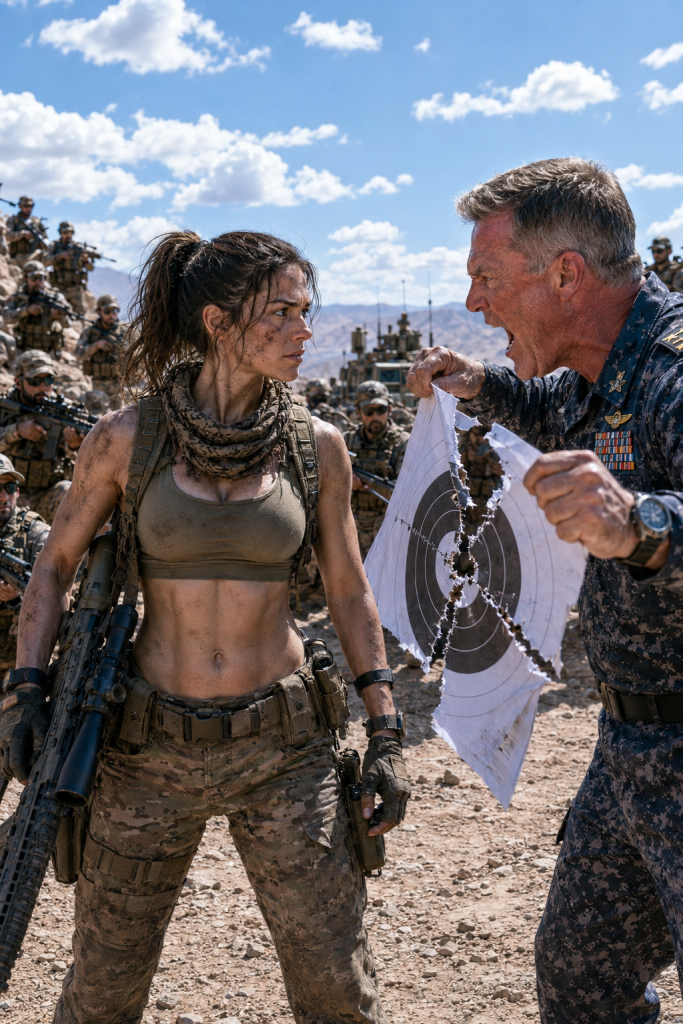
Kincaid ripped the paper down with both hands.
The sound tore across the desert.
He didn’t stop there. He shredded the center mass, ripped through the kill zone, and let the pieces drop into the dust around his boots.
“Target invalidated,” he barked. “Improperly mounted. Wind interference. Non-standard conditions. Qualification null and void.”
Garrison took one step forward.
“Sir, you just destroyed official training documentation.”
Kincaid turned on him.
“I am the inspecting authority.”
“No,” Garrison said. “You’re a man having a public meltdown in government pants.”
One of the D.C. liaisons made a tiny choking noise.
Kincaid pointed at me.
“She failed. Chief Brooks is a liability. This entire circus exists because Washington wanted a poster girl.”
I didn’t move.
Didn’t blink.
Didn’t give him the satisfaction of seeing where that landed.
He leaned toward me, spitting the words now.
“You think a trident makes you one of them?”
Then the desert answered for me.
Clack.
One rifle bolt.
Then another.
Clack.
Clack.
From the ridge.
From the scrub.
From behind a rusted truck shell half-buried in sand.
Clack-clack-clack-clack.
Forty precision rifles chambered live rounds in perfect sequence.
Kincaid froze with torn paper still in his hands.
And for the first time all morning, he finally understood he was surrounded.
PART 3
The sound of forty sniper rifles racking at once will strip the rank right off a coward.
Kincaid’s mouth opened.
Nothing useful came out.
He turned in a slow half-circle, searching the rocks, the scrub, the shallow cuts in the ridge. He couldn’t see them. That was the point.
Task Force Echo didn’t stand around looking heroic for visitors.
They disappeared.
They watched.
They recorded.
And when one of their own got railroaded in broad daylight, they made sure the railroad had witnesses from every angle.
“What is this?” Kincaid said.
His voice cracked on the last word.
Nobody helped him recover it.
He looked at Captain Miller.
“Order them to stand down.”
Miller took two deliberate steps back.
Not toward me.
Away from Kincaid.
“That doesn’t appear necessary.”
“Necessary?” Kincaid snapped. “They just chambered rounds on a superior officer.”
“They chambered rounds on a military firing range,” Miller said. “During a scheduled live-fire evolution. After you destroyed a training target.”
Kincaid’s face blotched red.
“You’re taking her side.”
Miller’s expression hardened.
“I’m taking the side with the bullet hole and the law.”
The older contractor finally moved.
He set his Starbucks cup on the hood of the Suburban, like he didn’t want to spill six dollars of iced coffee during a federal collapse.
Then he unclipped the radio from his vest.
“Echo Actual, this is Overwatch One,” he said. “Target secure. Infraction confirmed. All stations stand down and make safe.”
Across the desert, bolts pulled back.
Weapons cleared.
The metallic echo rolled off the ridge like a verdict.
Kincaid stared at him.
“Who the hell are you?”
The man reached into his vest and flipped open a badge wallet.
Gold shield.
Department of Defense Office of Inspector General.
“Special Agent David Corwin,” he said. “This is Special Agent Liam Foster.”
The younger contractor gave Kincaid a polite little nod.
Not friendly.
Professional.
That was worse.
Corwin put the badge away.
“You really should have read the room before committing obstruction in front of us.”
Kincaid took one step back.
“This is entrapment.”
“No,” Corwin said. “This is you making choices with witnesses present.”
Kincaid looked at me.
Then at Garrison.
Then at the torn pieces of target paper on the ground.
His brain was trying to build a door where there wasn’t one.
Corwin continued.
“You’ve been under review for six months, Commander. Targeted discrimination. Abuse of authority. Manipulation of readiness standards. Retaliatory administrative actions. We had emails. We had memoranda. We had testimony.”
He looked at the shredded paper.
“But we didn’t have you physically destroying government training evidence because a chief petty officer outshot your prejudice.”
Kincaid swallowed.
His throat worked like he had sand in it.
“You authorized this?”
“SOCOM authorized the inspection. You designed the trap. We just watched you step in it.”
Garrison reached into his pouch and pulled out a ruggedized tablet.
His grin came slow and mean.
“Also, sir, fun little tech update since your last PowerPoint war. Echo’s running networked optic feeds today.”
Kincaid stared at the tablet.
Garrison tapped the screen.
Forty thumbnails appeared.
Each from a different angle.
Each recorded.
Each timestamped.
He opened one feed.
The target filled the screen. The hostile face jerked as the bullet punched through dead center.
He opened another.
Same shot.
Different scope.
Another.
Another.
“You didn’t destroy proof,” Garrison said. “You made confetti.”
The younger agent, Foster, tilted his head.
“Pretty expensive confetti.”
Kincaid’s breathing changed.
That was the first medical sign.
Fast inhale.
Short exhale.
Shoulders lifting too high.
He looked at the ridge again, as if the desert itself had betrayed him.
He wanted the old world back. The one where he could call a woman “liability,” write a memo, slap a stamp on it, and go home to his house in Virginia with his pension untouched.
But this wasn’t a conference room at the Pentagon.
This was a live range.
And everybody here knew the difference between authority and competence.
I stepped forward.
Just one step.
Kincaid flinched.
That small movement told the whole story.
“Commander,” I said, “would you like me to retrieve another copy of the target from the camera feeds?”
His eyes cut to me.
“You think this is funny?”
“No, sir.”
I looked down at the torn paper by his boots.
“I think it’s documented.”
Garrison made a sound in his throat.
Not a laugh.
Close enough.
Kincaid’s jaw shook.
“You people think you can ruin me?”
Corwin answered before anyone else could.
“You ruined yourself when you forgot the government keeps receipts.”
Miller folded his arms.
“And when you forgot chiefs don’t miss because you need them to.”
The D.C. liaisons had gone pale. One of them quietly slid his phone into his pocket, like maybe not recording this would save him from being asked about it later.
Too late.
Everything was recording.
The optics.
The radios.
The body mics.
The range cameras.
Kincaid had walked into a Nevada valley surrounded by rifles, cameras, and men who knew exactly what he was.
That kind of pressure does strange things to the body.
His skin went gray under the red.
His lips parted.
His polished boots shifted in the dust.
“I…” he said.
Nobody filled the silence for him.
Not this time.
He looked at me one more time.
I didn’t gloat.
I didn’t smile.
I had learned early that when a man is digging his own grave, handing him a bigger shovel is charity.
So I just stood there.
Dust on my uniform.
Sweat drying on my neck.
Trident on my chest.
Kincaid’s eyes rolled slightly upward.
Garrison noticed first.
“Medic,” he said.
Kincaid’s knees buckled.
He dropped straight down beside the torn target paper, face-first into the Nevada dirt.
For one ugly second, nobody moved.
Then training overrode disgust.
“Corpsman up!” Garrison shouted.
A medical truck staged behind the ridge roared forward, throwing dust behind it. A Navy corpsman jumped out before the vehicle fully stopped.
He hit the ground running.
“Move,” he barked.
Even Corwin stepped back.
The corpsman rolled Kincaid onto his back, checked his airway, then pressed two fingers to his carotid.
“He’s got a pulse. Rapid and weak.”
Garrison looked down at him.
“Heat?”
“Heat plus panic,” the corpsman said. “His nervous system just pulled the plug.”
Foster adjusted his sunglasses.
“That’s one way to decline an interview.”
Corwin didn’t laugh.
“Transport him to base hospital. Agent Foster rides with him. He remains under federal custody once medically cleared.”
Kincaid’s face was caked with dust.
A strip of shredded target paper had stuck to his sleeve.
There was something almost poetic about that, but I wasn’t in the mood to be generous.
The corpsman and his partner lifted him onto the stretcher. His boots hung off the end, still shiny, still useless.
As they loaded him into the truck, the entire range stayed quiet.
Not respectful.
Just finished.
The medical vehicle pulled away first.
Then one of the Suburbans.
Then the second.
Dust swallowed them.
When the sound faded, Captain Miller turned to me.
He came to attention.
A full salute.
Clean.
Deliberate.
Earned.
“Chief Brooks,” he said, voice carrying across the target berm, “your qualification is validated. Shot confirmed. Bearing under duress exemplary. Your place in this unit is not in question.”
I returned the salute.
“Thank you, sir.”
He lowered his hand.
“And for the record, Chief, that was one of the finest long-range shots I’ve ever seen.”
Garrison looked at him.
“Sir, careful. She’s already difficult to live with.”
I finally let myself breathe.
Not much.
Just enough.
Miller turned to Garrison.
“Master Chief, take charge of the range. Complete the training schedule. I’ll be at Fallon starting paperwork.”
Garrison nodded.
“Aye, Captain.”
Miller paused.
Then he looked toward the torn target pieces.
“One more thing.”
“Yes, sir?”
“Bag the evidence.”
Garrison smiled.
“With pleasure.”
Miller left.
Corwin stayed behind.
He walked over to me and kept his voice low.
“Chief Brooks, you may be asked for a formal statement.”
“I figured.”
“You handled yourself well.”
“I did my job.”
He studied me for half a second.
Then nodded.
“That’s usually what scares them.”
He walked back toward his vehicle.
Across the valley, the ridgeline began to move.
At first, it looked like the rocks were shifting.
Then men stood up.
One by one.
Ghillie hoods.
Painted rifles.
Dust-caked gloves.
Task Force Echo emerged from places Kincaid had looked at and failed to see.
They didn’t cheer.
They didn’t clap.
This wasn’t a football movie.
Operators don’t hug in the end zone because somebody passed a test.
They walked down from the ridge in loose formation, rifles slung, faces unreadable behind dust and camo.
Staff Sergeant David “Gonzo” Gonzalez reached me first.
He didn’t stop.
He just tapped one fist against my shoulder pad.
“Good shooting, Chief.”
Then he kept walking.
Sergeant First Class William Cobb passed next, beard full of sand, eyes hidden behind scratched Oakleys.
“Wind read was nasty.”
I nodded.
“Could’ve been worse.”
He snorted.
“Yeah. Could’ve been PowerPoint.”
One by one, the men passed.
A shoulder tap.
A nod.
A short word.
Nothing big.
Nothing soft.
Exactly enough.
In that world, acceptance didn’t come with speeches. It came when men trusted you behind them with a loaded rifle and no second guess.
That morning, nobody second-guessed me.
Garrison crouched near the paper scraps and started collecting them into an evidence bag. Then he paused, picked up one torn piece, and held it in his palm.
The center section.
The hole was still there.
Burned edges.
Perfect placement.
He looked toward Corwin, who was checking his phone.
“Agent, you need this exact piece?”
Corwin glanced over.
“Photograph it first.”
Garrison did.
Then he handed the scrap to me.
“Keep it after evidence clears,” he said. “For the next desk warrior who wants to rewrite gravity.”
I took it carefully.
The bullet hole looked smaller in my hand.
Funny how one little circle could wreck a man’s pension.
PART 4
By noon, Kincaid’s career had a pulse, but nothing else.
The base hospital cleared him for questioning after two bags of IV fluid, one blood pressure check, and what I heard was a spectacular argument with a nurse who did not care about his rank.
Never pick a fight with a Navy nurse.
Especially not one holding your chart.
Back on the range, we resumed training.
That surprised the D.C. people more than anything.
They expected drama. Maybe a debrief. Maybe me sitting alone in a Humvee, processing my feelings like some cable-news segment with patriotic music.
Instead, I went back to work.
Because that was the point Kincaid never understood.
I didn’t want to be admired.
I wanted to be useful.
Garrison called wind.
I adjusted.
We shot until the barrels heated and the data books filled with corrections. Steel rang. Paper tore. Brass landed in the dust.
Nobody mentioned Kincaid unless the joke was too good to waste.
At 1300, Gonzo opened an MRE, looked inside, and sighed.
“Chicken chunks. Proof the Pentagon hates troops equally.”
Cobb leaned against a Humvee.
“Careful. Say that near Kincaid and he’ll create a new qualification test for poultry.”
Garrison didn’t look up from his scope.
“Eighteen hundred meters. Three-inch sauce packet margin. Zero fail.”
Even I laughed at that.
Just once.
Small.
Enough.
By 1500, Agent Corwin returned from Fallon with Captain Miller. Their Suburban stopped near the firing line, and both men stepped out looking like they had spent the afternoon in rooms with fluorescent lights and bad coffee.
That is where military justice lives.
Not in dramatic courtrooms.
In offices with printers that jam.
Corwin walked straight to me.
“Chief Brooks.”
I stood.
“Agent.”
“Commander Kincaid has been relieved pending investigation.”
Garrison muttered, “There’s a headline.”
Corwin continued.
“His access has been suspended. His office has been sealed. Digital forensics is pulling his devices, email archives, and travel records.”
“Travel records?” I asked.
Corwin’s mouth barely moved.
“Government card misuse has a way of appearing when people think no one is checking.”
Garrison looked delighted.
“Please tell me he put a steakhouse on Uncle Sam’s tab.”
“Several,” Corwin said. “And one boutique hotel in Georgetown during a conference he did not attend.”
Cobb whistled from behind us.
“That’s not a paper trail. That’s a parade route.”
Captain Miller stepped forward.
“Chief, there will be interviews. Possibly hearings. You won’t be alone in any of it.”
I nodded.
“Understood.”
Miller looked out at the range.
“I also want to make something clear. Nobody is pulling you off Echo.”
I held his gaze.
“I wasn’t planning on leaving.”
Garrison said, “Good. I hate breaking in new shooters.”
Corwin handed me a sealed evidence receipt.
“For the target fragment. Once processed, it can be returned to you.”
I looked at the paper.
“Returned as in personal property?”
“As in the federal government has enough copies to bury him without needing your souvenir.”
I took the receipt.
“Appreciated.”
Corwin lowered his voice.
“Kincaid asked whether you had filed a complaint.”
“No.”
“He seemed confused by that.”
“I bet.”
Men like Kincaid understand paperwork as an ambush because that is how they use it. They don’t understand people who let performance do the talking until the paperwork becomes inevitable.
I hadn’t filed a complaint because I knew what would happen.
A committee.
A review.
A quiet warning.
Maybe a memo about “leadership climate.”
Maybe a senior officer telling me off the record that I was talented, but I needed to “manage perception.”
Translation: take the hit politely.
So I had kept shooting.
Kept qualifying.
Kept showing up before sunrise while Kincaid stacked little administrative bricks around my name.
And now he had trapped himself inside the wall.
“Will you give a statement today?” Corwin asked.
“Yes.”
We did it in a conference room near the range operations building.
Metal table.
Two chairs.
A wall clock that clicked too loud.
An American flag in the corner and a framed photo of some admiral shaking hands with people who looked exhausted.
Agent Foster recorded.
Corwin asked questions.
I answered.
No speeches.
No therapy language.
No dramatic pauses.
“What did Commander Kincaid say before the final shot?”
“He said, ‘You miss this, and we can all stop pretending.’”
“What did you understand that to mean?”
“That he intended to remove me from the unit if I failed.”
“Did you fail?”
“No.”
“Did Commander Kincaid verify the target?”
“Yes.”
“What did he do after seeing the confirmed hit?”
“He ripped the target off the backing and destroyed the center section.”
“Did you touch the target before he destroyed it?”
“No.”
“Did you instruct any sniper teams to chamber rounds?”
“No.”
“Did you feel threatened by Task Force Echo chambering rounds?”
“No.”
Foster looked up.
“You didn’t?”
I looked at him.
“They weren’t threatening me.”
Corwin’s pen stopped for a second.
Then continued.
The interview lasted forty-two minutes.
When it ended, Corwin closed his folder.
“Chief Brooks, off the record for half a second?”
I leaned back.
“Is that a real thing with federal agents?”
“No,” he said. “Forget I phrased it that way.”
I waited.
He looked tired now. Not weak. Just like a man who had seen too many careers built on people staying quiet.
“You should know Kincaid’s network is going to make noise.”
“I assumed.”
“They’ll say you were protected.”
“They already do.”
“They’ll say standards were bent.”
“They saw the shot.”
“They’ll say Echo intimidated him.”
“They heard him destroy evidence.”
Corwin nodded.
“Good.”
“Good?”
“You’re not surprised. That helps.”
I stood.
“Agent, I went through BUD/S with men waiting for me to quit before breakfast. I’ve had instructors count my pushups louder than everyone else’s and quieter when they didn’t like the number. I’ve had officers call me inspirational in public and experimental in private.”
I picked up my cover from the table.
“Kincaid isn’t new. He’s just the first one dumb enough to commit fraud in front of forty scopes.”
Corwin almost smiled.
“Statement concluded.”
Outside, the sun had started its slow drop. The desert lost none of its heat, but the light changed, turning the ridgelines hard and sharp.
Garrison was waiting by the Humvee with two bottles of water.
He handed one to me.
“Fun afternoon?”
“Riveting.”
“Did they ask if you were scared?”
“Yes.”
“What’d you say?”
“That Echo wasn’t aiming at me.”
He nodded.
“Correct answer.”
We stood there a minute, watching men pack gear.
No music.
No big emotional release.
Just the sound of cases closing, bolts locking open, and someone arguing about who stole his last Copenhagen can.
Garrison uncapped his water.
“You know this isn’t over.”
“I know.”
“Kincaid has friends.”
“So do I.”
He looked at me.
That time, I did smile.
Not big.
Not warm.
Just enough to show teeth.
Two weeks later, the hearing happened in a secure conference facility outside Virginia Beach.
No cameras.
No press.
No patriotic banner.
Just uniforms, legal counsel, investigators, and a long table where careers went to die quietly.
Kincaid showed up in dress blues that fit a little too tight at the collar. His face looked thinner. His eyes were busy, jumping from person to person, looking for loyalty and finding calendars instead.
His attorney sat beside him.
A Navy JAG captain with perfect hair and the expression of a man who had advised his client to settle and been ignored.
I sat across the room in service dress, hands folded, posture straight.
Garrison sat behind me.
So did Gonzo, Cobb, Captain Miller, Corwin, Foster, and enough senior leadership to make the air expensive.
The hearing officer opened with administrative language.
Then Corwin played the videos.
Not one.
Not five.
Forty.
Scope feed after scope feed showed the same thing.
My shot.
The target.
The hit.
Kincaid approaching.
Kincaid ripping the paper.
Kincaid declaring failure.
Kincaid accusing me of being a liability.
Kincaid calling the inspection invalid after the result embarrassed him.
By the twelfth angle, his attorney stopped taking notes.
By the twenty-first, one admiral removed his glasses and rubbed the bridge of his nose.
By the thirty-fourth, Kincaid stared down at his own hands.
Then they played audio from my rifle mic.
“You miss this,” his voice said through the speakers, “and we can all stop pretending.”
Nobody moved.
That was the kind of sentence that sounds smaller in the moment than it does in a courtroom.
On playback, it sounded like intent.
The hearing officer looked at Kincaid.
“Commander, do you dispute that this is your voice?”
Kincaid’s attorney touched his sleeve.
Kincaid swallowed.
“No.”
“Do you dispute that Chief Brooks hit the target within the required margin?”
His attorney leaned in hard this time.
Kincaid’s jaw worked.
“No.”
“Do you dispute that you destroyed the target after confirming the hit?”
Kincaid stared at the table.
“No.”
The room did not explode.
That only happens in movies.
In real life, disgrace lands quietly.
A few pens move.
A chair creaks.
A man who thought he was untouchable realizes nobody is coming.
Then the hearing officer read the preliminary findings.
Abuse of authority.
Retaliation.
Falsification attempt.
Destruction of official training evidence.
Conduct unbecoming.
Referral for court-martial proceedings.
Suspension of command authority.
Recommendation for removal from Naval Special Warfare channels.
Separate financial misconduct review pending.
Kincaid closed his eyes.
His attorney looked relieved that the client had finally run out of rope.
When it was over, people stood.
Chairs moved back.
Folders closed.
Kincaid didn’t look at me.
That was smart.
But as I turned to leave, his wife stepped into the hallway.
I recognized her from a photo on his office wall.
Blonde.
Virginia Beach country-club polish.
Diamond ring.
Expensive purse.
The kind of woman who had probably smiled through too many official dinners while men like Kincaid explained courage over bourbon.
She looked at him.
Then at the JAG officers.
Then at me.
Her face didn’t crumple. She didn’t perform.
She just removed her wedding ring and dropped it into his palm.
It hit his skin with a tiny click.
“Richard,” she said, “I hope your standards keep you warm.”
Then she walked past me toward the elevators.
Garrison leaned near my ear.
“Damn.”
I kept walking.
“Good wind call.”
He blinked.
“What?”
“She waited for the perfect moment.”
PART 5
Kincaid lost his command, his clearance, his pension review, and his wife before lunch.
By Friday, his name was gone from the office door.
By Monday, nobody said it out loud unless legal required them to.
The Navy does not mourn men who mistake rank for character. It just reassigns the parking space.
Three weeks later, my target fragment came back in a clear evidence sleeve.
The burned bullet hole sat in the center, ugly and perfect.
Garrison found me at the Anvil, back behind the rifle, reading wind off dust.
He handed it over.
“Government says you can have your trash back.”
I tucked it into my shoulder pocket.
“Sentimental of them.”
He looked downrange.
“Eight hundred meters. Wind right to left. Ten knots.”
I settled behind the optic.
The desert shimmered.
The steel target waited.
Behind me, forty operators went quiet because the work had started again.
No speeches.
No applause.
No permission.
Just breath, pressure, and proof.
I found the reticle.
Garrison said, “Send it.”
I did.
Steel rang across Nevada.
And this time, nobody dared call it luck.
THE END