### Part 1
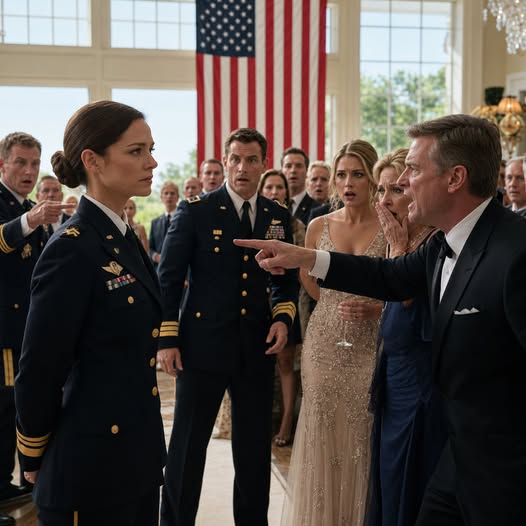
I knew something was wrong when my mother stepped in front of the glass doors instead of opening them.
Behind her, Cedar Ridge Country Club looked like a picture from a Southern wedding magazine. White roses climbed the stone columns. A string quartet played beneath a striped awning near the fountain. Valets in black vests jogged between polished SUVs while women in bright dresses crossed the circular drive carrying silver gift bags.
I had driven almost seven hours from Fort Campbell to Bowling Green.
Seven hours of interstate construction, gas-station coffee, and hot Kentucky wind pushing against my truck. I had spent two weeks trading shifts and requesting leave because our section was already short-staffed. I had changed into my dark blue dress uniform in the restroom of a Love’s travel stop, balancing my garment bag on a hook that kept slipping loose.
Now my mother stood between me and my sister’s wedding with her arms folded.
“What’s going on?” I asked.
Her eyes moved over my uniform, my overnight bag, and the small wrapped gift under my arm. She did not smile.
“Lauren wants today to be peaceful.”
I waited for the rest.
When it did not come, I laughed once. It was not a real laugh. It was the sound a person makes when her mind refuses to understand what her ears have already heard.
“I drove seven hours.”
“I know.”
Advertisements
“Then move.”
My father appeared beside her. He kept one hand in his pocket and looked toward the parking lot instead of at me.
“Claire,” he said, “don’t make a scene.”
Those words pushed something cold through my chest.
I looked past them. Through the open ballroom doors, at least a hundred people stood beneath chandeliers drinking champagne. Waiters carried trays between tables covered in ivory linen. There were enough imported flowers in that room to pay three months of my rent.
“You said it was family only,” I said.
“It is,” Mom replied.
My father finally looked at me.
“Immediate family and close friends.”
I stared at him.
“I’m her sister.”
Mom’s expression tightened. “Lauren and Ethan decided it would be better if you watched through the livestream.”
For several seconds, I could hear everything at once—the fountain splashing, a valet closing a car door, violin music drifting through the heat.
Then I saw Lauren.
She stood near the staircase inside the ballroom in a fitted white gown with pearl buttons down the back. Her hair was pinned beneath a lace veil. She looked happy, beautiful, and completely at ease.
She turned toward the entrance.
Our eyes met.
I thought she would come outside. I thought she would at least look embarrassed.
Instead, my little sister looked away and accepted a champagne glass from one of her bridesmaids.
That hurt more than my parents’ words.
I remembered walking her to elementary school because she was afraid of the older kids. I remembered working evenings at a grocery store during community college after Dad lost his job. I remembered wiring money home from Germany when Mom said the power company had posted a shutoff notice.
I had always been family when someone needed rescuing.
Apparently, weddings were different.
Mom lowered her voice. “Please don’t ruin this for her.”
I looked at the gift in my hands. Inside was an engraved silver picture frame Lauren had admired online. It had cost more than I should have spent, but I had imagined giving it to her after the ceremony.
I placed it carefully on a table beside the entrance.
“Got it,” I said.
My father’s shoulders relaxed as though I had finally started behaving.
I turned around and walked back toward my truck.
Nobody followed me.
Nobody called my name.
Nobody said there had been a misunderstanding.
A family with two young daughters passed me in the parking lot. The girls wore matching yellow dresses and complained that their shoes hurt. Their father carried both pairs of sandals beneath one arm while their mother laughed.
Normal family noise.
I climbed into my truck and closed the door.
The cab was hot enough to sting my palms through the steering wheel. My phone buzzed on the passenger seat.
A livestream invitation appeared on the screen.
I turned the phone facedown and started the engine.
Forty minutes later, I stopped at a highway travel center. The air inside smelled like coffee, diesel fuel, and fried chicken. Truckers moved through the aisles carrying giant plastic cups. A child begged his mother for a neon-green toy tractor.
Nobody there knew I had just been removed from my sister’s wedding.
That anonymity felt kinder than anything my family had offered.
I bought a coffee I did not want and sat in my truck while wedding pictures began appearing in the family group chat. My cousins posted heart emojis. My aunt shared a photograph of Lauren walking down the aisle on Dad’s arm.
No one asked where I was.
I opened a message to my sister.
I typed, I hope it was worth it.
I deleted it.
Then I typed, You could have told me before I drove all this way.
I deleted that too.
At sunset, orange light spread across the parking lot. I wiped my face, although I could not remember when I had started crying.
“I’m done begging,” I said aloud.
I believed the worst part was over.
Twelve days later, my mother called and demanded $23,000—and casually revealed that my name was already on the wedding contract.
### Part 2
When Mom called, I was sitting in a cramped motor-pool office staring at a maintenance spreadsheet that looked as though three people had edited it during an earthquake.
The fluorescent lights buzzed above me. Outside, a military truck reversed across the lot, producing a loud warning beep every few seconds. My coffee had gone cold, my left knee ached from an old training injury, and one boot was loosened beneath my desk because my foot had swollen during the afternoon.
Mom had not contacted me since the wedding.
No apology. No explanation. Not even one of her carefully vague messages about misunderstandings and hurt feelings.
I watched her name flash across the screen before answering.
“Hello?”
“Why isn’t your card working?”
She did not greet me. She sounded irritated, as though I had failed to complete a chore.
“What card?”
“The payment card. The venue called. The final charge was declined.”
I leaned back in my chair.
“Okay.”
There was a sharp pause.
“What do you mean, okay?”
“I mean your card being declined has nothing to do with me.”
The reversing truck beeped again.
Mom lowered her voice. That was never a good sign. My mother became quiet only in church or immediately before saying something cruel.
“Claire, don’t start this. We need you to handle the balance.”
“What balance?”
“The wedding balance.”
I closed my eyes.
“How much?”
“Twenty-three thousand.”
The number seemed to remain in the air after she said it.
On my desk sat a paper coffee cup with CLAIRE written as CLARE in black marker. I stared at it because focusing on a misspelled name felt easier than accepting the conversation.
“You want me to pay twenty-three thousand dollars for a wedding I wasn’t allowed to enter?”
“Oh, stop being dramatic.”
My grip tightened around the phone.
I had been called difficult, stubborn, intimidating, cold, too serious, and impossible to please. Being called dramatic after my parents barred me from my sister’s wedding was almost impressive.
“I drove seven hours,” I said. “You told me to watch online.”
“Lauren needed peace that day.”
“And now she needs money.”
“She’s beginning her marriage. You’re her older sister.”
There it was.
I was her sister now.
“What does that mean?” I asked.
“It means family helps family.”
I stared at the peeling paint on the file cabinet.
“Apparently I’m family when there’s an invoice.”
Mom sighed heavily. “Ethan’s parents have certain expectations. We couldn’t embarrass ourselves in front of them.”
“So you embarrassed me instead.”
“Claire, this constant need to make everything about you is exhausting.”
For one dangerous second, I wanted to shout. I wanted to tell her exactly what I thought of her, Dad, Lauren, and their imported roses.
But I knew the pattern.
If I raised my voice, the forged history would begin immediately. Claire was jealous. Claire was unstable. Claire had allowed military life to make her bitter.
I kept my tone flat.
“I’m not paying.”
Mom gasped.
“You have a secure government paycheck.”
I looked around the office. The dusty fan in the corner barely moved the hot air. The chair beneath me had been repaired with silver tape. My truck needed tires, and I had been postponing a dental crown because I hated the cost.
“I earn that paycheck.”
“The Army pays for your housing and medical care.”
“The Army does not exist so Lauren can order a champagne wall.”
“You listen to me,” Mom snapped. “Your name is already on the paperwork. You need to deal with this before it becomes a serious problem.”
The room seemed to go silent.
Even the truck outside stopped moving.
“My name is on what?”
She did not answer.
I stood and closed the office door.
“Mom, what paperwork?”
“It was just a standard backup arrangement.”
“What arrangement?”
“The venue required a second financial guarantor.”
“I never agreed to that.”
“Lauren said it was routine.”
“I never signed anything.”
Another pause.
This one contained fear.
Mom’s voice softened. “Don’t make this ugly.”
I looked at the military forms on my desk, each one requiring dates, initials, and signatures. In my work, a missing serial number could trigger an investigation. A false signature could end a career.
“It became ugly before I answered the phone,” I said.
Then I hung up.
My hands were shaking.
I hated that my mother could still make me feel twelve years old, even after years of leading soldiers, dealing with equipment shortages, and briefing officers who outranked me.
I breathed until my hands steadied. Then I searched for Cedar Ridge Country Club and called the events office.
A cheerful woman answered.
“Cedar Ridge Events, this is Natalie.”
I gave her my name.
Her voice changed immediately.
“Oh, Ms. Morgan. We’ve been trying to reach you.”
Fear moved through me like ice water.
“I need copies of every document containing my name.”
“Is there a concern?”
“I never agreed to pay for my sister’s wedding.”
Silence.
Then I heard a keyboard.
“Let me pull the file.”
I waited while the fluorescent lights hummed above me.
When Natalie returned, she no longer sounded cheerful.
“Ms. Morgan, you are listed as the secondary guarantor for the remaining balance.”
“I did not sign that.”
“We also have a scan of your driver’s license, your military email address, and an electronic signature.”
My mouth went dry.
“Send everything to me.”
The email arrived six minutes later.
I opened the attached contract and found my full legal name beneath a signature that almost resembled mine.
Almost.
Whoever had copied it had studied the shape but missed the habit. I always looped the first letter of my last name. The person who forged it had drawn each stroke slowly, creating a stiff imitation.
Below the signature was a scanned copy of my old Kentucky driver’s license.
I knew exactly who had that file.
Two years earlier, while I was deployed, Mom had demanded copies of my identification for what she described as urgent family medical paperwork.
At the time, I had sent them without asking enough questions.
Now that same image sat inside a wedding contract I had never seen.
And tucked into the account information was a recovery email address belonging to my sister.
### Part 3
I printed every page before leaving work.
The printer jammed halfway through, and I stood beneath the harsh office lights pulling out a wrinkled sheet covered with half of my forged signature. The absurdity of it nearly made me laugh.
I carried the documents home in a plain manila folder.
My apartment smelled faintly of the lemon cleaner I had used that weekend. A bowl of apples sat untouched on the counter. Someone upstairs dragged furniture across the floor while I spread the contracts beneath the kitchen light.
There were three separate agreements.
The venue contract listed me as a guarantor.
A catering addendum contained the same false signature.
A payment authorization form included the last four digits of an old credit card I had closed the previous year.
This was not one desperate mistake made on the morning of the wedding.
Someone had planned it.
I searched my email and discovered two messages from vendors buried in the junk folder. Both referred to conversations I had supposedly had with Lauren.
One message thanked me for “continuing the Morgan family tradition of supporting Lauren.”
Another confirmed my willingness to cover any remaining expenses after the reception.
I had never spoken with either company.
At 6:45 the next morning, I was waiting outside the legal-assistance office on base.
The building had beige walls, industrial carpet, and a coffee machine that produced something the color of muddy water. I sat beneath a poster explaining consumer-protection rights and felt strangely ashamed.
I had done nothing wrong.
Still, my face warmed when Captain Julia Reyes invited me into her office and asked why I needed help.
That was the talent my family possessed. They could make their wrongdoing feel like my embarrassment.
Captain Reyes looked young, perhaps thirty-two, but her eyes had the tired patience of someone who had heard every possible version of family disaster. She read the documents without interrupting.
Her silence made me nervous.
After fifteen minutes, she placed the contract on her desk and tapped the signature.
“This is not yours?”
“No.”
“You did not authorize your sister, your parents, or anyone else to sign for you?”
“No.”
“You never agreed verbally to guarantee these payments?”
“No.”
She folded her hands.
“Then you need to treat this as identity theft and possible forgery.”
The words sounded too large for Lauren.
I pictured her at five years old, refusing to enter kindergarten unless I walked her to the classroom. I pictured the purple backpack I bought when Mom said money was too tight. I pictured her at sixteen, crying in my passenger seat after her first boyfriend broke up with her.
Forgery belonged to strangers in courtrooms, not to the little sister whose scraped knees I used to bandage.
Captain Reyes must have noticed my expression.
“I’m not telling you how to feel about your family,” she said. “But legally, you need to protect yourself before you protect anyone else.”
“What happens if I simply refuse to pay?”
“You dispute every charge in writing. You notify every vendor that the documents were unauthorized. You freeze your credit, change your passwords, and file an identity-theft report. Do not accept responsibility for any part of the debt.”
I looked at the manila folder.
“What happens to Lauren?”
“That depends on what the vendors and investigators discover.”
My stomach twisted.
The old instinct appeared immediately.
Maybe I could negotiate.
Maybe I could pay a smaller amount.
Maybe I could prevent the situation from becoming public.
Captain Reyes watched me.
“Sergeant Morgan, whoever did this expected you to feel exactly what you’re feeling right now.”
“What am I feeling?”
“Responsible for protecting the people who harmed you.”
I sat very still.
After the appointment, I made calls from my truck during lunch.
The florist recognized my name.
“Oh, yes. Lauren told us you were helping with the final expenses.”
Helping.
The word sounded harmless, like stacking chairs after a church supper.
The catering manager forwarded an email in which Lauren had written, My sister Claire is our backup. She’s in the Army and extremely stable financially.
I read the sentence three times.
My couch came from Facebook Marketplace. I bought store-brand cereal. I had delayed replacing my cracked phone screen for six months.
But in Lauren’s version of reality, being unmarried and childless meant I possessed unlimited funds.
The photographer sent an additional agreement with the same fake signature.
By Friday, my kitchen table had disappeared beneath evidence: printed emails, contracts, screenshots, call notes, and dates written in a spiral notebook.
Documentation calmed me. My career had trained me to prepare records that could survive inspection. Once I stopped thinking like the wounded daughter and started thinking like a noncommissioned officer, the pattern became obvious.
They had planned for Claire the sister.
They had not prepared for Sergeant Morgan.
On Saturday morning, Natalie from Cedar Ridge called again.
“I found something in the electronic-signature history,” she said. “You should probably see it.”
My bare feet pressed against the cold kitchen tile.
“What is it?”
“The contract was opened from an account registered to Lauren Whitfield.”
I gripped the edge of the counter.
Natalie continued carefully.
“The verification code was also sent to her phone.”
Outside, someone started a lawn mower. A dog barked. A child shouted from the apartment courtyard.
Ordinary Saturday noises surrounded me while the history of my relationship with Lauren changed shape.
My sister had not merely used information Mom provided.
Lauren had personally opened the contract and signed my name.
Natalie emailed the digital record.
I stared at the device information, login time, and recovery address.
Then I saw the date.
The contract had been signed three weeks before the wedding—the same week Lauren called me crying and asked whether I had received approval for leave.
She had known I was coming.
She had forged my name anyway.
And somewhere between that phone call and the ceremony, my entire family had decided I would be easier to charge if I was not inside the room.
### Part 4
I called Mom that evening even though Captain Reyes had advised me to keep all communication in writing.
Some part of me still wanted an explanation that hurt less than the evidence.
Mom answered on the fourth ring.
“Are you ready to stop punishing everyone?”
No hello.
No concern.
No shame.
“Did you give Lauren my driver’s license?”
Silence followed.
It lasted less than two seconds, but it was enough.
“She needed information for the venue.”
“She used it to forge my signature.”
“Don’t use that word.”
“What word would you prefer?”
“She was overwhelmed.”
I closed my eyes.
My family had its own translation system.
Theft became stress.
Lying became confusion.
My refusal became cruelty.
“Did Dad know?”
“Your father does not need additional pressure.”
That meant yes. Perhaps he had not known every detail, but he had known enough to remain silent.
“I sent you that license because you said Dad needed medical paperwork.”
“He was having tests.”
“So you kept my identification.”
“I keep family records.”
“You gave those records to Lauren so she could pretend to be me.”
Mom exhaled sharply.
“You always make things sound so ugly.”
“No. I’m finally saying them accurately.”
Her voice hardened. “What do you expect us to do? The venue wants payment. Lauren and Ethan just got married. We cannot allow this to destroy their future.”
“You should have thought about that before using my name.”
“She assumed you would help.”
“She never asked.”
“We knew how you would react.”
That sentence stopped me.
They had excluded me because asking beforehand risked hearing no.
Instead, they intended to place the debt in my name and depend on shame to keep me quiet.
“Did you stop me at the door because the vendors were there?” I asked.
Mom said nothing.
Suddenly, the wedding exclusion made more sense.
The florist might have thanked me for the payment arrangement. The venue manager might have mentioned my guarantee. Ethan or his parents might have asked questions Lauren could not answer.
Keeping me outside was not only cruel.
It was practical.
“You didn’t want me to discover the contracts,” I said.
“That is ridiculous.”
“Is it?”
“Lauren wanted one day without tension.”
“She created the tension.”
“You’ve always resented her.”
I laughed softly. “There it is.”
“What?”
“The reason you use whenever I stop cooperating.”
“You have no idea what she has been through.”
“I know what she has done.”
Mom began crying. For most of my life, that sound had acted like a fire alarm. I would apologize, soften my words, and search for a way to restore calm.
This time I listened without moving.
“I raised you,” she said. “I sacrificed everything for both of you.”
“And now you believe that gives you ownership of my identity?”
“How can you speak to your mother like this?”
“The same way you could hand my license to someone forging my name.”
She stopped crying.
Her voice became low and cold.
“If you report your sister, don’t expect this family to welcome you back.”
I looked around my quiet apartment.
A refrigerator hummed. Evening light fell across the contracts on my table. On the wall hung a framed photograph of my promotion ceremony. Mom, Dad, and Lauren had all claimed they were too busy to attend.
I had spent years trying to earn entrance into a place where I was welcome only as long as I paid.
“I drove seven hours to discover I wasn’t welcome,” I said. “You already answered that question.”
I ended the call.
For three nights, I barely slept.
I ate cold pizza over the sink and handfuls of chocolate chips from the bag. At work, I functioned through habit. Check the reports. Answer questions. Correct mistakes. Keep moving.
On Monday morning, I stood before the bathroom mirror wearing my uniform.
I was thirty-nine. The skin beneath my eyes looked gray. My back hurt. My left knee clicked when I bent it.
For a few minutes, I considered paying the bill.
I opened my banking application and looked at my savings.
The amount represented years of overtime, deployment pay, and quiet sacrifices. It was supposed to become a down payment on a small home after retirement.
Twenty-three thousand dollars would damage that plan, but it would not destroy me.
Paying might bring silence.
That temptation frightened me more than the contract.
I had nearly convinced myself when another email arrived from the venue.
FINAL NOTICE—CLAIRE MORGAN.
My name sat in the subject line beside a debt I had not created.
Something inside me settled.
Not snapped.
Settled.
I opened a new message.
I did not authorize these charges, sign these agreements, or consent to serve as guarantor. I formally dispute all financial responsibility.
I attached the documents and copied Captain Reyes.
Then I contacted each vendor, froze my credit, changed every password, and filed an identity-theft report.
At 4:17 that afternoon, I received a message from Lauren.
How could you do this to me?
I stared at those six words until anger gave way to absolute clarity.
She still believed the victim was herself.
Then another message appeared—from Ethan, the husband I had never been permitted to meet.
Did you really refuse to attend our wedding because you didn’t approve of me?
### Part 5
I read Ethan’s message three times.
Until that moment, I had assumed he knew everything. I pictured him standing beside Lauren while my parents blocked the entrance. I imagined them deciding together that I was too difficult to include but financially useful enough to exploit.
His question suggested a different story.
I did not answer immediately.
Instead, I opened my photographs.
At 2:14 p.m. on the wedding day, I had taken a picture through my windshield. The country-club entrance was visible beyond the hood of my truck. My mother stood near the doors speaking with a valet. The image contained a location tag and timestamp.
I sent it to Ethan.
Then I attached the livestream invitation, the message from Mom saying Family members only, and the photograph of the unopened wedding gift I had left at the entrance.
My response contained one sentence.
I drove seven hours and was turned away at the door.
He called less than a minute later.
I let the phone ring twice before answering.
“This is Claire.”
“Lauren told me you chose not to come.”
His voice was quieter than I expected.
“I was there.”
“She said you didn’t support the marriage.”
“I had never met you.”
“I know.”
The silence between us felt enormous.
I walked onto my balcony. The concrete still held the day’s heat. Below, a neighbor loaded grocery bags into a minivan while two children argued over who got to carry the cereal.
“Did you know my name was on the contracts?” I asked.
“No.”
The answer came quickly.
“Did you know your wife used a copy of my driver’s license?”
“No.”
“Did you believe I volunteered to pay?”
“Yes.”
That answer came more slowly.
I leaned against the railing.
“Why?”
“Because Lauren said you always handled family expenses.”
The words landed with a dull, familiar weight.
“She told my parents the same thing,” Ethan continued. “Whenever anyone asked about the final balance, she said you had agreed to cover it.”
“Did anyone speak directly to me?”
“No.”
“Did that seem strange?”
“Yes,” he said. “It does now.”
I appreciated that he did not invent excuses.
He told me Lauren had managed most of the planning. Ethan paid a significant amount. His parents contributed to the venue and rehearsal dinner. Lauren claimed my parents would cover the remaining vendors.
Whenever the budget increased, she repeated the same promise.
Claire will handle it.
Claire has savings.
Claire doesn’t have children.
Claire won’t mind.
Hearing those phrases from a stranger made me feel as though I were listening to people describe a household appliance.
Not a sister.
Not a daughter.
A resource.
“I found an email,” Ethan said.
“What email?”
“One she sent before the wedding. I didn’t understand it at the time.”
My phone vibrated with a new message.
I opened the forwarded email.
The note was short, written six weeks before the ceremony.
Don’t worry about the remaining balance. Claire will pay after the reception. She always complains first, but she comes through.
I read the final sentence again.
She always complains first.
Every time I had objected to paying a utility bill, car repair, credit-card minimum, or emergency loan, my resistance had become part of the process. They did not view my no as an answer.
They viewed it as the unpleasant stage before surrender.
“Claire?” Ethan said.
“I’m here.”
“I didn’t know.”
“I believe you.”
“I’m sorry.”
I believed that too.
Not because I trusted him, but because confusion has a sound. His voice carried the flat shock of someone discovering that the person sleeping beside him had created an entire false reality.
“I’m sending you the contracts,” I said.
“What are you going to do?”
“Protect myself.”
“And Lauren?”
“That is no longer my responsibility.”
After the call, I emailed him everything—vendor correspondence, signature records, identification scans, and the formal disputes.
No insults.
No emotional commentary.
The facts were ugly enough.
For three days, my phone remained silent.
Then Mom called from an unfamiliar number.
I answered without thinking.
“What did you do?” she screamed.
I held the phone away from my ear.
“What are you talking about?”
“You poisoned Ethan against his own wife.”
“I sent him documents.”
“You had no right.”
“I had every right. My name is on them.”
“You knew this would damage their marriage.”
“Lauren damaged her marriage.”
“Why can’t you let anyone be happy?”
There was the family logic again. Their happiness required my ignorance, money, and silence. My refusal was treated as sabotage.
I waited until Mom ran out of accusations.
Then I said, “If the truth destroys something, the truth wasn’t the weakness.”
I ended the call and blocked the number.
That evening, Ethan sent me another message.
I confronted Lauren. She says your parents told her you had already agreed.
Before I could respond, Dad emailed.
Your mother and sister are blaming each other. We need to meet as a family before this gets worse.
I almost deleted it.
Then a final message arrived from my Aunt Vivian.
Meet at my house Sunday. Bring every document. Your mother has been lying to all of us about more than the wedding.
### Part 6
Aunt Vivian lived in Owensboro in a yellow-brick ranch house with ceramic birds lining the porch and wind chimes that rang whenever the air moved.
It was not the setting anyone would choose for the largest confrontation of her adult life.
But family disasters rarely happen in dramatic places. They happen in kitchens smelling of coffee, beneath school photographs and refrigerator magnets collected from vacation towns.
I arrived ten minutes early.
Military habit.
The July heat shimmered above the driveway. My stomach felt tight, and my knee ached after the two-hour drive. I sat in the truck with the air conditioner running and considered leaving.
Then I remembered Lauren turning away from me inside the ballroom.
I remembered Mom saying family only.
I took the evidence folder and walked to the house.
Aunt Vivian opened the door before I knocked.
She was seventy-four, barely five feet tall, and tougher than most officers I had served under.
She hugged me without speaking.
The simple kindness nearly broke my composure.
“You holding up?” she asked.
“I’m trying.”
“That counts.”
Everyone else was already inside.
Mom and Dad sat at one end of the dining table. Mom’s arms were folded. Dad studied the wood grain as though expecting instructions to appear.
Lauren sat beside Ethan, but several inches separated their chairs.
Her wedding glow was gone. She wore no makeup, and her hair hung loosely around her face. For one dangerous moment, she looked like the little sister I remembered.
Then I saw the gold wedding band on her hand and thought of my forged signature.
Two cousins, Uncle Ray, and Aunt Vivian’s neighbor Marlene occupied the remaining chairs. Marlene had worked for a bank’s fraud department for twenty-eight years and had apparently been invited as a neutral witness.
A tray of cinnamon rolls sat untouched in the center of the table.
Nobody spoke when I entered.
Aunt Vivian poured herself coffee.
“All right,” she said. “Who wants to start lying?”
Mom’s face tightened.
“Vivian, that isn’t productive.”
“Then tell the truth. That’ll save time.”
Mom turned toward me.
“Claire has always had trouble managing family disagreements.”
No greeting.
No apology.
Straight to character assassination.
I set the folder on the table.
“Interesting beginning.”
Lauren’s eyes filled with tears.
Growing up, her crying functioned like an emergency switch. The moment tears appeared, everyone stopped asking questions and began comforting her.
I looked away.
Dad cleared his throat.
“We’re not here to point fingers.”
A laugh escaped me.
He frowned. “What?”
“The fingerprints are on legal documents.”
No one smiled except Aunt Vivian.
I opened the folder.
“We’re sticking to facts.”
Mom sighed. “Claire, please don’t turn this into one of your military briefings.”
“That’s exactly what I’m doing.”
I began with the timeline.
I explained my leave request, seven-hour drive, arrival at Cedar Ridge, and exclusion from the ceremony. I placed the timestamped photograph on the table.
Then I presented the contracts, verification records, fake signatures, identification scan, vendor emails, and payment demands.
I did not raise my voice.
Calmness bothered Mom more than anger would have. Anger could be dismissed. Documentation could not.
Whenever she tried to interrupt, I slid another page toward Marlene.
Ethan spoke after I finished.
“Lauren told me Claire refused to attend.”
Lauren wiped her face.
“I was under pressure.”
No one answered.
“I didn’t know what else to do,” she whispered.
I believed she had felt pressured. The wedding had grown beyond their budget. Ethan’s parents were wealthier than ours. Lauren had spent her life desperately maintaining appearances.
But pressure did not open my email account.
Fear did not scan my license.
“Scared people ask for help,” I said. “They don’t steal identities.”
Mom leaned forward.
“Nobody stole anything.”
Nearly everyone at the table turned toward her.
She seemed to realize how ridiculous the statement sounded.
“We always knew Claire would eventually help,” she corrected.
There it was.
Not an excuse.
The actual plan.
“You assumed I would surrender once the bill arrived.”
“That isn’t what happened.”
“Then explain what happened.”
Mom opened her mouth, but nothing came out.
A full minute passed.
Finally, she said, “I sent Lauren the identification records.”
Lauren closed her eyes.
Dad remained motionless.
Ethan leaned away from his wife.
Mom rushed on. “I believed the venue needed verification.”
“You also gave her access to my old email,” I said.
“I gave her a password you used years ago. I didn’t know it still worked.”
Marlene wrote something on a legal pad.
Dad looked up sharply.
“You told me Claire had agreed.”
Mom turned toward him. “You knew she would.”
“That wasn’t the question.”
For the first time, a crack appeared between my parents.
Before Mom could answer, Aunt Vivian rose and walked to a drawer near the kitchen. She returned with a small flowered notebook.
“I have a question for Lauren,” she said.
Lauren looked up.
“Last year, you borrowed sixty-five hundred dollars from me for an emergency medical procedure.”
Mom went pale.
Aunt Vivian opened the notebook.
“There was no procedure, was there?”
Lauren stared at the table.
“No.”
The word was barely audible.
Aunt Vivian nodded slowly.
“That’s what I thought.”
Then she turned several pages and read the names of four relatives Lauren had also borrowed money from.
One by one, the people around the table began telling stories.
A broken furnace that had never been broken.
A dental emergency that never occurred.
A tuition bill from a program Lauren had already left.
The wedding fraud was not the beginning.
It was simply the first time she had taken too much from someone unwilling to hide it.
### Part 7
The room changed after Aunt Vivian opened her notebook.
Until then, everyone had treated the wedding as an isolated disaster—a good woman under pressure making one terrible choice.
Now a pattern lay across the table.
My cousin Rebecca had loaned Lauren twelve hundred dollars for an emergency car repair. Two weeks later, Lauren posted photographs from a beachfront hotel in Charleston.
Uncle Ray paid a supposed overdue utility bill. The account had never been behind.
Aunt Vivian’s sixty-five hundred dollars had financed deposits for the florist and photographer.
Each lie had been small enough to excuse. Each relative had assumed the others knew more. Nobody wanted to embarrass Lauren or upset Mom.
Silence had protected her better than any plan.
Lauren sat beneath the dining-room light looking younger and older at the same time.
“I was going to pay everyone back,” she said.
“With what?” Ethan asked.
She looked at him helplessly.
He did not soften.
“You told me your aunt gifted that money.”
“I meant to replace it after the wedding.”
“With Claire’s money?” Aunt Vivian asked.
Lauren’s face crumpled.
Mom pushed back her chair.
“This is becoming cruel.”
“No,” Marlene said calmly. “It is becoming clear.”
Mom glared at her. “You’re not family.”
Marlene capped her pen.
“That may be why I can see what your family refuses to.”
Dad rubbed both hands over his face.
“How much?” he asked.
Lauren did not answer.
“How much do you owe people?”
“I don’t know.”
“You don’t know?”
“Maybe fourteen thousand.”
Aunt Vivian began adding figures from her notebook.
Rebecca checked old bank records on her phone. Uncle Ray remembered another loan. Ethan listed credit-card charges Lauren had claimed her parents would reimburse.
The total reached thirty-eight thousand dollars before they stopped finding new amounts.
That did not include the remaining wedding bill.
Ethan stood and walked toward the kitchen window.
He stared outside at the bird feeder.
“Our marriage started with more than sixty thousand dollars in hidden debt,” he said.
Lauren rose halfway from her chair.
“We can fix this.”
He turned.
“You told me Claire hated me. You forged her signature. You lied to my parents. You lied about our finances. Which part do you want to fix first?”
Mom rushed toward Lauren.
“She made mistakes.”
“So did I,” Ethan said. “I believed her.”
Lauren looked at me.
The plea in her eyes was familiar.
For years, I had responded to that expression by reaching for my wallet, my truck keys, or my phone.
This time, I remained seated.
“Claire,” she whispered. “Please.”
Mom looked relieved, as though the old rescue ritual had begun.
I asked, “Please what?”
“Tell everyone I’m not a criminal.”
The room went silent.
I felt grief beneath my anger. Lauren was not a stranger. She was the child who slept in my bed during thunderstorms and the teenager who borrowed my sweaters without asking.
But love could not change facts.
“I can’t tell them that.”
“You know me.”
“I thought I did.”
Mom began crying.
“What kind of sister says that?”
“The kind whose name was forged.”
Dad turned toward Mom.
“Did you know about the other loans?”
She shook her head too quickly.
Aunt Vivian watched her.
“Diane.”
Mom stared at the floor.
Dad’s voice became quiet.
“What did you know?”
“She needed help.”
“How much?”
“I don’t remember.”
Aunt Vivian flipped to another page.
“I do.”
Over the previous three years, Mom had borrowed money from relatives on Lauren’s behalf while claiming the funds were for household repairs, medical care, and Dad’s prescriptions.
Dad looked physically ill.
“You used my health?”
“You wouldn’t understand.”
“I understand that people believed I was sick.”
“You were stressed.”
“I was not dying.”
Mom’s excuses collapsed into tears.
For the first time, I saw the system clearly.
Lauren had not developed her entitlement alone. Mom had protected her from consequences, rewritten every failure, and recruited relatives into paying for the next one.
Dad had participated through silence.
And I had helped by repeatedly solving whatever reached me.
I stood.
My chair scraped against the floor.
“I am not your emergency fund,” I said.
Nobody moved.
“I am not your backup plan. I am not the daughter you hide outside until a bill arrives.”
Mom covered her face.
I continued, because the words had waited most of my life to exist.
“I’m done buying my place in this family.”
Lauren cried openly now.
“I’m sorry.”
“No, you’re scared.”
“That doesn’t mean I’m not sorry.”
“Maybe one day you’ll know the difference.”
Ethan removed his wedding ring and placed it on the table.
Lauren stared at it.
“I need space,” he said. “Not a weekend. Not a few days. I need to understand who I married.”
She reached for him, but he stepped away.
Mom turned toward me with sudden fury.
“Are you happy now?”
The question was so predictable that it almost calmed me.
“No,” I said. “That’s what you never understood. I didn’t want revenge. I wanted a family that wouldn’t steal from me.”
I picked up my folder.
At the doorway, Dad finally spoke.
“Claire.”
I looked back.
His face seemed to have aged during the afternoon.
“I should have stopped this.”
“Yes,” I said.
He waited, perhaps expecting comfort.
I gave him none.
Outside, the evening air smelled like cut grass. The wind chimes moved above Aunt Vivian’s porch.
I had reached my truck when Marlene hurried after me.
“There’s something else,” she said.
She handed me a photocopied bank statement Aunt Vivian had found among Mom’s records.
On it was an automatic monthly transfer from an account bearing my name—an account I had never opened.
The wedding contract was not the only place my identity had been used.
### Part 8
Marlene and I sat inside my truck while the air conditioner blew warm air across the dashboard.
The bank statement showed a joint savings account opened eighteen months earlier at a regional bank in Bowling Green.
The names listed were Claire Morgan and Diane Morgan.
My mother and me.
Except I had never visited that branch, signed those documents, or agreed to share an account.
Monthly transfers of four hundred dollars had moved from the joint account into Lauren’s checking account. Several larger deposits had come from personal loans.
“Where did Aunt Vivian find this?” I asked.
“Your mother left a folder at her house after asking Vivian to help organize some financial paperwork.”
I examined the dates.
The account had been opened while I was stationed in Texas for training.
“Could Mom have opened it without me?”
“Not legally,” Marlene said. “But with your identification, personal information, and a forged signature, she might have succeeded.”
The wedding debt was twenty-three thousand dollars.
The larger question was how much damage had already been done.
I called Captain Reyes from the driveway.
She told me not to contact Mom. She advised me to request my full credit reports, notify the bank’s fraud department, and add the new information to the existing report.
I drove home through darkness.
The headlights illuminated flat stretches of highway and occasional billboards advertising injury lawyers, church services, and fireworks. My phone remained silent in the cup holder.
For years, silence from my family had frightened me. It meant someone was angry. It meant I would eventually be required to apologize.
That night, silence felt like evidence.
At home, I opened my credit reports.
Two personal loans appeared under my name.
One had been paid regularly for fourteen months.
The second was three payments behind.
Together, the original amounts totaled nearly forty thousand dollars.
I sat at my kitchen table until the screen blurred.
The loan applications listed an address belonging to my parents.
One used my military employment information.
The other included an income figure higher than my actual salary.
I called the lenders the next morning.
Both had electronic signatures.
Both had copies of my identification.
Both used an email address created from my name and birth year.
The recovery phone number belonged to Mom.
I went to the bank with Marlene two days later.
The fraud investigator, a gray-haired man named Mr. Holland, led us into a private office. He reviewed the documents and pulled up the account-opening records.
A security image appeared on his monitor.
Mom sat at a bank employee’s desk wearing a pale green blouse.
Beside her sat Lauren.
The timestamp showed 10:32 a.m. on a Wednesday when I was eight hundred miles away.
Mr. Holland enlarged a scanned signature card.
My name appeared at the bottom.
The same incorrect first letter.
The same careful imitation.
“I’m sorry,” he said. “This should not have happened.”
“How did it happen?”
“The employee who opened the account no longer works here. Your mother apparently claimed you were deployed and had completed the paperwork in advance.”
“Was there a notarized authorization?”
“No.”
“Then why was the account approved?”
He looked uncomfortable.
“It appears procedures were not followed.”
I felt too tired to become angry.
“What happens now?”
“We freeze the account, conduct an internal review, and provide records to investigators. You’ll need to dispute the loans separately.”
Captain Reyes connected me with a civilian attorney specializing in identity fraud.
His name was Marcus Bell. His office stood above a bakery in Clarksville, and the stairwell smelled like cinnamon and butter.
Marcus reviewed my growing file.
“This is not a family misunderstanding,” he said. “It is a sustained pattern of financial fraud.”
“I know.”
“Do you?”
The question irritated me.
He must have seen it in my face because he leaned back.
“You still speak about protecting them from consequences.”
“I don’t want my parents in prison.”
“That decision is not entirely yours. They made decisions involving lenders, businesses, and false documents.”
I looked toward the window.
Below us, a delivery driver unloaded flour from a white van.
Marcus continued.
“You are allowed to grieve them and still tell the truth.”
That afternoon, I submitted formal disputes on both loans.
The lenders requested affidavits, identification records, military travel documentation, and proof that I had been outside Kentucky when the applications were filed.
I had all of it.
The Army recorded nearly everything.
For once, the institution people mocked as overly bureaucratic became my strongest protection.
When Mom realized the bank account had been frozen, she called my commanding officer’s office.
She claimed I was experiencing an emotional crisis and targeting my family.
My first sergeant, a woman named Angela Brooks, invited me into her office.
She closed the door and placed a written call summary on the desk.
“Do you need help?” she asked.
“Yes,” I said honestly. “But not the kind she described.”
I showed her the police report and attorney’s letter.
Angela read them slowly.
Then she said, “Your mother attempted to use your chain of command to silence a fraud investigation.”
Hearing it described that way made the final thread inside me break.
Not emotionally.
Practically.
I changed my emergency contact. Removed my parents from every military record where they were not legally required. Updated my will. Replaced Mom as the beneficiary of my life-insurance policy.
The person I selected instead was Aunt Vivian.
Three days later, Dad appeared outside my apartment holding a cardboard box.
Inside were dozens of documents Mom had hidden—including a sealed envelope containing a third loan application bearing my name.
### Part 9
Dad stood in the hallway wearing an old Western Kentucky University cap and a shirt damp with sweat.
He looked smaller than I remembered.
Not physically. Morally.
I did not invite him inside.
“What is that?” I asked.
“Things I found.”
He held out the box.
I took it but kept one foot against the bottom of the door.
“Where’s Mom?”
“At home.”
“Does she know you’re here?”
“No.”
That surprised me.
Dad had spent most of his life avoiding choices that might upset her. He worked, paid what he could, and disappeared into television whenever conflict entered the room.
“You should give this to my lawyer.”
“I wanted to explain.”
“I don’t need an explanation from you.”
His mouth tightened.
“I didn’t know everything.”
“You knew enough.”
“I thought the wedding paperwork was just a temporary arrangement.”
“Using my name without permission is not temporary.”
“I should have asked questions.”
“Yes.”
He looked down the empty hallway.
A neighbor’s television played behind a closed door. Somewhere outside, a motorcycle accelerated along the street.
“Your mother said you’d always taken care of things.”
“And you believed that made it acceptable?”
“No.”
“But you did nothing.”
He removed his cap and rubbed the top of his head.
“I was afraid the family would fall apart.”
“It already had. You were afraid you’d be required to admit it.”
The words hurt him. I saw that.
For years, I would have softened them.
I did not.
Dad pointed toward the box.
“There are loan papers, emails, and some notes your mother kept. I don’t know what all of it means.”
“Why bring it now?”
“Because she called your commander.”
“So that was the line?”
His face reddened.
“It made me realize how far she was willing to go.”
“She stole my identity.”
“I know.”
“She helped Lauren forge wedding contracts.”
“I know.”
“She lied to relatives using your health.”
“I know.”
“But involving the Army finally bothered you.”
He did not answer.
I understood then that Dad’s awakening was not courage. It was fear. Mom’s actions had reached an institution he respected and could not control.
I took the box.
“I’ll give it to my attorney.”
“Claire, I’m sorry.”
I met his eyes.
“I believe you regret what happened.”
“That’s not the same as being sorry?”
“No. Regret is wishing the consequences had not arrived. Remorse is wishing you had not caused the harm.”
He flinched.
I closed the door.
The box contained a history of betrayal arranged in manila folders.
Mom had kept copies of loan applications, payment schedules, and messages between herself and Lauren.
One email made my stomach turn.
Lauren had written, Claire’s credit is excellent because she never does anything fun. We can use the loan temporarily and pay it off before she notices.
Mom replied, Make sure the statements come here.
Another message concerned the wedding.
If Claire sees the contract before the ceremony, she’ll refuse. We’ll tell her afterward when there’s no choice.
The message was dated two months before the wedding.
The exclusion had been planned.
They needed me absent long enough for the ceremony, photographs, and vendor work to be completed. Afterward, they believed the bill would become my unavoidable burden.
Inside the sealed envelope was an unsigned application for a third personal loan of twenty-five thousand dollars.
My employment information had been completed.
My Social Security number was written at the top.
The listed purpose was home improvement.
Mom had apparently intended to borrow against my identity again after the wedding.
At the bottom of the box, I found a handwritten note.
Claire will complain, but she won’t report family.
I photographed everything and called Marcus.
The evidence changed the investigation. This was no longer a dispute centered on questionable signatures. It showed planning, concealment, and intent.
Ethan filed for legal separation that same week.
Lauren left him twelve voicemails and then appeared at his parents’ house. They asked her to leave.
Mom blamed me in a five-page email.
She accused me of humiliating Lauren, destroying her marriage, frightening Dad, and dividing the extended family.
She never used the words forged, stolen, or illegal.
At the bottom, she wrote, A loving daughter would stop this before people get arrested.
I forwarded the email to Marcus without responding.
The venue removed my name from its account after confirming the signature irregularities. The photographer and caterer did the same. The disputed wedding balance returned to Lauren, Ethan, and my parents based on the contracts they had genuinely signed.
Ethan paid only the portion he had personally authorized.
My parents sold their recreational fishing boat and borrowed against their house to cover the rest.
For the first time, their choices belonged to them.
Then the county investigator called.
He had completed the first stage of his review and wanted to interview Mom and Lauren separately.
Before that happened, Lauren came to my apartment alone.
Through the peephole, I saw her holding the silver picture frame I had left at the country club.
### Part 10
I opened the door but left the chain fastened.
Lauren stood in the hallway wearing jeans, a gray sweatshirt, and no wedding ring.
The silver frame rested against her chest.
“I need to talk to you.”
“My attorney told me not to discuss the investigation.”
“I’m not here about the investigation.”
“That’s the only reason you’re here.”
She looked down.
For several seconds, neither of us spoke.
The hallway smelled like someone’s garlic dinner. An elevator chimed at the far end. Life continued around the most painful conversation of my life.
“I found this after the wedding,” Lauren said, lifting the frame.
Inside the box was a photograph of us from years earlier. She was eleven, I was eighteen, and we were sitting on the hood of Dad’s old truck eating ice cream.
“I didn’t open it until last week.”
I waited.
Her eyes filled with tears, but she did not use them as a weapon this time.
“I don’t know how I became this person.”
“Yes, you do.”
The answer startled her.
“You were protected from every consequence,” I said. “Mom translated every lie into an emergency. Dad looked away. I paid whatever remained.”
Lauren pressed the box against her sweatshirt.
“I know.”
“No. You’re beginning to know.”
“Ethan won’t speak to me except through his lawyer.”
“That is his right.”
“I lost my job.”
I had not heard that.
“What happened?”
“My employer found out about the investigation. I handled customer accounts.”
The consequences had spread beyond the wedding and marriage.
Years earlier, I would have immediately considered sending money.
The thought did not even appear.
“I’m sorry you’re facing that.”
She gave a broken laugh. “You sound like a stranger.”
“We are strangers.”
“I’m still your sister.”
“So was I when you watched Mom turn me away.”
Her face went still.
I had wondered about that moment for months. Now I wanted the truth.
“Why didn’t you stop them?”
Lauren stared at the frame.
“I was afraid you’d walk inside and someone would mention the contracts.”
At least she did not lie.
“So you knew.”
“Yes.”
“You knew I had driven from Fort Campbell.”
“Yes.”
“You knew I had taken leave.”
“Yes.”
“And you looked at me through the doors.”
Her mouth trembled.
“Yes.”
I felt something final settle inside me.
Not anger.
Not hatred.
An ending.
Lauren stepped closer.
“I’m sorry.”
“I believe you feel sorry now.”
“Can you ever forgive me?”
The question might once have controlled me. My family treated forgiveness as an eraser, something owed the moment an offender cried convincingly enough.
“I don’t know,” I said. “But forgiveness would not restore our relationship.”
Her eyes widened.
“I thought maybe, after everything is settled—”
“No.”
The word was calm.
She began crying.
“I’m trying to take responsibility.”
“Then take it without demanding a reward.”
“I’m not demanding anything.”
“You came here hoping an apology would give you your sister back.”
She wiped her face with her sleeve.
“I miss you.”
“You missed access to me long before you noticed me.”
That sentence hurt us both.
She placed the silver frame on the floor outside my door.
“I want you to have it.”
“I bought it for you.”
“I don’t deserve it.”
“Deserving it is not the point.”
I closed the door gently.
Through the wood, I heard her stand there for nearly a minute before walking away.
I left the frame outside until morning.
Then I carried it inside and removed the old photograph.
I kept the picture.
I donated the frame.
The investigation continued through autumn. Prosecutors did not pursue the harshest possible charges because the lenders recovered significant funds and both Mom and Lauren entered negotiated agreements.
Lauren pleaded guilty to financial fraud and identity misuse. She received probation, mandatory restitution, community service, and a permanent record that prevented her from working in positions involving client finances.
Mom accepted responsibility for facilitating the accounts and loans. She was ordered to pay restitution and comply with financial monitoring.
Dad was not charged, but he had to explain under oath what he had known.
The experience aged him.
My fraudulent loans were removed. The credit bureaus corrected my records. The bank reimbursed fees and acknowledged that account-opening procedures had failed.
By November, the legal crisis had mostly ended.
The emotional aftermath did not.
Mom sent letters through relatives, each one describing her loneliness and poor health. None acknowledged what she had done without immediately explaining why she believed it had been necessary.
I returned every letter unopened.
Dad called twice. I answered once.
He asked whether we could start over.
I told him starting over was impossible because he still wanted a relationship without honestly examining the old one.
After that, he stopped calling.
On Thanksgiving morning, I sat alone in my apartment eating scrambled eggs and drinking coffee when Aunt Vivian knocked on the door carrying a pie and a leash.
At the other end of the leash stood an elderly black Labrador with a gray muzzle and one crooked ear.
“He needs somewhere safe,” she said. “I thought you might understand each other.”
### Part 11
The dog’s name was Walter.
He was nine years old, overweight by twelve pounds, and deeply suspicious of stairs. His previous owner had entered assisted living, and the shelter struggled to place older dogs because everyone wanted puppies.
Walter walked into my apartment, sniffed the couch, drank half a bowl of water, and fell asleep on my rug as though he had signed a lease.
Aunt Vivian set the pumpkin pie on the counter.
“I invited you to Thanksgiving,” she said.
“I know.”
“You didn’t answer.”
“I wasn’t ready for a room full of relatives.”
“Fair enough.”
She opened my cabinet, found two plates without asking, and cut pie before noon.
We ate at the kitchen table while Walter snored beneath us.
For the first time in months, family did not feel like a negotiation.
By December, Walter and I had developed a routine.
I walked him before dawn, returned for coffee, and left him with a puzzle feeder while I went to base. In the evenings, he waited at the door with the solemn expression of an employee whose shift had been extended without approval.
He did not need me to fix his credit, defend his lies, or finance imported flowers.
He needed dinner, slow walks, and a warm place to sleep.
That kind of responsibility felt clean.
I also began therapy.
For years, I had dismissed the idea because nothing was technically wrong with me. I worked, paid bills, and completed every mission assigned to me.
My therapist, Dr. Naomi Price, listened to that explanation and said, “Functioning is not the same as being well.”
During one appointment, she asked why I had paid so many family expenses.
“Because they needed help.”
“Every time?”
“That’s what they said.”
“And what did helping them give you?”
The question irritated me.
“I wasn’t doing it for myself.”
“Most patterns give us something, even painful ones.”
I stared at the tissue box on the table.
The room smelled faintly of peppermint tea.
Finally, I said, “It made me necessary.”
Dr. Price nodded.
Being necessary had felt safer than being loved.
Love could disappear. Usefulness came with proof. A paid bill produced gratitude, at least temporarily. A solved crisis earned a phone call, an invitation, or a few weeks of peace.
I had confused dependence with closeness.
Understanding that did not make me feel foolish.
It made me feel free.
In January, I moved into a smaller apartment closer to base. The new place had one bedroom, a narrow balcony, and maple trees beyond the parking lot.
Some people called it a downgrade.
I loved it.
There was no guest room for relatives expecting free lodging. No storage closet filled with items I kept in case someone needed them. No extra space dedicated to an imaginary future in which my family finally valued me.
I bought a used wooden rocking chair for forty dollars and placed it on the balcony.
Walter claimed the rug beside it.
The first letter from Lauren arrived in February.
It contained no request for money.
She wrote that she was working at a garden center, attending court-required counseling, and repaying Aunt Vivian fifty dollars at a time.
She said Ethan had filed for divorce.
Near the end, she wrote, I understand that saying sorry does not obligate you to return.
I read that sentence several times.
Then I placed the letter in a drawer.
I did not reply.
A month later, another letter arrived.
She described renting a small room from a woman she met through church. She admitted she had spent years resenting my stability while depending on it. She wrote that Mom still blamed everyone except herself.
Again, Lauren asked for nothing.
Again, I did not respond.
Silence was not revenge.
It was the space I needed to discover who I was when nobody was demanding something.
At work, I applied for a leadership position I had postponed twice because the schedule would make family emergencies harder to manage.
I got the position.
Angela brought grocery-store cupcakes to the office. The frosting was too sweet, and someone accidentally bought candles shaped like the number fifty.
I laughed until my stomach hurt.
That spring, I used part of my recovered savings for something I had delayed since my twenties.
I traveled alone to Maine.
I rented a small cabin near the coast, ate lobster rolls from paper trays, and watched gray waves strike the rocks beneath a cold sky. Nobody called asking for bailouts. Nobody demanded my return.
On my final evening, I sat beside the water while my phone displayed a voicemail from Mom.
I did not play it.
Instead, I deleted it unheard.
The next morning, I received an email from my attorney confirming that the final restitution payment connected to the wedding fraud had cleared.
The case was closed.
But when I returned to Kentucky, a certified envelope waited in my mailbox.
Dad had changed his will—and the enclosed letter claimed he had finally told Mom he was leaving her.
### Part 12
Dad’s letter was six pages long.
For once, it contained no request that I fix anything.
He wrote that he had moved into a furnished apartment near his brother. He admitted that remaining silent had allowed Mom and Lauren to use me for years. He described silence as cowardice rather than peacekeeping.
He had changed his will to divide his property equally between Lauren and me, but I understood immediately why he had included the legal documents.
He was still trying to repair emotional harm with assets.
I called the attorney listed on the letter and declined the inheritance.
The attorney sounded surprised.
“You understand this could eventually be a substantial amount?”
“Yes.”
“May I ask why?”
“Because I don’t want money serving as a substitute for accountability.”
I sent Dad a brief letter.
I hope you build an honest life. I do not want your property, and I am not ready for a relationship.
That was the last direct communication between us for more than a year.
Some relatives believed I was too harsh.
They had not stood outside the country club.
They had not discovered their names on loans.
They had not watched their mother attempt to weaponize their employer after financial manipulation failed.
People often encourage forgiveness because another person’s boundary makes them uncomfortable.
I stopped explaining mine.
Lauren continued writing every few months.
Her letters became shorter. She reported her restitution progress, her work, and the ordinary struggles of living within her income.
She never again asked whether I forgave her.
Two years after the wedding, I saw her at Aunt Vivian’s funeral.
The church smelled like old hymnals and lilies. Rain tapped against the stained-glass windows. Walter, now too old for long walks, waited at home with Angela.
Lauren stood near the back wearing a plain navy dress.
She had cut her hair shorter. Fine lines had appeared around her eyes. She looked less polished than the bride I remembered and more real than the sister I had known.
We approached each other after the service.
“I’m sorry about Aunt Vivian,” she said.
“So am I.”
“She was good to me even after everything.”
“She believed accountability and compassion could exist together.”
Lauren nodded.
For a moment, I expected her to ask for another chance.
She did not.
“I finished paying her estate last month,” she said.
“I’m glad.”
“Mom didn’t come.”
“I noticed.”
Mom had moved to Florida to live near one of her cousins. According to Dad, she still described herself as the family’s true victim.
I no longer felt angry when I heard that.
Her version of reality had become irrelevant to mine.
Lauren glanced toward the church doors.
“I won’t keep you. I just wanted to say I’m grateful you reported me.”
That was not what I expected.
She gave a small, embarrassed smile.
“I hated you for it. For a long time. But nothing would have stopped if you hadn’t.”
I looked at my sister.
I believed her.
That did not restore what we had lost.
“I hope you keep building something better,” I said.
“I will.”
We hugged briefly.
It was not reconciliation.
It was an acknowledgment between two adults connected by history but no longer entitled to each other’s lives.
Then we walked in opposite directions.
Years have passed since the wedding.
I eventually retired from the Army and bought a modest house outside Clarksville with a screened porch and enough yard for an old dog to wander slowly in the sun.
Walter lived to twelve.
On his final morning, I sat beside him on the porch while maple leaves moved in the breeze. Losing him hurt more than I expected, but the grief was clean. It came from love, not betrayal.
I placed his collar beside Aunt Vivian’s photograph on my bookshelf.
My life became quiet in ways I once would have mistaken for loneliness.
I learned to cook meals for one without feeling abandoned. I traveled when I wanted. I volunteered with a veterans’ legal-aid organization, helping service members recognize financial abuse before shame convinced them to hide it.
Occasionally, I met someone whose story sounded like mine.
A parent opened a credit card in their name.
A sibling borrowed money through deception.
A spouse treated access to their paycheck as proof of love.
They often asked the same question.
“Am I terrible for refusing to save them?”
I always answered carefully.
“You are not required to destroy yourself to protect someone from the consequences of harming you.”
The $23,000 wedding bill was never mine.
Neither were Lauren’s lies, Mom’s manipulation, Dad’s silence, or the family reputation they tried to place on my shoulders.
For decades, I believed love meant showing up first, paying the balance, and leaving last.
Now I understand love without respect is not love.
It is access.
It is appetite.
It is a debt that grows each time you pay it.
My parents told me I was not family when I stood outside those glass doors holding a wedding gift.
Twelve days later, they remembered I was their daughter because a payment failed.
That was the moment I finally stopped trying to earn a place among them.
I did not forgive Mom.
I did not return to Dad.
Lauren and I never became close again.
But I no longer needed anger to keep my distance. The truth did that for me.
The greatest victory was not watching them sell the boat, repay the loans, or face a courtroom.
It was waking up without dread.
It was opening my banking application and seeing only decisions I had made.
It was hearing my phone ring without wondering who needed money.
It was discovering that peace did not require anyone else’s permission.
For most of my life, my family treated my strength like shared property.
In the end, I did not punish them.
I simply took it back.
THE END!
Disclaimer: Our stories are inspired by real-life events but are carefully rewritten for entertainment. Any resemblance to actual people or situations is purely coincidental.