### Part 1
The invitation arrived on a Tuesday morning, wedged between a property-tax notice and a catalog for patio furniture we would never buy.
My husband, Adam, slid the cream-colored envelope across the kitchen island while I was scraping burnt toast into the sink.
“Grant’s summer dinner,” he said. “Saturday after next.”
I looked at the embossed gold crest. “The country-club one?”
“The country-club one.”
“Where men compare square footage and women pretend chilled cucumber soup is food?”
Adam smiled, but it faded quickly. “He’s considering joining the investment group for my new project.”
There it was.
Adam had spent fourteen months developing a medical scheduling platform for small clinics. He had used nearly all our savings, worked late most nights, and begun waking at three in the morning to check projections on his phone.
Grant Holloway could bring in three major investors with a single call.
“So we need to make a good impression,” I said.
“We need to avoid making a bad one.”
I rinsed the toast crumbs from my fingers. “Those are not the same thing.”
“With Grant, they are.”
Grant had been Adam’s best friend since college. He was a commercial developer who owned two homes, four cars, and enough expensive watches to time several continents at once. He rarely insulted people directly. He preferred polished little questions that told everyone exactly where he believed they belonged.
How do you keep busy these days, Claire?
Do you ever miss having a real career?
Isn’t gardening supposed to be relaxing at your age?
Grant knew I had served in the Army. Adam had mentioned it years earlier. But Grant seemed to imagine that I had spent my career arranging supplies in a quiet office somewhere in Kansas.
I had never corrected him.
Two Saturdays later, Adam and I drove to the Shoreline Country Club north of Chicago. Lake Michigan flashed through the trees like hammered silver. Valets in white jackets moved between German sedans and black SUVs, opening doors before the engines had stopped humming.
Inside, the air smelled of lemon polish, lilies, and expensive perfume.
Grant greeted Adam with a booming laugh and a two-handed handshake. Then he kissed the air beside my cheek.
“Claire. You look comfortable.”
I glanced down at my dark blue dress. “That was the objective.”
His wife, Vanessa, gave a small cough that might have been a laugh.
We were seated at a round table beside the windows. The sun lowered over the lake while a jazz trio played near the bar. Around us, people discussed acquisitions, elections, vacation properties, and private schools.
By dinner, the conversation had turned into a competition over stress.
A venture capitalist described closing a deal while suffering chest pains. A hospital executive talked about firing sixty employees before Christmas. Grant explained that he had once risked forty-two million dollars on a waterfront development.
“People use the word pressure too casually,” he said, turning his wineglass by the stem. “Real pressure is knowing one wrong decision can destroy hundreds of lives.”
Several people nodded.
I noticed an older man sitting two tables away.
Silver hair. Straight shoulders. A pale scar near his left ear.
Lieutenant General Malcolm Rourke, retired.
I had not seen him in nearly seven years.
He had not noticed me yet.
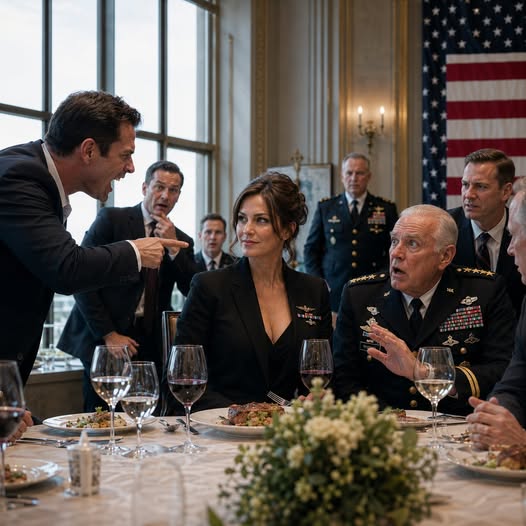
Grant leaned back and looked directly at me. That familiar amusement appeared in his eyes.
“What about you, Claire?”
I set down my water.
“Me?”
“Can you even handle pressure?”
The table laughed.
Not viciously. That would have been easier.
It was the soft, dismissive laughter reserved for a harmless person who had wandered into an adult conversation.
Adam’s smile tightened. “Grant.”
“What?” Grant spread his hands. “I’m including her.”
I looked toward General Rourke.
He had turned at the sound of the laughter.
Our eyes met.
I smiled at Grant. “Only if it’s easier than flying an Apache through enemy fire.”
For one beat, the table went silent.
Then the laughter doubled.
Vanessa covered her mouth. Someone slapped the table. Grant lifted his glass as though I had delivered the perfect punch line.
Across the room, General Rourke’s whiskey glass tilted sharply.
Amber liquid spilled across his hand.
He stood so fast that his chair scraped the floor.
And as he began walking toward us, the expression on his face told me he had heard every word.
### Part 2
The laughter faded one person at a time.
General Rourke did not hurry. He never had. Even during briefings conducted under incoming fire, he had moved with the steady patience of a man who believed panic was contagious.
People recognized him as he crossed the ballroom.
A retired three-star general did not need an introduction in that crowd. Several guests straightened. One man whispered his name to his wife. Grant placed his wineglass on the table and adjusted his jacket.
I stood.
Rourke stopped in front of me.
For a moment, I saw the years between us—the memorial services, the hospital corridors, the retirement ceremony in Washington where I had slipped out before the reception.
Then his stern face softened.
“Colonel Donovan.”
Every sound at our table disappeared.
“General,” I said.
He extended his hand. His grip was firm, his palm still damp with whiskey.
“It’s been too long.”
“Almost seven years.”
“Seven years, two months.”
That was Rourke. He remembered dates, names, grid coordinates, and every promise he had failed to keep.
Grant stared at me.
“Colonel?”
Rourke turned toward him. “That’s correct.”
Adam rose from his chair. He had seen photographs of Rourke but had never met him.
“General, I’m Adam Donovan.”
Rourke shook his hand warmly. “Good to finally meet you.”
The word finally hung in the air.
Adam noticed it too.
Grant recovered enough to gesture toward an empty chair. “Please join us.”
Rourke sat beside me, although his attention remained on my face.
“You disappeared after retirement,” he said.
“I moved.”
“You changed your number.”
“I wanted quiet.”
“You achieved it.”
The comment carried no judgment, but I felt Adam glance at me.
Vanessa leaned forward. “You were really a colonel?”
“Yes.”
“For how long?”
“Long enough.”
“And you actually flew helicopters?”
“Apaches.”
“In combat?”
I touched the condensation on my water glass. “Yes.”
The guests exchanged looks. Their surprise should not have bothered me. It did.
Grant gave a short laugh. “Claire, you’ve been coming to our dinners for fifteen years.”
“That sounds right.”
“You never said anything.”
“You never asked anything that wasn’t about Adam’s work or my roses.”
Vanessa looked down at her plate.
Rourke hid a smile behind his glass.
Grant did not. “You have to admit, this is difficult to believe.”
Adam’s head snapped toward him. “What is that supposed to mean?”
“I don’t mean she’s lying.” Grant raised both palms. “I mean Claire doesn’t exactly act like—”
“Like what?” I asked.
He hesitated.
Rourke answered for him. “Like a woman who commanded an attack-helicopter battalion?”
A server approaching with coffee stopped so abruptly that the cups rattled on her tray.
Grant’s mouth remained slightly open.
I turned to Rourke. “You’re enjoying this.”
“Immensely.”
“I can tell.”
He leaned back. “Claire was always uncomfortable with praise. Made award ceremonies unnecessarily difficult.”
Something cold moved through my stomach.
“General.”
He heard the warning.
For several seconds, nobody spoke. Beyond the windows, the last strip of orange sunlight vanished behind the dark lake.
A man across the table asked, “What kind of missions did you fly?”
“Different kinds.”
“Rescue?”
“Sometimes.”
“Close-air support?”
I nodded.
Rourke studied me. “Do you still hear Raven Two-Seven?”
My fingers tightened around the glass.
The table disappeared for half a heartbeat.
I smelled hot metal. Hydraulic fluid. Dust inside my teeth.
Then I was back beneath the chandeliers, listening to silverware touch china.
Rourke’s expression changed. He had not meant to say it aloud.
Adam leaned closer. “What’s Raven Two-Seven?”
“An old call sign,” I said.
“Whose?”
I met Rourke’s eyes.
He set down his drink.
“Not tonight,” he said quietly.
Grant noticed the tremor in my hand before I hid it beneath the table.
For the first time that evening, he stopped looking amused.
Dessert arrived, but the conversation never fully recovered. People asked polite questions. I gave careful answers. Rourke redirected anything that came too close to the places I had spent years locking away.
When Adam left briefly to speak with Grant’s potential investors, Rourke touched my elbow.
“Does he know about Leah?”
My throat tightened.
“No.”
“He should.”
“That isn’t your decision.”
Rourke looked past me.
Adam had returned sooner than either of us realized.
He was standing directly behind my chair, holding two cups of coffee.
And from the expression on his face, he had heard the name.
### Part 3
Adam did not ask about Leah until we were in the car.
Rain had started while we were inside the club. It tapped against the windshield in scattered drops, turning the headlights ahead of us into white smears.
He drove with both hands on the wheel.
I watched wet trees slide past the passenger window.
“Who was Leah?” he finally asked.
“A pilot.”
“That isn’t what I asked.”
I folded my hands in my lap. “She served with me.”
“Was she Raven Two-Seven?”
I said nothing.
Adam’s jaw tightened.
During twenty-two years of marriage, I had seen him angry only a handful of times. He did not shout. He became careful. Each word was selected and placed between us like a piece of glass.
“You told me you flew combat missions,” he said. “You told me you lost people. I never pushed because I thought I was respecting you.”
“You were.”
“Was I? Or was I helping you keep me outside?”
I turned toward him. “Some things aren’t easy to bring home.”
“I didn’t ask whether they were easy.”
The windshield wipers swept back and forth.
At a stoplight, Adam looked at me.
“What bothers me isn’t that strangers knew your rank. It’s that a man I’d never met knew exactly what could make your hands shake, and I didn’t even know the name.”
The light turned green.
A horn sounded behind us.
Adam drove on.
At home, I went upstairs and removed my dress. When I opened the closet, I saw the corner of a dark wooden box on the highest shelf.
Adam had built that box for me fifteen years earlier. He believed it held old documents and retirement papers.
It contained a folded flag, two sets of dog tags, an unopened letter, and a medal I had never displayed.
I shut the closet before he entered the bedroom.
“Are you going to tell me?” he asked.
“Not tonight.”
His face hardened. “That’s exactly what Rourke said.”
He took a pillow from the bed and went downstairs.
I did not sleep.
At 4:17 a.m., I gave up and made coffee. The kitchen smelled faintly of last night’s rain through the open window. Somewhere down the block, a garbage truck groaned to a stop.
My phone rang at nine.
Rourke.
“You created a problem,” I said.
“I know.”
“Adam heard you.”
“I know that too.”
“You don’t get to drag names out of graves because you feel nostalgic.”
His breathing changed.
“I wasn’t nostalgic, Claire.”
“Then what were you?”
“Angry.”
“At Grant?”
“At everyone laughing.”
“That was my problem to handle.”
“I watched people underestimate you for twenty-one years.”
“And I survived without your assistance.”
Silence filled the line.
Then Rourke said, “Holloway is asking questions.”
I closed my eyes. “Of course he is.”
“He called a former Pentagon liaison this morning.”
“How do you know?”
“The liaison called me.”
That was the world Grant inhabited. He did not wonder privately. He made calls. He hired people. He treated uncertainty like a hostile takeover.
“Let him search,” I said.
“There are things he won’t understand.”
“Most people don’t.”
“Claire, if he finds the inquiry—”
I gripped the counter.
The inquiry had lasted four months. Twelve sworn statements. Flight data. Radio transcripts. Maps covered with red arrows. Men in clean uniforms deciding whether choices made in darkness and dust had been brave, reckless, or both.
“The findings were sealed,” I said.
“Parts were. Parts weren’t.”
After we hung up, I found Adam asleep on the couch. His glasses rested crookedly on the rug, and his laptop remained open on the coffee table.
A photograph filled the screen.
I was thirty-six, standing beside an Apache in Afghanistan, helmet beneath my arm. Four other pilots stood around me.
Leah Mercer was at my left shoulder.
Someone had circled her face in red.
Beneath the photograph was an email from Grant.
I know who Raven Two-Seven was. You need to ask Claire why the official report says she was ordered to leave her behind.
### Part 4
Adam woke while I was still staring at the screen.
He sat up slowly, followed my gaze, and rubbed both hands over his face.
“I was going to show you.”
“When?”
“When you came downstairs.”
I closed the laptop.
“You let Grant investigate me?”
“I didn’t let him do anything. He sent the email at five this morning.”
“And you opened it.”
“Of course I opened it.”
The room smelled of cold coffee and the leather conditioner Adam used on the couch. Outside, a lawn sprinkler clicked in a slow, cheerful rhythm that did not belong in the conversation.
“Did you leave her?” he asked.
“No.”
“The report says—”
“You haven’t seen a report. You’ve seen a sentence Grant selected.”
“Then tell me what happened.”
I looked at the family photographs on the mantel. Our wedding in Milwaukee. Adam holding our niece at her baptism. The two of us in Maine, smiling beneath a red umbrella while rain soaked our shoes.
Those memories belonged to the life I had built after the Army.
Leah belonged to the life that had nearly destroyed me.
“I was leading a two-aircraft team,” I said. “Her aircraft went down.”
Adam waited.
“That’s all I can give you right now.”
His expression closed.
“That isn’t all you can give me. It’s all you’re choosing to give me.”
He went upstairs to shower.
At noon, Grant called.
I considered ignoring him, then answered.
“I want to apologize for last night,” he said.
“That was quick.”
“I also want to ask you something.”
“That sounds more like you.”
He exhaled. “Did you disobey a direct order in Afghanistan?”
I looked toward the stairs. Adam had stopped halfway down.
“Where did you hear that?”
“There’s a summary attached to a public award citation. Most of it is vague, but it mentions a withdrawal order.”
“Grant, stop digging.”
“Why?”
“Because you aren’t looking for truth. You’re looking for a version that lets you feel correct.”
“That’s not fair.”
“It’s exactly fair.”
He lowered his voice. “You made me look like an idiot.”
“You did that without my help.”
Adam closed his eyes.
Grant ended the call.
Three days later, we attended a hospital foundation luncheon because Adam needed to meet one of the same investors from the country club. I had planned to smile, eat overcooked salmon, and leave.
Grant approached before the first course.
He carried a folder.
“Not here,” I said.
“I need five minutes.”
“No.”
Rourke appeared beside him as if summoned by my irritation.
The general wore a gray suit and carried a glass of iced tea. “What’s in the folder?”
Grant stiffened. “Public records.”
“That phrase usually means someone has misunderstood a government document.”
Grant pulled out a photocopy. Lines had been blacked out. My name appeared near the top.
Rourke read one paragraph.
His face lost all amusement.
“Where did you get this?”
“It was attached to a military archive request.”
“This version should not have been released.”
“So it’s real,” Grant said.
I took the page.
The type was blurred, but I recognized every sentence.
At 0214 hours, MAJ Donovan acknowledged the order to disengage.
At 0216 hours, MAJ Donovan reversed course.
At 0219 hours, Raven Two-Seven reported catastrophic damage.
Adam read over my shoulder.
His face went pale.
Grant pointed to the final line.
“You turned around after being ordered out. Three minutes later, the other helicopter was shot down.”
“Enough,” Rourke said.
Grant ignored him. “Did your decision get that pilot killed?”
The luncheon continued around us. Glasses clinked. A microphone squealed near the stage. No one nearby spoke, but everyone was listening.
I folded the paper along its existing crease.
“Her name was Major Leah Mercer,” I said. “She had a husband, a seven-year-old son, and more courage than anyone at this table will ever understand.”
Grant’s confidence flickered.
“But did your decision—”
“I said enough,” Rourke repeated.
This time, his voice carried the weight of command.
Grant stepped back.
Rourke turned to Adam. “The withdrawal order came from me.”
Adam stared at him.
“And if you want to blame someone for what happened to Raven Two-Seven,” the general said, “you should begin with the man who sent both aircraft into that valley.”
Then he looked at me.
“But Claire has never blamed me.”
He was wrong.
I had blamed him for twelve years.
I had simply blamed myself more.
### Part 5
I left the luncheon before the speeches.
Adam followed me into the parking garage, but I kept walking until the sound of music and polite applause had vanished behind the concrete walls.
“Claire.”
My heels struck the pavement sharply.
“Claire, stop.”
I reached our car and turned.
“What do you want me to say?”
“The truth.”
“Which version? The military version? Grant’s version? The one written by people who listened to radio recordings in an air-conditioned room?”
“Your version.”
A black sedan passed between us, tires hissing over damp concrete.
I leaned against the car.
“We were supporting a reconnaissance team in a mountain valley. Weather moved in faster than predicted. Communications started failing. Then the team was ambushed.”
“How many soldiers?”
“Seventeen.”
Adam waited.
“Our fuel was low. Visibility was collapsing. Intelligence reported more fighters moving toward the valley. General Rourke ordered us to withdraw.”
“And you didn’t.”
“Not immediately.”
“Why?”
“Because the team leader was on the radio.”
I could still hear the voice.
Young. Controlled. Trying not to let his men hear fear.
Raven flight, we cannot move. Multiple wounded. Do not leave us here.
“I turned back,” I said.
“And Leah followed you?”
“Yes.”
“Did you order her to?”
The question struck harder than Grant’s accusation.
“I told her to hold outside the valley.”
“That isn’t what I asked.”
My mouth went dry.
Before I could answer, my phone rang.
The name on the screen stopped me.
Jonah Price.
I had not spoken to him in nine years.
He had been the reconnaissance team’s senior medic, one of the seventeen people in the valley.
I answered.
“Colonel?”
His voice was rougher than I remembered.
“Jonah.”
“Somebody requested the Raven transcripts.”
I looked at Rourke’s document in my hand.
“Grant Holloway.”
“I don’t know that name.”
“He’s a friend of my husband.”
“Not much of a friend.”
I almost laughed.
Jonah continued, “The archive contacted me because my statement is referenced in the inquiry.”
“Did you release it?”
“No.”
“Good.”
“But someone released part of the cockpit audio.”
The parking garage seemed to tilt.
“That recording was sealed.”
“Apparently not sealed tightly enough.”
Adam watched my face.
“What part?” I asked.
Jonah was silent for several seconds.
“The part where you told Major Mercer to stay back.”
Relief came first.
Then Jonah finished.
“And the part where she answered you.”
My fingers went cold.
Leah’s final words had never been included in the written findings. Rourke had made sure of that. They were personal, spoken during a combat mission but never intended for a hearing room, a newspaper, or a wealthy man’s private investigation.
“Who has it?” I asked.
“I’m trying to find out.”
After we disconnected, Adam touched my arm.
“What did she say?”
I pulled away.
“Claire.”
“Not here.”
We drove home separately because I could not bear to sit beside him.
That night, I opened the wooden box in our closet for the first time in five years.
The smell of cedar and old paper rose into the room.
Beneath my medals lay a photograph of Leah kneeling beside her son, both of them wearing plastic Viking helmets at a school fair. Next to it was the sealed letter from her husband.
I had carried it through three moves and never opened it.
Adam stood in the doorway.
He did not ask permission before sitting beside me.
For a while, neither of us spoke.
Then my phone chimed.
An email had arrived from an unknown address.
The subject line contained only two words.
RAVEN AUDIO.
The message had no text, only an attachment.
Adam reached for the laptop.
I grabbed his wrist.
Because after twelve years of refusing to hear Leah’s final transmission, I suddenly understood that someone else had already listened to it.
### Part 6
Rourke arrived at our house forty minutes later.
He wore dark slacks and an Army windbreaker that looked older than our marriage. Rain clung to his silver hair. He did not wait to be invited inside.
“Don’t open the attachment,” he said.
Adam stood near the kitchen table. “Why?”
“Because we don’t know whether it’s authentic.”
“It’s authentic,” I said.
Rourke looked at me.
“The file name includes the mission date and the aircraft time code. Whoever sent it had access to the original archive.”
Adam’s face tightened. “Grant?”
Rourke removed his wet jacket. “I spoke to him. He denies sending it.”
“Do you believe him?” Adam asked.
“I believe he’s frightened.”
“That wasn’t the question.”
Rourke glanced at me. “Yes. I believe him.”
We sat around the kitchen table while rain drummed against the windows. The laptop rested between us like an unexploded device.
Adam opened the email headers and searched for anything useful. The message had been routed through several anonymous services.
“It could be someone trying to embarrass you,” he said.
“Or someone trying to force the story out,” Rourke replied.
I looked at the attachment.
“Play it.”
Rourke’s head lifted. “Claire.”
“I’m finished letting other people decide which parts of my life I’m allowed to hear.”
Adam clicked the file.
Static filled the kitchen.
Rotor noise pulsed beneath fragmented voices. Coordinates. Warnings. A soldier calling for medical evacuation.
Then my younger voice came through, clipped and breathless.
Raven Two-Seven, hold west of the ridge. That is an order.
Leah answered immediately.
Negative, Raven Six. You’re not going in alone.
My chest contracted.
Raven Two-Seven, maintain position.
A burst of static.
Then Leah laughed.
Even distorted by the recording, I recognized it. Bright, reckless, alive.
You can court-martial me when we get home.
The file ended.
Adam covered his mouth.
I stared at the dark laptop screen.
For twelve years, I had remembered giving Leah an order. I had remembered seeing her aircraft appear behind me in the night-vision display. I had remembered the flash when a round struck her tail.
But I had buried the sound of her laughter.
Rourke lowered his head.
“She chose to follow,” Adam whispered.
“I was her commander.”
“You ordered her not to.”
“I knew she wouldn’t listen.”
“That doesn’t make it your fault.”
“You weren’t there.”
His chair scraped backward.
“No,” Adam said. “I wasn’t. Because you decided I could be your husband but not the person who knew you.”
The words landed harder than he intended. I saw regret cross his face, but he did not take them back.
Rourke rose. “I’ll find out who accessed the audio.”
After he left, Adam and I remained at the table.
I told him the rest.
Leah followed me into the valley. We engaged the fighters long enough for the reconnaissance team to move its wounded to a clearing. Her aircraft took damage during the second pass.
The pilot in the front seat, Captain Eric Shaw, survived the crash.
Leah did not.
I landed under fire to pull Shaw from the wreckage while another helicopter extracted the ground team. By sunrise, sixteen of the seventeen soldiers were alive.
The seventeenth had died before we reached them.
I received a combat decoration.
Leah received one posthumously.
“Grant thinks you made a reckless decision,” Adam said.
“Some officers agreed with him.”
“What did the inquiry decide?”
“That returning to the valley violated the withdrawal order.”
Adam’s eyes darkened.
“And?”
“That the order was based on incomplete intelligence. That my actions prevented the destruction of the ground team.”
“So they cleared you.”
“They promoted me.”
I stood and carried our empty cups to the sink.
Adam remained behind me.
“There’s something else,” he said.
I turned.
He held the photocopied report from the luncheon.
At the bottom of the final page, almost hidden beneath a black redaction bar, was a handwritten notation neither of us had noticed.
Audio release authorized by M. Rourke.
### Part 7
I drove to Rourke’s house before sunrise.
He lived in a brick ranch near the lake, the kind of practical home that looked strangely modest beside the mansions surrounding it. A small American flag snapped in the wind above his porch.
He opened the door before I knocked.
“You found the notation.”
I pushed past him.
The house smelled of coffee, furniture wax, and the wood smoke left from last night’s fire. Framed photographs covered one wall—soldiers, ceremonies, aircraft, young faces preserved before age and war changed them.
“You released the recording?”
“Sit down.”
“No.”
“Claire.”
“Why?”
Rourke walked toward the kitchen. “Because I believed you needed to hear it.”
“You had twelve years.”
“You would have refused.”
“I am refusing now.”
“No. Now you’re furious. That’s different.”
I followed him.
He poured coffee into two heavy mugs. His hands were steady, but the skin around his eyes looked gray.
“You sent it anonymously.”
“I asked an archivist to release the authorized segment. I did not send the email.”
“Then who did?”
“I don’t know.”
I laughed once, without humor. “Convenient.”
Rourke put down the pot.
“You have carried Leah’s death like a sentence handed down by a court that never existed.”
“You don’t get to decide when I stop.”
“No. But I can remind you of the evidence you buried.”
He slid a folder across the counter.
Inside was Jonah Price’s statement.
I remembered his handwriting—tight block letters pressed hard enough to mark the pages beneath.
Major Donovan’s decision to return prevented the capture or death of the surviving team members. Major Mercer acted voluntarily despite direct instructions to remain outside the engagement area.
There was another document beneath it.
A statement from Captain Eric Shaw, the surviving pilot from Leah’s aircraft.
I had never read it.
Major Mercer told me she would not allow Raven Six to enter the valley without cover. She understood the risk and made her decision before Major Donovan reversed course.
I closed the folder.
“Why didn’t you give me this before?”
“I tried. You walked out of the inquiry before the final findings were read.”
“I had a funeral to attend.”
“You had three funerals to attend. Then you volunteered for another deployment.”
Anger rose through me, hot and clean.
“You signed the mission order.”
“Yes.”
“You sent us into that valley with weather intelligence that was already outdated.”
“Yes.”
“You ordered us out while seventeen men were begging for help.”
“Yes.”
Each answer came without defense.
Rourke gripped the counter.
“I have lived with my decisions too, Claire. The difference is that I never believed suffering made my version of events more accurate.”
The room became very still.
My phone rang.
Grant.
I nearly rejected it, then answered.
His voice sounded strained. “Someone sent Vanessa the audio.”
“What?”
“And three reporters.”
My stomach dropped.
“Has anyone published it?”
“Not yet. One reporter called for comment.”
Rourke held out his hand for the phone. I ignored him.
“Grant, did your investigator access military archives?”
Silence.
“Answer me.”
“I hired a research firm.”
“Did they access the recording?”
“They said they found someone with documents connected to the inquiry.”
Rourke closed his eyes.
“Who?” I demanded.
“I don’t know his real name.”
“You started this because you couldn’t tolerate being wrong at a dinner table.”
“I didn’t ask anyone to send files to reporters.”
“But you opened the door.”
Grant’s breathing became audible.
Then he said, “There’s another problem.”
“What?”
“The firm found the unredacted award recommendation.”
I looked at Rourke.
That document included aircraft locations, unit names, casualty details, and the recommendation he had submitted after the mission.
“What are they planning to do with it?” I asked.
“I don’t know.”
“Then find out.”
I disconnected.
Rourke stared at the folder between us.
“If that recommendation becomes public, the press won’t focus on the mission.”
I knew what he meant.
The original recommendation had been for the Distinguished Service Cross.
But there was a reason I had fought to keep the citation out of newspapers, and it had nothing to do with humility.
Attached to it was Leah’s last written evaluation of me.
And in that evaluation, she had revealed the promise I made before our final flight—the promise I failed to keep.
### Part 8
The reporters called by noon.
One wanted to know why I had “concealed” a major combat decoration. Another asked whether I had disobeyed orders for personal glory. A third left a voicemail requesting comment on rumors that my actions had caused another pilot’s death.
I listened to each message once, then turned off my phone.
Adam found me in the garden.
I was kneeling beside a row of basil, pulling weeds with enough force to tear their roots apart. The soil was damp and dark beneath my fingernails.
“You can’t hide out here forever,” he said.
“I’m not hiding.”
“You’ve weeded the same bed three times.”
I sat back on my heels.
Adam lowered himself onto the stone border. He had not shaved. There were shadows beneath his eyes from another night on the couch.
“Grant called me,” he said.
“What did he want?”
“To apologize.”
“He’s becoming efficient at apologizing after causing damage.”
“He also gave me the name of the research firm.”
That made me look up.
“Rourke is handling it.”
“Rourke handled the recording too.”
I pulled off my gardening gloves.
“What are you suggesting?”
“That you stop giving control to men who believe they know what is best for you.”
The accuracy of it irritated me.
Adam handed me a printed page.
The research firm had terminated Grant’s contract that morning. One of its subcontractors—a former records technician named Douglas Pike—had copied documents without authorization.
Pike was now attempting to sell them.
“Federal investigators are involved,” Adam said. “The reporters may never get the full file.”
“May.”
“Yes.”
A breeze stirred the tomato vines. Wind chimes rang on a neighboring porch.
Adam watched me.
“What promise did you make to Leah?”
I stared at the dirt beneath my shoes.
The evaluation in the award file had been written three weeks before the mission. Leah had recommended me for battalion command. Most of it described my judgment, discipline, and ability to remain calm.
The final paragraph was personal.
Major Donovan believes responsibility means carrying every danger herself. I have made her promise that when the worst day comes, she will trust the rest of us to choose our own courage.
“I promised I would stop trying to protect everyone by making every decision for them,” I said.
Adam was silent.
“Then Leah followed me into the valley and died.”
“So you decided trusting her was the mistake.”
“Yes.”
“And after you came home, you did the same thing to me.”
I looked at him sharply.
He continued before I could interrupt.
“You chose what I was allowed to know. You decided silence protected me. You built our marriage around the same promise you think you broke.”
The wind chimes rang again.
I wanted to argue. Instead, I felt something inside me give way.
Not dramatically. No tears. No sudden relief.
Just exhaustion.
“I didn’t know how to tell you,” I said.
“You could have started with her name.”
Adam took my dirty hand.
“I’m not asking you to relive every mission. I’m asking you not to make me a guest in your life.”
That evening, I opened the letter from Leah’s husband.
The paper had yellowed slightly along the folds.
He wrote that their son, Caleb, had grown into a quiet boy who loved airplanes but hated loud noises. He wrote that grief had made him angry at everyone for a while—at the Army, at Leah, at me.
Then he wrote the sentence I had been too afraid to read.
Leah would have followed you into that valley even if you had threatened to shoot her down yourself.
I laughed and cried at the same time.
At the bottom, he had added a second note in different ink.
Caleb is twenty now. He wants to meet you when you’re ready.
A photograph slipped from the envelope.
A young man in an Army flight-school uniform stood beside a training helicopter.
Pinned to his chest was Leah’s old set of wings.
On the back, he had written a phone number and six words.
Colonel Donovan, I need the real story.
### Part 9
I called Caleb the next morning.
His voice sounded like Leah’s in ways that hurt—the same quick rhythm, the same habit of laughing softly before saying something serious.
We agreed to meet at a diner outside Milwaukee.
Adam offered to drive. I almost refused out of habit. Then I nodded.
The diner had red vinyl booths, chrome napkin dispensers, and a pie display that rotated with a faint mechanical hum. Rain streaked the windows. The coffee tasted burnt enough to remove paint.
Caleb arrived in jeans and a flight-school jacket.
For one impossible second, I saw Leah.
Then he smiled, and the resemblance shifted into something entirely his own.
“Colonel.”
“Claire is fine.”
“My mother would have said that was a trap.”
“She would have been correct.”
He laughed.
Adam sat beside me but allowed Caleb and me to talk.
Caleb wanted details no official citation could provide. Whether Leah was afraid of thunderstorms. Whether she really cheated at cards. Whether she sang during long flights.
“She didn’t sing,” I said. “She committed crimes against music.”
“That sounds more accurate.”
He asked about the mission last.
I told him everything I could.
I did not polish his mother into a symbol. I told him she was stubborn, funny, impatient, and brave. I told him she ignored my order. I told him she saved my life by engaging the position that had targeted my aircraft.
When I finished, Caleb stared through the rain-streaked window.
“Did she suffer?”
“No.”
That answer, at least, was true.
He nodded and wiped his thumb beneath one eye.
“My dad always said she chose to go.”
“She did.”
“Do you believe that?”
“I’m learning to.”
Caleb reached into his jacket and removed a small digital recorder.
“My dad found this in a box after he moved last year. Mom recorded messages before missions. Most were for us.”
He slid it across the table.
“One was for you.”
My hands remained in my lap.
“I don’t know if I can.”
“That’s okay.”
He left the recorder between us.
“No one gets to choose when you listen.”
The sentence felt deliberate.
Perhaps Adam had spoken to him. Perhaps Caleb had simply inherited his mother’s instincts.
After lunch, we stood beneath the diner awning. Rain struck the parking lot hard enough to bounce.
Caleb hugged me.
“Thank you for bringing her home.”
My throat closed.
I watched him drive away before I placed the recorder in my purse.
On the way back to Chicago, Adam’s phone rang through the car speakers.
Grant.
Adam looked at me. I nodded.
Grant sounded exhausted.
His waterfront project had lost two investors overnight. A structural review had discovered problems with a retaining wall near the lake. Repairs could delay construction for a year.
“Why are you telling me?” Adam asked.
“Because I need to speak to Claire.”
I leaned toward the console. “I’m here.”
Silence followed.
“I know I have no right to ask you for anything,” Grant said.
“That’s the first correct thing you’ve said in weeks.”
“I’m sorry.”
“Apologies don’t reverse consequences.”
“I know.”
His voice cracked slightly.
“I have four hundred employees, subcontractors, families. If the lenders pull out, the company may collapse.”
The same man who had once laughed while asking whether I could handle pressure now sounded as though each breath required permission.
“What do you want from me?” I asked.
“I want to know how you make decisions when every option hurts someone.”
I looked at the wet highway ahead.
“You don’t start by asking how to save yourself.”
“Then where do I start?”
“With the people who will pay for your decision but have no voice in making it.”
Grant was silent.
I thought the conversation had ended.
Then he said, “The engineers found something else. Something my executives knew about six months ago.”
“What?”
“A safety report.”
Adam and I exchanged a look.
Grant lowered his voice.
“If I disclose it, we may lose everything. If I don’t, people could eventually get hurt.”
The rain beat harder against the windshield.
For the first time, Grant’s question about pressure was no longer insulting.
It was terrifyingly real.
### Part 10
Grant’s office occupied the top floor of a glass building overlooking the Chicago River.
When I arrived Monday morning, his receptionist led me past framed architectural drawings and photographs of ribbon-cutting ceremonies. Everything smelled of new carpet and dark-roast coffee.
Seven executives waited in the conference room.
They looked annoyed to see me.
Grant stood near the windows, wearing yesterday’s shirt beneath an expensive jacket. A stack of reports covered the table.
“This is Colonel Claire Donovan,” he said.
A silver-haired attorney frowned. “Is this a military matter?”
“No,” I replied. “It’s a leadership matter.”
That did not improve his expression.
Grant explained the problem.
Six months earlier, an engineering consultant had warned that the planned retaining system might fail during an extreme storm combined with unusually high lake levels. The probability was low. The consequences were not.
One executive argued the report was overly conservative. Another said redesigning the structure would add thirty million dollars and destroy the construction schedule.
A third suggested commissioning a new study from a “more practical” firm.
I listened for twenty minutes.
Then I asked, “Who lives downhill?”
Silence.
Grant opened a map.
The development sat above a public marina, a park, and two older apartment buildings.
“How many residents?” I asked.
“About three hundred,” someone said.
“And during summer?”
“With visitors? More.”
The attorney folded his arms. “The current design meets code.”
“That wasn’t my question.”
He leaned back. “With respect, Colonel, combat experience does not make you a structural engineer.”
“No. That’s why I’m listening to the engineer you already paid.”
A younger woman at the end of the table lowered her eyes.
I looked at her. “You disagree with them.”
Every head turned.
She swallowed. “I was on the review team.”
“What did you recommend?”
“A redesign.”
Grant stared at her. “You told me the risk was manageable.”
“I was told to revise the language.”
“By whom?”
The chief operating officer shifted in his seat.
There it was.
Not one dramatic villain. Not a secret conspiracy. Just a chain of people softening words because the original words were expensive.
Pressure rarely announces itself with alarms. Sometimes it arrives as an edited paragraph.
Grant dismissed everyone except the engineer, the attorney, and me.
For the next three hours, we examined emails, timelines, and cost estimates. By noon, Grant understood that several senior officers had concealed the report’s strongest conclusions.
He stood at the window, looking down at tour boats moving along the river.
“If we disclose this, the lenders freeze the project.”
“Probably.”
“Hundreds of people could lose their jobs.”
“Yes.”
“If we don’t disclose it, there may never be a failure.”
“Also true.”
He turned. “How is that supposed to help?”
“It isn’t.”
His face reddened. “You make it sound simple.”
“No. I’m telling you it isn’t simple.”
I walked toward the window.
“In the valley, I had an order to withdraw. The order was reasonable based on the information available. Seventeen people were trapped. Staying risked my pilots. Leaving abandoned the ground team.”
“What did you do?”
“You know what I did.”
“And someone died.”
“Yes.”
Grant looked away.
“You asked how people function under pressure,” I said. “They accept that there may be no painless choice. Then they decide which consequences they are morally willing to own.”
He sat down heavily.
The attorney advised limited disclosure, careful language, and confidential negotiations with lenders.
Grant listened.
Then he looked at the young engineer.
“If your family lived in those apartments, would you accept the current design?”
“No.”
His answer came slowly.
“Neither would I.”
That afternoon, Grant called the lenders, the city, and the project partners. He disclosed the report and suspended construction voluntarily.
By evening, the story had reached local television.
Holloway Development Faces Major Delay After Safety Concerns.
The company’s stock dropped. Two investors withdrew. Commentators called Grant reckless, dishonest, courageous, and incompetent—sometimes in the same broadcast.
At 11:30 that night, he called me.
“We may not survive this.”
“You might not.”
“Do you ever regret turning back?”
I thought of Leah’s recorder inside my desk drawer.
“Every day,” I said.
Grant was silent.
Then I added, “I would regret leaving them more.”
Before he disconnected, he told me federal investigators had recovered the stolen military documents from Douglas Pike’s apartment.
Nothing classified had reached the press.
I should have felt relieved.
Instead, Grant said something that made my blood run cold.
“There was another file in Pike’s possession. It wasn’t from the Army.”
“What kind of file?”
“A private recording made at the country club.”
Someone had recorded the entire conversation before General Rourke walked to our table.
And Adam’s voice was on it.
### Part 11
Grant sent the recording directly to me.
I listened alone in my car outside his office.
At first, there was only ballroom noise—music, glasses, conversations overlapping. Then Grant’s voice became clear.
You know what people don’t understand? Pressure.
I heard the familiar discussion. The money. The boasting. The laughter.
Then, thirty seconds before Grant asked me the question that started everything, Adam spoke quietly.
Go easy on Claire tonight.
Grant laughed. Why? Afraid she can’t handle us?
She doesn’t like being the center of attention.
That’s because there’s nothing to put in the center.
Adam responded, but a burst of applause from another table covered his words.
Then Grant said, Relax. I’ll keep her entertained while you talk to the investors.
The audio ended shortly after Rourke called me Colonel.
I sat behind the steering wheel, staring at pedestrians hurrying beneath umbrellas.
Adam had known Grant intended to use me as a joke.
He had asked him to go easy, then left me at the table because he needed the investment.
It was not betrayal on the scale of stolen money or an affair.
It was smaller.
That made it more familiar and, in some ways, more painful.
He had decided I could absorb the insult because his business mattered more in that moment.
When I reached home, Adam was in the kitchen preparing dinner.
He looked up and knew immediately.
“Grant called you.”
“He sent me the recording.”
Adam set down the knife.
“I warned him.”
“You warned him to go easy.”
“I didn’t know what he was going to say.”
“You knew enough.”
He wiped his hands on a towel.
“I needed the meeting with those investors.”
“I know.”
“Claire—”
“I spent years believing I protected you by keeping the worst parts of my life outside our marriage. You told me that was wrong.”
“It was.”
“And you protected your opportunity by letting your friend treat me like furniture.”
His face went pale.
“That was wrong too,” he said.
The simple admission stopped my anger from becoming louder, but it did not remove it.
“I’m sorry.”
“You should be.”
“I should have shut him down before the dinner.”
“Yes.”
“I should have left the table when he laughed at you.”
“Yes.”
He swallowed.
“I can’t change it.”
“No.”
The room smelled of garlic and onions beginning to burn in the pan. Adam turned off the stove.
“What happens now?”
I looked at the man I had loved for more than two decades.
He had not mocked my service. He had not exposed my records. But he had stood inside a system of small humiliations because challenging his wealthy friend might cost him something.
Love did not make that harmless.
“I need space,” I said.
Adam nodded.
He moved into the guest room without arguing.
Over the next two months, we attended counseling separately and together. He ended discussions with Grant’s investors and found funding elsewhere, on less favorable terms. He never presented that choice as a sacrifice I owed him gratitude for.
He apologized again, but I did not offer quick forgiveness.
Forgiveness given to stop discomfort is only another form of silence.
Meanwhile, Grant’s company entered restructuring. He sold his vacation home, two cars, and a private parcel of land to keep payroll running. The waterfront project was redesigned. The marina remained open. The apartment residents received copies of the safety findings.
People who had once praised his confidence now called him weak.
He kept going.
In October, General Rourke asked me to speak at a veterans’ benefit.
I refused.
He asked again.
I refused more creatively.
Then a letter arrived from the event committee.
The gala would establish a flight-training scholarship in Leah Mercer’s name.
The primary donor wished to remain anonymous.
I called Rourke.
“Who funded it?”
“I’m not supposed to say.”
“General.”
He sighed. “Grant Holloway.”
The news unsettled me more than another apology would have.
Grant had not attached his name. He had not called the press. He had not even told me.
That evening, I opened Leah’s recorder.
Her voice filled the quiet room.
And the first thing she said was, “Claire, if you’re hearing this, you’re probably blaming yourself for something stupid again.”
### Part 12
I sat on the floor beside my desk while Leah spoke.
Her recording had the soft background hum of a portable air conditioner. Somewhere farther away, someone dropped a metal tool and cursed.
“Here’s what you never understand,” she continued. “You think being in command means every choice belongs to you. It doesn’t. Some choices belong to the people who love you enough to follow.”
I pressed both hands over my mouth.
She laughed quietly.
“If I ever get myself killed, do not turn me into one of your private ghosts. Tell Caleb I loved flying. Tell him I was scared sometimes. Tell him courage is mostly doing your job while your stomach tries to climb into your throat.”
The recording lasted three minutes.
She complained about powdered eggs. She reminded me that I owed her twenty dollars from a card game. She said her husband would need help remembering to pay the water bill.
Then her voice softened.
“And Claire? Trust people. That’s an order.”
The recording clicked off.
I remained on the floor until the room grew dark.
Adam found me there.
He did not ask what was wrong. He sat beside me, leaving a few inches between us.
I played the recording again.
When it ended, he wiped his eyes.
“I’m sorry,” he said.
“For what?”
“For every time I asked why you couldn’t just talk about it.”
“You didn’t know.”
“I could still have been kinder.”
I looked at him.
“I’m not ready to pretend the country-club dinner doesn’t matter.”
“I know.”
“You chose access to Grant’s money over defending me.”
“I know.”
“I may forgive you eventually. But forgiveness doesn’t mean I will forget what you’re capable of when approval is on the line.”
Adam nodded.
“I don’t want you to forget. I want to become someone who doesn’t do it again.”
That was the first answer that did not ask me to comfort him.
I agreed to speak at the gala.
The event was held in a downtown Chicago hotel ballroom filled with veterans, military families, business leaders, and volunteers. American flags stood beside the stage. A display near the entrance showed photographs of Leah from flight school through her final deployment.
Caleb attended in uniform.
Grant sat near the back.
Adam was in the front row, but there was an empty chair between him and General Rourke. Neither man tried to close the space for me.
Rourke introduced me.
He described leadership as responsibility carried when nobody was watching. He mentioned my rank and years of service but not the medal, the valley, or the inquiry.
For once, he understood where the story belonged.
I walked to the podium.
Five hundred faces turned toward me.
“I spent twenty-one years in the Army,” I began. “For much of that time, people assumed courage meant not being afraid.”
The ballroom became quiet.
“That is nonsense.”
A few people laughed.
“I was afraid in training. I was afraid in combat. I was afraid when young soldiers looked at me and expected an answer I did not have.”
I told them about responsibility.
I told them pressure was not a contest. A parent working two jobs could carry it. A nurse at the end of a long shift could carry it. A business owner deciding whether to tell an expensive truth could carry it.
Then I looked toward Grant.
“Pressure does not reveal whether we feel fear. It reveals who we are willing to sacrifice to escape it.”
Nobody moved.
I spoke Leah’s name.
Caleb bowed his head.
When I finished, the audience stood.
The applause felt too large, so I focused on individual sounds—the scrape of chairs, someone crying near the stage, Rourke clearing his throat.
Then Grant walked toward the microphone.
He had not been scheduled to speak.
A year earlier, that would have irritated me.
This time, he looked terrified.
“A few months ago,” he said, “I asked Colonel Donovan whether she could handle pressure.”
Laughter moved through the room.
Grant did not smile.
“I asked because I believed a quiet person must be an unimportant person.”
The laughter stopped.
“I was wrong about her. More importantly, I was wrong about strength.”
He publicly admitted the joke, the investigation, and the damage his pride had caused. He did not ask me to forgive him.
When he finished, he stepped away without looking for applause.
Before I could leave the stage, Caleb approached carrying a small velvet case.
Inside were Leah’s wings.
“I think she would want you to have them tonight,” he said.
I touched the cold metal.
Then he leaned closer.
“There’s someone else here to see you.”
A woman rose from a table near the exit.
She was older, with Leah’s eyes and the same stubborn line to her mouth.
Her mother had once refused to speak to me after the funeral.
Now she was walking straight toward me.
### Part 13
Margaret Mercer stopped a few feet away.
The ballroom watched in silence.
She wore a simple black dress and held a folded sheet of paper in both hands. Age had narrowed her shoulders, but her gaze remained sharp.
“Colonel Donovan,” she said.
“Mrs. Mercer.”
“You sent flowers every year.”
“Yes.”
“I threw away the first eleven arrangements.”
“I assumed you might.”
Her mouth tightened.
“For a long time, I needed someone to blame.”
I understood that better than she knew.
Margaret looked at the wings in my hand.
“I blamed the Army. I blamed General Rourke. I blamed my daughter for choosing that life.” Her eyes lifted to mine. “And I blamed you because you survived.”
No one near us moved.
“You had every right to be angry,” I said.
“Angry, yes. Cruel, no.”
She unfolded the paper.
It was a copy of Leah’s final evaluation—the document attached to my award recommendation.
Margaret pointed to the last paragraph.
“She wrote that you tried to carry every danger yourself.”
“I remember.”
“She also wrote that she trusted you more than any commander she had served under.”
My vision blurred.
Margaret took my hand and closed my fingers around Leah’s wings.
“My daughter did not follow weak people. She did not follow fools. And she certainly did not follow orders she disliked.”
A quiet laugh moved through the nearby tables.
“She made her choice,” Margaret said. “You have punished yourself long enough for respecting it.”
Then she hugged me.
I did not feel absolved.
Real grief does not vanish because someone says the right words in a ballroom.
But for the first time, Leah’s memory did not feel like a cockpit warning screaming inside my skull.
It felt like laughter over bad coffee.
After the gala, I found Grant alone near the coat check.
“You didn’t need to make that speech,” I said.
“Yes, I did.”
“You didn’t ask for forgiveness.”
“I haven’t earned it.”
That answer surprised me.
“I don’t hate you, Grant.”
“I’ll accept that as progress.”
“It isn’t friendship.”
“I know.”
“And your anonymous donation doesn’t erase what you did.”
“I know that too.”
He nodded once and walked away.
That was the relationship we kept.
We became civil, occasionally cooperative, but never close. Some consequences should remain visible. Otherwise, apologies become inexpensive.
Grant’s company survived. It became smaller and less glamorous. The redesigned waterfront project opened two years later with a reinforced retaining system, a public park, and fewer luxury units than originally planned.
No one was injured.
Adam’s medical platform also survived. He found new investors and stopped treating powerful men’s approval as a form of oxygen.
Our marriage changed.
We did not return to what we had been, because what we had been included too much silence. We built something more honest instead.
I forgave Adam eventually, but not in the sentimental way people describe forgiveness. I did not declare the wound erased. I watched what he did afterward.
He defended a young employee during a meeting when a wealthy investor mocked her accent. He walked away from a contract when a client insulted one of his programmers. He stopped laughing politely when cruelty entered a room wearing an expensive suit.
Those choices mattered more than promises.
General Rourke continued interfering in my life.
Caleb completed flight training and became a rescue pilot. Before his first assignment, he sent me a photograph of Leah’s wings pinned inside his locker.
I began speaking to veterans and military families—not because I wanted attention, but because hiding had stopped feeling like peace.
The wooden box moved from the closet to my study.
Leah’s photograph sat on the shelf beside my medal.
One summer evening, three years after the country-club dinner, Adam and I attended another charity event overlooking Lake Michigan.
The room smelled of lilies and polished wood. A jazz trio played by the windows. Wealthy people discussed deals while pretending not to measure one another.
Grant was there.
So was Rourke.
A young businessman joined our table and began complaining about the stress of managing a new company.
Then he looked at me.
“And what do you do, Mrs. Donovan?”
Before Adam could answer, I smiled.
“I flew Apache helicopters for twenty-one years.”
The man blinked. “Seriously?”
“Seriously.”
Across the room, Rourke lifted his glass.
Grant lowered his eyes, hiding a small smile.
No one laughed.
For years, I believed strength meant carrying every burden without allowing anyone to see its weight.
I was wrong.
Strength was telling the truth without performing it for applause. It was setting boundaries after apologies. It was accepting that love could survive disappointment only when behavior changed. It was remembering the dead without joining them inside the moment they were lost.
And pressure?
Pressure was never about who had the most money at risk, the highest rank, or the most dramatic story.
Pressure was the instant when fear offered you an easy way out at someone else’s expense.
Character was what you chose next.
THE END!
Disclaimer: Our stories are inspired by real-life events but are carefully rewritten for entertainment. Any resemblance to actual people or situations is purely coincidental.