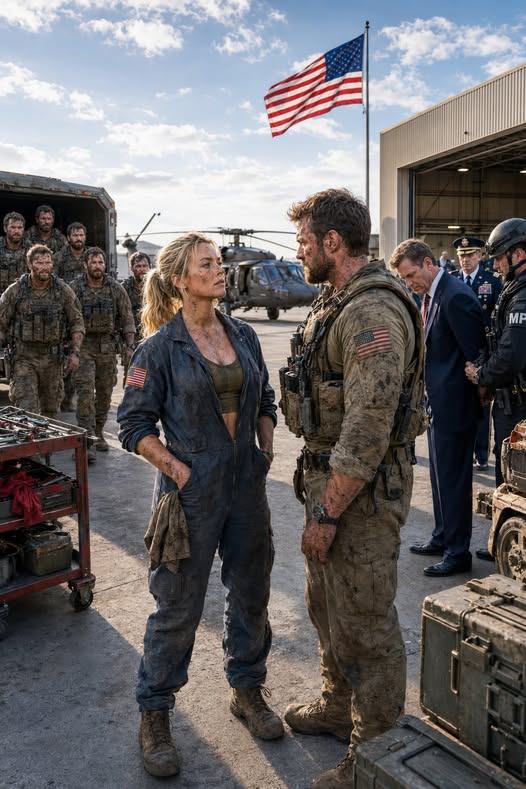
PART 1 — THE WOMAN IN THE GREASE-STAINED COVERALLS
“Tell the mechanic to shut up and fix the truck,” Colonel Pierce said, loud enough for half the motor pool to hear.
He didn’t look at me when he said it.
Men like Pierce never looked directly at women they thought were beneath them. They looked through us, around us, over us—anything to avoid admitting we were in the room.
I was under the hood of an M-ATV at Fort Halstead, a joint training base carved into the dry, ugly edge of the Nevada desert. Dust got into everything out there. Engines. Rifles. Coffee. Marriages. Reputations.
I had grease on my jaw, a busted knuckle wrapped in electrical tape, and a Starbucks cup cooling on the fender beside me.
My name was Staff Sergeant Nova Anderson.
To most of the base, I was “Wrench.”
Not Nova.
Not Sergeant Anderson.
Wrench.
The quiet woman in the motor pool who could rebuild a transmission faster than most men could explain why they broke it. The one who wore coveralls instead of lipstick. The one officers forgot to salute because I was usually standing next to a stack of tires.
That morning, Colonel Everett Pierce stood in my garage wearing sunglasses that cost more than my rent and a tan tactical jacket with the logo of a private defense contractor stitched on the sleeve.
Apex Dominion Solutions.
The kind of company that sold “security solutions” to the Pentagon, billed taxpayers like a luxury resort, and still couldn’t keep a convoy radio from dying in the desert.
Behind him stood his son, Tyler Pierce, a civilian consultant with perfect teeth, a Rolex, and the soft hands of a man who had never changed a tire without calling roadside assistance.
Tyler looked at the busted vehicle, then at me.
“Can she even certify this unit?” he asked.
I slid out from under the hood and wiped my hands on a rag.
“She can hear you.”
Tyler smirked. “Great. So we’ve established basic function.”
A few soldiers laughed.
Not because it was funny.
Because rich men make weak men nervous.
Colonel Pierce tilted his head toward me. “That vehicle needs to be ready by 1800. SEAL Team Bravo is moving tonight for a live-capture exercise.”
“Exercise?” I asked.
Pierce finally looked at me.
His mouth tightened.
“Did I stutter, Sergeant?”
“No, sir. You just said something stupid clearly.”
The motor pool went quiet.
A socket wrench dropped somewhere behind me and hit concrete with a sharp crack.
Pierce took off his sunglasses slowly. He had the kind of face that belonged on campaign posters and courtroom sketches.
“Excuse me?”
I pointed at the vehicle.
“Comms are glitching. Fuel pressure is unstable. The rear differential has metal shavings in the oil. If Bravo takes this into the desert tonight, they’ll be lucky to make it twenty miles.”
Tyler gave a fake laugh.
“Wow. She’s dramatic.”
I looked at him.
“No. Dramatic is charging the federal government $38 million for upgraded field vehicles and delivering rolling coffins with Bluetooth.”
A few soldiers suddenly became fascinated with the floor.
Pierce stepped closer.
“You are a mechanic. You are not command. You are not operations. You are not paid to have opinions.”
I leaned against the fender.
“Actually, sir, I’m paid to keep people alive by making sure your overpriced toys don’t fail.”
His jaw flexed.
“Fix it.”
“I’m red-tagging it.”
“You’re what?”
“Taking it out of service.”
Tyler laughed again, but this time it came out thin.
“You don’t have the authority.”
I pulled a clipboard off the workbench and slapped the inspection sheet against his chest.
“I do when the vehicle is unsafe.”
Pierce stared at the form.
For one second, the mask slipped.
Not anger.
Panic.
Then he shoved the clipboard back at me.
“You will clear that vehicle by 1800, Sergeant Anderson, or you’ll spend the rest of your career inventorying lug nuts in North Dakota.”
I picked up my coffee.
“It’ll be nice to see snow.”
He leaned in close.
“I know your file.”
No, he didn’t.
He knew the fake file.
He knew the pretty lie printed for men like him.
Staff Sergeant Nova Anderson. Combat stress transfer. Support role. No special clearance. No active deployment profile.
A harmless woman with a wrench.
He didn’t know about the eight years before that.
He didn’t know about the name buried under black ink in classified folders.
Phantom.
He didn’t know that I had once spent nine days behind enemy lines with a cracked rib, a dead radio, and a mission no one would admit existed.
He didn’t know I could read the room better than his consultants could read a balance sheet.
And he definitely didn’t know why his face had changed when I mentioned the vehicle’s comms.
Pierce turned away.
“Clear it,” he said.
Then he and Tyler walked out of my garage like they owned the base.
In a way, they almost did.
Apex Dominion had contracts everywhere. Vehicle upgrades. Drone support. Communications systems. Base security. Half the officers treated Tyler Pierce like a visiting prince because his father had friends in Washington and the company had money in every pocket that mattered.
I watched their black GMC Yukon peel out of the motor pool.
Then I opened the vehicle’s comms panel.
The wiring was wrong.
Not sloppy.
Wrong on purpose.
A civilian mechanic might have called it a bad installation. A lazy inspector might have called it wear and tear.
I called it sabotage.
Someone had built a failure into Bravo’s vehicle.
A delay.
A blind spot.
A way to make six SEALs disappear in the desert and blame it on equipment malfunction.
At 1400 hours, my phone buzzed.
Not my Army phone.
The other one.
The one hidden inside a hollowed-out socket case under my bench.
I didn’t touch it right away.
I looked around the garage first.
Three mechanics argued over a brake assembly. A private ate gas station beef jerky like he had a personal grudge against his digestive system. A radio played country music from 2009.
Normal day.
Normal noise.
Normal cover.
Then I walked into the parts cage, shut the door, and pulled the phone free.
One message.
BRAVO COMPROMISED. LIVE CAPTURE CONFIRMED. PROTOCOL VALKYRIE AUTHORIZED.
I read it once.
Deleted it.
Then I stood there for three seconds, listening to the hum of fluorescent lights.
Six SEALs had just been taken.
Apex Dominion’s vehicle had failed exactly where it needed to fail.
And Colonel Pierce had tried to force me to clear it.
Cute.
I stepped back into the garage and grabbed my clipboard.
Sergeant Miller looked up from a tool chest.
“Wrench, you good?”
“Need to take the desert recovery truck out.”
“For what?”
“Parts run.”
He squinted. “To where?”
I pulled on my stained baseball cap.
“Hell, apparently.”
He laughed because he thought I was joking.
That was always the advantage of being underestimated.
Nobody hears the truth when it comes from a woman covered in grease.
PART 2 — THE MESSAGE THEY THOUGHT I WOULD IGNORE
By 1700, every man who outranked me was pretending six missing SEALs were a paperwork problem.
Command called it “temporary loss of contact.”
Apex called it “a vehicle-related delay.”
Colonel Pierce called it “unfortunate but manageable.”
I called it what it was.
A setup.
In the operations building, officers stood around digital maps with coffee breath and expensive panic.
Pierce pointed at a screen. “We wait for drone confirmation.”
Lieutenant Commander Hayes’s team had been missing for nine hours.
Nine hours in the Nevada desert with a hostile militia group that called itself the Republic Shield.
They weren’t patriots.
They were armed criminals wearing flag patches they hadn’t earned.
They had bought Apex equipment through shell companies. They had former contractors training them. They had money, vehicles, encrypted radios, and enough arrogance to kidnap U.S. military personnel on American soil.
I stepped into the briefing room.
Pierce’s eyes snapped to me.
“Why are you here?”
I held up a maintenance tablet.
“Because your vehicle didn’t break. It was made to break.”
The room changed.
Not loudly.
No gasps. No dramatic music.
Just men shifting their weight because truth had walked in wearing steel-toed boots.
Tyler Pierce sat at the end of the table, scrolling on his phone.
He didn’t look bored now.
I tapped the tablet and threw the diagnostic report onto the screen.
“Comms were rerouted through a nonstandard relay. Fuel system had a timed pressure drop. GPS blackout was triggered remotely.”
A major whispered, “Jesus.”
Pierce said, “That’s an outrageous accusation.”
I looked at Tyler.
“Your company installed the upgrade package.”
Tyler smiled without showing teeth.
“Careful, Sergeant. Defamation gets expensive.”
“So does treason.”
His face went flat.
Pierce slammed his hand on the table.
“Enough. You are dismissed.”
“No, sir.”
That one landed hard.
Pierce took a step toward me.
“You forget your place.”
I pointed at the map.
“My place is wherever the missing Americans are.”
Silence.
Then my hidden phone vibrated once in my pocket.
A second message.
OFFICIAL RESCUE BLOCKED. POLITICAL EXPOSURE RISK. VALKYRIE ACTIVE. PHANTOM SOLO.
There it was.
The government didn’t want a headline.
Contractor-linked militia captures SEAL team during classified domestic training operation.
Nobody in Washington wanted that on CNN before breakfast.
So they needed a ghost.
Pierce looked around the room.
“Nobody moves without my authorization.”
I picked up my tablet.
“Good thing I’m nobody.”
I walked out before he could answer.
At 1815, I filed a routine maintenance request for the desert recovery truck.
Destination: Forward Supply Annex 12.
Purpose: parts retrieval.
Estimated return: morning.
Approved automatically.
Nobody cared when the mechanic left base.
Nobody checked the back compartments.
Nobody asked why the truck had extra fuel, medical kits, signal gear, and equipment that didn’t appear on any inventory list.
At the gate, a young guard leaned out of the booth.
“Late run, Wrench?”
“Yep.”
“Want me to scan the cargo?”
I handed him a Dunkin’ bag.
He looked inside.
Two donuts.
His face lit up.
“You’re a national treasure.”
“Put that in my evaluation.”
He waved me through.
The desert opened in front of me, flat and dark and mean.
Fort Halstead disappeared in my mirrors.
Fifteen miles out, I pulled off the service road, killed the headlights, and changed.
Coveralls off.
Black field gear on.
Hair pinned tight.
Rifle assembled.
Sidearm checked.
Body armor secured.
No speeches.
No fear.
Just work.
At 1940, I received one burst of satellite imagery.
Republic Shield compound.
An abandoned lithium processing facility north of Dry Basin.
Forty armed hostiles.
Six prisoners.
Multiple vehicles.
Jammed communications.
No air support.
No official backup.
I stared at the compound map and took a slow sip of cold Starbucks.
“Alright,” I said to no one.
“Let’s fix it.”
PART 3 — THE NIGHT THE MECHANIC STOPPED BEING HARMLESS
The first guard made the mistake of looking at my truck instead of the shadow beside it.
He never got a warning.
He didn’t get a movie scene.
He didn’t get a last line.
One second, he was posted near the outer fence of the old lithium plant with a rifle hanging loose against his chest.
The next, he was on the ground, zip-tied, gagged, and breathing through pure regret.
I don’t waste people when I don’t have to.
But I don’t negotiate with men guarding captured Americans either.
I took his radio, his access card, and his cheap gas station sunglasses.
Then I moved.
The facility sat under the desert moon like a dead industrial animal.
Concrete buildings.
Rusty catwalks.
Floodlights.
Chain-link fence.
A faded sign that still read: AUTHORIZED PERSONNEL ONLY.
I almost laughed.
The Republic Shield had painted flags on two guard towers.
Of course they had.
Men like that always needed symbols because they had no substance.
Through my scope, I saw Hayes first.
Lieutenant Commander Daniel Hayes.
Hands bound.
Face bruised.
Still sitting upright like the chair owed him money.
The other five SEALs were alive too.
That mattered.
Alive changed the plan.
Dead men get carried.
Living men can fight.
I counted hostiles.
Not amateurs.
Several moved like former military. A few held rifles the right way. One near the main office wore an Apex Dominion tactical vest with the logo cut off badly, like removing the patch erased the invoice.
It didn’t.
I took photos.
Faces.
Vehicles.
Equipment.
Serial numbers.
Apex was dirty.
Pierce was dirty.
Tyler was either involved or too stupid to know where his toys went.
My money was on involved.
At 2032, my earpiece crackled.
A voice came through.
“Phantom, this is Control. Confirm visual.”
“Six alive.”
“Enemy strength?”
“Forty, give or take the cowards hiding indoors.”
A pause.
“Rules remain deniable.”
“Convenient.”
“Nova—”
“Don’t.”
Another pause.
“You have no extraction guarantee.”
“I brought my own ride.”
I cut the line.
Then I started removing advantages.
Not with fireworks.
Not with nonsense.
Quietly.
A fuel relay went first.
A communications booster went second.
Two vehicle engines became very expensive paperweights.
A generator shed lost its will to participate.
Every move had one purpose.
Make the compound smaller.
Make their choices worse.
Make my people easier to reach.
At 2115, one of the militia men walked into the prisoner room carrying a tablet.
He put it in front of Hayes.
I zoomed in through a cracked window.
Tyler Pierce’s face appeared on the screen.
Well.
There it was.
Tyler smiled like he was hosting a golf podcast.
“Commander Hayes. I’m sorry about the discomfort.”
Hayes spat blood onto the concrete floor.
“Your customer service sucks.”
Tyler’s smile twitched.
“I need the access codes from your training package.”
Hayes laughed once.
“That’s adorable.”
Tyler leaned closer to the camera.
“You think this is about you? This is about showing the Pentagon that Apex Dominion is the only company capable of handling domestic threat response. A little crisis. A little failure. A dramatic rescue. Contracts triple.”
My jaw tightened.
So that was the play.
Create the disaster.
Sell the solution.
Very American.
Very expensive.
Very stupid.
Hayes said, “You kidnapped U.S. Navy personnel for a contract?”
Tyler shrugged.
“You say kidnapped. I say proof of concept.”
I recorded every word.
Then Tyler said something that moved him from corrupt to dead-buried-in-court.
“And don’t worry about the mechanic. My father handled her.”
Hayes looked up.
Even beaten, he smiled.
“You mean Wrench?”
Tyler rolled his eyes.
“She’s a grease monkey with an attitude.”
Hayes leaned back in the chair.
“Oh, son.”
Tyler frowned.
Hayes smiled wider.
“You picked the wrong mechanic.”
I almost felt bad for Tyler.
Almost.
At 2138, I triggered the blackout.
The compound went dark.
Not movie dark.
Real dark.
The kind of dark that turns arrogant men into noisy men.
Shouts erupted.
Boots pounded metal stairs.
Someone fired into nothing because fear has terrible aim.
I moved through the east fence breach before they understood they had one.
A man stepped around the corner with a rifle raised.
I dropped him with a suppressed shot to the vest plate hard enough to fold him backward.
He lived.
He would wake up with cracked ribs and a new respect for women in maintenance.
Two more came from the loading bay.
I put them down fast.
Non-lethal where possible.
Permanent when necessary.
I won’t dress it up.
Some men that night did not get second chances.
Not because I enjoyed it.
Because they were standing between six Americans and home.
Inside the facility, the air smelled like dust, old chemicals, and cheap tactical cologne.
Militia men shouted over dead radios.
One yelled, “Where is she?”
That told me Tyler had warned them.
Cute.
I moved through the maintenance corridor.
My corridor, really.
Every building has bones.
Pipes.
Vents.
Power boxes.
Drainage.
Men with rifles guard doors.
Mechanics use the building itself.
I came through a service hatch behind the prisoner room.
Hayes saw me first.
He didn’t react.
Good man.
One of the guards turned too late.
I hit him with the butt of my rifle and introduced his face to the floor.
The second raised his weapon.
Hayes kicked his chair backward into the guard’s knees.
I handled the rest.
Fast.
Ugly.
Efficient.
When the room cleared, Hayes looked up at me.
“Took you long enough, Wrench.”
I cut his restraints.
“Had to stop for coffee.”
He looked at my gear.
Then at the unconscious men on the floor.
Then back at me.
“What the hell kind of motor pool are you running?”
“The kind with standards.”
I freed the other SEALs.
One had a dislocated shoulder.
One had a cut over his eyebrow.
One had a limp.
All six could move.
More importantly, all six were angry.
I handed Hayes a rifle.
“Can you fight?”
He checked the chamber.
“I can complain and fight.”
“Multitasking. Nice.”
Outside, the compound erupted again.
Not from explosives.
From confusion.
Vehicles wouldn’t start.
Radios were dead.
Floodlights stayed off.
Men ran toward problems that had already moved.
One militia leader screamed orders near the central yard.
He wore body armor, a headset, and confidence he had rented from someone smarter.
I put a round into the concrete beside his boot.
He froze.
I stepped into view just enough for him to see my silhouette.
He raised his rifle.
Hayes spoke behind me.
“Bad idea.”
The man hesitated.
That hesitation saved him.
Barely.
I fired low.
He dropped, alive, loud, and suddenly very interested in surrender.
The SEALs moved behind me in a tight line.
No wasted motion.
No chest-thumping.
Just professionals leaving hell by the employee exit.
We crossed the yard under smoke and shouting.
A militia truck tried to block the service road.
Its engine died before it completed the turn.
I had worked on it earlier.
A little mechanical spite goes a long way.
As we reached the fence, my earpiece crackled again.
“Phantom, be advised. Base command reports you absent without authorization. Colonel Pierce has filed a detainment order.”
I laughed.
Hayes looked at me.
“What’s funny?”
“My night just got dumber.”
We cleared the fence and moved into the desert wash.
Behind us, the old lithium plant screamed itself apart without understanding it had already lost.
Forty hostiles had started the night armed, organized, and funded.
By midnight, most were down, zip-tied, running, or begging into dead radios.
Not one SEAL was left behind.
Not one.
At the truck, Hayes saw the hidden medical setup, weapons locks, comms array, and reinforced panels.
He stared.
“Nova.”
I opened the driver’s door.
“Don’t make it weird.”
“You’re not just a mechanic.”
I climbed in.
“Tonight I am.”
He got into the passenger seat, wincing.
“Then remind me never to complain about an oil change again.”
I started the engine.
“Smartest thing you’ve said all night.”
We drove south with the lights off.
In the rearview mirror, the compound shrank into darkness.
Then my phone buzzed.
A video call request.
Unknown number.
I answered on the dash screen.
Tyler Pierce appeared, his face pale now, his expensive hair messy.
“Sergeant Anderson,” he said.
I kept driving.
“Tyler.”
He swallowed.
“I don’t know what you think you’re doing.”
“Driving.”
“You have no idea how big this is.”
I glanced at Hayes.
He raised an eyebrow.
I looked back at the road.
“Tyler, you kidnapped SEALs to sell a defense contract. The only thing big here is the sentencing guideline.”
His voice sharpened.
“My father will bury you.”
I smiled.
“No.”
Then I tapped the screen and played his own recorded words back to him.
His face changed.
That was the moment he understood.
Not the blackout.
Not the failed vehicles.
Not the missing prisoners.
That recording.
Men like Tyler don’t fear death first.
They fear exposure.
“Nova,” he said quickly. “Wait. We can discuss—”
I ended the call.
Hayes leaned back.
“You recorded him?”
“I’m a mechanic.”
“So?”
I took a turn hard enough to make him grab the dashboard.
“I document defects.”
PART 4 — THE MEN WHO SOLD OUT THEIR OWN FLAG
When I drove through Fort Halstead’s gate with six rescued SEALs in the back, Colonel Pierce was waiting with military police.
He had changed clothes.
That was the first thing I noticed.
Fresh uniform.
Polished boots.
Hair perfect.
The man had prepared for a photo op, not a rescue.
Beside him stood Tyler, pretending his hands weren’t shaking.
Two MPs stepped toward my truck.
“Staff Sergeant Anderson, exit the vehicle.”
I cut the engine.
The desert behind us was starting to lighten at the edges.
Morning coming in cold and gray.
I climbed out slowly.
Pierce looked past me into the truck.
His face tightened when he saw Hayes alive.
Not relieved.
Annoyed.
That told me everything.
“Sergeant Anderson,” Pierce said, voice smooth for the audience gathering near the gate, “you are being detained for unauthorized departure, theft of military equipment, and interference with an active command operation.”
I shut the truck door.
“Good morning to you too, sir.”
Tyler stepped forward.
“You assaulted private security personnel.”
Hayes climbed out of the passenger side, stiff and bruised.
He looked at Tyler.
“Private security personnel? That’s what we’re calling kidnappers now?”
Tyler pointed at him.
“You’re in shock. You don’t understand what happened.”
Hayes laughed, dry and mean.
“I was tied to a chair for ten hours while you asked for access codes over video. My understanding is pretty crisp.”
The crowd grew.
Mechanics.
Soldiers.
Medics.
Officers who had come running when they heard Bravo was back.
Pierce’s eyes moved across them.
He needed control.
Men like him always do.
“Commander Hayes, you need medical attention. We’ll debrief later.”
“No,” Hayes said.
Pierce blinked.
“No?”
Hayes took one step closer.
“You tried to bury us.”
The base went still.
Pierce lowered his voice.
“Careful, Commander.”
Hayes pointed at me.
“She came when you wouldn’t.”
Pierce snapped, “She acted outside command authority.”
“She acted inside a human spine,” Hayes said. “You should try it sometime.”
Someone coughed to hide a laugh.
Tyler’s face went red.
“This is absurd. She fabricated evidence to cover misconduct.”
I pulled the tablet from my vest and handed it to the nearest MP.
“Video. Audio. Vehicle diagnostics. Serial numbers. Financial routing data pulled from their field tablets. Apex equipment in the compound. Tyler on camera. Colonel Pierce on comms delaying response.”
The MP stared at the tablet like I had handed him a live snake.
Pierce barked, “Do not touch that.”
Wrong move.
Everyone heard it.
The MP looked at Pierce.
Then at Hayes.
Then at me.
He took the tablet.
Pierce’s jaw clenched.
“Sergeant, you are making a career-ending mistake.”
I looked down at my grease-stained hands.
Funny thing.
Even after everything, they still looked like a mechanic’s hands.
“Sir, with respect, I don’t think you’re in charge of careers anymore.”
A black SUV came through the gate.
Then another.
Then three more.
Federal plates.
Department of Defense investigators.
FBI.
A woman in a navy suit stepped out first.
Dana Whitaker.
I had met her twice in places that did not exist on maps.
She walked past Pierce without greeting him.
That alone was beautiful.
“Staff Sergeant Anderson,” she said.
“Ma’am.”
“Commander Hayes.”
“Ma’am.”
Then she turned to Pierce.
“Colonel Everett Pierce, you are relieved of duty pending investigation into conspiracy, obstruction, and material support connected to the abduction of U.S. military personnel.”
Pierce’s face hardened.
“This is outrageous.”
Dana looked bored.
“Usually is.”
Tyler backed up half a step.
An FBI agent blocked him.
Dana turned to him.
“Tyler Pierce, you’re coming with us.”
Tyler laughed once.
A desperate little sound.
“Do you know who my father is?”
Dana smiled.
“Yes. He’s the man who just became evidence.”
Two agents took Tyler by the arms.
His Rolex flashed in the morning light as they cuffed him.
That part shouldn’t have felt satisfying.
It did.
Pierce didn’t get cuffed at first.
Men like him usually get the courtesy of a room, a chair, and one last chance to lie politely.
But then Hayes spoke.
“He ordered us to use that vehicle.”
Dana turned.
Hayes continued.
“He insisted. Even after Anderson red-tagged it.”
Pierce said, “That’s false.”
Sergeant Miller pushed through the crowd.
“No, sir. It isn’t.”
Every head turned.
Miller looked like he wanted to be anywhere else.
But he stayed.
“I was there. Sergeant Anderson warned you. You threatened her.”
Pierce stared at him.
“Miller.”
Miller swallowed.
Then his spine showed up.
“You told her she’d end up in North Dakota.”
A ripple moved through the crowd.
Another mechanic stepped forward.
Then another.
By the time Dana finished collecting statements, the motor pool had done what officers hadn’t.
Told the truth.
Pierce’s wife arrived twenty minutes later in a white Mercedes SUV, wearing yoga pants, diamonds, and the expression of a woman who had just received a very informative phone call from a divorce lawyer.
She didn’t go to him.
She went to Dana.
“My attorney will provide full access to our financial records,” she said.
Pierce turned pale.
“Linda.”
She looked at him like he was roadkill near a country club.
“You put my name on shell companies, Everett.”
He lowered his voice.
“Not here.”
She raised hers.
“Here is perfect.”
Tyler, already in cuffs, stared at his mother.
“Mom?”
She looked at him.
“You and your father can Uber to prison.”
That line spread across the base by lunch.
By noon, Apex Dominion’s stock was collapsing.
By 1400, cable news had the story.
By 1700, three senators were pretending they had never played golf with the Pierces.
By dinner, Tyler’s fiancée had deleted every photo of him from Instagram except one.
The one where she cropped him out and kept the yacht.
Fort Halstead changed faster than command wanted to admit.
The motor pool got quiet when I walked in.
Not scared quiet.
Corrective quiet.
The kind that happens when people are recalculating every joke they ever made.
Major Davidson approached me near Bay Four.
He cleared his throat.
“Anderson.”
I kept sorting tools.
“Sir.”
“I owe you an apology.”
I looked at him.
He seemed uncomfortable, which improved my afternoon.
“I underestimated you,” he said.
“Most people do.”
“I should have listened.”
“Yes, sir.”
He waited for me to make it easier.
I didn’t.
Finally, he nodded.
“Bravo is alive because of you.”
I picked up a torque wrench.
“Bravo is alive because Pierce got sloppy.”
Davidson frowned.
“That’s not how I’d put it.”
“That’s why people like Pierce get away with it.”
He didn’t answer.
Good.
Some silence is useful.
Two days later, I was ordered to a secure hearing in Washington, D.C.
No cameras.
No press.
No glossy hero nonsense.
Just a windowless room, a long table, and people wearing suits that cost more than my truck.
They asked me what happened.
I told them.
Not all of it.
Enough.
They asked why I acted without authorization.
I looked at the panel.
“Because authorization was busy protecting itself.”
One general coughed into his fist.
Dana Whitaker hid a smile behind her pen.
They asked if I understood the legal implications of my actions.
I said yes.
They asked if I regretted anything.
I said yes.
The room leaned in.
I said, “I regret not red-tagging every Apex vehicle on base sooner.”
No one laughed.
That was fine.
I wasn’t there for comedy.
At the end, a defense official closed his folder.
“Staff Sergeant Anderson, officially, you performed emergency recovery support under extraordinary circumstances.”
Officially.
There it was.
The government’s favorite word.
Officially, I was still a mechanic.
Officially, there was no Protocol Valkyrie.
Officially, there was no Phantom.
Unofficially, six SEALs went home to their families.
Unofficially, Apex Dominion lost its contracts, its offices got raided, its executives resigned, and Tyler Pierce discovered that federal holding cells did not offer bottle service.
Unofficially, Colonel Everett Pierce’s career was over before his lawyer finished saying “misunderstanding.”
As I left the hearing, Hayes waited outside with his arm in a sling and a vending machine coffee in his hand.
He offered it to me.
I took one look.
“That coffee looks like a hate crime.”
“It’s government coffee.”
“Same thing.”
He smiled.
Then his face changed.
Serious now.
“We’re recommending you for a medal.”
“No.”
“Nova.”
“No.”
“You saved us.”
“I fixed a problem.”
“You walked into a compound alone.”
“And now I’d like to walk into a hotel shower.”
He studied me.
“Why do you hate being seen?”
I looked down the hallway.
Marble floors.
Flags.
Portraits of serious men who had made serious mistakes.
“I don’t hate being seen.”
“Could’ve fooled me.”
“I hate what people do after they see you. They turn you into a symbol. A headline. A speech. Then they stop seeing the work.”
Hayes nodded slowly.
“You’d rather be Wrench.”
“I’d rather be useful.”
He handed me an envelope.
“What’s this?”
“Something useful.”
Inside was a photo.
Six SEALs standing outside the Fort Halstead medical wing.
Banged up.
Alive.
Each holding a cheap cardboard sign.
Together, the signs read:
THANKS FOR THE OIL CHANGE.
I stared at it longer than I should have.
Hayes looked away, giving me room.
Smart man.
I put the photo back in the envelope.
“Tell your team their handwriting is embarrassing.”
“I’ll pass that along.”
At the end of the hall, Dana Whitaker waited by the elevator.
She didn’t waste time.
“You’re being reassigned.”
I sighed.
“Of course I am.”
“Motor pool supervisor. East Coast training facility.”
“Sounds boring.”
“It won’t be.”
Hayes looked between us.
“What does that mean?”
Dana smiled.
“It means some problems keep breaking.”
I looked at the elevator doors.
My reflection stared back at me.
Grease under one fingernail.
A bruise on my cheek.
Uniform clean enough for Washington, not clean enough to fool anyone who knew better.
Dana said, “Your country still needs mechanics.”
I stepped into the elevator.
“Then stop buying garbage parts.”
The doors closed before she could answer.
PART 5 — THE LAST THING THEY CALLED ME
Three months later, Colonel Pierce stood in federal court while his own son testified against him.
Tyler folded fast.
Of course he did.
Men raised on private schools, ski trips, and platinum credit cards tend to confuse discomfort with persecution.
He gave up his father, the Apex board, the shell companies, the militia contacts, the fake emergency contracts, and every officer who had taken money to look away.
Pierce lost his rank.
His pension froze.
His wife filed for divorce before the lunch break.
Apex Dominion collapsed so hard business channels used the phrase “corporate crater.”
I watched five minutes of the coverage on a diner TV in Virginia while eating pancakes at 0600.
Then I turned back to my coffee.
The waitress nodded at the screen.
“You following that mess?”
“Not really.”
“Crazy world.”
“Bad maintenance.”
She laughed and refilled my mug.
Outside, rain tapped the windows.
My new base was twenty minutes away.
New garage.
New trucks.
New officers pretending they knew more than they did.
My phone buzzed.
A message from Hayes.
Bravo wants to know if you do birthday parties.
I typed back.
Only if the cake has a warranty.
Then another message appeared.
Unknown sender.
Encrypted.
PACKAGE AT RISK. MECHANIC REQUIRED.
I paid cash, left a tip big enough to make the waitress blink, and walked outside.
My truck sat under a flickering diner sign.
Nothing special.
Gray paint.
Toolboxes in back.
A cracked travel mug in the cup holder.
Just a mechanic’s truck.
I opened the door, paused, and looked at my reflection in the wet glass.
For years, they had called me Wrench like it was an insult.
Now I understood something Pierce never had.
A wrench is simple.
Quiet.
Overlooked.
But put it in the right hands, and it can take apart anything.
Even men who think they own the machine.
I started the engine and drove into the rain.
Somewhere ahead, another problem was waiting.
And I was very good at repairs.
THE END