PART 1
“Don’t touch anything important, Harper,” Nancy said, right before the U.S. military kicked open our ambulance doors and proved she had no idea who I was.
At Mercy General, humiliation came in grape-colored scrubs.
Nancy wore them every shift, along with clogs that cracked against the linoleum like she was sentencing people to prison. She was charge nurse, ruler of the dry-erase board, queen of passive-aggressive Post-it notes, and the kind of woman who thought a laminated badge gave her a military rank.
I was standing in Bay 4 with a plastic basin full of vomit in my hands when she decided to remind me of my place.
“You’re floating today, Harper,” she said without looking up from her tablet. “Vitals. Cleanups. Stocking. Bed changes. Nothing invasive.”
I dumped the basin into the hopper and hit the flush valve.
The machine roared.
Nancy kept talking over it.
“And don’t touch central lines. Don’t start anything complicated. Don’t freelance. I don’t need some temp nurse turning my ER into a malpractice seminar.”
I washed my hands with soap that smelled like fake lemons and chemicals.
“Understood,” I said.
She glanced at me then, annoyed I hadn’t begged for respect.
“Good. Leave the heavy lifting to my core staff.”
Behind her, two of her “core staff” were arguing about whether the hospital Starbucks kiosk had switched to oat milk because of “liberal pressure.” Dr. Mason Chen, a second-year resident with a stethoscope still too shiny to trust, was trying to place an IV in an elderly man whose blood pressure was falling faster than his dignity.
I didn’t say any of that.
I dried my hands on a paper towel that scratched like sandpaper and walked past Nancy like her words were bad weather.
You don’t become a float nurse because you want applause.
You become one because nobody remembers your face.
No unit claims you. No one invites you to Christmas brunch. No one asks if you want to join the group chat. You cover lunches, answer call lights, empty trash, chart fast, and disappear before someone learns enough about you to ask questions.
That was the deal I wanted.
For three years, Mercy General gave me the one thing the military never could.
Anonymity.
My name was Harper Vale.
On paper, I was thirty-four, licensed, competent, quiet, and boring.
In the hospital gossip chain, I was “the float with the limp.”
That limp came from a piece of shrapnel that had punched through my left knee in a country most of Nancy’s staff only knew from cable news graphics. But nobody at Mercy knew that. They assumed maybe I’d played college soccer. Maybe I’d slipped on ice. Maybe I was clumsy.
Fine by me.
I had spent six years making decisions that decided who got home and who got folded into a flag. Now I wanted simple tasks. White sheets. Plastic water pitchers. Insurance complaints. A turkey sandwich from the cafeteria that tasted like wet cardboard.
Civilian misery was tidy.
It had billing codes.
Bay 6 did not stay tidy.
The old man on the bed was eighty, maybe eighty-five. His name was Carl Bowers. Fractured pelvis after slipping on his daughter’s wet porch. His skin had gone gray and waxy. The monitor kept chirping in that small, irritating way machines do right before everything becomes everyone’s problem.
Dr. Chen missed another vein.
A dark bruise spread beneath Carl’s thin skin.
“Damn it,” Chen muttered.
Nancy was on the phone snapping at lab about a lost blood sample.
The core nurses were laughing at something on TikTok.
Carl’s daughter stood near the curtain in a University of Kentucky hoodie, chewing the skin off her thumb, trying not to panic because nobody official had given her permission.
Chen reached for another needle.
His hand shook.
Not much.
Enough.
My fingers twitched.
Muscle memory is rude like that. It doesn’t ask whether you retired, resigned, broke down, moved states, changed your hair, bought cheap scrubs at Target, or promised yourself you would never again be the person everyone looked at when the room went bad.
It just wakes up.
I walked over.
Chen didn’t even look at me until I opened the drawer on the IV cart.
“I’ve got this,” he snapped.
“No,” I said, pulling a pediatric butterfly needle. “You’re turning his arm into deli meat.”
His face went hot.
“Excuse me?”
“Hold his wrist.”
“I don’t need a float nurse telling me—”
“His pressure is dropping, his abdomen is rigid, and that pelvis could hide enough blood to kill him while you protect your ego.”
That got his attention.
Carl’s daughter looked at me like I had slapped the room awake.
Chen swallowed, then held the old man’s wrist.
I tapped the back of Carl’s hand, found the vein, slid the needle in, and got flashback clean and fast.
No drama.
No speech.
Just blood where it needed to be and saline running wide open.
I taped it down.
“Order a crossmatch,” I said. “Now.”
Chen stared at the line like it had appeared by magic.
I walked away before he could decide whether gratitude would damage his brand.
In the break room, the coffee had been sitting too long. It looked like engine sludge and tasted like regret. I poured it anyway and sat in the corner chair with a crack in the vinyl that pinched the back of my thigh.
My knee throbbed.
My hands were steady.
That was the part I hated.
Nancy shoved the door open three minutes later.
“Harper,” she said, “break’s over.”
I looked at the clock.
“I’ve been here four minutes.”
“Bay 3 needs a cleanup. After that, isolation cart. And next time you want to showboat in my ER, remember you’re not assigned to critical care.”
I took one more sip of burnt coffee.
“Sure.”
She waited for me to apologize.
I didn’t.
Her smile got thin.
“Real nurses understand chain of command.”
I stood, dropped my cup into the trash, and moved past her.
“Then you should introduce me to one.”
Her face twitched.
I should not have said it.
But some days, my mouth still wore combat boots.
By 2 p.m., I was elbow-deep in the isolation cart, counting N95 masks and trying to ignore the ache in my knee. Outside, rain smeared the ER windows. An Uber driver was arguing with security because he wanted to leave a drunk college kid on a bench. A woman in yoga pants screamed into her iPhone about her Blue Cross deductible. Somewhere, a child cried like the world had personally betrayed him.
Normal American emergency room music.
Then the building vibrated.
Not shook.
Vibrated.
It started in my teeth.
The plastic wrapper in my hand crinkled.
I stopped breathing.
Civilian medevac helicopters whine. They sound frantic and light, like angry insects.
This was lower.
Heavier.
A hard, rhythmic thud that moved through concrete, glass, bone.
Thump.
Thump.
Thump.
My stomach went cold.
MH-60M Black Hawk.
Not one.
More than one.
The masks slipped from my hand and spilled across the floor.
Nobody else reacted at first. Nancy yelled into the phone. Chen tapped at a computer. The TV in the waiting room played a local news segment about gas prices.
Then the red phone at the charge desk rang.
The ER froze.
That phone never rang unless the county had run out of polite options.
Nancy stared at it.
“Answer it,” I said.
She shot me a look, then picked up.
“Mercy ER, this is Nancy.”
Her face changed.
All the color drained out.
“No, you cannot land here. We’re not a Level One. We don’t have—”
She stopped.
Whoever was on the other end wasn’t asking permission.
The thudding grew louder.
The ambulance bay doors rattled hard enough to make the glass shiver.
Nancy dropped the phone.
“Code yellow,” she shouted, voice cracking. “Clear trauma bays. Incoming military casualties. They’re landing in the south lot.”
Dr. Chen whispered, “Military?”
I backed against the wall.
No.
Not here.
Not me.
Not again.
The smell hit next.
Aviation fuel through the vents.
Wet asphalt.
Burnt dust.
Old memories don’t walk into a room.
They kick the door off the hinges.
PART 2
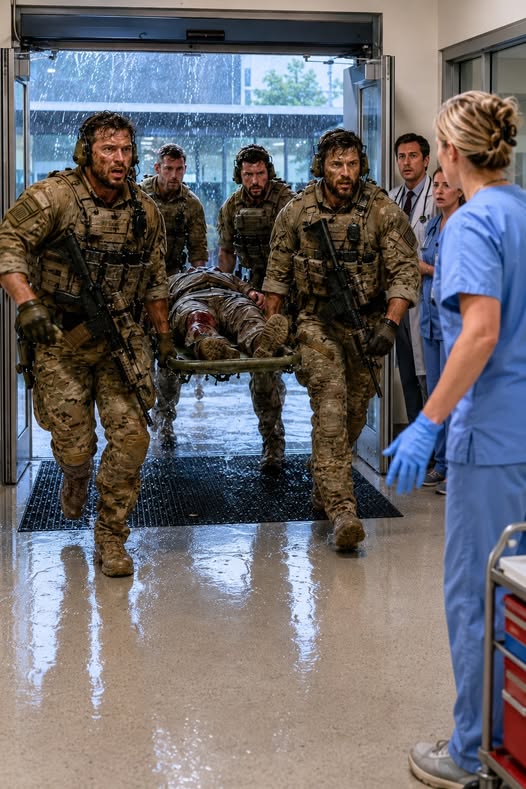
The first man through the ambulance doors had blood on his boots and murder in his voice.
He was huge, bearded, filthy, and wearing tactical gear that looked obscene under Mercy General’s soft white lights.
Behind him came three more operators moving with tight, practiced violence. Plate carriers. Dust-caked boots. Combat shirts dark with sweat. No one had a weapon raised, but every civilian in that ER understood the room no longer belonged to them.
They carried a litter.
The man on it was dying.
“Clear the damn way!” the lead operator roared.
A gurney rolled into his path.
He shoved it aside with one hand.
It smashed against the wall hard enough to knock a framed hospital mission statement crooked.
Compassion. Integrity. Community.
Cute.
Dr. Aris, our attending, rushed forward with Chen half a step behind him.
“I’m Dr. Aris,” he said. “Trauma bay one. Move him now.”
The operator blocked him with one gloved hand to the chest.
“Back off.”
Aris blinked.
“I’m the attending physician.”
“And I’m the guy who watched him bleed through two tourniquets in the air,” the operator said. “So unless your name is Dusty, you’re background noise.”
My pulse punched once, hard.
Dusty.
The name did not belong in Kentucky.
It belonged in sand, heat, rotor wash, and bad radio reception.
Nancy stepped forward, clutching her tablet like it could protect her.
“Sir, I’m the charge nurse. You need to tell us what unit you’re with so I can contact the proper—”
“Stop talking.”
Nancy’s mouth snapped shut.
The operator scanned the room.
His eyes moved past doctors, nurses, techs, security guards.
Then he shouted so loud the monitors seemed to flinch.
“Where is Dusty?”
No one moved.
No one knew the ghost he was calling.
The man on the litter arched off the mattress. His chest wound bubbled pink foam beneath a soaked pressure dressing. His left leg ended below the knee, the tourniquet twisted cruelly high on his thigh.
But the leg wasn’t what scared me.
His neck did.
Trachea shifting.
Pressure building.
Chest not moving right.
Minutes, maybe less.
One of the operators looked up.
“Wyatt, he’s crashing.”
Wyatt.
Of course it was Wyatt.
The last time I had seen Sergeant Major Wyatt Blake, he was dragging me out of a burning vehicle by the back of my armor while I screamed at him to go back for a kid we both knew was already dead.
He looked older now.
So did I.
He turned in a slow circle.
“I need Whiskey Six!” he yelled. “I need Dustoff Actual right now!”
My hands shook inside my scrub pockets.
Harper Vale did not know those names.
Harper Vale stocked masks and charted vitals.
Harper Vale got insulted by Nancy and went home to a one-bedroom apartment with a frozen pizza and a dead phone battery.
Harper Vale was safe.
The dying man made a wet, choking sound.
That sound cut through every lie I had built.
I pushed off the wall.
Nancy saw me move.
“Harper,” she hissed. “Stay out of the way.”
I walked past her.
Past Chen.
Past Aris.
Wyatt turned, ready to crush whoever got between him and his man.
Then he saw my face.
Not my hair.
Not my scrubs.
My stance.
His expression cracked.
“Dusty?”
“Move,” I said.
He moved.
Just like that.
Every person in the ER saw a Special Ops operator twice my size step aside because the float nurse told him to.
I looked down at the soldier.
His name tape read HAYES.
I pulled on gloves.
“Nancy,” I said.
She stared at me.
“Nancy.”
“What?”
“Fourteen-gauge angiocath. Scalpel. Chest tube tray. Now.”
Her face twisted with panic and authority trying to occupy the same square inch.
“You’re not authorized to—”
I looked at her.
Not angry.
Not loud.
Just finished with her.
“Bring me the tray, Nancy, or explain to his mother why your ego was the thing that killed him.”
She ran.
PART 3
I had spent three years pretending I didn’t know how to keep men alive in pieces, and then Mercy General watched me do it in ninety seconds.
The ER went silent in the way rooms go silent when everyone understands the rules just changed.
Nancy dropped the tray onto the bed so hard the instruments jumped.
Her hands fluttered.
“Do you need Betadine? Consent? I mean, we need—”
“Stop making paperwork noises.”
Wyatt barked one short laugh.
It died fast.
Hayes was fading.
His lips had that terrible blue-gray edge. His chest barely rose. The dressing at his collarbone foamed with every weak breath.
I tore open the angiocath.
Dr. Aris stepped closer.
“Harper, wait. We need to transfer him. We need imaging.”
“No.”
“You can’t just—”
“Infection kills in three days. Tension pneumothorax kills in three minutes.”
He stopped.
I found the spot.
Second intercostal space. Midclavicular line.
My fingers knew before my head finished the sentence.
“Hold him,” I said.
Two operators pinned Hayes with careful force.
“I’m sorry,” I told him, though he couldn’t hear me.
Then I drove the needle in.
The catheter punched through.
Air hissed out hard.
Pink blood sprayed across my blue scrubs.
Someone gasped.
Chen whispered, “Oh my God.”
Hayes dragged in a breath that sounded like gravel in a wet pipe.
The monitor changed.
Oxygen climbing.
Heart rate ugly but present.
“Temporary,” I said. “Tube.”
Aris didn’t argue this time.
He handed me the scalpel.
No lidocaine.
No polite setup.
No pretty medicine.
Combat medicine is not a TED Talk. It is math under pressure. It is hands moving faster than fear. It is deciding which terrible thing buys the most time.
I made the cut.
Blood welled dark.
I took the forceps and spread through muscle.
The sound made Nancy turn away.
Good.
Some people should look away.
I pushed my finger into the incision, swept for clots, felt rib, lung, heat, damage.
“Tube.”
Aris slapped it into my palm.
I fed it in.
Dark blood rushed through the plastic.
“Pleuravac,” I said.
Chen scrambled, hands clumsy but moving.
Suction started.
The machine gurgled.
Hayes breathed.
Not well.
Enough.
“Now OR,” I said. “And call vascular, thoracic, anesthesia, blood bank. Tell them to stop acting like this is a drill.”
Aris snapped back into command mode because doctors are like Wi-Fi routers; sometimes you unplug the arrogance and they reconnect better.
“Move!” he shouted. “OR One. Massive transfusion protocol. Let’s go.”
The staff surged.
The operators stepped back but stayed close, eyes scanning doors, windows, exits. They had brought the war inside and still expected it to follow.
As they rolled Hayes away, his hand slipped off the side of the gurney.
For one second, his fingers brushed mine.
Cold.
Alive.
Then he was gone down the hall.
The ER remained frozen around me.
My scrubs were soaked from chest to waist. Blood dotted my face. A strand of hair had come loose and stuck to my cheek.
Nancy stood by the charge desk like someone had unplugged her.
Dr. Chen stared at me with the pale, embarrassed horror of a man realizing the person he dismissed had just saved a life he almost watched leave.
Wyatt remained.
He took one step toward me.
I lifted a hand.
“Not here.”
He understood.
I walked straight into the sluice room, kicked the door shut, and turned the sink on full blast.
Hot water hit my gloves.
Red spiraled into the drain.
I stripped the gloves off and scrubbed with hospital soap until my skin burned.
It didn’t help.
Some smells don’t live on skin.
They live behind the eyes.
The door opened.
Wyatt came in and filled the little room with tactical gear, dried blood, and old history.
He didn’t speak at first.
That was kind of him.
He pulled a stack of paper towels from the dispenser and handed them to me.
I took them.
“You look terrible,” I said.
“You always did know how to comfort a man.”
“Why are you here?”
“Because Hayes had five minutes and the nearest Level One had twenty.”
“That doesn’t answer my question.”
Wyatt leaned against the wall. His face looked carved down by sandpaper and sleepless nights.
“Dispatch tracked your license.”
I laughed once.
It came out sharp.
“You used my nursing license like a GPS tag?”
“Emergency credential sweep. Your name came up at Mercy. I made the call.”
“You violated airspace.”
“Several people are upset.”
“You stormed a civilian ER.”
“Also on the complaint list.”
“You dragged my past into my workplace.”
That landed.
Wyatt looked down.
“Yeah,” he said. “I did.”
My hands tightened around the paper towels.
“I’m not Whiskey Six anymore.”
“I know.”
“No, you don’t. Because if you knew, you wouldn’t have come here.”
He looked at me then.
“You think I had options?”
I didn’t answer.
“Hayes asked for you before he lost consciousness.”
That cut through the room.
I looked away.
“He doesn’t even know me.”
“He knows the stories.”
“Stories get people killed.”
“So does pretending you’re less than you are.”
The sink kept running.
I reached behind me and shut it off.
The sudden silence felt rude.
Wyatt reached into a pouch and pulled out a small fabric patch. Subdued American flag. Tiny skull stitched in one corner. Dirty, stiff with dried blood.
My old team patch.
I stared at it like it was something venomous.
“Don’t,” I said.
He set it on the steel sink anyway.
“You saved him.”
“I stabilized him.”
“That’s what saving means when the world is on fire.”
I swallowed.
My throat felt raw.
“I left that life because it ate everything.”
“I know.”
“No, Wyatt. You don’t get to say that like we’re at a VFW bar sharing bad whiskey. I wake up at 3:17 every morning because that’s when the mortar hit. I sit with my back to the wall at Applebee’s. I can tell the difference between fireworks and rifle fire from three neighborhoods away. I buy cheap coffee because Starbucks gets too crowded near the pickup counter.”
He stayed quiet.
“I am tired,” I said. “Not sleepy. Tired.”
His jaw flexed.
“I know that kind.”
Maybe he did.
That made me angrier.
“I built a life where nobody needed me to be exceptional. Nobody saluted. Nobody screamed my call sign. Nobody bled out with my hands inside their chest.”
“You call this a life?”
I turned.
He didn’t flinch.
“You let that woman out there talk to you like you stole her lunch money.”
“She’s harmless.”
“She’s not harmless. She’s small. There’s a difference.”
I looked at the patch.
He followed my eyes.
“You don’t have to come back,” he said. “Nobody’s asking.”
“Then what are you doing?”
“Reminding you that hiding isn’t healing.”
The line was almost too neat.
I hated it.
“You rehearse that on the flight?”
“Between the illegal landing and the near-death patient, yeah, I had time.”
Despite myself, I smiled.
Barely.
Wyatt saw it and wisely did not celebrate.
A knock hit the door.
Not polite.
Administrative.
The door opened before either of us answered.
Marjorie Kent stood there in a cream blazer, pearls, and the sour expression of a woman who had just been forced to walk quickly in heels.
Hospital administrator.
I had seen her face on internal emails about parking fees and “resilience workshops.”
Behind her hovered Nancy, pale and eager, trying to look like a victim of national security.
“There you are,” Marjorie said.
I glanced down at my ruined scrubs.
“Sharp work, detective.”
Her eyes narrowed.
“Ms. Vale, we need to discuss what happened in my emergency department.”
Wyatt straightened.
Marjorie noticed him and recalculated her tone.
“Sergeant Major, I understand your team was under pressure, but this facility has protocols.”
Wyatt smiled without warmth.
“Your facility also had a dying American operator in the lobby and a charge nurse telling the only person qualified to touch him to stand against a wall.”
Nancy’s face went blotchy.
“That is not what happened.”
I leaned against the sink.
“It is exactly what happened.”
Marjorie looked at me.
“Ms. Vale, you performed an emergency procedure outside your assigned duties.”
“I performed within my license and training under immediate life-threatening conditions.”
“You are a float nurse.”
“Congratulations on reading the schedule.”
Nancy jumped in.
“She threatened me.”
Wyatt turned his head slowly.
Nancy regretted speaking but continued because some people treat holes like places to keep digging.
“She said she would break my fingers.”
Marjorie’s eyebrows lifted.
“Is that true?”
I nodded.
“Yes.”
Nancy looked triumphant.
I added, “It was medically effective.”
Wyatt coughed into his fist.
Marjorie did not enjoy that.
“This is serious,” she said. “There will be an internal review.”
“Good,” I said. “Pull the security footage.”
Nancy’s triumph vanished.
“And the audio from the trauma bay,” I added. “Also review Bay 6, where Dr. Chen failed twice on a crashing pelvic fracture while your charge nurse ignored the monitor.”
Chen, standing outside the open door, looked like he wanted the floor to open and accept him.
Marjorie’s face tightened.
“This hospital does not appreciate threats.”
“Then stop hiring them into management.”
Nancy gasped.
Marjorie stepped closer.
“Ms. Vale, you are currently suspended pending—”
Wyatt’s phone rang.
He answered without asking permission.
“Blake.”
He listened.
His face changed.
He looked at me.
Then he held the phone out.
“For you.”
I didn’t take it.
“Who is it?”
“General Hollis.”
The name hit Marjorie like a dropped tray.
Nancy blinked.
“General?” she whispered.
Wyatt’s smile turned mean.
“Three stars. Try not to transfer him to voicemail.”
I took the phone.
“This is Harper.”
The voice on the other end was older, flat, and furious.
“Dusty, is my man breathing because of you?”
“Yes, sir.”
“Good. Is the hospital giving you trouble?”
I looked at Marjorie.
She had gone very still.
“They’re considering it.”
“Put me on speaker.”
I tapped the screen.
The general’s voice filled the sluice room.
“This is Lieutenant General Marcus Hollis, United States Army Special Operations Command. The nurse you are attempting to discipline just kept one of my operators alive after your facility became the closest viable point of care. Any administrator who wants to turn that into a liability issue should first consider whether they enjoy congressional phone calls before dinner.”
Marjorie’s mouth opened.
Nothing came out.
The general continued.
“And someone tell your charge nurse that calling a decorated combat medic ‘not authorized’ while a man suffocates in front of her is a bold career choice.”
Nancy looked physically smaller.
I handed the phone back to Wyatt.
The sluice room stayed silent.
Then Marjorie smoothed her blazer.
“We should all take a breath.”
I laughed.
“No.”
PART 4
By 5 p.m., Nancy had lost her charge desk, Dr. Chen had lost his attitude, and Mercy General’s legal department had lost the fantasy that I was an easy target.
Hospital politics move faster than bloodwork when liability smells expensive.
Within an hour, three people from Risk Management showed up with laptops, tight smiles, and the energy of lawyers pretending not to be lawyers. Security pulled footage. The county dispatch recording got forwarded. Someone from the Army called the CEO directly. Someone else from the governor’s office called the CEO’s assistant, which at Mercy General was basically calling God’s babysitter.
Nancy stopped speaking to me.
A gift.
I changed into spare surgical scrubs two sizes too big and sat in a conference room with a bottle of Dasani, a stale granola bar, and dried blood still under one fingernail.
Marjorie Kent sat across from me.
To her left was Human Resources.
To her right was Legal.
Nancy sat at the end of the table, arms crossed, face stiff with the kind of outrage people wear when consequences arrive before they finish lying.
Dr. Aris stood near the wall.
Chen stood beside him, staring at his shoes.
Wyatt stood behind my chair like a bad decision with a beard.
Legal cleared his throat.
“Ms. Vale, we want to establish a clear timeline.”
“Great,” I said. “Use the security cameras. They don’t need bathroom breaks or promotions.”
HR smiled like her face hurt.
Marjorie folded her hands.
“Harper, no one is questioning that you acted under pressure.”
“Five minutes ago you were suspending me.”
“That was before we had more complete information.”
“That was before a three-star general used his outside voice.”
Wyatt made a sound that might have been a laugh.
Legal looked at him.
Wyatt looked back.
Legal found his notes fascinating.
Nancy leaned forward.
“I was trying to maintain order. She threatened physical violence, ignored chain of command, and exposed this hospital to massive liability.”
I turned to her.
“You told me to stand against the wall while a man died.”
“I didn’t know who you were.”
“That’s the first honest thing you’ve said all day.”
Her face flushed.
“You deliberately concealed your background.”
“I applied as a nurse. My license is valid. My certifications are current. My personnel file includes military medical experience.”
Marjorie glanced at HR.
HR’s eyes dropped to her laptop.
That told me everything.
They had it.
They just never read it.
Of course they hadn’t. Hospitals love credentials until reading them requires effort.
Dr. Aris finally spoke.
“She’s right.”
Everyone looked at him.
He cleared his throat.
“I reviewed her file after the incident. Combat medic. Flight paramedic equivalency. Trauma certifications. Critical care transport experience. She was more qualified than anyone in that room to do what she did.”
Chen swallowed.
“And she told me to order blood on Mr. Bowers,” he said quietly. “She caught the pelvic bleed before I did.”
Nancy snapped, “Mason.”
He looked at her.
“No. I almost missed it.”
The room shifted.
Small truth.
Big damage.
I watched Nancy understand she was losing the room and reaching for the only weapon she had left: superiority.
“She’s unstable,” Nancy said.
There it was.
Wyatt moved behind me.
I lifted one finger without looking.
He stopped.
Nancy saw it.
She hated that he obeyed me.
“She had some kind of episode,” Nancy continued. “She disappeared into the sluice room. She was shaking. She’s clearly carrying trauma that makes her unsafe in a civilian hospital.”
The words landed carefully.
Not loud.
Not crude.
Worse.
They were polished enough to sound concerned.
I looked at her for a long moment.
Then I took out my phone, opened my banking app, and placed it face down on the table.
Everyone stared.
Nancy frowned.
“What are you doing?”
“Showing restraint. Because the old me would’ve made you cry by now, and the current me is trying to keep this meeting billable.”
Legal coughed.
I leaned forward.
“You don’t get to weaponize trauma after hiding behind incompetence. You don’t get to call me unstable because I saved a man you were ready to watch die from a safe distance.”
Nancy’s lips pressed flat.
“You threatened me.”
“Yes. In an emergency. You moved. He lived. That’s my favorite kind of management.”
Wyatt looked at the ceiling like he was praying for maturity and receiving none.
Marjorie spoke carefully.
“Ms. Vale, our concern is workplace culture.”
That almost made me laugh again.
“Workplace culture?”
I pointed at Nancy.
“She called me ‘not a real nurse’ in front of staff.”
Nancy stiffened.
“She assigned me cleanup duties after I assisted a crashing patient.”
Marjorie blinked.
I kept going.
“She instructed me not to touch anything important without reviewing my qualifications. She discouraged clinical action based on status, not skill. She delayed response during a mass casualty arrival because she was waiting for a protocol to make her brave.”
The room went quiet.
“And if you want to talk culture,” I said, “ask your float pool how many times they’ve been treated like rented furniture by permanent staff.”
HR typed something very fast.
Nancy’s face had gone from red to white.
“This is ridiculous,” she said. “I have been here sixteen years.”
“And today you proved time served isn’t the same as leadership.”
That one hurt.
I saw it hit.
Marjorie saw it too.
Legal closed his folder.
“We’re recommending administrative leave for Charge Nurse Nancy Whitcomb pending formal review.”
Nancy stood so quickly her chair screeched.
“You cannot be serious.”
Marjorie did not look at her.
“Nancy, sit down.”
“No. I have given this hospital sixteen years. Sixteen. I missed birthdays. I worked Christmas. I trained half this department.”
I looked at her.
“And still couldn’t recognize competence unless it arrived with helicopters.”
Her eyes snapped to mine.
For one second, I saw the real thing under all that control.
Fear.
Not of me.
Of becoming ordinary.
Security arrived at the door.
Not dramatic.
Not two huge guys dragging her out.
Just one tired officer named Pete who usually dealt with drunk patients and vending machine theft.
“Nancy,” he said gently, “they need your badge.”
Her hand went to her ID.
She didn’t remove it.
Marjorie finally looked at her.
“Now.”
Nancy unclipped the badge.
Her fingers shook.
She placed it on the table like it weighed ten pounds.
Nobody clapped.
Nobody cheered.
Real consequences are usually quiet.
They embarrass you in fluorescent lighting.
Nancy walked out past me.
At the door, she stopped.
“You think this makes you special?”
I looked up.
“No. It makes me employed.”
Her mouth opened.
Closed.
She left.
By 7 p.m., Hayes was out of surgery.
Alive.
Critical, but alive.
Wyatt got the call while I was sitting outside the OR vending machines eating peanut M&M’s because my blood sugar had filed a formal complaint.
He lowered the phone.
“Tube worked. Vascular got control of the leg. Thoracic says he’s stubborn enough to annoy people by morning.”
I nodded.
“Good.”
Wyatt sat beside me.
His gear was gone now, replaced by a black T-shirt and cargo pants someone had found for him. He still looked like trouble, just less federally funded.
He glanced at the vending machine.
“Dinner?”
“Protein, sugar, capitalism.”
“Balanced.”
I shook the M&M’s into my palm.
“You going back?”
“To base?”
“To whatever classified swamp you crawled out of.”
“Tomorrow.”
I nodded.
He waited.
I hated that he knew me well enough to wait.
Finally, I said, “I’m not coming with you.”
“I didn’t ask.”
“You were going to.”
“No,” he said. “I was hoping you’d stop punishing yourself in a job where people mistake quiet for weak.”
That sat between us.
Down the hall, a janitor pushed a mop bucket past a framed poster that said HEROES WORK HERE.
I stared at it.
Hospitals put words like that on walls because putting safe staffing ratios there would be too honest.
“I like being useful,” I said.
“I noticed.”
“I don’t like being needed.”
“Too bad. Humans are inconvenient.”
I leaned back against the wall.
“My therapist says I confuse peace with disappearance.”
“Smart therapist.”
“Expensive therapist.”
“Even smarter.”
I smiled.
A real one this time.
Wyatt reached into his pocket and pulled out my old patch.
The skull flag.
“I brought it back.”
“I left it in the sink.”
“Yeah. Dramatic. Wasteful. Very you.”
I took it this time.
The fabric was rough against my thumb.
For three years, I had treated that patch like a threat.
Now it felt like evidence.
Not that I belonged back there.
That I had survived it.
Marjorie appeared at the end of the hall, walking fast.
Behind her came the CEO of Mercy General, a silver-haired man named Robert Kline who had once sent a hospital-wide email about “gratitude-centered leadership” while cutting weekend differentials.
He extended his hand.
“Ms. Vale. Robert Kline. I wanted to personally thank you.”
I looked at his hand.
Then at him.
“I’m not in the mood for a LinkedIn moment.”
His hand lowered.
Wyatt studied the vending machine like it was the most interesting thing in Kentucky.
Kline smiled tightly.
“Fair. What you did today was extraordinary.”
“What your hospital did before that was ordinary. That’s the problem.”
Marjorie inhaled through her nose.
Kline glanced at her.
Good.
Maybe her day could get worse.
I stood.
My oversized scrubs hung off me. My knee hurt. My hair was a mess. There was dried blood near my watchband.
I had never looked less impressive.
I had never felt less afraid.
“You want to thank me?” I said. “Stop treating float nurses like disposable bodies. Audit your charge staff. Review trauma readiness. Pay for training that isn’t just a slideshow with clip art. And put Nancy’s replacement through leadership training before handing them a clipboard and a personality disorder.”
Wyatt choked.
Kline’s smile disappeared.
Then, to his credit, he nodded.
“Send me your recommendations.”
“No.”
He blinked.
“I’m sorry?”
“You don’t get free consulting because I bled on your floor.”
Marjorie looked horrified.
I kept going.
“You can pay me for it, or you can hire someone else to tell you the same thing in worse shoes.”
Kline stared.
Then he laughed once.
Not because it was funny.
Because he knew he had walked into a negotiation he couldn’t win.
“Name your terms.”
That was when Nancy came around the corner.
She had no badge now.
No tablet.
No kingdom.
She must have been escorted to collect her purse, because she clutched a Michael Kors tote against her ribs like a flotation device.
She saw me standing with the CEO.
She saw Wyatt beside me.
She saw the patch in my hand.
Her face changed.
Not anger this time.
Understanding.
The world had moved on without asking her permission.
I slid the patch into my pocket.
Then my phone buzzed.
Unknown number.
I answered.
“This is Harper.”
A weak male voice crackled through.
“Is this Dusty?”
I stopped breathing.
Wyatt stood.
The hallway narrowed.
“Hayes?” I said.
A pause.
Then a rough laugh.
“Ma’am, they told me I owe you scrubs.”
My eyes closed.
Just for one second.
“You owe me expensive ones,” I said. “Not hospital vending-machine blue. I’m thinking designer.”
“Copy that,” he whispered. “Thank you.”
I swallowed hard.
“Stay alive long enough to pay me back.”
“Yes, ma’am.”
The call ended.
I stood there with the dead screen in my hand.
No applause.
No swelling music.
Just vending machines, floor wax, and the most exhausted kind of relief.
Nancy was still watching.
For once, she had nothing to say.
PART 5
The next morning, Mercy General sent an email calling Nancy’s exit “a leadership transition,” which was corporate language for “the float nurse won.”
By noon, her name was gone from the charge schedule.
By three, the staff group chat had mysteriously rediscovered kindness.
Dr. Chen found me in Bay 6, where Carl Bowers was awake, grumpy, and demanding real coffee instead of “hospital mud.”
Chen stood near the curtain, hands in his coat pockets.
“I was an ass,” he said.
Carl looked at him.
“Good start, kid.”
I checked Carl’s IV.
Chen cleared his throat.
“You saved him too. Mr. Bowers.”
I shrugged.
“I told you to order blood.”
“You knew.”
“I paid attention.”
He nodded.
“I’ll try that.”
That was enough.
Later, Kline approved paid trauma training for float staff, an external review of ER command protocols, and a consulting contract with my name on it that had enough zeroes to make my credit card debt nervous.
Nancy filed a complaint.
It died quietly after Legal watched the footage.
Wyatt left before sunset.
No dramatic goodbye.
Just a black SUV at the curb, rain on the windshield, and him rolling down the window.
“You keeping the patch?” he asked.
I touched my scrub pocket.
“For now.”
“You still hiding?”
I looked back at Mercy General.
At the ambulance bay doors.
At the nurses rushing in and out under fluorescent lights.
“No,” I said. “I’m floating.”
He grinned.
“Different thing?”
“Very.”
The SUV pulled away.
I walked back inside.
Nancy’s old charge desk was empty.
The trauma board was full.
Someone had left a fresh Starbucks on the counter with my name written wrong.
Haper.
Close enough.
I picked it up and took a sip.
Then the red phone rang again.
Every head turned toward me.
I set the coffee down.
Calmly.
“Somebody answer it,” I said. “And this time, don’t make me repeat myself.”