PART 1
The first insult came before the plane even left the gate.
“Careful with that book, sweetie,” the man in 11B said, leaning so far into my space I could smell his airport whiskey and peppermint gum. “Looks like the kind of thing that gives pretty girls headaches.”
I looked up from the manual in my lap.
Not a textbook.
Not homework.
A classified-adjacent technical manual on advanced avionics systems I was reviewing because I was scheduled to train junior pilots the following week.
But Gerald Thompson did not know that.
Gerald saw ripped jeans, white sneakers, a navy hoodie, a messy ponytail, and a woman who looked younger than she was.
So he smiled at me like I was a child trying to use a credit card for the first time.
“Engineering?” he asked.
“Something like that,” I said.
He chuckled.
That little corporate laugh.
The kind men use when they think they have already won a conversation no one invited them into.
“I run a consulting team in D.C.,” he said. “Senior partner. Thirty-two years in the game. I can spot ambition from across a room.”
“Congratulations.”
He missed the blade in my tone.
Men like Gerald usually do.
He nodded toward the manual. “College?”
“No.”
“Grad school?”
“No.”
He smiled wider, pleased with himself. “Trade program?”
I turned one page.
Across the aisle, a woman in a beige cardigan looked up from her Starbucks cup and gave me the kind of tight sympathetic smile women give each other when a man is performing in public.
Gerald kept going.
“Look, don’t take this the wrong way. But some fields are brutal. Engineering. Aviation. Defense. That whole world chews people up. Especially young women who think passion is the same thing as discipline.”
I capped my pen.
Slowly.
“Is that so?”
“Oh, absolutely,” he said. “I’ve hired plenty of kids your age. Smart, sure. But soft. They want the title before the work.”
I almost laughed.
Not because it was funny.
Because I had heard some version of that sentence in classrooms, hangars, briefing rooms, aircraft carriers, and officer lounges from men who later had to stand when I entered.
I looked back down.
Gerald took my silence as permission.
“You know what I always tell young women?” he said. “Pick a lane where you can shine. Communications. HR. Client relations. Something people-facing. You don’t need to prove you can do the hardest thing in the room.”
The woman across the aisle finally snapped.
“She can study whatever she wants,” she said.
Gerald raised both hands. “Just giving practical advice.”
“Practical,” I said, “is usually what people call rude when they want credit for it.”
His smile flickered.
Good.
United Flight 1634 pushed back from San Diego International at 3:47 p.m. on a Tuesday.
San Diego to Washington Dulles.
Four hours.
Boeing 757.
Two hundred and three souls on board, including crew.
Business travelers in wrinkle-resistant suits.
A family with two tired kids and one iPad at 4%.
A retired couple already asleep before the safety demo ended.
A lobbyist in first class loudly explaining tax policy to a woman who had clearly chosen death over conversation.
And me.
Seat 11C.
Window.
Economy.
No uniform.
No name tag.
No rank.
Just Alexis Chen, twenty-nine years old, trying to take ten days of leave without being recognized by anyone who knew how to Google a Navy call sign.
My commanding officer had practically thrown me out of his office two days earlier.
“Go be normal,” Captain Harris had said.
“Define normal, sir.”
“Sleep. Eat food that did not come out of a foil pouch. Watch stupid television. Buy an overpriced latte. I don’t care. Just stop acting like the Navy will collapse if you sit down.”
“I’m fine.”
“You have been deployed back-to-back for eighteen months.”
“I said I’m fine.”
“You said that before you fell asleep standing up during a maintenance briefing.”
“That was a tactical blink.”
He pointed at the door.
“Leave, Commander.”
So I left.
I packed civilian clothes.
I refused the business-class upgrade because I wanted anonymity more than legroom.
I bought a black coffee at the airport, burned my tongue, and sat in 11C beside Gerald Thompson, a man who thought thirty-two years in management consulting made him qualified to diagnose my future.
For the first hour, the flight was boring.
Blessedly boring.
The engines settled into their usual deep hum.
The seat belt sign clicked off.
Flight attendants rolled carts down the aisle selling snack boxes that cost more than they should.
Gerald opened his laptop and began typing a PowerPoint deck with the intensity of a man defusing a bomb.
I read.
I underlined.
I made notes.
At some point, Gerald looked over again.
“Still at it?”
I did not answer.
“You know, work-life balance matters too.”
“That why you’re editing slides at thirty-seven thousand feet?”
The woman across the aisle coughed into her coffee.
Gerald’s jaw tightened.
Then he put on noise-canceling headphones and finally gave the entire row the gift of his silence.
Ninety minutes into the flight, I heard it.
Not a bang.
Not an explosion.
Not anything dramatic enough for regular passengers to notice.
Just a slight shift in the engine tone.
A wrongness.
A drag under the sound.
My pen stopped moving.
My eyes went to the window.
The right wing looked normal for half a second.
Then the aircraft dropped hard and rolled right.
Not turbulence.
Turbulence bumps.
This pulled.
This grabbed the plane by one side and tried to twist it out of the sky.
The cabin screamed before the oxygen masks fell.
Plastic doors snapped open overhead.
Yellow cups dropped into faces, laps, coffee, laptops.
Someone behind me yelled, “Oh my God!”
A child started crying.
Gerald grabbed his mask with both hands and fumbled like the thing had personally betrayed him.
“What’s happening?” he shouted. “What’s happening?”
I had my mask on in two seconds.
My seat belt was still fastened.
My hands were steady.
Not because I was fearless.
Fear is useful.
Panic is not.
I looked out the window again.
Black smoke was streaming from the right engine.
Thin at first.
Then thick.
Then ugly.
Engine fire.
The aircraft rolled again.
The pilot corrected, but the correction came late and heavy.
Hydraulic issue, maybe.
Flight control degradation.
Possible engine failure in progress.
Gerald was praying now.
Badly.
Loudly.
The woman across the aisle gripped both armrests and stared straight ahead.
The PA crackled.
A male voice came on first.
Controlled.
Too controlled.
“Ladies and gentlemen, this is Captain Richardson. We are experiencing technical difficulties. Please put on your oxygen masks immediately and remain seated with your seat belts fastened. Flight attendants, take your emergency positions.”
Then silence.
Too much silence.
Thirty seconds later, another voice came on.
Female.
Younger.
Shaking at the edges.
“This is First Officer Sarah Mitchell. Captain Richardson has become incapacitated. We have lost primary flight control systems, and engine number two is on fire. If there is anyone on board with flight experience, any flight experience, please identify yourself to a flight attendant immediately.”
The cabin exploded.
People shouted.
Someone started sobbing.
A man yelled, “I flew Cessnas!”
Another yelled, “My brother’s a pilot!”
Gerald grabbed my sleeve as I unbuckled.
“Sit down,” he snapped. “She said stay seated.”
I looked at his hand.
Then at him.
“Move your fingers.”
He let go.
I stepped into the aisle as the aircraft shuddered under my feet.
Gerald stared at me like I had lost my mind.
“You’re not going up there.”
I braced one hand against the overhead bin as the plane rolled again.
“Watch me.”
PART 2
The flight attendant tried to block me because, to him, I looked like someone who needed permission to rent a car.
“Ma’am, return to your seat,” he said.
His name tag read Michael.
His face was pale, but his voice still worked. That mattered.
“I’m a pilot,” I said. “I need the cockpit.”
He looked at my hoodie.
My ripped jeans.
My sneakers.
Then he looked past me, searching the cabin for someone older, taller, louder.
Someone who matched the emergency in his head.
“Ma’am, we need real flight experience.”
“I fly F/A-18 Super Hornets off aircraft carriers.”
He froze.
I stepped closer.
“My name is Commander Alexis Chen. United States Navy. Active duty. I have 1,847 flight hours, 247 combat missions, and I need you to knock on that cockpit door right now.”
His expression changed.
Not belief yet.
Recognition of a tone.
The tone of someone not asking.
He knocked.
The cockpit door opened two inches.
First Officer Sarah Mitchell looked out, sweat shining across her forehead.
Michael said, “She says she’s a military pilot.”
Sarah saw me and almost closed the door.
“No. I don’t have time for passengers playing hero.”
I put one hand flat against the doorframe.
“First Officer Mitchell. Right engine is burning. Aircraft is rolling right under degraded control. Your captain is down. You are minutes from losing this airplane.”
Her eyes sharpened.
Good pilot.
Scared, but still processing.
“I’m not here to take your aircraft,” I said. “I’m here to help you keep it.”
She stared at me.
“You’re too young.”
“I’m twenty-nine.”
“That does not help your case.”
“No,” I said. “But my hours do.”
The plane dropped.
The cockpit warning alarms screamed behind her.
Sarah made the decision.
“Get in.”
PART 3
The cockpit looked like a Christmas tree designed by Satan.
Red warnings.
Amber warnings.
Messages stacking over messages.
Autopilot disengaged.
Engine two fire.
Hydraulic pressure dropping.
Flight control faults.
Captain Richardson was slumped in the left seat, unconscious, oxygen mask loose against his face.
Sarah was in the right seat, fighting the yoke with both hands.
Her knuckles were white.
But she was still flying.
That mattered more than anything.
I slid into the jump seat and scanned the instruments.
Altitude: dropping.
Airspeed: unstable.
Heading: wandering.
Right engine: fire warning active.
Left engine: carrying everything.
“Fire suppression?” I asked.
“Activated,” Sarah said. “No confirmed extinguish.”
“Shut down engine two completely.”
“I know the checklist.”
“I know you do. Run it. I’ll monitor.”
She looked at me once.
That look pilots give each other when rank, age, gender, ego, and every stupid human category gets stripped away by physics.
There are only two kinds of people in a cockpit during an emergency.
Useful.
And not.
Sarah was useful.
“Fuel shutoff valve,” she said.
“Closed,” I confirmed.
“Engine two throttle.”
“Idle. Cutoff.”
“Hydraulic isolation.”
“Check it twice,” I said. “You’re bleeding pressure.”
She checked.
Her face tightened.
“Hydraulic B is dropping fast.”
“I see it.”
The aircraft yawed left as the dead engine stopped producing thrust and the left engine shoved us unevenly through the sky.
Sarah corrected.
Too sharp.
The nose wandered.
“Rudder trim,” I said. “Easy. Do not chase it. Let the airplane talk before you answer.”
“Copy.”
“Small corrections. She’s hurt, not dead.”
Sarah gave one short laugh.
It sounded like fear trying to pass as humor.
“I usually prefer my aircraft unhurt.”
“Luxury mindset.”
She laughed again.
Better.
Humor keeps the brain oxygenated in ways medical journals refuse to appreciate.
I keyed the radio.
“Mayday, mayday, mayday. Denver Center, this is United 1634 declaring emergency. Boeing 757. Captain incapacitated. Engine two fire. Primary flight control degradation. We need nearest suitable airfield, longest runway, priority handling, emergency services staged.”
The controller answered immediately.
“United 1634, Denver Center. Nearest suitable is Denver International. Bearing two-seven-zero, ninety-six miles. Can you maintain altitude?”
I looked at the vertical speed.
“No. We are losing altitude at approximately eight hundred feet per minute. Request direct Denver, no holding, no delay.”
“United 1634, cleared direct Denver. Runway three-four left. Sixteen thousand feet available. Emergency vehicles notified.”
“Copy. Direct Denver. Three-four left.”
Sarah exhaled hard.
“Sixteen thousand feet,” I said. “That is a beautiful amount of concrete.”
“You always this calm?”
“No.”
“When are you not?”
“Parking garages. Bad sushi. Navy paperwork.”
She shook her head without taking her eyes off the instruments.
“Who are you?”
“Right now? Your least annoying passenger.”
The descent began.
Long.
Controlled.
Ugly.
The aircraft did not want to cooperate.
The dead right engine pulled drag.
The left engine pushed asymmetrically.
The damaged flight controls responded like they were receiving our requests through bad Wi-Fi.
Sarah flew anyway.
“Speed two-one-zero,” she said.
“Bring it to one-eighty slowly.”
“Flaps?”
“Not yet. We need to see how much control authority you still have. Make one change at a time. This plane is already having a bad day.”
She nodded.
At twenty-eight thousand feet, the cockpit door opened behind us.
Michael leaned in.
“Passengers are asking what’s happening.”
“Tell them we have the situation under control,” Sarah said.
He looked at me.
I said, “Tell them exactly this: the aircraft is damaged, we are diverting to Denver, emergency crews are waiting, and they need to stay seated, masked, and quiet so the crew can work.”
He swallowed.
“Quiet?”
“Yes. Panic is contagious. So is control. Sell control.”
He nodded and shut the door.
A minute later, the PA clicked on.
Michael’s voice rolled through the cabin.
Firm now.
Useful.
I watched the altimeter unwind.
Twenty-six thousand.
Twenty-five.
Twenty-four.
Then the radio came alive with a new voice.
Not civilian.
“United 1634, this is Viper Flight, two F/A-18 Super Hornets out of Buckley. We have been scrambled to escort you into Denver. Request aircraft status and identification of assisting pilot.”
My hand paused over the mic.
For one second, I hated every possible version of the next ten minutes.
Because once I said my name on that frequency, leave was over.
My commanding officer would know.
Public Affairs would know.
Somebody would leak something.
There would be video, headlines, interviews, and strangers online arguing about whether I looked old enough to command a parking garage.
I took the mic.
“Viper Flight, United 1634. We are single engine, descending, degraded controls, first officer flying, passenger pilot assisting.”
“United 1634, copy. Identify assisting pilot.”
Sarah glanced at me.
I pressed the transmit button.
“Viper Flight, assisting pilot is Commander Alexis Chen, call sign Reaper, United States Navy.”
Three seconds of silence.
Real silence.
The kind that has weight.
Then someone on the frequency said, “Say again. Did you say Reaper?”
“Affirmative.”
Another voice cut in.
Older.
Sharper.
“United 1634, this is Colonel Webb. Confirm Commander Alexis Chen, call sign Reaper, is on board.”
“It’s me, Colonel,” I said. “Currently on leave. Currently busy.”
A beat.
Then his voice changed.
Not softer.
More formal.
“Commander Chen, Viper Flight is yours. Whatever you need, you have it.”
Sarah stared at me.
The kind of stare that would have been funny if we were not in a crippled airplane.
“Reaper?” she said.
“Long story.”
“The F-18 pilots know you?”
“Apparently some of them read.”
Outside the windshield, two gray shapes appeared against the late afternoon sky.
Fast.
Clean.
Predatory.
The first Super Hornet slid into position off our left wing.
The second took the right.
Close enough that I could see the pilot’s helmet turn toward us.
My aircraft.
My world.
Now escorting me while I sat in a commercial cockpit wearing torn jeans and a hoodie.
Colonel Webb came over the radio.
“United 1634, Viper One has visual. We have your six, Commander.”
I looked at the runway data.
“Thank you, Colonel. Keep an eye on our right side. If the fire reignites or you see structural damage worsening, call it immediately.”
“Copy.”
Sarah’s hands steadied.
Sometimes confidence is borrowed.
That day, she borrowed mine.
I borrowed theirs.
That is how crews work.
At fifteen thousand feet, we started configuring.
“Approach speed will be one-five-five,” I said. “Not standard. Add ten knots for control margin.”
“That’s fast.”
“Yes.”
“Landing long?”
“With sixteen thousand feet? Land in Wyoming if you want.”
She snorted.
Good.
“Flaps one,” I said.
“Flaps one.”
The plane shuddered.
Not terrible.
“Hold. Feel it.”
“I have it.”
“Flaps five.”
More vibration.
The left wing dipped slightly.
Sarah corrected.
“Nice,” I said.
“Don’t compliment me like I’m a student driver.”
“Then stop gripping the yoke like it owes you money.”
Her mouth twitched.
At ten thousand feet, Denver appeared through the haze.
Runways.
Lights.
Fire trucks waiting.
A whole city’s worth of consequence spread out beneath us.
The radio stayed clean.
No chatter.
No traffic.
The sky belonged to one damaged Boeing, one terrified but capable first officer, two fighter jets, and a Navy commander everyone had mistaken for a college kid.
At four thousand feet, Sarah lowered the gear.
“Gear down,” she said.
“Three green,” I confirmed.
The aircraft jolted.
Gerald would be sweating through his expensive shirt right about now.
For one petty second, I hoped he remembered the communications comment.
Then I let it go.
Petty thoughts are allowed.
Distraction is not.
“Runway in sight,” Sarah said.
“Cleared straight in,” Denver Tower confirmed. “Wind three-one-zero at eight. Emergency vehicles standing by.”
“United 1634, continuing.”
“Okay,” I said. “You are going to fly this all the way down. No hero moves. No big correction. Small hands. Trust the sight picture.”
“I’m scared,” Sarah said.
There it was.
Honest.
Clean.
No shame in it.
“I know.”
“I’ve never done anything like this.”
“You’re doing it right now.”
The runway grew bigger.
One thousand feet.
“Stable,” I said.
Five hundred.
“Hold it.”
Two hundred.
“Begin easing back.”
One hundred.
“Flare now. Gently.”
The main gear hit hard.
A solid, honest, beautiful thump.
Both wheels down.
No bounce.
No skid.
Sarah deployed reversers.
Brakes came in controlled pulses.
The damaged airplane roared, shook, fought, and finally surrendered to the runway.
Fire trucks chased us in lines of red and white.
The Boeing slowed.
Slowed again.
Then stopped with thousands of feet to spare.
For three seconds, nobody in the cockpit moved.
Then Sarah put her forehead against the yoke.
“We’re down,” she whispered.
“Yes.”
“We’re actually down.”
“Yes.”
She laughed once.
Then her shoulders shook.
I looked out at the emergency vehicles surrounding us.
“You landed the airplane,” I said.
She turned toward me, eyes wet, face wrecked.
“You saved us.”
“No,” I said. “We did our jobs.”
PART 4
When I walked back into the cabin, the man who had called me “sweetie” could not look me in the eye.
The passengers were crying.
Laughing.
Calling spouses.
Holding strangers.
One woman kept saying, “I’m alive,” into her phone like she needed the sentence to become legal record.
A little boy in row 18 gave me a thumbs-up with a shaking hand.
I gave one back.
Then I reached row 11.
Gerald Thompson stood in the aisle.
His tie hung loose.
His face had gone the color of printer paper.
The confidence was gone.
Not reduced.
Gone.
Like someone had unplugged him.
“I owe you an apology,” he said.
The cabin around us went quieter.
People listened.
Of course they did.
Americans can survive a near-death experience and still recognize good public accountability when it appears.
Gerald cleared his throat.
“I judged you. I spoke down to you. I assumed you were… less capable than you are.”
“Less capable,” I repeated.
He flinched.
Good.
“I was wrong,” he said.
“Yes.”
“I called you sweetie.”
“You did.”
“I told you engineering might be too hard.”
“You did.”
“I suggested communications.”
The woman across the aisle made a sound that was not quite a cough.
I looked at Gerald.
His expensive watch caught the emergency lights flashing through the windows.
Red.
White.
Red.
White.
“You made a lot of assumptions in a very small amount of time,” I said.
“I know.”
“No,” I said. “You know now.”
He lowered his eyes.
“I’m sorry, Commander.”
There it was.
Commander.
Not sweetie.
Not young lady.
Not pretty thing.
Commander.
I nodded once.
Not warm.
Not cruel.
Just finished.
Then I walked off the aircraft.
Cold Denver air hit my face as soon as I stepped onto the stairs.
Fire crews moved around the plane.
Airport vehicles flashed.
Ground staff stared.
And at the bottom of the stairs stood two fighter pilots in flight suits.
Colonel Marcus Webb was one of them.
The other was younger, maybe twenty-five, still wearing the expression of someone trying very hard not to stare.
The second my foot touched the tarmac, both men snapped to attention.
Their salutes were sharp.
Clean.
Public.
Behind me, passengers pressed against windows.
Phones came up.
Of course they did.
The twenty-first century does not let history happen without witnesses.
I returned the salute.
Colonel Webb dropped his hand first.
“Commander Chen,” he said. “An honor.”
“Thank you for the escort, Colonel.”
“We would’ve escorted you to the moon if you asked.”
The younger pilot looked like he might pass out from admiration and discipline fighting inside the same body.
“Ma’am,” he said. “I studied your Syria engagement at Top Gun.”
“Parts of that are still classified.”
“Yes, ma’am. The parts we had were enough.”
I gave him a look.
He straightened.
“Respectfully, ma’am.”
Behind us, paramedics were bringing Captain Richardson down the stairs. Alive. Unconscious, but alive.
Sarah Mitchell followed.
She paused beside me, wrapped in a foil blanket, mascara smudged, hair pulled loose from its bun.
A reporter was already shouting from behind a security barrier.
“Commander! Commander Chen! Is it true you landed the plane?”
Sarah answered before I could.
“She helped me land it,” she said. “And if she had not been on board, we would not be standing here.”
I looked at her.
“Careful. Public Affairs hears compliments and turns them into paperwork.”
Sarah laughed.
It came out broken but real.
Three days later, the video went viral.
Not the landing.
Not the cockpit.
A forty-second clip shot through terminal glass.
Me, walking down the stairs of a battered Boeing 757 in ripped jeans and a hoodie while two F-18 pilots saluted me on the tarmac.
The caption was simple.
Everyone thought she was a college kid. Then fighter pilots called her Commander.
Twelve million views by morning.
Thirty million by Friday.
By the end of the week, my face was on every major network.
Not my official Navy portrait.
No.
The hoodie photo.
The one where I looked tired, annoyed, and like I wanted every camera in America to develop a mechanical failure.
Headlines wrote themselves.
29-Year-Old Navy Commander Saves 203 Lives.
Passenger Mocked as “Too Young” Helps Land Burning Plane.
F-18 Pilots Salute Mystery Woman After Emergency Landing.
My commanding officer called me on day four.
“Commander.”
“Sir.”
“I told you to go on leave.”
“I did.”
“You helped land a commercial airliner.”
“There was an engine fire.”
“You see how that sounds like the opposite of rest?”
“With respect, sir, I did sit down for most of it.”
Silence.
Then he sighed.
“You’re impossible.”
“Yes, sir.”
“Public Affairs wants one interview.”
“No.”
“They said recruiting numbers spiked.”
“No.”
“They said young women are calling Navy aviation offices asking about flight training.”
I stared at the wall.
Damn it.
He knew exactly where to hit.
“One interview,” I said.
“One.”
“I choose the outlet.”
“Fine.”
“No morning shows.”
“Fine.”
“No fake surprise reunion with Gerald from 11B.”
He paused.
“That was requested.”
“Absolutely not.”
So I did one sit-down interview.
Full dress whites.
Bright studio lights.
A correspondent with perfect hair and the careful voice people use around decorated service members.
“Commander Chen,” she said, “you are twenty-nine years old. You command a fighter squadron. You have flown hundreds of combat missions. Why do people still underestimate you?”
“Because they look before they listen.”
She blinked.
Good answer.
Too short for television.
She tried again.
“Does it bother you?”
“Yes.”
That made her smile.
“At least you’re honest.”
“I’m a pilot. Bad information gets people killed.”
She leaned forward.
“What would you say to the man on the plane who dismissed you?”
“I already said it.”
“What did you say?”
“Very little.”
“Why?”
“Because the landing was the lesson.”
The clip went viral again.
Of course it did.
But the real consequence did not happen on television.
It happened quietly.
Gerald Thompson lost two major clients after one of them recognized him from a passenger video where he was apologizing in the aisle.
Not because I named him.
I didn’t.
The internet did what the internet does.
Someone found his LinkedIn.
Someone found the consulting firm.
Someone found old panels where he spoke about “young talent lacking grit.”
His firm issued a statement about “values.”
Corporate translation: Gerald had become expensive.
He stepped down from his leadership role within a month.
Not fired, officially.
Men like Gerald are rarely fired.
They “transition.”
They “advise.”
They “spend more time with family,” even when their family would prefer a warning.
But he lost the corner office.
He lost the stage.
He lost the easy authority of being the loudest man in the room.
And from what I heard later, he also lost something more useful.
Certainty.
Six months after the emergency, a letter reached me through Navy Public Affairs.
Heavy stationery.
Washington return address.
Gerald Thompson.
I almost threw it away.
Then I opened it.
He wrote that he had spent months thinking about seat 11C.
About every young employee he had interrupted.
Every woman he had “coached” into a smaller dream.
Every junior consultant he had mistaken for soft because they did not perform exhaustion the way his generation did.
He wrote that after stepping down, he started mentoring three employees at his firm.
Actually mentoring.
Listening before advising.
Asking before assuming.
He wrote one sentence near the end that made me stop.
You saved my life once on that plane, Commander. Then you ruined the version of me that deserved to be ruined.
I read that twice.
Then I folded the letter and put it in the small locker beside my bunk.
Not because I forgave everything.
Forgiveness is not a vending machine where an apology goes in and absolution drops out.
I kept it because proof matters.
Proof that some people can be embarrassed into becoming better.
Proof that consequence can do what politeness never could.
Sarah Mitchell changed too.
She did not leave commercial aviation immediately.
But six months later, she applied for a Navy aviation lateral program.
In her application essay, she wrote about Denver.
About fear.
About the cockpit.
About learning that steadiness was not the absence of terror but the refusal to let terror touch the controls.
She was accepted.
The first time she emailed me from training, the subject line said:
Still gripping the yoke like it owes me money.
I laughed so hard in the ready room that three pilots turned around.
I did not explain.
Some jokes belong to the people who survived them.
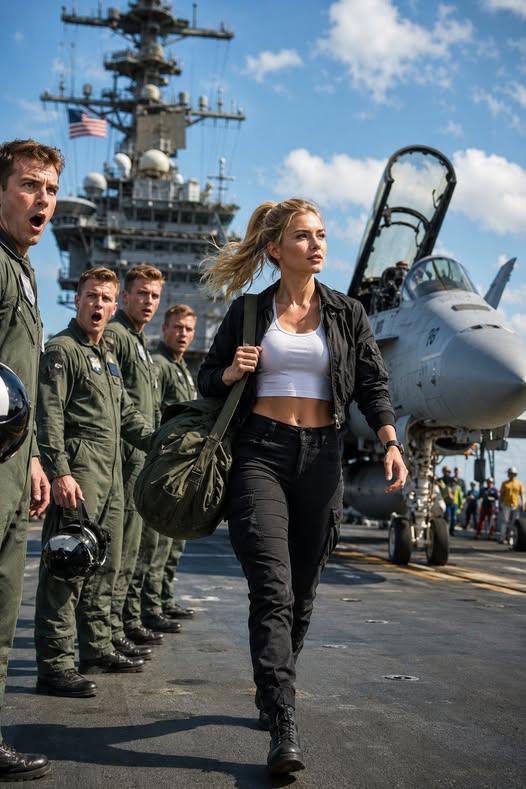
One year after United 1634, I returned to the carrier deck at sunrise.
The Pacific was steel-blue.
The air smelled like jet fuel, salt, and burnt coffee.
My F/A-18 waited under the morning light like a loaded question.
A junior pilot stood near the ladder, helmet tucked under one arm.
Young.
Nervous.
Trying not to look nervous.
“Commander,” he said.
“Yes?”
“Can I ask you something?”
“Depends how expensive the answer is.”
He smiled, then swallowed.
“How did you know you were ready? Back then. When everyone thought you were too young.”
I looked at the deck crew moving with practiced speed.
At the ocean beyond the carrier.
At the aircraft I had spent my adult life earning.
“I didn’t,” I said.
He looked surprised.
Good.
Young pilots need fewer myths and more truth.
“I knew I was prepared,” I said. “That’s different. Ready is a feeling. Prepared is a record.”
He nodded slowly.
“So what do you do when they underestimate you?”
I climbed the ladder and paused before lowering myself into the cockpit.
“You let them.”
He frowned.
“You let them?”
“Of course,” I said. “Surprise is free ammunition.”
Then I put on my helmet.
The canopy lowered.
The world narrowed to instruments, breath, radio, runway, sky.
And for the first time in a long time, I thought about Gerald in 11B.
About Michael blocking the cockpit door.
About Sarah saying I was too young.
About two F-18 pilots saluting me in front of two hundred stunned passengers.
The thing about being underestimated is that people think they are taking something from you.
Respect.
Authority.
Space.
They are not.
They are handing you leverage.
They are telling you exactly how blind they are.
All you have to do is wait for the moment when vision matters.
The catapult officer gave the signal.
I pushed the throttle forward.
The jet trembled under me, alive and violent and perfect.
Then the carrier launched me into the morning.
PART 5
By the time the story ended, Gerald had lost his throne, Sarah had found her courage, and I had stopped shrinking myself for people with small imaginations.
The world kept trying to make the lesson cute.
“Girl power.”
“Hidden hero.”
“Don’t judge a book by its cover.”
Fine.
Let them make posters.
I knew what really happened.
A man saw a young woman and mistook her for harmless.
A crew faced disaster and chose competence over appearance.
A first officer landed an injured aircraft with shaking hands and steel nerves.
And two hundred and three people walked away because, for once, the right person was allowed through the door.
I did not become stronger that day.
I already was.
The difference was, everyone else finally had to see it.
Months later, when reporters asked if I felt vindicated, I said no.
Vindication is too loud.
What I felt was cleaner than that.
I felt free.
Free from explaining.
Free from softening my voice.
Free from laughing at insults so insecure people could stay comfortable.
Gerald’s world got smaller.
Mine did not.
Sarah’s world got bigger.
Mine kept climbing.
And every time someone looked at my face, my age, my size, my hoodie, my silence, and decided I could not possibly be the most dangerous person in the room, I let them enjoy that mistake.
Because sooner or later, every room has a cockpit door.
And when it opens, assumptions do not fly the plane.
I do.