Signature: eXGraJ+7zTS4gEa3gsMwXPSA17m3dU4UxwPEyV5KEawJk62hhxLQdc0REURiwmh/Dhj4IMj+yVUyBWHyotbdCUWG7+Xest/3Nn+jWHTrTGjPp+NdoEns72LpoWBd4PMA7Lrm1m+qYqRW3nrF+zqXk0nJH+qIAMp0pVqN/YgH2r0MakRSF/j7l/EwtMj3Le0mF5unYSSoADXumlkQUUzHZQ==
PART 2
The gym doors opened with a heavy metallic groan.
At first, nobody moved.
Nobody even breathed.
A single German Shepherd stepped inside first.
Then another.
Then a Belgian Malinois.
Then five more.
Then ten.
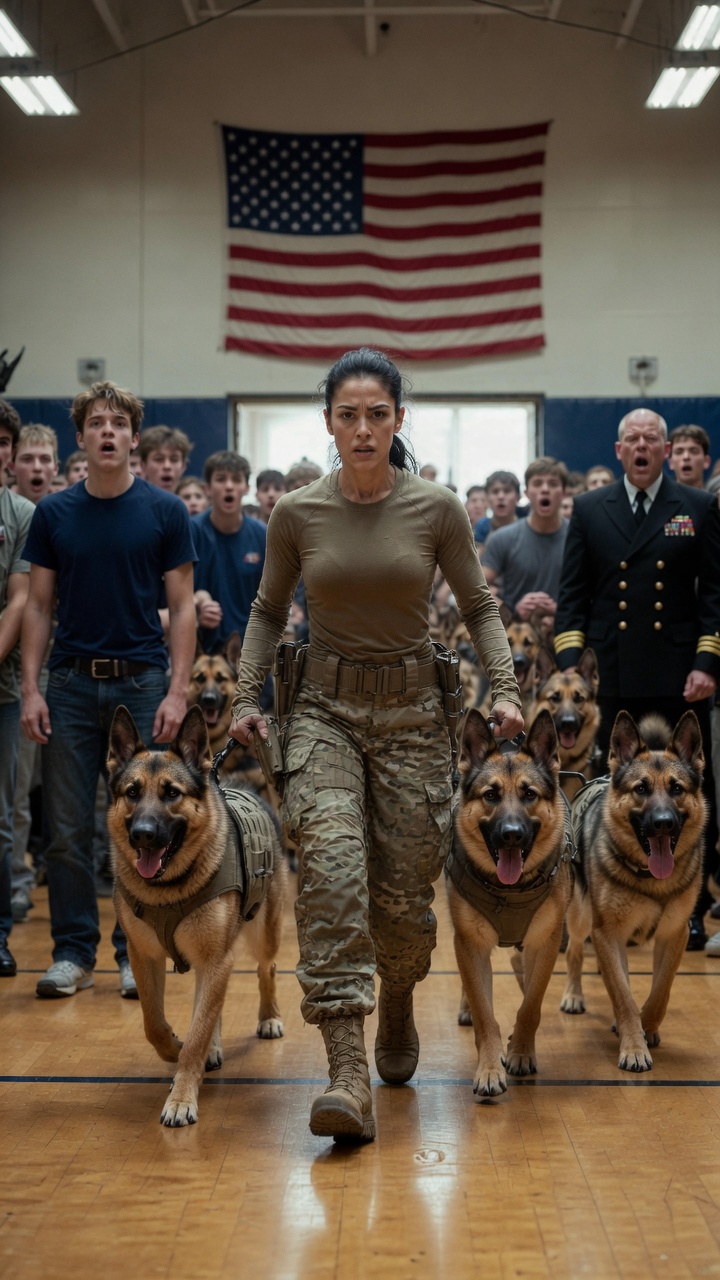
Then the entire entrance filled with dogs moving in absolute silence except for the controlled rhythm of their paws against the floor.
They did not bark.
They did not pull.
They did not scatter.
They entered like soldiers.
Each dog wore a tactical harness marked with unit numbers. Some had muzzles clipped to their vests. Some carried training pouches. A few had small camera rigs mounted along their backs. Behind them came handlers in dark training uniforms, faces focused, posture disciplined.
But the dogs were not looking at the handlers.
They were looking at my mother.
Rachel Reed stood near the center of the basketball court, hands relaxed at her sides, her expression unreadable.
Fifty pairs of eyes locked on her.
Titan stood beside me, body tense but perfectly still.
The students who had laughed at me minutes earlier were silent now. Some leaned back on the bleachers as though distance might protect them from what they were witnessing. Teachers exchanged confused looks. Phones rose slowly into the air, recording.
Lieutenant Brandon Carter’s smile faded inch by inch.
Chief Ramirez, standing near the Navy booth, whispered something under his breath.
I caught only two words.
“Impossible timing.”
The lead handler stepped forward, a tall woman with cropped black hair and a scar running along her jawline.
“Commander Reed,” she said.
The gym froze again.
Commander.
Not ma’am.
Not trainer.
Not fitness instructor.
Commander.
My mother gave a slight nod.
“Master Sergeant Vale.”
Lieutenant Carter’s eyes flicked between them.
His face had gone pale.
“Commander?” he repeated, his microphone still live.
The word echoed through the speakers.
My mother turned her head toward him.
“Yes, Lieutenant.”
That single sentence changed the room.
Until then, people had doubted her because doubt was easy. She looked too young. Too calm. Too ordinary. The kind of woman people walked past in grocery stores without wondering what she had survived.
But rank is a language even arrogance understands.
Lieutenant Carter cleared his throat.
“There must be some confusion.”
My mother said nothing.
Master Sergeant Vale looked at him with open contempt.
“There’s no confusion, sir.”
The lieutenant stiffened at the way she said sir.
Not respectful.
Procedural.
Like a warning label.
He lowered the microphone slightly. “This is a school event. Who authorized military working dogs to enter this building?”
“I did,” my mother said.
“You?”
“Yes.”
His confidence tried to return, but it limped now.
“With all respect, Commander, you can’t simply bring an operational canine unit into a civilian school gym.”
My mother glanced toward the dogs.
“Training unit.”
“Still,” he said, voice tightening, “this is highly irregular.”
“That’s why I filed the paperwork.”
A few teachers looked toward Principal Wallace, who had been standing near the bleachers with a clipboard clutched against his chest. His mouth opened and closed once.
“I received a notice,” he admitted weakly. “I thought it was for a small demonstration. Maybe two dogs.”
Master Sergeant Vale did not blink.
“You approved Harborview High as a controlled environment for a multi-dog obedience and threat-identification exercise.”
The principal looked like he wanted the floor to swallow him.
“I may not have read every attachment.”
My mother’s gaze returned to Lieutenant Carter.
“You wanted a demonstration.”
The gym went so quiet that I could hear the faint hum of the overhead lights.
Lieutenant Carter looked at the students, then at the teachers, then finally at my mother.
He had a choice.
Back down publicly, or continue the performance he had started.
Men like him rarely choose humility when an audience is watching.
He lifted the microphone again.
“Of course,” he said, forcing a smile. “Everyone here would benefit from seeing proper discipline in action.”
My mother’s eyes narrowed slightly.
It was the only sign she gave.
But I knew her.
That tiny shift meant Lieutenant Carter had just stepped exactly where she wanted him.
She turned toward the dogs.
“Line.”
One word.
Soft.
Precise.
The entire gym watched as fifty military working dogs moved into formation.
Not chaos.
Not excitement.
Formation.
They split into five rows of ten, spacing themselves evenly across the court. Their handlers stepped behind them but did not touch them. The dogs sat simultaneously, heads forward, ears alert.
The sound of fifty bodies hitting the floor at once was sharp and clean.
A girl near the front whispered, “No way.”
My mother raised her right hand.
“Down.”
Every dog dropped.
“Hold.”
They became statues.
Not one paw shifted.
Not one tail wagged.
Even Titan beside me lowered himself automatically, though my mother had not looked at him.
I felt a strange heat behind my eyes.
Not because I was proud, though I was.
But because less than ten minutes earlier, two hundred students had laughed at the idea that this woman could belong to the world she had mastered.
Now the whole room was watching that world kneel to her voice.
Lieutenant Carter swallowed.
“It’s impressive,” he said. “But canine handling is not proof of special warfare qualification.”
My mother slowly turned.
A murmur passed through the crowd.
Even some of the students seemed to understand he had gone too far.
But Carter had trapped himself. If he stopped now, the story would become simple: he mocked a boy, and the boy’s mother made him look foolish.
So he kept digging.
“I respect all service members,” he said loudly. “But facts matter. The Navy SEAL community has standards, records, and history. We shouldn’t mislead students.”
My hands curled into fists.
Titan lifted his head.
My mother noticed from across the gym.
Without looking directly at me, she gave a tiny downward motion with two fingers.
Stand down.
Titan relaxed.
So did I.
Barely.
Chief Ramirez stepped forward.
“Lieutenant,” he said quietly, “I suggest you stop.”
Carter snapped his head toward him.
“Chief, are you telling me to stop clarifying official Navy history?”
Chief Ramirez’s jaw hardened.
“I’m telling you that you’re speaking on things above your access.”
The words landed hard.
Above your access.
Lieutenant Carter’s expression changed again.
Not embarrassment this time.
Fear.
My mother walked toward the Navy simulator. It was set up like a compact tactical challenge: a mock corridor projected on screen, target recognition panels, timed response controls, and a physical obstacle station with weighted dummies, rope grips, and balance beams.
The kind of thing designed to impress teenagers.
Not test operators.
She studied it for three seconds.
Then looked at Carter.
“What would you like demonstrated?”
The lieutenant’s mouth tightened.
He gestured toward the simulator.
“This system measures tactical decision-making under stress. Civilian-friendly, of course.”
“Of course.”
“And the obstacle component tests agility, strength, and reaction time.”
My mother nodded once.
“Run it.”
A recruiter tapped the control panel.
The screen flashed.
SIMULATION READY.
Carter stepped back, clearly relieved to be dealing with equipment again.
“This is designed for students,” he announced. “The record today is one minute and forty-eight seconds.”
A few students glanced at each other.
That record belonged to Dylan Price, captain of the football team, who had strutted around afterward like he had personally invaded enemy territory.
My mother removed her field jacket and handed it to Master Sergeant Vale.
Underneath, she wore a fitted black training shirt. The scars on her arms were visible now.
Thin white lines.
Jagged marks.
One burn scar near her left shoulder.
The gym’s silence deepened.
People noticed.
People always noticed scars when the person wearing them stopped hiding.
Carter noticed too.
His eyes lingered a moment too long.
My mother saw it.
“Begin,” she said.
The buzzer sounded.
She moved.
Not fast like an athlete trying to show off.
Fast like wasted movement had been trained out of her body.
The first screen flashed: civilian, weapon, civilian, hostile.
Her hand struck the response controls in a blur.
Correct.
Correct.
Correct.
Correct.
The mock corridor changed.
She adjusted before most people understood what they were seeing.
A weighted dummy blocked the obstacle lane. It was supposed to take two students to drag it. My mother seized the straps, shifted her weight, and moved it aside with ruthless efficiency.
No strain.
No drama.
Just technique.
She crossed the balance beam low and smooth, rolled beneath a swinging padded barrier, vaulted the final platform, and hit the end buzzer.
The screen froze.
TIME: 00:32.
For three seconds, nobody reacted.
Then the gym exploded.
Students shouted.
Teachers clapped despite themselves.
Even the Coast Guard recruiter laughed out loud and shook his head.
Dylan Price slowly sat down on the bleachers, his face blank with disbelief.
Lieutenant Carter stared at the timer.
My mother picked up her jacket.
“Is that enough?”
Carter’s jaw worked.
He couldn’t call it fake.
He couldn’t call it unimpressive.
So he reached for the only weapon he had left.
Documentation.
“With respect,” he said, though there was no respect in it, “physical ability doesn’t answer the original claim.”
My mother slipped her jacket over one arm.
“And what claim was that?”
“That you are a Navy SEAL.”
The microphone caught his words clearly.
The whole gym waited.
My mother’s gaze moved across the crowd.
For the first time, I saw something pass over her face.
Not fear.
Not shame.
A kind of weariness.
As if she had known this moment would come someday, but had hoped it wouldn’t happen in front of her son.
She looked at me.
I wanted to tell her she didn’t have to prove anything.
But she wasn’t proving it to him anymore.
She was deciding how much truth the room was allowed to survive.
Chief Ramirez stepped closer.
“Commander,” he said carefully, “you don’t have to—”
“I know.”
That was all she said.
Then she reached into her jacket pocket and removed a flat black case.
Not a wallet.
Not an ID holder.
Something heavier.
She opened it.
Inside was a worn metal badge-like insignia resting against dark fabric.
The Trident.
The Navy SEAL pin.
Gasps traveled across the gym.
Lieutenant Carter looked as if someone had cut the floor out beneath him.
But my mother did not hold it up like a trophy.
She held it like evidence from a crime scene.
“This,” she said, “was awarded after completion of a program that officially never existed.”
Carter’s mouth opened.
No sound came out.
She continued, voice calm.
“Years ago, a joint evaluation pipeline was authorized under classified directive. The purpose was to determine whether selected female operators could complete modified integration into Naval Special Warfare mission sets without public disclosure.”
A teacher whispered, “Classified?”
Chief Ramirez closed his eyes briefly, like a man watching a locked door get kicked open.
My mother looked at Carter.
“No woman had officially earned the Trident. That statement is true for the public record. It is not the whole truth.”
The lieutenant’s face turned red.
“You’re discussing classified material in a high school gym.”
“No,” she said. “I’m correcting a public insult using information already declassified in part.”
Master Sergeant Vale stepped forward and handed her a folder.
My mother opened it and withdrew a single sheet.
“Partial release authorization. Signed this morning.”
Carter stared at the page.
“This morning?”
“Yes.”
“You knew this would happen?”
My mother’s expression did not change.
“I knew someone from Naval recruitment had been telling students that my son was a liar.”
My stomach tightened.
The room seemed to pull inward.
Carter glanced toward me.
For the first time, his eyes did not look polished or confident.
They looked exposed.
I realized then that this had not begun with my question.
My mother had already known.
She had come prepared.
The dogs.
The handlers.
The documents.
All of it.
Lieutenant Carter lowered the microphone.
But my mother wasn’t finished.
“Three months ago,” she said, “my son submitted an essay for a scholarship connected to military families. In it, he wrote about me. Someone flagged the claim and sent a complaint through unofficial channels.”
Carter’s face hardened.
“That wasn’t—”
“You attached a note.”
The gym went silent again.
My mother unfolded another page.
“You wrote, ‘Applicant appears to be fabricating military family history for personal advantage. Recommend review of integrity.’”
I felt my face burn.
I had wondered why the scholarship committee stopped responding.
I had assumed I wasn’t good enough.
My mother looked at me then, and for the first time her calm cracked.
Only slightly.
But enough.
She knew I had carried that disappointment quietly.
She knew I had blamed myself.
Lieutenant Carter stepped back.
“I was protecting standards.”
“You were protecting your pride,” she said.
No one moved.
Even the dogs remained motionless, as though they understood the weight in her voice.
Carter tried to recover.
“If the records are classified, then any reasonable officer would question the claim.”
“A reasonable officer would verify before humiliating a student in front of his peers.”
His throat bobbed.
“I didn’t intend—”
“Yes,” she said. “You did.”
The words were soft.
Final.
A few students turned toward me.
Not laughing now.
Not smirking.
Some looked ashamed.
Others looked fascinated.
I hated all of it.
The attention.
The pity.
The sudden respect that arrived only after power walked through the door with fifty dogs and a folder full of proof.
My mother turned away from Carter and faced the students.
“Listen carefully,” she said.
The gym obeyed.
“Rank does not make someone honest. Confidence does not make someone correct. And laughter does not make cruelty harmless.”
Her gaze swept over the bleachers.
“Some of you laughed because an adult gave you permission. Remember how easy that was.”
No one looked comfortable after that.
Good.
Then she turned to me.
“Mason.”
I stood slowly.
Titan rose with me.
My mother’s voice softened. “Bring him.”
I walked across the court with Titan at my side. Every step felt unreal. Students leaned away to make room, though Titan ignored them completely.
When I reached my mother, she placed one hand briefly on my shoulder.
Not dramatic.
Not sentimental.
Just steady.
Then she looked at Titan.
“Guard.”
Titan moved.
He crossed in front of me and sat facing outward, body aligned perfectly between me and the crowd.
A protective position.
Several students whispered.
My mother looked at Lieutenant Carter.
“This dog is not a pet. He is retired from military working service after sustaining injuries during an overseas recovery operation. He responds to Mason because Mason helped rehabilitate him.”
Carter stared at Titan.
Then at me.
Something like shame flickered across his face.
Too late.
My mother continued.
“The fifty dogs here today are part of a rehabilitation and advanced obedience program for military working canines transitioning between service roles. Mason has trained with them for two years.”
The gym shifted again.
That was my secret.
Not the Trident.
Not the scars.
Mine.
I looked down, uncomfortable.
My mother had warned me that people admire discipline only after they understand its value. Before that, they call it strange.
Master Sergeant Vale gave a sharp whistle.
One of the Malinois rose and trotted toward the center of the gym carrying a small pouch in its mouth. It stopped before my mother and sat.
She took the pouch and handed it to me.
“Run Echo Pattern.”
I blinked.
“Here?”
“Yes.”
My pulse quickened.
Echo Pattern was not a simple obedience drill. It was a multi-command sequence using hand signals, silence, scent markers, and moving formations. I had practiced it hundreds of times at the training facility, but never in a crowded gym with every eye fixed on me.
I looked at her.
She gave one nod.
Trust.
I turned to the dogs.
My mouth had gone dry.
Titan remained at my left.
The lead Malinois watched me, waiting.
I raised two fingers.
“Echo.”
The first row stood.
I flicked my wrist.
They split left and right.
No barking.
No hesitation.
I touched the pouch to Titan’s nose, then pointed toward the far bleachers where Master Sergeant Vale had placed hidden scent markers before the event began.
“Find.”
Titan moved like a shadow.
Three dogs followed.
Then another group crossed behind them, forming a moving barrier between the students and the active search team.
Gasps rose from the bleachers.
I stopped speaking after that.
Hand signal.
Pause.
Two taps against my leg.
Open palm.
The dogs responded.
They flowed around chairs, tables, displays, and recruitment booths without disturbing a single object.
One Labrador stopped near the Army table and sat.
A German Shepherd sat near the bleachers.
Titan climbed halfway up the steps and froze beside a folded sweatshirt.
Master Sergeant Vale called out, “Marker one found.”
Another handler called, “Marker two found.”
Then, “Marker three found.”
I gave the recall signal.
All dogs returned to formation.
The entire sequence had taken less than ninety seconds.
When the last dog sat, the gym erupted again.
But this time, the applause did not feel like noise.
It felt like reversal.
Like every laugh from earlier had been pulled back, crushed, and replaced with something heavier.
My mother leaned close.
“Well done.”
Two words.
That was all I needed.
Principal Wallace approached, sweating visibly.
“Commander Reed, perhaps we should move this discussion to my office.”
My mother looked at him.
“Now you want privacy?”
His face reddened.
“I simply mean—”
“You had privacy when my son was being humiliated. You chose silence.”
The principal looked away.
Several teachers did too.
Lieutenant Carter removed the microphone from his collar and set it on a nearby table.
For the first time since the assembly began, he looked small.
He approached us slowly.
“Mason,” he said.
Titan’s head turned.
Carter stopped immediately.
My mother gave no command.
She only watched.
The lieutenant swallowed.
“I owe you an apology.”
My throat tightened.
Two hundred students stared.
Part of me wanted to say something sharp. Something that would make him feel even a fraction of what I had felt when they laughed.
But my mother had taught me that power loses shape when you spend it on revenge too quickly.
So I said nothing.
Carter’s eyes dropped.
“I spoke without verifying the facts. I used my position to embarrass you. That was wrong.”
The words were correct.
But they sounded rehearsed.
My mother noticed too.
“Say the rest,” she said.
He looked at her.
His jaw tightened.
“I interfered with your scholarship review.”
A wave of whispers moved through the gym.
My hands went cold.
Carter continued, each word dragged out of him.
“I submitted a recommendation questioning your integrity. I had no verified basis for doing so.”
My mother’s voice was flat. “And?”
His eyes flicked toward Chief Ramirez.
The chief gave him nothing.
Carter exhaled.
“And I did it because I believed your claim reflected badly on the Navy.”
My mother tilted her head slightly.
“No.”
Carter’s face tightened.
“Because it reflected badly on me.”
There it was.
The truth.
Ugly.
Public.
Smaller than the damage it caused.
My mother stepped closer to him.
“You will contact the committee today.”
“Yes, Commander.”
“You will retract your statement.”
“Yes, Commander.”
“You will provide a written apology to Mason, the school, and every student who heard you misuse your authority.”
His face flushed.
“Yes, Commander.”
She held his gaze a moment longer.
Then she said, “Dismissed from this demonstration.”
The lieutenant froze.
Technically, she had no command over him in that school gym.
Not in the ordinary way.
But nothing about that moment was ordinary.
Carter looked toward Chief Ramirez.
The chief did not help him.
Slowly, Lieutenant Carter stepped away from the center of the court.
Nobody clapped.
Nobody whispered.
They simply watched him retreat to the Navy booth he had owned so confidently minutes earlier.
My mother turned back to the students.
“The demonstration is over.”
Master Sergeant Vale raised one hand.
The dogs rose as one.
“Exit formation.”
The rows shifted smoothly, turning toward the gym doors.
That was when Titan growled.
Low.
Deep.
The kind of sound that bypassed thought and went straight into instinct.
Every handler in the room reacted.
Not with panic.
With readiness.
My mother’s head turned toward Titan.
He was staring at the equipment storage room near the far corner of the gym.
The door was closed.
It had been closed all afternoon.
A strange stillness settled.
Master Sergeant Vale’s hand moved toward her radio.
My mother raised two fingers.
Wait.
Titan growled again.
This time, three other dogs responded, their bodies stiffening, ears forward.
The students sensed the change before they understood it.
The room’s energy shifted from awe to fear.
My mother looked at Principal Wallace.
“Is anyone supposed to be in that room?”
The principal blinked.
“No. It’s just storage.”
“Who has access?”
“Custodial staff. Coaches. Administration.”
My mother’s eyes narrowed.
“Mason, behind me.”
I obeyed immediately.
Titan did not move from my side.
Lieutenant Carter called from near the Navy booth, “What’s going on?”
No one answered him.
Master Sergeant Vale gave a silent hand signal. Four handlers moved along the edges of the court, dogs at heel. Chief Ramirez guided nearby students back from the corner.
My mother walked toward the storage room.
Slowly.
Controlled.
Her entire body changed as she moved.
She was no longer a mother defending her son.
She was something older than that.
Sharper.
A person built for rooms where hesitation could kill.
She stopped six feet from the door.
“Open it,” she said.
Principal Wallace looked terrified.
“I—I don’t have the key.”
One of the coaches stepped forward, fumbling with a ring of keys.
His hands shook so badly that Chief Ramirez took them from him.
The chief unlocked the door.
Before he turned the handle, my mother said, “Everyone back.”
The gym obeyed.
Even Lieutenant Carter.
Chief Ramirez pulled the door open.
At first, it looked like ordinary storage.
Stacked mats.
Folded tables.
Ball carts.
A rack of old volleyball nets.
Then Titan lunged forward one step and barked once.
Sharp.
Controlled.
A command bark.
My mother entered the room.
Master Sergeant Vale followed with two dogs.
Seconds stretched.
The students held their breath.
Then my mother emerged holding a black hard-shell case.
It was about the size of a small toolbox.
A red tag hung from the handle.
PROPERTY OF NAVAL TRAINING DIVISION.
Lieutenant Carter’s face changed.
Not confusion.
Recognition.
My mother saw it immediately.
“What is this doing here?” she asked.
Carter walked forward quickly.
“That’s classified training equipment.”
Chief Ramirez blocked his path.
“Then why is it in a high school storage closet?”
Carter’s mouth opened.
Closed.
Opened again.
“I don’t know.”
My mother set the case on a table.
“Do not touch it.”
Master Sergeant Vale examined the tag without opening the case.
Her expression darkened.
“Commander.”
“What?”
Vale pointed to a small broken seal near the latch.
My mother’s face went still.
The kind of still that made my stomach twist.
“What is it?” I asked.
She did not answer me.
Instead, she turned to Carter.
“Where is the second case?”
He went pale.
“What?”
“The equipment travels in pairs. Where is the second case?”
“I don’t know what you’re talking about.”
Titan growled again.
This time, he was not looking at the storage room.
He was looking at the Navy booth.
More specifically, at Lieutenant Carter’s glossy display table.
The poster behind it still read:
COURAGE STARTS HERE.
My mother followed Titan’s gaze.
Then she looked at Carter.
“Move away from the booth.”
He didn’t.
“Mason,” she said, voice low, “take Titan and step back.”
But Titan had already begun moving.
Not lunging.
Tracking.
Nose low, body tense.
He passed the simulator.
Passed the table of brochures.
Stopped beneath the Navy display.
Then sat.
My heart pounded.
Chief Ramirez knelt and carefully lifted the tablecloth.
Underneath sat a second black case.
Same size.
Same tag.
But this one had no seal at all.
The gym erupted into frightened whispers.
Carter looked like he might be sick.
“I didn’t put that there,” he said.
My mother’s eyes locked on him.
“Then who did?”
Before he could answer, every phone in the gym buzzed at once.
Not one.
Not a few.
Every phone.
Students gasped, pulling screens from pockets.
Teachers looked down.
Recruiters reached for devices.
My own phone vibrated in my hand.
A message had arrived from an unknown sender.
No subject.
No name.
Just a video.
I tapped it before I could think.
The screen showed security footage from the school hallway earlier that morning.
Lieutenant Carter stood near the gym entrance.
Beside him was a man in a dark civilian suit.
The man handed him the black case.
Carter looked around.
Then took it.
The video ended.
Slowly, every face in the gym turned toward him.
Carter’s lips parted.
“That’s not what it looks like.”
My mother’s voice was deadly quiet.
“What did you bring into this school?”
“I was told it was demonstration equipment.”
“By whom?”
He didn’t answer.
Titan barked again.
The sound cracked through the gym.
And then, from the speakers overhead, the school intercom clicked on.
A distorted voice filled the room.
“Commander Reed.”
My mother froze.
The dogs went silent.
The voice continued, calm and mechanical.
“You should have stayed buried.”
My mother’s face changed in a way I had never seen before.
For the first time in my life, Rachel Reed looked afraid.
Not for herself.
For me.
The intercom crackled again.
“Hello, Mason.”
My blood turned cold.
Beside me, Titan pressed against my leg.
The voice laughed softly.
“Your mother didn’t tell you why she really left the teams, did she?”
My mother turned toward me.
“Mason, don’t listen.”
But it was too late.
The entire gym was listening.
The voice dropped lower.
“She didn’t retire because of injury. She disappeared because of what happened on Operation Black Harbor.”
Chief Ramirez whispered, “No.”
Master Sergeant Vale went rigid.
My mother’s eyes closed for half a second.
And in that half second, I understood something terrible.
The humiliation.
The dogs.
The cases.
Lieutenant Carter.
None of it had been the real event.
It had been a message.
A trap.
The intercom hissed once more.
“Tell your son the truth, Commander. Or we will.”
Then the speakers went dead.
No one moved.
No one spoke.
My mother stood beneath the bright gym lights, surrounded by fifty silent military dogs, exposed in front of two hundred students who now understood they had witnessed only the first layer of something much darker.
I looked at her.
“What is Operation Black Harbor?”
Her eyes met mine.
And for the first time, my mother had no command ready.
No answer.
Only silence.
THE END OF PART 2 – LIKE, SHARE AND COMMENT “FULL STORY” IF YOU WANT TO READ FULL STORY.