Signature: nRWtOaM+6BVfvrt1zJ16o8r/zEf5jJ6/K6n3of/mtpLOv8tSCCycydpJpcCn13Ny2fxz4wEN+Pho38qqxKcF1x86r1W1hipbAMYr9ngVmQ+c52BSUmO/OXHL9uzb43QYtJbxKtgV1upC6V9hZyV0HusxIE8Oj2zWHoKu6qr7+77W518U/hU2lodPbJ23txpzofoW4jqqaigrDv6k5YEPYQ==
“Ma’am, someone has been using your name.”
For one breathless moment, I thought I had misunderstood him.
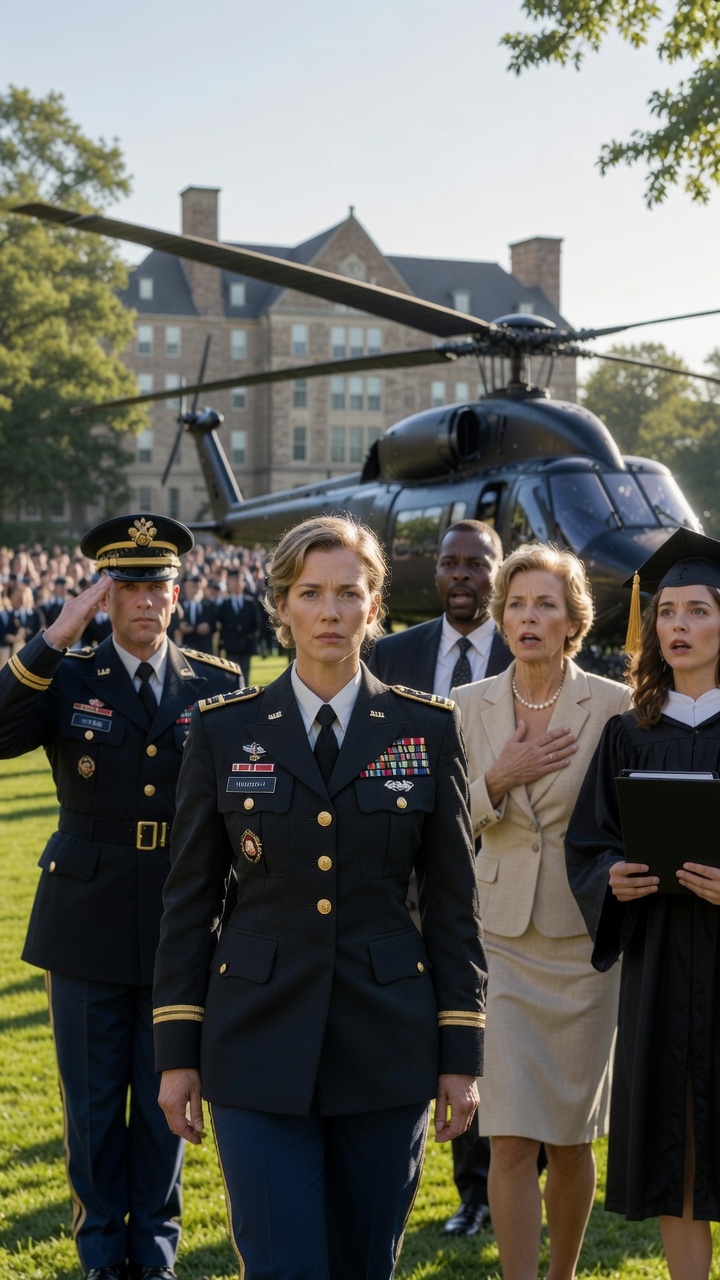
The helicopter blades thundered behind us, flattening the grass and sending graduation programs skittering across the lawn like startled birds. Hundreds of people stared from behind rows of white chairs. My sister stood frozen near the stage, bouquet hanging at her side. My mother’s hand covered her mouth. My father looked as if someone had taken the world he understood and tilted it sideways.
I turned back to the officer.
“What do you mean, using my name?”
His jaw tightened.
“I can explain, but not here.”
The urgency in his voice was quiet, controlled, and far more frightening than panic would have been.
I glanced toward my family.
For years, I had wanted them to look at me and truly see me. Not as the quiet one. Not as Olivia’s older sister. Not as the daughter who moved away and made life easier by needing nothing.
Now they were staring.
And all I wanted was to disappear again.
The university president stepped closer, clutching the sealed envelope the officer had handed him.
“Colonel,” he said nervously, raising his voice over the rotor wash, “perhaps we can move this discussion inside—”
“There isn’t time,” the officer replied.
Colonel.
I looked at the name tape on his uniform.
HARRISON.
Colonel Mark Harrison.
The name pulled at something in my memory, faint but real. Not a friend. Not family. Something official. Something from the part of my life I never discussed because no one ever asked, and when they did, they stopped listening halfway through the answer.
My mother suddenly pushed through the aisle.
“Rebecca?” she called. “What is happening?”
I looked back.
She was struggling against the wind, one hand holding her hat in place, her face pale with confusion. My father followed close behind her. Olivia stood a few steps back, no longer the center of attention and clearly unsure what to do with that.
For a second, I was twelve years old again, standing in the school lobby with a certificate no one remembered to come see me receive.
Then Colonel Harrison spoke.
“Dr. Carter, we need your decision.”
Dr. Carter.
My mother stopped walking.
My father blinked.
Olivia’s expression changed completely.
I closed my eyes for half a second.
Of course.
That would be the first thing they heard.
Not danger.
Not identity theft.
The title.
I opened my eyes.
“Where are we going?”
“To Fort Halden,” Harrison said. “Secure briefing room. You’ll be back as soon as possible.”
“Fort Halden is two hours away.”
“Not by air.”
The helicopter waited, door open, crewman watching the perimeter.
My heart hammered against my ribs.
I had spent years trying to keep my life separate. Not secret exactly, but private. Privacy had been easier than explaining things to people who had already decided my life was small.
But whatever this was, it had found me in the middle of Olivia’s graduation.
I turned toward my parents.
“I need to go.”
My mother’s mouth opened.
“Rebecca, wait. Why did he call you doctor?”
I stared at her.
That question, of all questions, nearly broke something in me.
Because she should have known.
I had sent the announcement three years earlier. A small email with a photo of me outside the research institute in Boulder, holding the certificate after my doctoral defense. My father had replied with a thumbs-up emoji. My mother had written, “That’s nice, honey. Olivia has interviews this week, so things are hectic.”
That’s nice.
Six years of work.
That’s nice.
“I earned my doctorate,” I said.
My mother looked wounded, as if I had hidden it from her on purpose.
“In what?”
The helicopter blades beat against the silence.
“Applied systems engineering.”
My father frowned slowly.
“I thought you did computer work.”
“I do.”
Colonel Harrison touched his earpiece, listening to something. His expression hardened.
“Dr. Carter.”
The choice was no choice at all.
I looked at my family one last time.
“I’ll call when I can.”
Olivia finally stepped forward.
“Rebecca,” she said, softer than I expected, “are you in trouble?”
I looked at her in her cap and gown, beautiful and uncertain, and for once I saw not the golden child, but a younger sister who had never understood the shadow she cast because nobody had ever asked her to look behind her.
“I don’t know,” I said honestly.
Then I followed Colonel Harrison to the helicopter.
The crewman helped me inside. The seat belt clicked across my chest. A headset was placed over my ears, muting the roar into a heavy mechanical pulse.
As the helicopter lifted from the university lawn, I looked out the window.
The quad grew smaller beneath us. White tents. Stone towers. A crowd of stunned faces.
My family stood together near the center aisle.
For once, they were the ones left behind without answers.
Colonel Harrison sat across from me, knees braced, portfolio secured under one arm. His face was calm, but his eyes were not.
“Start talking,” I said through the headset.
He nodded once.
“Three weeks ago, an access credential under your name was used to enter a restricted civilian-military research archive.”
My stomach tightened.
“My name?”
“Your full legal name. Rebecca Anne Carter. Correct Social Security number. Correct biometric profile on file.”
“That’s impossible.”
“It should have been.”
“What archive?”
He hesitated.
“Defense-adjacent infrastructure modeling. Most of it is unclassified but sensitive. Some sections are not.”
I stared at him.
“My work is environmental systems forecasting. Water grid resilience. Wildfire evacuation modeling. I don’t touch classified materials.”
“You consulted on a project two years ago.”
“One project. Six weeks. I never had permanent clearance.”
“I know.”
The way he said it told me he knew more than my family ever had.
He opened the leather portfolio and handed me a photograph.
It showed a woman entering a facility checkpoint. Dark hair tucked into a low bun. Glasses. Navy blazer. She was turned slightly away from the camera, but the resemblance was close enough to make my skin crawl.
Close enough to be intentional.
“That isn’t me,” I said.
“We know.”
“How?”
“Because at the time this image was taken, you were presenting at a conference in Denver. In front of two hundred people.”
I remembered that conference. The bad coffee. The broken projector. The graduate student who cried in the restroom because her first presentation had gone poorly.
Someone had walked into a secure archive wearing my life while I was speaking about drought patterns.
“What did she access?”
“That’s the part we need your help understanding.”
He handed me another sheet.
A list of file names.
Most meant nothing to me at first. Technical strings. Project codes. Data packages.
Then my eyes stopped on one title.
CARTER-HOLBROOK MODEL: LEGACY VERSION.
The cabin seemed to shrink.
Colonel Harrison watched me closely.
“You recognize it.”
I swallowed.
“Yes.”
“What is it?”
I looked out at the green land passing far below us.
“It was my first major model. A predictive system for municipal water stress under extreme weather conditions. I built it in graduate school with Professor Elaine Holbrook.”
“And why would someone access it under your identity?”
“I don’t know.”
But that was not completely true.
The Carter-Holbrook model had failed.
Not technically. It worked too well in some ways. It revealed patterns certain people didn’t want seen, especially when private infrastructure companies manipulated supply projections to win public contracts.
Elaine Holbrook had told me, “Models don’t lie, Rebecca. People do.”
Then she died six months later in what everyone called an accident.
I had never liked how neat the explanation felt.
Colonel Harrison leaned forward slightly.
“There’s more.”
Of course there was.
He handed me the sealed envelope the university president had briefly held, now opened. Inside was a formal request, a temporary summons of cooperation, and a copy of a message sent that morning to multiple federal offices.
The message was short.
Dr. Rebecca Carter has agreed to transfer legacy credentials and model authority effective immediately.
My blood went cold.
“I didn’t send this.”
“We know.”
“Who received it?”
“Several offices. A private contractor. And your former university account.”
“My account was closed years ago.”
“It was reopened.”
I looked up sharply.
“By whom?”
“That is what we hoped you could tell us.”
The helicopter banked slightly, sun flashing across the window.
A memory surfaced.
My mother on the phone two months ago, distracted as usual, asking whether I still used my old university email because someone had sent a message about alumni records.
I had said no.
She had said, “Oh, never mind then. Olivia needs help with her graduation hotel.”
At the time, it had barely registered.
Now it returned with teeth.
“My mother received something,” I said.
Harrison’s eyes sharpened.
“What?”
“I don’t know. A message about alumni records, maybe. She asked me about my old university email.”
“When?”
“Two months ago.”
He wrote it down.
I frowned.
“Why come to the graduation? Why not call me?”
“We tried.”
“My phone hasn’t rung.”
“Not that phone.”
I stared at him.
He handed me a printed call log.
Dozens of attempts had been made to a number I had not used in five years.
My old number.
The one still listed on my family’s shared contact forms because no one ever updated my information.
Then I saw something else.
Emergency contact: Margaret Carter.
My mother.
“She never told me anyone called,” I said.
“According to our records, someone answered twice.”
The words landed quietly, heavily.
“Someone pretending to be me?”
“No,” Harrison said. “Someone claiming to be authorized to speak on your behalf.”
My chest tightened.
“My mother.”
He did not confirm it.
He didn’t need to.
The rest of the flight passed in a tense silence. I kept staring at the photo of the woman who looked enough like me to make strangers believe.
But not enough like me for anyone who loved me to be fooled.
That thought hurt more than I wanted it to.
At Fort Halden, we landed near a low administrative building surrounded by pine trees and controlled gates. It was less dramatic than the arrival at the university, which somehow made it more unsettling. Serious things rarely announce themselves with music.
Inside, I was taken to a conference room with gray walls, a long table, and no windows.
A woman in a dark suit stood when we entered.
“Dr. Carter,” she said. “I’m Agent Priya Shah, federal investigations liaison. Thank you for coming.”
“Did I have a choice?”
Her expression softened slightly.
“Yes. But not much of a comfortable one.”
I almost appreciated the honesty.
She gestured to a chair.
“We’re not accusing you of wrongdoing.”
“That’s reassuring.”
“We are trying to determine who used your credentials and why.”
I sat.
Colonel Harrison remained near the door.
Agent Shah opened a laptop and turned the screen toward me. On it was the same checkpoint photo, then another image from inside a hallway. The woman’s face was clearer there.
I felt my breath catch.
Not because she looked like me.
Because I knew her.
Not well.
Not personally.
But I had seen her before.
“Her name is Natalie Voss,” I said.
Agent Shah’s eyes flicked to Harrison.
“Where do you know her from?”
“She was a research assistant in the Holbrook lab. Years ago. She left before the model audit.”
“Why?”
“There were concerns about data access. Elaine never explained it fully. Natalie said she was being pushed out unfairly.”
“Did she have reason to impersonate you?”
I shook my head slowly.
“She didn’t like me. But this is bigger than dislike.”
Agent Shah tapped a key. Another image appeared.
Natalie standing beside a man outside a hotel conference entrance.
I didn’t know the man.
But there was something familiar about him.
His posture.
The tilt of his head.
Then I realized why.
I had seen him in family photos.
Not my family.
Olivia’s graduation weekend photos.
He was standing beside my sister in a picture my mother posted the night before, smiling warmly with one hand in his pocket.
I leaned closer.
“Who is he?”
Agent Shah watched my reaction.
“We were hoping you could tell us.”
I stared at the screen.
“He was at my sister’s graduation dinner.”
“Name?”
“I don’t know.”
Harrison pulled out his phone and showed me a photo taken from a distance at the ceremony. My mother, father, Olivia, and the same man standing near the VIP tent.
My pulse quickened.
“My parents know him.”
Agent Shah’s tone remained careful.
“According to university records, he attended as a donor guest. Name listed as Daniel Mercer.”
“That name means nothing to me.”
“It may not be his real one.”
The room chilled around me.
I thought of Olivia in her white dress at the pre-graduation dinner, laughing beside relatives and strangers while I was somewhere across town in a budget motel because nobody had remembered to include me in the family reservation.
“Is my sister involved?” I asked.
Agent Shah did not answer immediately.
That was answer enough to make my stomach twist.
“We don’t know,” she said. “But her name appears in the same donor network connected to the reopened university account.”
“Olivia is twenty-three. She just graduated in public policy. She doesn’t know anything about my work.”
“Does she know you?”
The question was gentle.
That made it worse.
I looked down at my hands.
“Not really.”
Agent Shah leaned back.
“Someone targeted your identity because they knew enough to use it, but not enough to avoid mistakes. Old phone number. Old account. Family contact information. Public academic record. It suggests they had access to pieces of your life, but not the current version.”
My family, I thought.
The people who knew my birthday, my childhood address, my mother’s maiden name.
The people who had no idea what I actually did.
A strange sadness opened inside me.
I had spent years feeling invisible.
Now invisibility had become useful to someone.
Agent Shah slid another document across the table.
“This was submitted electronically with the transfer request.”
It was a scanned signature page.
My signature.
Except it wasn’t.
The shape was close, but too neat. Too careful. Someone had copied it from somewhere official.
I stared at it.
“That’s not mine.”
“We believe that. But the source document used to create it may have come from your family’s records.”
“What kind of records?”
“Medical forms. School forms. Old tax filings. Anything signed.”
A memory rose unexpectedly.
My mother keeping neat file boxes in the hall closet. One for Olivia. One for me. Olivia’s bursting with awards, photos, scholarship letters. Mine thinner. Older. Forgotten.
“How much damage can they do?” I asked.
Agent Shah exchanged a look with Harrison.
“That depends on whether the transfer was completed.”
“Was it?”
“Not yet. The system flagged an inconsistency.”
“What inconsistency?”
Harrison answered.
“Your doctoral credential status.”
I frowned.
“I don’t understand.”
“The impersonator used ‘Dr. Rebecca A. Carter’ but submitted verification tied to a master’s-level record. Whoever assembled the packet didn’t know about your doctorate.”
I almost laughed.
Not because it was funny.
Because the thing my family had ignored was the thing that saved me.
Agent Shah looked at me steadily.
“We need you to help us lock down the model authority and confirm which records were altered. We also need to understand who in your family may have provided information, knowingly or unknowingly.”
“My parents wouldn’t knowingly help someone commit fraud.”
“I believe you,” she said. “But people can be used through trust, pride, confusion, or flattery.”
Flattery.
I thought of my mother glowing beside Olivia, telling everyone “our Olivia” as though excellence belonged to one child and politeness to the other.
How easy would it be for someone to approach her through Olivia? Through admiration? Through a donor connection?
Very easy.
Hours passed in that windowless room.
I verified files, old accounts, signatures, contacts. I answered questions about graduate school, Professor Holbrook, Natalie Voss, and the Carter-Holbrook model. Each answer seemed to open another door.
By late afternoon, my head ached.
Colonel Harrison brought me coffee in a paper cup.
“You’re doing well,” he said.
“I don’t feel like it.”
“That’s usually how doing well feels in rooms like this.”
I gave him a tired look.
“Do you practice lines like that?”
His mouth almost smiled.
“Only the useful ones.”
For the first time all day, I felt something loosen in my chest.
Then Agent Shah returned holding her phone.
“Your family is asking for you.”
My body went still.
“They’re here?”
“At the front gate.”
Of course they were.
“What did they say?”
“Your mother says she has a right to see her daughter. Your father says he wants to understand what’s going on. Your sister is crying.”
I closed my eyes.
The old version of me would have gone immediately. Smoothed everything over. Explained gently. Apologized for causing concern.
But I was not sure that version of me could survive what came next.
“Do I have to see them?”
“No,” Agent Shah said.
The answer surprised me.
Colonel Harrison looked at me.
“It might help to hear what they know. But it is your choice.”
My choice.
It had been a long time since anyone had said that and meant it.
I thought of my mother asking why he called me doctor. My father cheering louder for Olivia than he had ever spoken for me. Olivia asking whether I was in trouble.
Then I thought of someone using old pieces of my life because nobody had bothered to know the new ones.
“I’ll see them,” I said. “But not alone.”
They brought my family into a smaller conference room.
My mother rushed toward me the moment I entered, then stopped when she saw Agent Shah and Colonel Harrison behind me.
“Rebecca,” she said, voice trembling. “Are you all right?”
“I’m fine.”
“You left in a helicopter.”
“I noticed.”
My father looked tired, his face drawn with worry. Olivia stood beside him in her graduation dress, her cap gone, her mascara slightly smudged.
No one spoke for a moment.
They looked at me differently now.
Not necessarily better.
Just differently.
My mother broke first.
“Why didn’t you tell us?”
I knew what she meant.
The title. The work. The officer. The fact that strangers in uniforms seemed to know more about me than my own parents.
“I did,” I said.
She blinked.
“What?”
“I told you. Over the years. You just didn’t listen.”
Color rose in her face.
“That isn’t fair.”
“Maybe not,” I said. “But it’s true.”
My father sank into a chair.
“Rebecca, we didn’t know you were involved in anything like this.”
“I’m not involved in anything like this. Someone used my identity.”
Olivia’s eyes widened.
“Who?”
I looked at Agent Shah.
She nodded slightly, allowing me to ask.
“Before I answer that, I need to know something. Who is Daniel Mercer?”
Olivia’s face changed.
My mother answered too quickly.
“A donor. He helped with Olivia’s fellowship application.”
“What fellowship?”
Olivia looked down.
“It’s a policy fellowship in Washington. I didn’t want to say anything until it was official.”
My mother touched her arm proudly.
“It’s very competitive.”
Even now.
Even here.
The familiar ache rose, but this time it did not swallow me.
“How did he find you?” I asked.
Olivia hesitated.
“At a university reception. He said he knew about our family because of your research.”
My father looked sharply at her.
“You didn’t tell us that.”
“I thought he was being polite.”
Agent Shah stepped forward.
“Did he ask about your sister?”
Olivia wrapped her arms around herself.
“Yes. At first. He said Rebecca’s work was impressive. Mom got excited because someone important actually knew about her.”
My mother flinched.
I looked at her.
“Actually knew about me?”
“That’s not what I meant.”
But it was.
Olivia’s voice grew smaller.
“He asked if you were coming to graduation. Mom said probably, but you were hard to reach. He asked whether we had an old number. Mom gave him the one in her phone.”
My mother pressed a hand to her chest.
“I didn’t know. He said he wanted to invite you to a professional reception.”
Agent Shah’s expression remained neutral.
“Did anyone give him documents?”
“No,” my father said firmly.
But my mother’s silence stretched too long.
I turned to her.
“Mom?”
She looked suddenly older.
“He asked for a copy of your old award certificate,” she said. “From high school. The science fair one. He said his foundation liked to feature women in science from local families. I thought it was sweet.”
My stomach tightened.
“My signature was on that application.”
Her eyes filled with tears.
“I didn’t think about that.”
Of course she hadn’t.
Because my life had been a box in a closet.
Something to pull out when useful.
Olivia began crying quietly.
“I’m sorry,” she said.
I looked at her, startled.
She wiped her cheek.
“I didn’t know he was using me to get to you. I thought, for once, someone connected to you was interested in me too.”
The honesty of that struck me.
All these years, I had assumed Olivia lived easily inside the attention.
Maybe she had.
But maybe being the golden child came with its own cage.
My father leaned forward, elbows on knees.
“Rebecca, tell us what to do.”
The sentence hit me strangely.
My father, who had spent most of my life assuming I needed little and knew less, was asking me for direction.
Agent Shah spoke before I could.
“For now, do not contact Daniel Mercer. Do not answer calls from unknown numbers. Do not delete any messages. We will need access to communications related to him.”
My mother nodded quickly.
“Anything. Of course.”
Olivia looked at me.
“Am I in trouble?”
I heard the fear beneath the question.
“No,” Agent Shah said. “Not based on what we know.”
Olivia exhaled shakily.
Then she turned back to me.
“Rebecca, I really am sorry.”
I wanted to tell her it was fine.
That old reflex rose immediately.
It’s fine.
Don’t worry.
I’m used to it.
But I stopped.
“I believe you,” I said. “But it isn’t fine.”
She nodded, tears slipping down her face.
“I know.”
That was more than anyone in my family had ever given me before.
A beginning, maybe.
Not forgiveness.
Not yet.
But something.
After they were escorted out, I remained in the room with Colonel Harrison.
Through the glass panel in the door, I saw my mother pause in the hallway and turn back as if she wanted to say more. Then she kept walking.
Harrison stood beside me.
“That was difficult.”
“Yes.”
“You handled it well.”
I laughed softly.
“Everyone keeps saying that today.”
“Maybe everyone is right.”
I looked at him.
“Why did you salute me?”
He seemed surprised by the question.
“At the university?”
“Yes.”
He considered his answer.
“Because you deserved respect before you were asked for help.”
The words landed quietly.
I looked away before he could see how much they affected me.
For years, I had worked hard not to need validation. I built a life in Colorado. Published papers. Led projects. Paid my own bills. Made my own coffee in a small apartment full of plants and books and silence.
I told myself being unseen had made me strong.
Maybe it had.
But being respected still mattered.
By evening, Agent Shah arranged for me to stay overnight in secure housing near the base while they continued tracing Daniel Mercer and Natalie Voss. My family drove to a nearby hotel under instructions not to speak to anyone outside official channels.
I should have slept.
Instead, I sat on the edge of a neatly made bed in a plain guest room, scrolling through old emails on my laptop.
Search: Daniel Mercer.
Nothing.
Natalie Voss.
Old academic threads. Lab schedules. A message from Natalie twelve years earlier.
Subject: Holbrook model access
Rebecca,
Elaine is wrong about the audit. You don’t know what she’s keeping from you.
Ask her who funded the first version.
N.
I stared at the message.
I had forgotten it existed.
At the time, I thought it was bitterness. Natalie had been angry, and I had been too focused on finishing my work to chase every accusation.
Ask her who funded the first version.
I opened another folder. Archived graduate files.
Professor Holbrook had been meticulous. Funding statements, grant notes, partner documents.
I found the original project proposal just after midnight.
The first page listed the university, the lab, and the research objective.
The second page listed early donors.
One name stopped me cold.
Carter Family Foundation.
That made no sense.
My family did not have a foundation.
We did not have donor money.
My parents were comfortable, not wealthy. My father sold insurance. My mother taught piano lessons for years before managing community events.
I scrolled down.
Primary private contributor: Eleanor Carter.
My grandmother.
I barely remembered her. She died when I was six. My mother rarely spoke of her except in careful sentences, the kind people use when memory is more complicated than grief.
Why would my grandmother fund my research years before I even entered college?
A knock sounded at the door.
I nearly dropped the laptop.
Colonel Harrison stood outside.
“Sorry,” he said. “Agent Shah found something.”
I opened the door wider.
“What?”
He held out a printed photo.
Security footage from the university graduation.
The donor guest, Daniel Mercer, stood near the VIP tent.
Only now, the angle was clearer.
He was facing my mother.
And my mother was crying.
Not politely emotional.
Not proud-graduation crying.
Terrified crying.
“What is this?” I whispered.
“We don’t know yet.”
But there was more.
In the photo, Mercer was handing my mother something.
A small silver key.
My phone buzzed on the desk behind me.
A message from my mother.
Rebecca, I’m sorry. There is something I should have told you years ago. It’s about your grandmother, your research, and why Olivia was never supposed to be the one they noticed.
A second message arrived immediately.
Do not trust the man calling himself Colonel Harrison.
I slowly looked up.
Colonel Harrison stood in the doorway, watching my face.
“What did she say?” he asked.
Behind him, the hallway lights flickered once.
And far down the corridor, an alarm began to sound.
END OF PART 2 – LIKE, SHARE AND COMMENT “THE ENTIRE STORY” IF YOU WANT TO READ THE FULL STORY