### Part 1
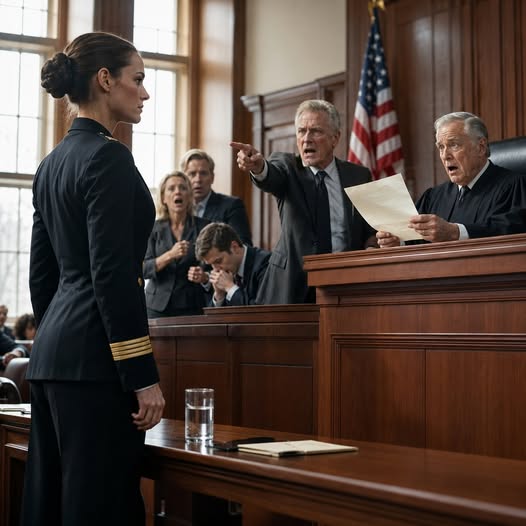
My father stood up in federal court and told a judge I had invented my entire life.
Not exaggerated it. Not padded it. Not misunderstood the paperwork.
Invented it.
He buttoned his navy suit jacket the way he used to button his dress blues, with two sharp tugs and a small lift of the chin. Colonel Warren Hale, retired United States Air Force, had always known how to make a room look at him. He had a square jaw, silver hair cut too close to be stylish, and the calm voice of a man who believed calmness was the same thing as truth.
“No service,” he said.
He paused.
“No sacrifice.”
Another pause.
“All fiction.”
Behind him sat three men who had once served under him. They looked older than the photographs I had seen in my father’s study, softer around the neck, slower in the eyes. But their backs were straight. Their hands were folded. Their sworn statements were already in the record.
My younger brother, Nolan, sat at the end of the row. He did not look at me. He looked at the floor between his polished shoes like there was an answer down there he had dropped and could not pick up.
I sat alone at the respondent’s table in a charcoal blazer, white blouse, and black slacks. No uniform. No medals. No lawyer whispering in my ear. Just a yellow legal pad, a capped pen, and a sealed envelope resting somewhere in the clerk’s file like a match waiting in a dry field.
Judge Elena Marquez looked over the top of her reading glasses.
“Colonel Hale,” she said, “you understand you are testifying under oath.”
“I do, Your Honor.”
“And your position is that your daughter’s military record is fraudulent.”
“My position,” my father said, turning his head just enough for the gallery to hear him clearly, “is that Mara Hale has spent years allowing people to believe she earned honors, rank, and benefits she did not earn. I am here to correct the record.”
Correct the record.
Those words moved through me colder than fear. They were his words, but they belonged to someone else. A dead man had taught me that records were not corrected by volume, confidence, or blood. They were corrected by evidence.
My father’s attorney, a narrow man named Dennis Rourke, rose with a folder in his hand. He had the eager dryness of someone who enjoyed technicalities because they let him wound people without raising his voice.
“Your Honor,” he said, “the petitioner will show that Ms. Hale’s claimed career advancement is inconsistent with every reasonable recollection of those who knew her military role. We will show that she served in support functions, administrative channels, and back-office assignments, none of which align with the designation she now claims.”
Support functions.
Administrative channels.
Back-office.
My father had been saying versions of that for fifteen years.
At family barbecues, he would introduce Nolan as “my son, Captain Hale, following the right road.” Then he would gesture toward me and say, “And Mara does support work for the Air Force.”
Support work.
The phrase had followed me like cigarette smoke in a wool coat.
I did not object. I did not sigh. I did not turn to see who believed him. I kept my eyes on the judge and listened to the hum of the air conditioning, the scratch of Rourke’s pen, the faint squeak of my father shifting his weight on expensive shoes he had probably polished himself.
Judge Marquez wrote something on her notepad.
Rourke called his first witness, then his second, then his third.
One said he had never seen me in any operational setting.
One said he had known me since childhood and had never heard me speak with “the confidence of a senior officer.”
One said the promotion process was too strict to allow mistakes, which was the first true thing said that morning.
Each man sounded certain until the next question made certainty expensive.
I wrote the same word on my legal pad three times.
Memory.
By the time Rourke finished, the courtroom smelled like stale coffee and old paper. My father leaned back slightly, not smiling, but close. He believed the hard part was over.
Then Judge Marquez turned to me.
“Ms. Hale,” she said, “you may proceed.”
I stood.
My knees did not shake. That surprised me. I had expected some physical betrayal, some tremor, some sign that my body understood my father had tried to bury me in public.
Instead, I felt still.
“Your Honor,” I said, “the respondent requests permission to submit Exhibit G for review.”
Rourke shot up. “Objection. Undisclosed.”
“It was disclosed six weeks ago,” I said. “Filed under seal with the exhibit index served to counsel.”
Rourke flipped through his folder too quickly. Paper snapped against paper. His face changed before he sat down.
“Withdrawn,” he muttered.
The clerk brought the envelope to the bench.
It was dark blue. Heavy. The kind of stationery people do not use unless the words inside are meant to outlive them.
My father saw the handwriting first.
All the color left his face.
Judge Marquez placed one finger on the seal, and my father whispered, so softly only the front row could hear it, “Where did you get that?”
For the first time that morning, I looked at him.
And for the first time in my life, my father looked afraid.
### Part 2
I grew up in Colorado Springs in a house that faced the mountains but worshiped the wall in my father’s study.
That wall held framed photographs, challenge coins, plaques, certificates, commendations, a folded flag from my grandfather’s funeral, and one silver-framed picture of my father shaking hands with a general whose name he mentioned more often than some relatives. Everything on that wall had a story. Every story had the same moral.
Service was what made you real.
My father had retired as a colonel when I was seventeen. He did not retire emotionally. He woke at 5:10 every morning, ran three miles even in snow, shaved like inspection was coming, and drank black coffee from a mug that said Aim High. When neighborhood kids asked what he did, he said, “I served.” Not “I used to serve.” Served. Present tense.
Nolan loved it.
He wore my father’s old flight jacket until the cuffs frayed. He memorized aircraft silhouettes. He knew the difference between rank insignias before he knew long division. When he got accepted into the Academy, my father stood in the driveway with one hand on Nolan’s shoulder and the other over his heart, as if a hymn was playing.
I joined through ROTC at a state school.
My father told people it was “a practical route.”
That was how he praised things he considered second-best.
I was not rebellious. I did not hate the military. I wanted to serve. I also wanted, quietly and with a hunger that embarrassed me, to prove that I could become something without being assembled from my father’s expectations.
The problem was that my early work was not easy to explain at dinner.
Some of it was classified. Some of it was boring to anyone outside the building. Most of it happened in rooms without windows, with acronyms nobody outside the chain needed to hear, under fluorescent lights that made everyone look mildly ill. I learned logistics, planning, personnel movement, risk assessment, crisis communications, and the particular art of making seventeen impossible things happen by Thursday without letting anyone outside the team know there had ever been a problem.
When my father asked, “How’s work?” he did not mean it as a question.
He meant: Confirm what I already believe.
So I answered, “Busy.”
He nodded like that proved something.
At my first family gathering after commissioning, he introduced Nolan as “the future of the Hale name” and me as “Mara, handling support work.”
We were in my aunt’s backyard in Pueblo. Burgers smoked on the grill. Someone had spilled beer near the cooler, and the grass smelled sour under the July sun. I remember holding a paper plate with potato salad sliding into baked beans while one of my father’s old friends asked me whether I typed reports.
“Sometimes,” I said.
My father laughed.
“She keeps the machine moving,” he said. “Not everyone needs to be out front.”
Out front.
Nolan glanced at me, then away.
I could have corrected them. I could have named assignments, carefully, generally, within what was allowed. I could have said enough to shift the temperature of that conversation.
But something about begging my father to believe me felt worse than being dismissed.
So I smiled, finished my potato salad, and helped my aunt carry folding chairs back to the garage.
That night, my mother found me washing dishes in the kitchen.
The house was loud behind us, men laughing too hard at stories they had told before. My mother dried a glass slowly and said, “He doesn’t know what to do with you.”
I stared into the sink. Grease floated on top of the water in trembling circles.
“He knows exactly what to do with me,” I said. “He files me under harmless.”
My mother did not answer right away.
Then she said, “Maybe that’s because harmless is easier for him.”
I looked at her.
Her face had the tired softness she carried after parties, when she had spent hours smoothing conversations before they became sharp. She loved my father. She also translated him for everyone else, as if he were a difficult language we should all be grateful she spoke.
“Mom,” I said, “what does that mean?”
She put the glass down.
“It means your father can be proud of Nolan without comparing himself to him.”
The kitchen faucet dripped once.
Before I could ask anything else, my phone buzzed on the counter.
Unknown number.
I wiped my hand on a dish towel and answered.
A woman’s voice said, “Lieutenant Hale? Hold for General Callan.”
The noise behind me seemed to fall away, one layer at a time.
My mother watched my face change.
A second later, a man came on the line, his voice low, clipped, and utterly awake.
“Hale,” he said, “I need you in Nevada before dawn. Pack light. Bring nothing you cannot afford to have locked away.”
I looked through the kitchen window at my father laughing under porch lights he had strung himself.
Then I said, “Yes, sir.”
The next morning, before the sun rose, I reported to a building with no sign on the door.
### Part 3
General Abram Callan did not look like the kind of man my father admired, which made me distrust him for the first ten minutes.
He was not tall. He did not fill a room by trying to fill it. His uniform looked worn in the exact way a uniform looks when the person wearing it has stopped thinking of it as clothing and started thinking of it as skin. His hair was iron gray, his face narrow, his eyes clear enough to make lying feel childish.
He did not shake my hand.
He pointed to a chair.
“Sit.”
I sat.
The office was colder than the hallway. There was one framed photograph on the desk, turned away from visitors, and a stack of folders arranged with mathematical precision. The room smelled faintly of burnt coffee and printer toner. Outside the narrow window, desert light pressed white against the glass.
General Callan opened a folder.
“Mara Hale,” he said. “Twenty-six. Strong evaluations. Weak self-advocacy. Excellent pattern recognition. Tendency to assume competence will be noticed without assistance.”
I blinked.
“That last part in my file, sir?”
“No,” he said. “That part took ninety seconds.”
I should have disliked him. Instead, I felt something in my spine straighten.
He turned a page.
“You have been recommended for a planning cell that does not exist on paper in the way people outside this building understand paper. You will not discuss its work with family. You will not correct people who misunderstand it unless correction is required by duty. You will not use secrecy as a theater curtain to make yourself more interesting.”
“Yes, sir.”
“What is the most undervalued skill in leadership?”
I thought of my father’s wall. Courage. Discipline. Vision. Presence.
Then I thought of the rooms where real work happened. The email chains saved under boring labels. The decision logs. The after-action reports no one wanted to write but everyone needed six months later when memory had become politics.
“Documentation,” I said.
Callan looked at me for the first time like I had said something useful.
“Correct.”
That was the interview.
For the next three years, he watched everything.
Not in a warm way. Not in a fatherly way. He did not compliment people to soften the day. He corrected errors in red ink and once returned a twelve-page brief to me with only two words written at the top: Think harder.
I did.
The work came in waves. A supply chain failure that could strand personnel overseas. A communications blackout that required five agencies to stop defending their turf long enough to solve a problem. A personnel extraction plan that changed six times in eleven hours because every new piece of information made the previous plan stupid.
Callan’s rule was simple: write down what changed, who knew, who decided, and why.
“Memory is not a system,” he said during one midnight review while rain rattled against the roof in a place where it almost never rained. “Memory is a witness with bad lighting.”
I lived on vending-machine almonds, burnt coffee, and the stubborn fear of letting the team down. I missed birthdays. I missed Christmas morning once and called from a stairwell where the concrete smelled damp and metallic. My father answered, listened to my apology, and said, “Support roles get busy too, I guess.”
I said, “Yes, sir.”
He said, “You don’t have to call me sir.”
But I did, because some habits are not respect. Some are armor.
General Callan noticed.
One evening after a review, he kept me behind. The room had emptied. Projector heat still hung in the air. Someone had left a half-eaten granola bar beside a laptop dock.
“You shrink on personal calls,” he said.
I closed my folder. “Sir?”
“You heard me.”
I looked at the blank screen at the front of the room.
“My father served twenty-four years,” I said. “He has a specific idea of what military value looks like.”
“And you are not it?”
“Not to him.”
Callan leaned back. His chair creaked once.
“Your father taught you to stand at attention,” he said. “Useful skill. But you mistook standing at attention for making yourself smaller.”
I felt heat rise in my face.
“With respect, sir, you don’t know my father.”
“No,” he said. “I know officers who build mirrors and call them families.”
That landed so precisely I hated him for a second.
Then he opened another folder and slid a document across the table.
It was an evaluation draft. Mine.
Not generous. Not inflated. Accurate.
Every strength was specific. Every weakness was traceable. Every claim had evidence. Reading it felt like stepping unexpectedly in front of a clean mirror after years of seeing myself in warped glass.
“You do the work,” he said. “Let the record show it.”
I touched the edge of the paper.
For reasons I did not understand then, my throat tightened.
Callan stood, already done with the conversation.
At the door, he stopped.
“One question, Hale.”
“Yes, sir?”
“Why is your father still listed as your emergency contact if he does not know where your real life begins?”
I had no answer.
He nodded once, as if my silence confirmed what he already knew.
That night, I went back to my quarters and changed the form.
The next morning, my mother called before breakfast, crying so quietly I almost missed it.
### Part 4
My mother had been hiding bills in a cookie tin.
Not dramatic bills. Not casino debts or secret credit cards from some other life. Medical copays. Roof repairs. A second mortgage statement folded so many times the creases had gone soft. The ordinary paper cuts that bleed a family slowly.
I found out because she called me from the laundry room with the dryer running behind her to cover her voice.
“Mara,” she said, “I need to ask you something, and I need you not to tell your father.”
That sentence has a smell in my memory: hot lint, lavender detergent, and fear.
My father had always been responsible with money. That was one of his pillars. Discipline, service, responsibility. But retirement had not fit him the way he expected. Consulting work came and went. Pride stayed. My mother’s diagnosis arrived quietly, then became expensive loudly.
I started sending $2,500 a month.
Then $2,800.
I labeled it household support so my mother would not feel like she had to lie to herself about it. She cried the first time the transfer cleared. I told her not to thank me. She did anyway.
For eight years, my father did not know.
Or maybe he did not ask.
That distinction would become important later.
During those years, my career moved in ways I could not explain at Thanksgiving. I moved between assignments. I learned to sleep on planes. I learned that authority was not volume. I learned that some rooms did not need the loudest person; they needed the person who remembered what had been decided at 2:13 a.m. when everyone else was angry, hungry, and wrong.
My father kept introducing me as support.
At Nolan’s promotion party, he raised a glass and said, “My son understands what it means to lead from the front.”
We were in a steakhouse outside Denver with brass light fixtures and too much noise bouncing off dark wood. Nolan’s friends clapped. My mother touched my knee under the table.
Later, in the parking lot, she said, “I’m sorry.”
“For what?”
“For letting him make you lonely in a room full of people.”
I could not look at her then.
The wind smelled like snow and exhaust. Across the lot, my father was laughing with Nolan and two officers who had asked me earlier if I planned to stay in until retirement or “try something real.”
My mother’s hand found mine.
“He is afraid,” she said.
“Of me?”
“Of being passed by.”
I laughed because the alternative was something worse.
“That’s ridiculous.”
“Yes,” she said. “Fear usually is.”
Her cancer returned the following spring.
By then General Callan was already ill too, though he had told almost no one. I was spending my days between secure rooms and hospital calls, between crisis briefs and my mother’s careful lies.
“I’m fine.”
“The new treatment is easier.”
“Your father is handling it well.”
He was not.
He controlled what he could. Appointment times. Medication schedules. The angle of her pillows. The visitors allowed into the house. He became efficient because efficiency was the only form of tenderness he trusted himself to perform.
Near the end, she asked me not to confront him.
We were alone in her bedroom in the house outside Colorado Springs. Late afternoon light came through beige curtains. A humidifier clicked on the dresser. Her wedding ring was loose on her finger.
“Mara,” she said, “promise me you won’t spend your life trying to make him see you.”
I sat beside her bed, holding a paper cup of ice chips.
“I stopped doing that.”
She smiled faintly.
“No, sweetheart. You stopped asking out loud.”
I hated that she knew the difference.
After the funeral, my father stood in the church hall beside a folding table covered in casseroles and introduced me to a retired major as “my daughter, Mara. Air Force support work.”
My mother’s ashes were not yet cold.
I looked at him. Really looked.
He was thinner. His suit hung wrong at the shoulders. Grief had made his face gray, but the old reflex was alive and well. He had put me in my place because grief had taken every other familiar thing from him.
The retired major asked, “Do you enjoy it?”
I said, “It has its moments.”
My father nodded, satisfied.
Three months later, he found the bank transfers.
He called me at 6:42 on a Sunday evening. I remember because I was standing in my kitchen, cutting an apple with a pocketknife, still in running clothes. Rain tapped against the window.
“I didn’t know,” he said.
No hello. No accusation. Just that.
“I know,” I said.
The line stayed open.
Then he said, “Your mother should have told me.”
I waited.
He did not say, Thank you.
He did not say, You carried us.
He did not ask where the money came from or what I had given up or why I had never mentioned it.
He only said, “We’ll discuss this later.”
We never did.
Nine months after my promotion ceremony, I was served with his lawsuit.
### Part 5
The invitation went out on cream cardstock so thick it felt almost ceremonial before anyone read a word.
I had argued against that.
Not officially. Officially, I understood protocol. Unofficially, I wanted the day to be smaller. Cleaner. Less likely to bruise.
The ceremony was scheduled for a bright October morning at Andrews. The sky was blue in that hard autumn way that makes every flag look sharper. The hangar smelled faintly of metal polish, floor wax, and jet fuel. Rows of chairs faced a small stage. People I had served with came in dress uniform and shook my hand with the careful smiles of those who knew what the day meant and what it had cost.
General Callan could not attend.
By then he was in treatment, though he still sent comments on documents at hours when no sick man should have been awake. He sent a note instead. One sentence.
Stand where the record placed you.
I kept that note in my pocket.
My father received his invitation two weeks before the ceremony.
He called after three days of silence.
“There must be a mistake,” he said.
I was in my office, door shut, holding the phone with one hand and a briefing packet with the other. Outside the glass, two majors were arguing politely over a schedule that had already become impossible.
“What mistake?” I asked.
“This ceremony.”
There it was.
Not confusion. Not pride badly disguised. Not even anger.
Certainty.
I looked at the invitation copy on my desk, at my name printed with the designation I had spent fifteen years earning one hard inch at a time.
“It isn’t a mistake,” I said.
My father exhaled through his nose.
“Mara, I know how these things work.”
That was the first time I understood he might actually do something about it someday.
Not because he had evidence. Because he had identity.
He did not come.
Nolan did, but he stood in the back. When I saw him after, near the coffee urns, he hugged me with one arm and said, “Big day.”
“Yeah.”
“I didn’t realize it had gotten this far.”
This.
As if my career were a misunderstanding that had wandered past the fence.
I wanted to ask whether he was happy for me. I wanted him to answer without checking our father’s face first.
Instead, I said, “It got here honestly.”
His jaw tightened.
“I didn’t say it didn’t.”
No. He had not said it.
That was the Hale family specialty: leaving the cruelest sentence implied and acting offended when someone heard it.
The ceremony itself was both formal and strangely quiet inside me. Hands pinned metal where cloth had waited. Cameras clicked. People applauded. Someone made a joke that did not land because half the room was crying. I smiled when required, shook hands when required, and felt the weight of a star settle onto my uniform like a question finally answered.
Afterward, I called General Callan.
His aide patched me through.
“You standing?” he asked.
“Yes, sir.”
“Good.”
A pause.
Then, softer, “Was he there?”
“No.”
Callan did not ask who I meant.
“Then remember who was.”
I looked across the hangar.
My team was there. Officers I had mentored. Enlisted personnel who had saved operations more times than anyone would ever publicly know. My mother’s best friend, Elaine, who had driven six hours and cried through the entire ceremony. People who had seen me work. People who did not need persuading.
“I will,” I said.
But I looked at the empty chair anyway.
The lawsuit arrived nine months later in a thick envelope delivered by a man who avoided my eyes. I signed for it on a Tuesday. The paper was warm from his truck.
The complaint alleged fraudulent advancement, improper documentation, misrepresentation of service, and unjust benefits.
My father’s name was on the first page.
Nolan’s statement was on page thirty-four.
I read it twice, then once more slowly.
He had written that my claimed advancement was “inconsistent with the family’s understanding of her service history.”
Family’s understanding.
The words smelled like my father’s study. Dust on plaques. Old coffee. Polished wood. A closed door.
I placed the complaint on my kitchen table and went to the hall closet.
At the back, under winter coats and a small safe of passports and insurance papers, sat the fireproof box where I kept documents that mattered.
I had not opened it in fourteen months.
Inside was the blue envelope General Callan had given me before he died.
On the back, in his narrow handwriting, was one sentence I had never allowed myself to read too closely.
For the day they choose memory over record.
My hands went cold.
And I knew exactly what kind of room was waiting for me.
### Part 6
General Callan told me he was dying on a Thursday morning between two meetings.
He did not soften it. He did not invite emotion into the room. He simply closed a folder, looked at me, and said, “The treatment failed.”
Outside his office, someone laughed in the hallway. A printer jammed. Normal sounds, insulting in their normalness.
I sat across from him with a pen in my hand and forgot what pens were for.
“What do you need, sir?”
“People to continue doing their jobs correctly.”
It was the most Callan answer possible, and because of that, it almost broke me.
He lost weight over the next months, but not authority. His uniform hung looser. His voice grew rougher. He began sitting during long briefings, which nobody mentioned because nobody wanted to be the first to admit the room had changed.
He still corrected sloppy thinking.
He still asked the question nobody wanted asked.
He still made colonels feel like cadets when they brought him assumptions dressed as plans.
One evening in November, he asked me to stay after everyone else left.
His office was dim except for the desk lamp. Rain moved against the window in thin silver lines. I remember that because we were in Virginia, and rain there had a patience desert rain never did. It tapped and slid and stayed.
Callan opened his middle drawer and took out three envelopes.
“One for my wife,” he said. “One for the unit. One for you.”
My chest tightened.
“Sir, I don’t—”
“Do not make this sentimental. You’re bad at it.”
I shut my mouth.
He slid the blue envelope across the desk.
“Do not open it until you need it.”
“How will I know?”
“You will not need to ask that question when the time comes.”
I stared at his handwriting across the front.
Brigadier General Abram Callan, USAF.
He was still alive then. The rank, the name, the ink, the hand that had written it. All alive.
“Is it guidance?” I asked.
“No.”
“An evaluation?”
“In a sense.”
“Sir—”
“Hale.”
I looked up.
“You have a dangerous belief that truth becomes obvious if you behave honorably long enough.”
I said nothing.
“It does not,” he said. “Truth needs witnesses. It needs records. It needs someone willing to put ink on paper before the argument begins.”
My throat burned.
“Is there an argument coming?”
“With men like your father, there is always an argument coming. The only question is whether it reaches a room that matters.”
I looked down at the envelope.
He had never met my father in any meaningful way. They had crossed paths decades earlier, when my father was a young officer and Callan was already the kind of man people remembered. But Callan knew systems. He knew pride. He knew what happened when a person built a self-image out of rank and then watched someone too close pass the point where he had stopped.
“I don’t want to fight him,” I said.
Callan’s face did not change.
“Then don’t. Let the record fight.”
He died sixteen months later.
At the memorial service, the chapel was full beyond capacity. People stood along the walls. Senior officers, young airmen, civilians with haunted eyes, a janitor who cried harder than anyone. That told me more about him than the speeches.
His wife found me afterward.
She was small, elegant, and steady in a way that made me understand the general had not been the only strong structure in his family. She held both my hands and said, “Abram said you would know what to do with your letter.”
“I hope he was right,” I said.
“He usually was.”
I put the envelope in the fireproof box and did not open it.
Through one assignment, then another.
Through my promotion.
Through my father’s silence.
Through Nolan’s careful distance.
Through every family gathering I stopped attending because absence was cleaner than being diminished over paper plates and sweet tea.
Then the lawsuit came.
I read my father’s complaint at my kitchen table while an ice storm ticked against the windows. The language was formal, but I could hear his voice under it. No service. No sacrifice. All fiction. He had simply found a lawyer to translate contempt into legal formatting.
I opened the fireproof box.
For a long moment, I just held the envelope.
Opening it felt like disturbing a grave.
Then I remembered Callan’s office, the rain, his exact words.
Truth needs witnesses.
I broke the seal.
I read the first line.
Then I sat down hard in the hallway, because the dead man had known more about my future than my living family had ever cared to know.
### Part 7
The week before the hearing, my father’s attorney offered me one chance to “avoid embarrassment.”
The email arrived at 7:18 a.m. with the subject line Settlement Discussion. I was eating toast over the sink because I had a 7:30 call and no appetite for ceremony.
Mr. Rourke proposed that I agree to a confidential correction of my record, waive certain benefits, and “acknowledge the possibility of administrative misunderstanding.”
Administrative misunderstanding.
I read that phrase three times.
Then I replied with one sentence.
No.
At 7:30, I joined the call and spent forty-five minutes discussing a personnel issue in the Pacific with people who cared about facts because lives and careers depended on them. Nobody asked whether my father believed in me. Nobody cared whether a retired colonel in Colorado had confused his disappointment with evidence.
That helped.
Work has saved me more times than comfort ever has.
Six weeks before the hearing, I filed Exhibit G under seal.
The clerk, a woman named Mrs. Alvarez with silver glasses on a chain, read the filing instructions, looked at the envelope, and then looked at me.
“This one matters,” she said.
“It does.”
She stamped the receipt and lowered her voice.
“Then make sure you’re in the room when it opens.”
“I will be.”
The morning of the hearing, downtown Denver was bright and mean with cold. The sidewalks had been salted white. Every breath burned. I arrived early because my father had taught me that late was a kind of disrespect, and some lessons remain useful even after the teacher becomes dangerous.
The federal courthouse lobby smelled of wet wool, metal detectors, and floor cleaner. Security took my belt, scanned my bag, and handed back my life in gray plastic trays. I rode the elevator with a public defender, a woman crying silently into a tissue, and a man in a red puffer jacket whispering, “Just tell the truth,” to himself over and over.
The courtroom was smaller than I expected.
That made it worse.
Large rooms let pain disperse. Small rooms keep it close.
My father arrived at 8:52 with Rourke, Nolan, and the three witnesses. He wore a dark suit and a tie the color of old wine. On his lapel was a small pin from his old unit.
A performance, but not a false one.
My father had served. He had sacrificed. That was part of what made his accusation so poisonous. He knew what service cost and still chose to deny mine.
Nolan saw me first.
He looked older than he had at the ceremony. There were lines at the corners of his mouth that had not been there before. His uniform fit perfectly. His expression did not.
He nodded once.
I did not nod back.
My father’s eyes moved to the empty chair beside me.
No attorney.
For half a second, satisfaction touched his face.
I had seen that look before. When Nolan beat me at chess as a child after my father had spent weeks coaching him. When I missed a free throw in high school and he said pressure reveals preparation. When I chose ROTC instead of the Academy and he said practical route.
He believed my solitude proved weakness.
He had never understood that I was rarely alone where it mattered.
Judge Marquez entered at nine.
Rourke opened for twenty-two minutes. He was prepared, polished, and wrong in expensive ways. He used phrases like plausible inconsistency and documentary irregularity. He mentioned support role five times. Each time, the judge wrote something down.
Then my father testified.
He did not look at me until he said the final line.
“My daughter has never earned what she claims to carry.”
That was the sentence that changed the air.
Not because it was new.
Because it was finally public.
The witnesses followed.
The first admitted he had not served with me.
The second admitted his knowledge came from “family familiarity.”
The third admitted, with visible discomfort, that the promotion process was indeed extremely rigorous and not easily manipulated.
I wrote one word on my pad after each testimony.
Not liar.
Not coward.
Not fool.
Limited.
That was the truth. Their statements were not built from knowledge. They were built from the border of knowledge. My father had dragged them to that border and convinced them the fog beyond it was proof nothing existed there.
At 11:41, Rourke rested.
Judge Marquez turned to me.
“Ms. Hale?”
I stood.
The room shifted. Chairs creaked. My father did not move.
“Your Honor,” I said, “I request that Exhibit G be opened and entered into the record.”
Mrs. Alvarez rose from beside the clerk’s station with the blue envelope in her hand.
My father stared at it as if it had begun breathing.
And when Judge Marquez broke the seal, I heard Nolan whisper, “Oh God.”
### Part 8
Judge Marquez read the letter silently first.
That was the worst part for them.
Silence gives guilty people too much room.
Rourke kept adjusting his glasses. The first witness leaned back with his arms crossed, then uncrossed them. The second stared at the judge’s hands. The third, my father’s former aide, went pale around the mouth.
My father watched the letter like it was a weapon pointed at him.
He knew General Callan’s name.
Everyone in the Air Force knew it, one way or another. Some knew the career. Some knew the decisions. Some knew the stories that had traveled through commands like weather. My father had once called him “one of the few real ones left” after reading an article about him. I had been home for Thanksgiving that year, peeling potatoes at the sink.
He had no idea I reported to the man.
Because he had not asked.
Judge Marquez finished reading. She placed the first page on top of the second and looked over the courtroom.
Then she read aloud.
“To any authority reviewing the service record of Mara Elaine Hale.”
My name sounded different in her voice. Official. Weighted. Free of family history.
“I write this statement while in full possession of my judgment and with direct knowledge of the officer described herein. From 2018 through 2022, I commanded Mara Hale in assignments whose public descriptions will necessarily remain incomplete. That incompleteness should not be mistaken for absence.”
Rourke stopped moving.
My father’s jaw flexed once.
Judge Marquez continued.
“Colonel Warren Hale may remember his daughter through the narrow lens of family conversation. I remember her through operational performance, command decisions, documented evaluations, peer review, subordinate outcomes, and promotion materials to which I was a direct contributor.”
The words moved through the room like doors opening one after another.
“For three years, I observed an officer who did not seek applause, did not inflate her record, and did not mistake secrecy for importance. She performed difficult work correctly under pressure. She accepted correction. She gave credit downward and took responsibility upward. She demonstrated judgment, restraint, and the capacity to lead people who were themselves difficult to lead.”
The first witness looked down.
“Her advancement was not accidental. It was not political favor. It was not administrative confusion. It was the predictable result of a record too consistent to ignore.”
My father closed his eyes.
Just for a second.
But I saw it.
Judge Marquez turned the page.
“In thirty-one years of service, I recommended many officers for advancement. Some were brilliant. Some were brave. Some were ambitious in ways that served the institution and some in ways that served only themselves. Mara Hale belongs to the smallest category: officers whose competence becomes infrastructure. People rely on them before they realize reliance has occurred.”
My throat tightened so suddenly I had to look at the table.
I had read the letter alone, but hearing it in court was different. Alone, it had comforted me. In court, it testified.
“She earned everything she carries. I watched her earn it. I signed the documentation supporting it. The documentation is accurate.”
Judge Marquez paused.
No one breathed loudly.
“This letter is not a favor. It is a record. I write it because memory is fragile, pride is selective, and truth left undocumented becomes vulnerable to whoever speaks most confidently after the witnesses are gone.”
The judge lowered the page.
“Signed, Lieutenant General Abram J. Callan, United States Air Force.”
There it was.
The rank.
The name.
The dead man in the room.
Rourke’s pen rolled off the table and clicked once against the floor.
No one picked it up.
Judge Marquez looked at my father’s attorney.
“Counsel,” she said, “your witnesses have testified that General Hale’s career is inconsistent with their recollection. General Callan’s letter predates this litigation, refers to direct command knowledge, and attests to the accuracy of the promotion documentation. Which timeline would you like the court to rely upon?”
General Hale.
The title landed with a force my father could not block.
Nolan finally looked at me.
Not at my blazer. Not at the empty chair beside me. At me.
As if I had been standing behind glass his whole life and someone had just turned on the light.
Rourke stood slowly.
“Your Honor, petitioner requests a brief recess to confer.”
“No,” Judge Marquez said.
One word. Flat. Final.
My father’s hand tightened on the edge of the table.
For the first time since he had walked into that courtroom, he did not look like a colonel, a father, or a man correcting the record.
He looked like a man realizing the record had been correcting him.
### Part 9
Rourke tried to save the case with fog.
That is what lawyers do when facts turn into walls.
He questioned the letter’s timing. He questioned whether General Callan could have anticipated the specific claims in the petition. He questioned whether the letter, however “emotionally compelling,” could speak to administrative details outside its scope.
Judge Marquez let him walk down every hallway.
Then she locked every door.
“Did General Callan command the respondent?”
“Yes, Your Honor, but—”
“Did he state direct knowledge of her performance?”
“Yes, but—”
“Did he attest that he signed documentation supporting advancement?”
“He did, Your Honor.”
“Do you have evidence that the signature is fraudulent?”
“No.”
“Do you have evidence that General Callan lacked capacity at the time of writing?”
“No.”
“Do you have evidence contradicting the official record beyond witness recollection?”
Rourke hesitated.
That hesitation was the sound of a case losing oxygen.
“No, Your Honor. Not at this time.”
My father turned sharply toward him.
Not at this time.
Those four words betrayed him more than any accusation I could have made. They revealed the complaint for what it was: not a house built on evidence, but scaffolding around resentment.
Judge Marquez turned to me.
“General Hale, do you wish to question the witnesses?”
I stood.
My father flinched slightly at the title. I do not think anyone else noticed.
I questioned the first witness.
“Chief Barrett, did you ever serve in my chain of command?”
“No, ma’am.”
“Did you ever review my complete service record?”
“No.”
“Did you ever request access to any official evaluation beyond what Colonel Hale summarized to you?”
His ears reddened.
“No, ma’am.”
“Thank you.”
I questioned the second witness.
“Lieutenant Colonel Price, when you stated that I did not present as a senior officer in family settings, were you referring to barbecues, funerals, holiday meals, and public veterans’ dinners?”
He swallowed.
“Yes.”
“At any of those events, did you ask me what my assignments involved?”
“No.”
“Did my security obligations permit me to describe all assignments in detail?”
“I suppose not.”
“Did you know that before signing your statement?”
“No.”
“Thank you.”
The third witness looked miserable before I even began.
“Captain Sloane,” I said, “you testified that the promotion process is too rigorous to allow irregular advancement.”
“Yes, ma’am.”
“Do you stand by that?”
He looked at Rourke, then at my father, then at the judge.
“Yes, ma’am.”
“Then if my advancement occurred through that process and was supported by official documentation, would the more reasonable conclusion be that the process functioned as intended?”
His face tightened.
“Yes, ma’am.”
“Thank you.”
I sat down.
No drama. No raised voice. No speech.
The truth did not need decoration.
Then Judge Marquez asked about the financial exhibits.
Rourke stiffened.
My father looked confused for half a second, then angry. He had forgotten, or assumed it would not matter, that my response filing included eight years of bank records.
“Colonel Hale,” the judge said, “your complaint repeatedly characterizes your daughter as having received unearned benefit from military status. Were you aware that she transferred substantial monthly funds into your household account for eight years?”
My father’s mouth opened.
Closed.
“Yes,” he said finally. “After my wife passed, I became aware.”
“Did you include that fact in your complaint?”
“No.”
“Why not?”
Rourke stood. “Your Honor, relevance—”
“It is relevant to credibility,” she said. “Sit down.”
He sat.
My father’s face had gone hard in the way it did when emotion threatened to become visible.
“It was a private family matter,” he said.
Judge Marquez looked at him for a long moment.
“You made your daughter’s life a public allegation, Colonel Hale. Privacy is not a door you may open from only one side.”
The courtroom went silent.
I felt nothing at first.
Then, unexpectedly, I felt my mother beside me. Not as a ghost. Not as comfort. As memory. Her hand on mine in a steakhouse parking lot. Her voice saying, He is afraid.
For years, I had thought understanding that fear might soften what he did.
It did not.
It only made the shape of the damage clearer.
Judge Marquez recessed for lunch at 12:16.
I walked into the hallway and stood by a window overlooking the street. The mountains were hidden behind winter haze. Car horns rose faintly from below. Someone nearby opened a vending-machine bag of chips, and the sharp smell of barbecue powder filled the corridor.
My father came alone.
He stood beside me without asking permission.
For a while, neither of us spoke.
Then he said, “I didn’t know.”
I kept my eyes on the glass.
And this time, I was ready for the difference.
### Part 10
“You didn’t know,” I said, “is not the same thing as you were not told.”
My father’s reflection looked older in the courthouse window. The fluorescent lights above us cut pale lines across his face. For years, I had imagined confronting him somewhere private. A kitchen. A driveway. My mother’s porch after dark. Some place where anger could sit down.
Instead, we stood in a federal courthouse beside a vending machine humming like an insect.
He put his hands in his pockets.
“I knew Callan,” he said.
“No,” I said. “You knew his name.”
His jaw moved.
“He was a good officer.”
“He was the best officer I ever served under.”
That hurt him. I did not say it to hurt him, but I saw it land.
My father looked away.
“I thought the invitation was a clerical error.”
“No, you didn’t.”
He turned back.
I was surprised by how calm my voice sounded.
“You thought it was an insult. You thought the system had given me something it refused to give you. You thought if I had it, the system must be broken.”
A muscle twitched near his eye.
“You don’t understand what it means to spend your life—”
“Trying to make general?” I asked.
The words came out sharper than I intended.
He went still.
There it was. The thing we had all walked around for years like furniture in a dark room.
He had gone before the board twice. Not selected twice. Retired as a colonel with a career most people would respect and a disappointment he had fed until it learned to speak in my voice.
“I earned my career,” he said.
“I never said you didn’t.”
“You think I’m jealous.”
“I think you’re human,” I said. “And I think you turned being human into a lawsuit.”
His eyes flashed.
“You embarrassed this family.”
“No,” I said. “I surpassed the story you preferred.”
The hallway sounds seemed to recede.
For a moment, he looked as if he might say something true and terrible. Something that would at least have the dignity of honesty.
Then he said, “Why didn’t you correct me?”
I laughed once.
Not because it was funny.
Because the question was so late it had arrived dressed as innocence.
“When?” I asked. “At Nolan’s commissioning? At Mom’s funeral? At the veterans’ dinner where you introduced me as back-office help before anyone asked my name? Which moment would have been convenient for you?”
His face reddened.
“You could have said something.”
“You could have asked something.”
He said nothing.
“Not once,” I continued. “Not what I commanded. Not what I carried. Not what I gave up. Not why I missed holidays. Not why Mom called me when the bills got too heavy. Not where that money came from. You wanted a version of me that did not threaten you, so you kept her alive by refusing to learn anything that might kill her.”
His mouth tightened.
At the end of the hall, Nolan stepped out of the conference room.
He saw us and stopped.
My father noticed him too, and the old instinct returned. Shoulders back. Chin up. Nothing to see.
But there was something to see now.
There was a cracked foundation. There was dust in the air.
“I’ll withdraw,” my father said.
The words should have brought relief.
They did not.
“Good.”
“I said I’ll withdraw, Mara.”
“I heard you.”
He looked at me then, really looked, and seemed confused that the offer had not repaired anything.
“What else do you want?”
There it was again. The Hale family ledger. Action offered, debt cleared. Apology unnecessary if procedure changed.
“I wanted a father who asked one honest question before calling me a fraud in court,” I said. “That option is gone.”
His face changed.
Pain, maybe.
Or pride reacting to pain like an immune system.
Nolan approached slowly.
“Dad,” he said, “Rourke needs you.”
My father did not move.
Nolan looked at me.
For the first time all day, his eyes were wet.
“Mara,” he said, “there’s something you should know.”
My father turned sharply.
“Nolan.”
But Nolan kept looking at me, and in his face I saw a different kind of fear. Not fear of losing authority. Fear of finally becoming visible.
“I helped him write the complaint,” Nolan said.
The vending machine hummed.
My father closed his eyes.
And whatever had remained of my childhood family finally broke cleanly in two.
### Part 11
Nolan had always confessed like he was asking permission to stop lying.
When we were kids, he once broke my mother’s blue glass lamp with a football and spent three hours insisting the dog had done it. Then, at dinner, he burst into tears over meatloaf and told the whole story in one breath. My father punished him for the lamp. My mother held him for the crying.
Standing in the courthouse hallway, he looked like that boy again.
Only this time, there was no one left to hold him.
“I didn’t think it would go this far,” he said.
I stared at him.
Behind him, through the conference-room window, Rourke paced with his phone pressed to his ear. The three witnesses sat around a table, looking like men who had sobered up after a bad idea.
“You signed a sworn statement,” I said.
“I know.”
“You helped draft a complaint accusing me of fraud.”
“I know.”
“You sat ten feet away while Dad called my service fiction.”
His eyes dropped.
“I know.”
My father’s voice cut in.
“That is enough.”
“No,” I said. “It’s not.”
He looked at me with command in his face, but command requires consent from someone or authority from somewhere. In that hallway, he had neither.
Nolan rubbed both hands over his face.
“Dad came to me after the ceremony,” he said. “He kept saying it didn’t make sense. That he knew your track, that nobody jumps like that, that there had to be some administrative mistake.”
I waited.
“At first I told him to drop it.”
That surprised me enough to hurt.
“Then?”
Nolan swallowed.
“Then my own promotion packet stalled. I was angry. I was tired of being compared to you and also told you weren’t really doing anything. It made no sense, and somehow that made it easier to blame you instead of him.”
My father said, “Nolan.”
Nolan shook his head.
“No, Dad. I’m done.”
The words were quiet, but they made my father step back as if shoved.
Nolan looked at me again.
“I told Rourke about the family dinners. About how Dad introduced you. About how you never corrected anyone. I said your record sounded inconsistent with what we knew.”
“What you knew,” I said.
He nodded miserably.
“What we chose to know.”
That was the first honest sentence anyone in my family had spoken all day.
It did not save him.
“I was jealous,” Nolan said. “And embarrassed. And I let Dad turn that into something official because official things feel true.”
A courthouse officer walked past us, keys jangling at his belt. Somewhere a door opened and released the smell of coffee.
I thought I would feel rage.
Instead, I felt distance.
A clean, widening distance.
There are betrayals that burn. There are others that freeze. Nolan’s froze something in me that had been reaching toward him for years.
“Did Mom know?” I asked.
He flinched.
“No. God, no.”
“Good.”
My father looked at the floor.
That told me he had wondered the same thing and feared the answer.
Nolan took a step toward me.
“I’m sorry.”
I held up one hand.
He stopped.
The gesture was small, but it carried fifteen years of swallowed corrections.
“I believe that you regret it,” I said. “I believe that you’re ashamed. I believe that today cost you the version of yourself you liked best.”
His mouth trembled.
“But I do not forgive you.”
He nodded quickly, like he had expected the blow and wanted to take it properly.
“I understand.”
“No,” I said. “You don’t. But you might someday.”
My father’s phone buzzed.
He looked at the screen, then at us.
“Court is reconvening early,” he said.
Of course it was.
Rooms that are finally ready do not like to wait.
We walked back together, the three of us separated by only a few feet and a decade of choices.
At the courtroom door, Nolan touched my sleeve.
I looked down at his hand until he removed it.
“Mara,” he whispered, “what are you going to ask the judge for?”
I opened the door.
“The record,” I said.
And this time, I meant all of it.
### Part 12
Rourke looked like a man who had aged five years over lunch.
His tie was loosened by a fraction. His legal pad had become a battlefield of crossed-out lines. When Judge Marquez returned, he stood before she fully sat down.
“Your Honor,” he said, “after consultation, petitioner moves to voluntarily dismiss the complaint.”
My father stared straight ahead.
Judge Marquez folded her hands.
“With prejudice?”
Rourke hesitated.
I stood.
“With prejudice, Your Honor. And with the letter entered into the record.”
Rourke’s shoulders tightened.
“My client—”
“Your client accused a sitting senior officer of fraud in federal court based on limited recollections and family assumptions,” Judge Marquez said. “I am inclined to ensure this matter does not return wearing a different coat.”
A sitting senior officer.
My father’s face shifted again at the title. Every official acknowledgment struck him harder than anger would have.
Judge Marquez turned to me.
“General Hale, are you requesting sanctions?”
The room went very quiet.
I had thought about that question for six weeks.
In the fireproof-box days. In the sleepless nights. In the gym at 4:30 a.m. when anger turned every mile into an argument. I had imagined asking for everything. Fees. Findings. A formal rebuke sharp enough to follow my father into every room where he tried to tell the story differently.
But I knew something my father had forgotten.
Not every victory needs to become punishment.
Some victories need to become boundaries.
“I request dismissal with prejudice,” I said. “I request that General Callan’s letter remain part of the record. I request that petitioner be instructed not to repeat claims of fraudulent service or advancement unsupported by evidence.”
Judge Marquez studied me.
“Nothing further?”
“No, Your Honor.”
My father looked at me then, and I saw the smallest flicker of relief.
He mistook restraint for mercy.
That was his final misunderstanding.
Judge Marquez granted the dismissal with prejudice. She entered the letter into the record. She warned my father, in language dry enough to sound almost gentle, that repeating allegations rejected by the court could expose him to further legal consequences.
Then she looked directly at him.
“Colonel Hale, your service record is not diminished by your daughter’s. The court suggests you stop behaving as though it is.”
No one moved.
My father’s eyes lowered first.
It was not an apology.
But it was something I had never seen before.
Defeat without ceremony.
When court adjourned, chairs scraped. Papers slid into briefcases. The three witnesses approached me one at a time.
Chief Barrett said, “I should have asked more questions.”
“Yes,” I said.
Lieutenant Colonel Price said, “Your father was very convincing.”
“Yes,” I said. “He usually is.”
Captain Sloane could barely look at me.
“General, I am sorry.”
I believed him.
“Be more careful with your signature,” I said.
He nodded.
Nolan waited by the back row, but I walked past him.
My father followed me outside.
The cold hit hard after the stale courthouse air. Sun flashed off car windshields. Snowmelt ran black along the curb. For a moment, downtown Denver looked too ordinary for what had just happened.
“Mara,” he said.
I stopped.
He stood on the courthouse steps, one hand on the rail. He seemed smaller without the courtroom around him. Or maybe I had finally stopped looking up.
“Sunday dinner,” he said.
I stared at him.
“What?”
“Come by this weekend. We can talk properly.”
There it was.
Not an apology.
An invitation to return to the old table and pretend the plates were clean.
I looked at the man who had raised me, dismissed me, benefited from me, accused me, and then tried to schedule reconciliation like a dental cleaning.
“No,” I said.
His brow tightened.
“Mara, don’t be dramatic.”
I almost smiled.
That had always been his last defense. When truth became inconvenient, he called it drama.
“I’m not being dramatic,” I said. “I’m being accurate.”
He gripped the rail.
“I’m still your father.”
“Yes,” I said. “That’s why this took so long to end.”
The wind moved between us.
Nolan came out behind him but did not speak.
I walked down the steps alone.
At the curb, my phone buzzed with a message from General Callan’s widow.
Thinking of you today. Abram said the right rooms arrive late, but they arrive.
I looked back once.
My father was still on the steps, staring after me like a man watching a plane depart without understanding he had never bought a ticket.
Then I got into my car and drove away.
### Part 13
The case closed on a Friday.
By Monday morning, the official record remained what it had always been. Accurate.
No announcement appeared in the sky. No orchestra played. My coffee tasted the same. My inbox was still full. A colonel in another command still needed a decision by noon. Someone still replied all when they should not have.
Life, I had learned, does not pause to admire your survival.
Six weeks later, I established the Abram Callan Memorial Scholarship for children of service members pursuing public service, engineering, logistics, or national security work. Not just pilots. Not just the visible paths. The quiet ones too. The load-bearing ones.
Mrs. Callan came to the first board meeting wearing a navy dress and her husband’s watch.
“He would have pretended to hate this,” she said.
“He would have corrected the application rubric.”
“He already did.”
She handed me a folder.
Inside were notes in General Callan’s handwriting.
Of course there were.
I laughed for the first time in weeks.
The laugh surprised me. It came from somewhere below the bruise.
My father did not call.
Nolan did.
I let it go to voicemail three times before I listened.
“Mara,” he said, voice rough, “I know you said you don’t forgive me. I’m not calling to ask. I just wanted you to know I corrected my statement with the court, and I told Dad I won’t discuss your career again unless I’m telling the truth. I should have done that years ago.”
A pause.
“I’m proud of you. I know that probably means nothing now. But I am.”
He hung up.
He was right. It did not fix anything.
But unlike my father, Nolan had at least begun with the correct tool: truth.
I saved the message. Not because I was ready to answer. Because records matter.
My father sent one letter two months later.
Not email. Not text. A letter on cream stationery from the desk where he had signed birthday cards my mother bought.
Mara,
I have spent considerable time thinking about the hearing. I regret that matters reached court. I acted on incomplete information and strong concern for the integrity of military service. I hope in time we can move forward as a family.
Dad
I read it at my kitchen table while rain tapped against the window.
Incomplete information.
Strong concern.
Move forward.
He still could not write the words.
I was wrong.
I hurt you.
You earned it.
I folded the letter once and placed it in the fireproof box. Not beside General Callan’s letter. In a separate folder.
Some records are monuments.
Some are warnings.
A year later, I attended a scholarship luncheon in Washington. One of the recipients, a nineteen-year-old from Ohio whose mother had served in maintenance, stood at the podium and talked about systems no one noticed until they failed.
“My mom says invisible work isn’t less important,” she said. “It’s just easier for careless people to ignore.”
Mrs. Callan reached under the table and squeezed my hand.
For a second, I saw every room at once.
My father’s study wall. My mother’s laundry room. General Callan’s office in the rain. The courtroom. The courthouse steps. The empty chair at my ceremony. The blue envelope on the bench.
I had spent years wanting my father to look at the record and see me.
In the end, the record had done something better.
It had shown me who had been looking all along.
I did not reconcile with my father.
That is the part people sometimes dislike.
They want the old man to soften, the daughter to forgive, the Sunday dinner to heal what the courtroom exposed. They want late love to arrive wearing a clean shirt and be welcomed because it finally found the address.
But love that arrives only after the evidence becomes undeniable is not love I trust with my life.
My father remained my father. I remained his daughter. Biology kept its fact. History kept its scar. But access is not owed to people who require a judge before they believe your pain.
I built a quieter life after that.
Not smaller. Quieter.
I had friends who knew when to ask and when to sit. I had work that mattered. I had young officers who learned quickly that if they brought me sloppy assumptions, I would ask for sources until their souls left their bodies. I had Mrs. Callan, who sent me Christmas cards with one handwritten sentence every year.
Leave the record better than you found it.
So I tried.
When officers under my command did excellent work, I wrote it down. When they struggled honestly, I wrote that down too. When someone quiet became essential, I made sure the record learned their name before the loudest person in the room could forget it.
Because General Callan had been right.
Memory is fragile.
Pride is selective.
Truth needs witnesses.
My father once stood in court and said I had no service, no sacrifice, and no truth behind what I carried.
A dead general disagreed.
He had written it down before the room was ready.
And when the room finally opened, his record stood taller than every living lie inside it.
THE END!
Disclaimer: Our stories are inspired by real-life events but are carefully rewritten for entertainment. Any resemblance to actual people or situations is purely coincidental.