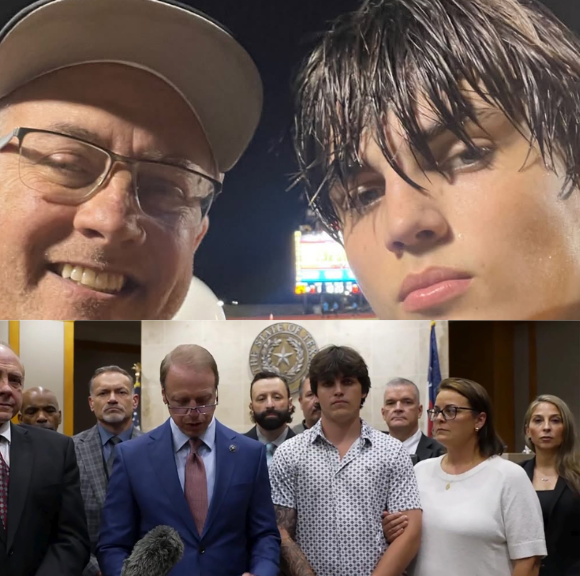
The air in the courtroom was not just still; it was heavy with the collective grief of a community that had been holding its breath for months. When the time finally arrived for the victim impact statements, the room seemed to shrink, the walls closing in as the focus shifted from the legal arguments and the minutiae of the trial to the raw, unvarnished reality of the loss.
At the center of this storm stood Jeff Metcalf. He approached the lectern not with the fire of a man seeking vengeance, but with the weary, shattered composure of a father who has had to bury his child. His target was clear—directed, firm, and agonizingly personal—at the defendant, Karmelo Anthony.
“We lost so much,” Metcalf began, his voice echoing in the chamber. “From the beginning, I asked people not to turn this into something political or divisive. For me, this has always been about accountability, responsibility, and the consequences of our actions.”
In a landscape where high-profile cases are often quickly absorbed into the hungry maw of the 24-hour news cycle and polarized social media discourse, Jeff Metcalf’s plea served as a profound interruption. It was a call to return to the basics of human interaction: the recognition that every action, every choice, and every moment of negligence ripple outward, carrying devastating consequences for others.
The Anatomy of a Loss
To understand the weight of that day in court, one must look past the headlines and understand who Austin Metcalf was. He was more than a name on a docket or a casualty in a criminal investigation. He was a son, a friend, and a young man with a trajectory that was cruelly arrested by the choices of another.
The tragedy that brought the Metcalfs to this courtroom was not a random occurrence of fate; it was the result of a series of decisions that, as Jeff Metcalf articulated, violated the unspoken contract of communal living. When a life is cut short, the aftermath is a vacuum—a silence where a future should have been.
Throughout the trial, the evidence presented was clinical and detached. The prosecution outlined the timeline, the evidence, and the legal statutes. But when Jeff took the stand, the clinical gave way to the visceral. He did not speak in legal jargon; he spoke in the language of a father whose world had been upended. His grief, he explained, was not merely a passive sadness. It was a complex, overwhelming force—a combination of profound anger and soul-crushing frustration.
This is the hidden cost of crime that the law books often fail to capture. The justice system is built on logic and precedent, but the victims are left to navigate the emotional chaos left in the wake of that system. For Jeff, the anger was not just about the event itself, but about the refusal of those involved to initially shoulder the weight of their own actions.
A Plea Against Division
Perhaps the most striking aspect of the testimony was Jeff Metcalf’s explicit request for sobriety and dignity. In an era where tragedies are frequently weaponized by opposing sides to fuel political agendas, Metcalf’s insistence on keeping the focus on “accountability, responsibility, and the consequences” felt radical in its simplicity.
“Every decision carries consequences,” he reminded the court. It is a fundamental moral axiom that often gets lost in the noise. When we treat tragedies as political talking points, we dehumanize the victim. We turn their suffering into a prop. By explicitly asking the public and the media not to turn this into something divisive, Metcalf was attempting to protect his son’s memory from being consumed by causes that did not belong to him.
This is a recurring theme in modern justice: the struggle to keep the victim’s experience from being subsumed by the narrative of the crime. When a trial becomes a spectacle, the victim is often sidelined. Jeff Metcalf refused to let that happen. By anchoring his statement in the universal values of human connection, he forced the courtroom—and by extension, the community watching—to look directly at the wreckage caused by the defendant’s choices.
The Human Capacity for Consequence
The defendant, Karmelo Anthony, sat with the gravity of the accusations laid out plainly. The courtroom, often an arena of sterile procedure, felt suddenly humanized by Metcalf’s words. He spoke of the choices made—the active, conscious decisions that led to the death of his son.
Metcalf’s message was not directed at the legal system, but at the individual sitting across from him. He wanted the defendant to understand the magnitude of what had occurred. This is the goal of a victim impact statement: to pierce the armor of the trial process and force a confrontation with the reality of the harm caused.
Metcalf highlighted that all people share a common humanity. This is a profound statement when coming from a man who had every right to be consumed by hatred. By acknowledging a common humanity, he was not excusing the actions of the defendant; rather, he was framing the tragedy within the context of a shared responsibility to protect one another. It was an assertion that the defendant, in his actions, had fundamentally betrayed the humanity that binds us all.
The Ripple Effect: Beyond the Courtroom
The impact of this case extends far beyond the walls of the courtroom. When a young man like Austin Metcalf is lost, the silence ripples outward, touching friends, educators, neighbors, and the broader community. The “consequences” that Jeff Metcalf spoke of are not contained within the sentencing guidelines or the years of incarceration handed down to the perpetrator. They are lived out in the daily life of a family that has to navigate a world that is now fundamentally different.
This case has sparked conversations within the community about the nature of justice and the expectations we place on one another. There is a growing fatigue with the ways in which societal fractures prevent us from addressing the core issues of violence and negligence. People are looking for something that transcends the binary of “us vs. them.” They are looking for the kind of moral clarity that Jeff Metcalf provided.
By speaking through visible emotion, Metcalf allowed the community to grieve with him. He validated the anger and the frustration that many felt, but he also provided a path forward that was rooted in accountability. He did not ask for the world to burn; he asked for the world to recognize the gravity of what had been lost and to hold those responsible to account.
Conclusion: The Unfinished Work of Justice
As the proceedings concluded, the silence in the courtroom remained. The legal chapter may have been coming to a close, but the reality of the loss remained.
Jeff Metcalf’s statement will likely be remembered not just for its emotion, but for its clarity. In a world of increasing complexity and division, he offered a touchstone: the simple, hard truth that our actions have consequences, and that we are responsible for the damage we inflict on others.
The trial of Karmelo Anthony will be recorded in the annals of the justice system as a victory for the prosecution, a milestone in a legal record. But for the Metcalf family, the real measure of the process is the recognition of their son’s worth and the insistence that his death was not just a tragic accident, but a consequence of choices that should never have been made.
As society continues to grapple with the issues of violence and the failures of the systems designed to prevent it, the words of Jeff Metcalf should serve as a reminder. We are all participants in a shared existence. We all have a responsibility to act with care, to consider the consequences of our choices, and to honor the humanity of those around us.
Austin Metcalf is gone, but the echo of his father’s plea remains: a call for a world where accountability is not just a legal term, but a guiding principle for how we treat one another. The grief is deep, the frustration is real, but the message is clear. It is a message that demands we look at our own choices, acknowledge the humanity of our neighbors, and commit ourselves to a path of responsibility. The silence of the courtroom has ended, but the lesson has only just begun.