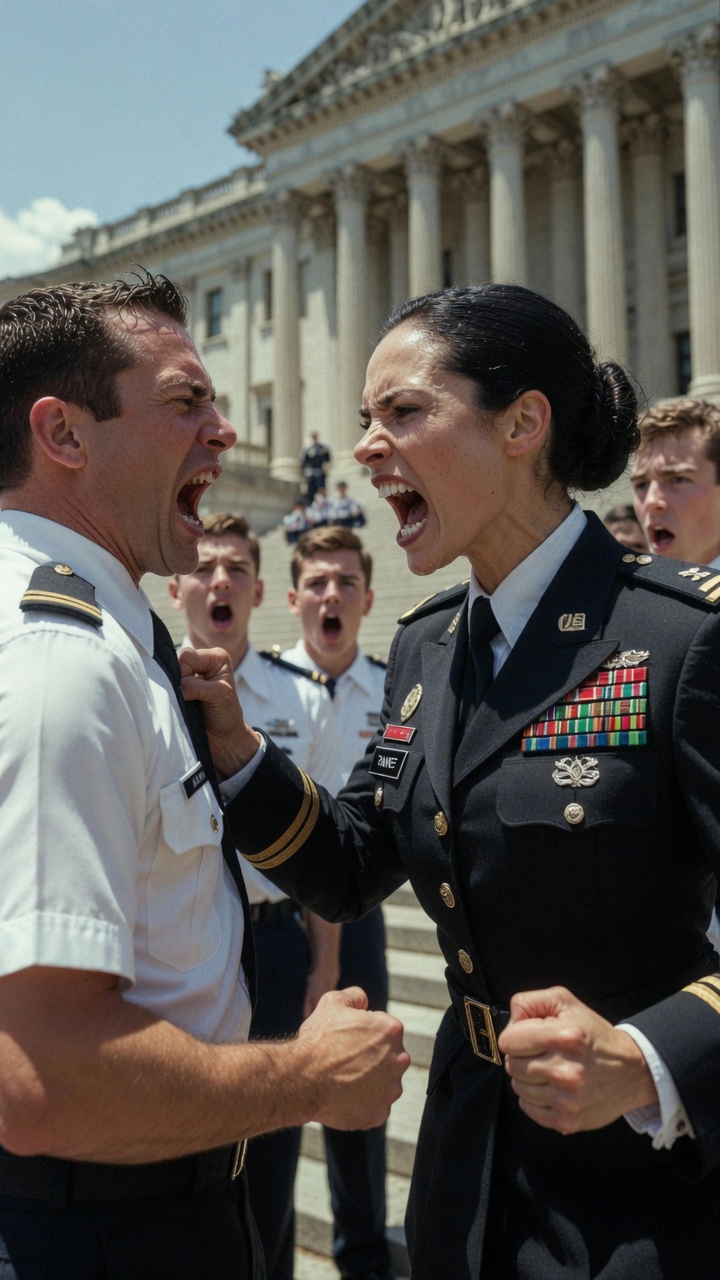
The training field went silent.
Not completely. Annapolis was never truly silent. Somewhere in the distance, a whistle blew. Shoes struck pavement in rhythm. Commands echoed between stone buildings that had shaped generations of officers.
But around me, the air tightened.
The senior officer who had stepped from the black official vehicle was Captain Eleanor Hayes.
Everyone knew her.
Not personally, perhaps, but by reputation. She was one of those officers who seemed carved from regulation and restraint. Her uniform never shifted out of place. Her eyes missed nothing. Her voice could cut through chaos without ever rising.
And now she was looking directly at me.
“Midshipman Parker,” she said.
My spine straightened.
“Yes, ma’am.”
“Come with me.”
A few heads turned. More whispers followed.
I stepped forward, keeping my face calm.
Behind me, I heard someone mutter, “What did she do?”
I knew the voice.
Bradley Knox.
Second-class midshipman. Confident. Popular. Loud in the way insecure people often were. He had been one of the first to call me weak during Plebe Summer. One of the first to laugh when I stumbled. One of the first to shove me outside that social event while his friends recorded it.
I did not look back.
Captain Hayes waited until I reached her side, then turned and walked toward the vehicle. I followed two steps behind.
The ride across campus lasted less than three minutes, but it felt longer.
She did not speak.
Neither did I.
The folder rested on her lap, sealed with a red tab. My name was printed across the top.
MADISON R. PARKER.
Underneath it, another label had been stamped in black ink.
RESTRICTED REVIEW.
My stomach tightened.
Restricted review meant something official. Something beyond ordinary discipline. Something that reached higher than rumors, higher than embarrassment, higher than Academy gossip.
We stopped outside a brick administrative building.
Captain Hayes stepped out first.
“Inside,” she said.
I followed her through polished corridors that smelled faintly of floor wax and old paper. Officers glanced up as we passed. No one smiled.
At the end of the hallway, she opened a conference room door.
Three people waited inside.
One was Commander Sloane, my company officer.
One was a legal officer I had never met.
And the third man sat with his hands folded on the table, wearing civilian clothes.
He had gray hair, broad shoulders, and the stillness of someone who had spent a lifetime learning how not to waste movement.
I recognized him instantly.
Everyone in the room probably expected me to react.
I didn’t.
But inside, something shifted.
Thomas “Ridge” Callahan.
Retired Navy SEAL commander.
Decorated operator.
Author.
Speaker.
Legend in certain circles.
My father had two of his books on our living room shelf. I had read them both before I turned fifteen.
Commander Callahan looked at me the way snipers looked through glass.
Patient.
Exact.
Unblinking.
Captain Hayes gestured toward the chair opposite him.
“Sit down, Midshipman.”
I sat.
No one spoke for a moment.
Then Commander Callahan leaned back.
“Madison Parker,” he said. “Daughter of Master Sergeant Michael Parker and Lieutenant Colonel Rebecca Parker.”
My pulse remained steady, but barely.
“Yes, sir.”
His eyes narrowed slightly.
“You don’t seem surprised that I know that.”
“My parents have both served long enough to be known in certain circles, sir.”
A faint smile touched his mouth.
“That’s one way to put it.”
Captain Hayes opened the folder.
“Midshipman Parker, footage involving you and several upperclassmen has circulated online. The Academy is conducting a formal inquiry.”
“I understand, ma’am.”
Commander Sloane folded his hands.
“The video shows physical contact initiated against you. It also shows verbal harassment. You did not retaliate.”
“No, sir.”
“Why not?”
I looked at him.
“Because retaliation would have changed the focus.”
The legal officer lifted his pen.
“The focus?”
“Yes, sir. If I struck back, the story would become about whether I used excessive force. Instead, the video shows exactly what happened.”
Commander Callahan watched me more closely.
“And what happened?”
I took a breath.
“They believed I was harmless. So they stopped hiding who they were.”
Silence followed.
Captain Hayes lowered her eyes to the folder, then looked up again.
“Did you intentionally allow the situation to continue?”
“Yes, ma’am.”
Commander Sloane stiffened.
“You allowed yourself to be shoved and humiliated?”
“I allowed them to make decisions.”
“That isn’t an answer.”
“It is, sir.”
The room went colder.
I knew how it sounded.
Cold. Calculated. Strange.
But my father had taught me something most people misunderstood: patience was not passivity. Sometimes the strongest move was not the first strike.
Sometimes it was letting the other person reveal their hand.
Captain Hayes closed the folder halfway.
“Midshipman Parker, this is serious. You could have reported earlier incidents.”
“Yes, ma’am.”
“Why didn’t you?”
“Because reports without proof are often treated as personality conflicts.”
The legal officer stopped writing.
Commander Sloane’s jaw tightened, but he did not interrupt.
I continued.
“I was new. Quiet. Already labeled weak. If I filed complaints too early, they would deny everything. Their friends would support them. I would become the problem. So I waited.”
Commander Callahan finally spoke again.
“And the video?”
“I didn’t record it.”
“No,” he said. “But you knew others were.”
I met his stare.
“Yes, sir.”
He looked almost amused.
“You saw the battlefield.”
I said nothing.
Captain Hayes’s expression remained controlled, but something in her eyes shifted.
“Midshipman Parker, there is another issue.”
She slid a printed image across the table.
It was a still frame from the video.
Bradley Knox’s hand was on my shoulder. His mouth was open in laughter. Two others stood nearby.
And behind them, half visible near the edge of the frame, was a face I knew.
Not from the Academy.
From my father’s old photographs.
My chest tightened before I could stop it.
Captain Hayes noticed.
“Do you recognize him?”
I kept my voice even.
“Yes, ma’am.”
“Name?”
“Ethan Vale.”
Commander Sloane frowned.
“He is not listed among the midshipmen involved.”
“No, sir. He’s not a midshipman.”
Commander Callahan leaned forward.
“Tell them who he is.”
I looked at him.
“Former Navy special warfare candidate. Discharged before completion.”
The legal officer’s eyebrows rose.
Captain Hayes turned one page in the folder.
“And how do you know him?”
I hesitated.
Because the answer was complicated.
Because Ethan Vale was not simply someone from my father’s past.
He was a warning.
A ghost story adults lowered their voices around.
And somehow, he had appeared on Academy grounds behind the people who targeted me.
“He served under my father briefly,” I said. “Years ago.”
Commander Callahan’s face hardened.
“That’s incomplete.”
I looked at him.
“Yes, sir.”
Captain Hayes waited.
I exhaled slowly.
“Ethan Vale blamed my father for ending his military career.”
No one moved.
“My father reported him during a joint training exercise after Ethan endangered two trainees. There was an investigation. Ethan was removed from the pipeline. He claimed my father ruined his life.”
Captain Hayes looked down at the photograph again.
“And now he appears in footage involving you.”
“Yes, ma’am.”
Commander Sloane’s voice was low.
“Was the harassment directed by him?”
“I don’t know.”
That was the truth.
But even as I said it, memory returned.
The first week of Plebe Summer, I had felt watched.
Not by instructors.
Not by classmates.
By someone who already knew my name.
At first, I dismissed it. Annapolis had eyes everywhere. I was not special.
But then came the comments.
Not generic insults.
Specific ones.
“Daddy can’t carry you here.”
“Maybe your mother can write you a recommendation to quit.”
“Parker privilege.”
Those words had not come from nowhere.
Someone had fed them information.
Captain Hayes tapped the photograph.
“Commander Callahan flagged this individual after watching the video.”
I looked at him.
“You recognized Ethan?”
“I recognized the way he stood,” he said.
That should have sounded ridiculous.
It didn’t.
Men like Callahan noticed things before other people knew there was something to notice.
“He was trying not to be seen,” Callahan continued. “People who are trying not to be seen always tell you where to look.”
A chill moved through me.
Captain Hayes opened another section of the folder.
“We are reviewing visitor logs, event access records, and security footage. At this time, Ethan Vale had no authorization to be present near that event.”
Commander Sloane’s face darkened.
“He was trespassing?”
“Possibly,” Hayes said. “Or he was brought in by someone.”
The room went silent again.
Bradley Knox.
His friends.
Someone with access.
Someone arrogant enough to believe rules applied only to people beneath him.
I kept my hands folded in my lap.
Captain Hayes studied me.
“Madison, this may no longer be only a bullying inquiry.”
I had expected that.
Still, hearing it aloud made the room feel smaller.
“What is it, ma’am?”
Commander Callahan answered.
“A test.”
I turned toward him.
“A test?”
He nodded.
“Someone wanted to see what you would do under pressure.”
“Ethan?”
“Maybe.”
“Why?”
Callahan’s eyes sharpened.
“Because of your father.”
The words landed heavily.
My father had retired from active duty with more scars than stories. He was respected, but not universally loved. People who enforced standards rarely collected only friends.
Captain Hayes leaned forward.
“Your father has been contacted.”
That broke my composure.
Only slightly.
But enough.
“You called him?”
“Yes.”
“And my mother?”
“Yes.”
I pictured them at home in North Carolina, receiving a call from the Naval Academy about a viral video involving their daughter, a disgraced former candidate, and possible targeting.
My father would go silent.
My mother would ask precise questions.
Neither would panic.
That was their way.
But I knew them well enough to know they would already be moving.
“What did they say?” I asked.
Commander Callahan answered.
“Your mother said you were trained not to fold.”
A faint ache opened in my chest.
“And my father?”
Callahan almost smiled.
“He asked whether Ethan still limps on his left leg.”
Despite everything, I nearly laughed.
That sounded exactly like him.
Captain Hayes did not smile.
“Midshipman Parker, until we understand the full scope of this situation, you are not to confront Bradley Knox, his associates, or Ethan Vale if you see him.”
“Yes, ma’am.”
“You are also not to discuss this inquiry publicly.”
“Yes, ma’am.”
Commander Sloane watched me.
“And Madison?”
“Yes, sir?”
“No more private tests.”
I nodded.
“Yes, sir.”
But inside, I knew that was impossible.
The test had already begun.
And I was not the one who started it.
When I left the conference room, the Yard felt different.
The same buildings stood beneath the afternoon sun. The same uniforms moved in clean lines. The same flags snapped in the Chesapeake wind.
But the Academy had shifted.
People stared openly now.
Some with curiosity.
Some with sympathy.
Some with resentment.
Viral attention changes everything.
Not because truth suddenly matters.
Because people fear being seen on the wrong side of it.
As I crossed toward Bancroft Hall, two plebes stepped aside.
One whispered, “That’s her.”
I kept walking.
Near the steps, Bradley Knox waited with two of his usual shadows: Mason Reed and Tyler Voss.
Bradley’s expression was not smug today.
It was controlled.
Too controlled.
He stepped into my path.
“Parker.”
I stopped.
“Knox.”
His eyes flicked toward the administrative building behind me.
“What did you tell them?”
“The truth.”
His mouth tightened.
“That’s not funny.”
“I wasn’t joking.”
Mason shifted nervously.
Tyler looked around as if expecting officers to emerge from the bushes.
Bradley leaned closer.
“You think this makes you untouchable?”
“No.”
“Good.”
I looked at him calmly.
“It makes you visible.”
His face flushed.
For one second, I thought he might grab me again.
This time, there were no laughing friends with phones held casually at chest height. No crowd noise to hide behind. No easy assumption that I would do nothing.
Just the two of us, standing in daylight.
He saw something in my face then.
Something he had missed before.
His hand stayed at his side.
“Stay away from me,” he muttered.
I stepped around him.
“With pleasure.”
I was almost past when he spoke again, lower.
“You don’t know what you’re in the middle of.”
I stopped.
Slowly, I turned.
Bradley’s expression changed as soon as he realized what he had said.
“What does that mean?” I asked.
He shook his head.
“Nothing.”
“Bradley.”
The use of his first name struck him harder than any insult.
His eyes darted to Mason.
Mason looked away.
Tyler swallowed.
That was all I needed to see.
They were scared.
Not of punishment.
Of someone else.
Before I could press further, Commander Sloane’s voice cut across the steps.
“Problem?”
Bradley snapped upright.
“No, sir.”
I turned.
“No, sir.”
Commander Sloane looked between us.
“Move along.”
We obeyed.
But as Bradley walked away, his shoulders looked smaller.
That night, the Academy was restless.
The video had spread further. News accounts were circling. Veterans were arguing online. Former midshipmen were naming patterns. Anonymous posts appeared and disappeared.
Some defended Bradley.
Most did not.
But the story had grown beyond me.
By 2200, I was sitting at my desk, pretending to review navigation principles while my roommate, Alicia Grant, watched me from her bunk.
Alicia was from Chicago, sharp as a blade, and emotionally impossible to fool.
“You’re not reading,” she said.
“I’m trying.”
“No, you’re staring at the same paragraph like it owes you money.”
I closed the book.
She climbed down from her bunk.
“Is it true?”
“That depends.”
“About the SEAL commander.”
“Yes.”
“About the guy in the video not being a student?”
“Yes.”
Her face changed.
“Madison.”
“I know.”
“That’s not normal.”
“I know.”
She sat across from me.
“Are you scared?”
I considered lying.
Then I remembered my mother.
Strength is decision.
“Yes,” I said.
Alicia nodded once.
“Good. Fear means your brain still works.”
That made me smile faintly.
A knock sounded at the door.
We both looked up.
It came again.
Three precise knocks.
Alicia opened it.
A messenger stood outside.
“Parker. You’re requested downstairs.”
My body went still.
“By whom?”
“Your parents.”
For one moment, I forgot how to breathe.
Then I stood.
Alicia stepped aside.
“I’ll be here,” she said.
I nodded and followed the messenger down.
The reception area near the entrance was mostly empty.
But my parents stood near the far wall.
My father looked older than he had two months ago. Or perhaps I was only seeing him differently. Broad-shouldered, close-cropped hair gone silver at the temples, eyes that had seen too much and stored most of it behind silence.
My mother stood beside him in civilian clothes, posture perfect, expression unreadable.
I stopped several feet away.
For the first time since Induction Day, I felt like someone’s daughter instead of a midshipman.
My mother crossed the distance first.
She hugged me hard.
Not long.
Not dramatic.
But hard enough to tell me everything she would not say in public.
My father waited until she released me.
Then he placed a hand on my shoulder.
“You okay, kid?”
I nodded.
“Yes, sir.”
His mouth twitched.
“Don’t ‘sir’ me right now.”
That almost broke me.
Almost.
“I’m okay, Dad.”
He studied my face.
“You sure?”
“No.”
He nodded.
“Better answer.”
My mother looked toward an empty side room.
“We need to talk.”
Inside, she shut the door.
My father remained standing.
My mother sat.
I stayed near the table, hands behind my back out of habit.
My father noticed.
“Relax, Madison.”
I did not.
He sighed.
“Or don’t.”
My mother leaned forward.
“Commander Callahan told us Ethan Vale was seen in the footage.”
“Yes, ma’am.”
Her eyes softened slightly.
“You know who he is.”
“Yes.”
“You don’t know everything.”
The room seemed to tighten.
My father looked away.
That frightened me more than anything.
Because my father faced pain directly.
Unless the pain had a name he had been avoiding for years.
“What don’t I know?” I asked.
My mother glanced at him.
He gave a small nod.
She continued.
“Ethan Vale was not only removed from training because of dangerous conduct. He was part of a group under investigation for off-book hazing and coercion.”
My throat tightened.
“At the Academy?”
“No,” my father said. “Before. During a selection preparation program. Informal. Unofficial. The kind of thing people pretend doesn’t exist until someone gets hurt.”
“Someone did get hurt?”
My father’s jaw tightened.
“A young candidate named Daniel Mercer.”
The name stirred something distant.
I had heard it before.
In whispers.
At barbecues where adults went quiet when kids entered the room.
“What happened to him?”
My father looked at me.
“He died.”
The words settled over the room.
No drama.
No thunder.
Just truth.
“Training accident?” I asked.
“That’s what the report said,” my mother replied.
“And what do you say?”
My father’s eyes darkened.
“I say Ethan Vale was there. I say Bradley Knox’s uncle was there. I say several men lied. And I say Daniel Mercer’s family never got the truth.”
The air left my lungs.
“Bradley’s uncle?”
My father nodded.
“Clay Knox. Former officer. Powerful friends. Clean record on paper.”
I thought of Bradley’s confidence.
His entitlement.
His panic.
The shape of the thing became clearer, and darker.
“This isn’t about me being quiet,” I said.
“No,” my mother replied. “It may have started because of your last name.”
My father stepped closer.
“Years ago, I pushed for the Mercer case to be reopened. I couldn’t make it happen. Too many doors closed.”
“And Ethan blamed you.”
“He blamed me for nearly exposing him.”
A cold realization spread through me.
“So he came here.”
“Maybe,” my mother said. “Or maybe someone invited him.”
Bradley’s warning returned.
You don’t know what you’re in the middle of.
I gripped the edge of the table.
“What does he want from me?”
My father’s answer came quietly.
“To make you quit. Or break. Or react badly enough that your credibility disappears.”
My mother added, “And if you become unreliable, anything you say about what you saw becomes easier to dismiss.”
“What I saw?”
My father reached into his jacket and removed a folded photograph.
He placed it on the table.
It showed a group of young men standing near a training course years ago.
Ethan Vale was there.
Younger. Smiling.
Beside him stood another man I recognized from Academy events.
Clay Knox.
Bradley’s uncle.
And at the far left, half turned away from the camera, was someone else.
Someone whose face sent a strange pressure behind my eyes.
“Who is that?” I asked.
My father did not answer immediately.
My mother did.
“Commander Sloane.”
For a moment, I thought I had misheard.
“My company officer?”
“Yes.”
I stared at the photograph.
Commander Sloane, younger but unmistakable, standing with the men connected to Daniel Mercer’s death.
“But he’s part of the inquiry.”
My father nodded.
“That’s what worries us.”
The room tilted.
Commander Sloane had been in the conference room. He had asked why I hadn’t reported earlier. He had told me no more private tests.
Was that concern?
Or control?
My mother’s voice lowered.
“Madison, listen carefully. Do not accuse him. Do not confront him. Do not share this photograph with anyone except Captain Hayes or Commander Callahan.”
“Does Callahan know?”
My father folded his arms.
“He suspected. Not confirmed.”
“Then why hasn’t he acted?”
“Because suspicion is not proof.”
I looked at the photograph again.
Proof.
That word had followed me from the beginning.
I had waited for proof against Bradley.
Now proof had arrived against someone far more dangerous.
And it was not enough.
A knock sounded at the door.
All three of us turned.
Captain Hayes entered without waiting long.
Her expression changed when she saw my parents.
“Master Sergeant. Colonel.”
My mother stood.
“Captain.”
Captain Hayes looked at the photograph on the table.
Her eyes narrowed.
No one spoke.
Finally, she shut the door behind her.
“Where did you get that?”
My father answered.
“Old file.”
Hayes stepped closer.
“Do you understand what you’re holding?”
“Yes.”
She looked at me.
“Madison, return to your room.”
I didn’t move.
My mother’s voice was calm.
“Captain, she deserves to know.”
Hayes looked at my mother.
“She deserves to stay alive.”
The room went silent.
My heartbeat slowed.
Alive.
Not safe.
Not enrolled.
Alive.
My father’s expression hardened.
“What happened?”
Captain Hayes placed a phone on the table.
The screen showed a paused security image.
A delivery entrance.
A shadowed figure.
A package.
“The Academy received an anonymous envelope thirty minutes ago,” Hayes said. “It contained a copy of the video, a list of names, and a note.”
She swiped the screen.
The note appeared.
Four words.
PARKER KNOWS TOO MUCH.
My mother inhaled once.
My father went completely still.
Captain Hayes looked at me.
“Do you?”
I stared at the message.
Parker knows too much.
Not Michael Parker.
Not Rebecca Parker.
Me.
I had spent weeks pretending to be weak.
Pretending not to notice.
Pretending I was only surviving.
But someone had seen through the camouflage.
Or feared that I would.
“I don’t know,” I said honestly.
Hayes held my gaze.
“That may not matter.”
My father turned toward her.
“What are you doing about Sloane?”
Captain Hayes did not blink.
“Watching him.”
“So you know.”
“I know enough to keep him close.”
That answer told me everything.
Commander Sloane had not simply been included in the inquiry.
He had been bait.
Or a suspect.
Or both.
Captain Hayes picked up the photograph.
“Where is the original?”
My father did not answer.
Hayes’s eyes sharpened.
“Master Sergeant.”
“Safe.”
“Good.”
She slipped the copy into her folder.
Then she looked at me.
“Midshipman Parker, you are being temporarily moved.”
My stomach tightened.
“To where?”
“A secured room under observation.”
“No.”
Everyone looked at me.
My father’s eyebrows lifted slightly.
Captain Hayes’s voice cooled.
“That was not a request.”
“With respect, ma’am, moving me openly confirms I’m scared and isolates me.”
“You are under threat.”
“Yes, ma’am. And whoever sent that note wants disruption. They want me pulled from routine, separated, watched. It makes me easier to track and easier to define as unstable.”
My mother’s eyes flickered.
My father looked almost proud despite himself.
Captain Hayes stepped closer.
“You are a plebe, not an investigator.”
“No, ma’am.”
“Then stop thinking like one.”
“I can’t.”
The words came before I could soften them.
Captain Hayes stared at me.
I added, “I won’t confront anyone. I won’t act without authorization. But hiding me won’t stop this.”
For a long moment, no one spoke.
Then Commander Callahan’s voice came from the doorway.
“She’s right.”
I turned.
He stood just outside, expression unreadable.
Captain Hayes frowned.
“You were asked to wait.”
“I got bored.”
No one laughed.
Callahan entered and looked at me.
“Parker, how good is your memory?”
“Good, sir.”
“How good?”
I understood the question beneath the question.
“Photographic under stress, according to my father.”
My father muttered, “Not officially.”
Callahan ignored him.
He placed three photographs on the table.
Academy crowd shots from the night of the confrontation.
“Tell me what’s wrong.”
Captain Hayes began to object, but my mother touched her arm lightly.
“Let her look.”
I studied the first image.
Students gathered outside the event. Bradley at the center. Mason laughing. Tyler holding a phone.
Nothing obvious.
Second image.
A wider angle.
Ethan Vale near the edge.
A maintenance cart behind him.
Third image.
Different angle.
Same crowd.
Same cart.
I leaned closer.
“The cart moved.”
Callahan’s eyes sharpened.
“Good.”
I pointed.
“In the first photo, it’s near the service path. In the third, it’s closer to the side entrance.”
Hayes looked.
“And?”
“The driver isn’t the same.”
My father stepped closer.
I tapped the image.
“First driver has a tattoo on his right forearm. Second driver doesn’t. Different build too.”
Callahan nodded.
“What else?”
I studied Ethan.
His stance.
His shoulders.
His head angle.
“He isn’t watching me.”
“No?”
“No. He’s watching the cart.”
Captain Hayes took the photograph.
The room changed again.
Because now the video was not only about harassment.
It was about movement.
Access.
A hidden exchange.
“What was on the cart?” I asked.
Hayes looked at Callahan.
Callahan answered.
“Unknown. Security footage cuts for ninety seconds.”
My mother’s expression hardened.
“Cuts?”
“Camera outage,” Hayes said.
My father gave a humorless laugh.
“Convenient.”
I looked at the photographs again.
Bradley had shoved me.
His friends had laughed.
Phones had recorded.
Everyone focused on the humiliation.
But behind it, something else had happened.
Something concealed by noise.
My humiliation had been cover.
The realization slid coldly into place.
“They didn’t target me because I was weak,” I said.
Callahan watched me.
“They targeted me because people would look at me.”
Captain Hayes nodded slowly.
“And not at the cart.”
The room fell silent.
I felt anger then.
Not hot.
Not reckless.
Precise.
They had used me.
Not only as a victim.
As camouflage.
They had counted on my silence.
They had counted on my shame.
They had counted on everyone watching the shove and missing the theft.
“What disappeared?” I asked.
No one answered immediately.
Then Hayes said, “A sealed personnel archive connected to legacy misconduct cases.”
My father’s face went pale with fury.
“The Mercer file.”
“Among others,” Hayes said.
Commander Callahan’s voice was low.
“Someone used your confrontation to remove evidence from Academy storage.”
My mouth went dry.
“And now they think I saw something.”
“You did,” Callahan said.
“The cart.”
“Maybe more.”
I closed my eyes.
Memory opened.
Laughter.
Bradley’s hand on my shoulder.
Someone chanting weak.
My back hitting the wall.
Phone lights.
A flash of movement beyond Mason’s elbow.
Ethan turning his head.
A maintenance cart rolling.
And a man in a cap leaning down as something was lifted beneath a tarp.
I opened my eyes.
“The man on the cart had a scar.”
Everyone focused on me.
“Where?” Callahan asked.
“Left side of his neck. Thin. Curved. Like a hook.”
My father swore under his breath.
Captain Hayes looked at him.
“You know him?”
My father nodded once.
“Clay Knox.”
The name struck the room like metal.
Bradley’s uncle.
The man connected to Daniel Mercer’s death.
The man whose record had survived untouched for years.
And he had been here.
On Academy grounds.
During my humiliation.
Taking the file that might expose him.
Captain Hayes picked up her phone.
“Lock down all exits.”
Callahan moved toward the door.
My father stopped him.
“Ridge.”
Commander Callahan looked back.
For the first time, I realized they knew each other well.
Better than I had understood.
My father’s voice was quiet.
“If Clay’s here, Ethan isn’t the threat.”
Callahan’s face became stone.
“I know.”
Then the alarms began.
Not loud at first.
A distant signal.
Then another.
Then voices in the hallway.
Captain Hayes opened the door.
An officer rushed toward her.
“Ma’am, we have a breach at the auxiliary lot. Vehicle left without clearance.”
“Description?”
“Dark SUV. Maryland plates obscured.”
Hayes looked at Callahan.
“Clay.”
My father stepped toward the hallway.
My mother grabbed his arm.
“Michael.”
He stopped, but every line of his body wanted movement.
Captain Hayes turned to me.
“Madison, you are staying here.”
For once, I didn’t argue.
Not because I wanted to obey.
Because my mind had snagged on something.
A detail.
Small.
Wrong.
The maintenance cart.
The tarp.
The man with the scar.
The vehicle leaving.
Too obvious.
Clay Knox had hidden for years. Men like that did not personally steal evidence, expose themselves to cameras, then flee in a vehicle with obscured plates unless they wanted people chasing it.
“Ma’am,” I said.
Hayes turned sharply.
“What?”
“The SUV is a distraction.”
Callahan stopped.
I pointed at the photograph again.
“The cart moved toward the side entrance. But if Clay wanted to remove files, he would head to a vehicle. He wouldn’t risk crossing open ground with evidence unless there was another transfer point.”
Hayes stepped back into the room.
“Where?”
I looked at the building map on the wall.
Service corridors.
Storage.
Laundry access.
Basement passage.
Then I saw it.
“Bancroft.”
My mother’s face changed.
“My room,” I said.
Everyone stared at me.
“They don’t think I saw the file. They think I have something else.”
Captain Hayes’s voice sharpened.
“What else?”
I remembered Bradley on the steps.
You don’t know what you’re in the middle of.
I remembered Mason looking away.
Tyler swallowing.
I remembered my desk drawer.
The small anonymous envelope someone had slipped under my door two nights earlier.
I had assumed it was another insult.
I had not opened it.
My blood went cold.
“There’s an envelope in my room,” I said.
Captain Hayes grabbed her radio.
But before she spoke, my phone buzzed.
A message appeared from Alicia.
MADISON, SOMEONE IS IN OUR ROOM.
Then another.
IT’S COMMANDER SLOANE.
Then the screen went black.
My mother reached for me, but I was already moving.
I ran.
Behind me, voices shouted.
Boots hit the hallway.
Captain Hayes ordered me to stop.
My father called my name.
I heard all of it.
I obeyed none of it.
Because Alicia was in that room.
Because Commander Sloane had told me no more private tests.
Because the man assigned to protect me had gone exactly where the real evidence waited.
I tore across the Yard under a darkening sky, every practiced weakness falling away.
People turned as I passed.
I was no longer near the back.
No longer stumbling.
No longer hiding.
I ran the way my father taught me.
Quiet body.
Clear mind.
No wasted motion.
By the time I reached Bancroft Hall, alarms were spreading. Midshipmen stood confused in corridors. Officers shouted instructions.
I slipped through a side stairwell before anyone could stop me.
Third floor.
Then fourth.
My lungs burned, but my thoughts stayed sharp.
At the end of the hallway, my room door stood open.
Inside, Alicia stood against the wall, pale but upright.
Commander Sloane was at my desk.
The drawer was open.
In his hand was the envelope.
He turned slowly when he saw me.
For a moment, neither of us moved.
Then he smiled.
Not kindly.
Sadly.
“Madison,” he said. “You should have stayed downstairs.”
I stepped into the room.
“Put it down, sir.”
Alicia shook her head slightly, warning me.
Sloane noticed.
His smile faded.
“You don’t understand what that is.”
“Then explain it.”
He looked toward the hallway.
Footsteps echoed below, still distant.
He had seconds.
So did I.
Sloane held up the envelope.
“This is not evidence. It is bait.”
“From who?”
His eyes darkened.
“From a dead man.”
The words landed strangely.
Daniel Mercer.
My throat tightened.
“What’s inside?”
Sloane’s expression flickered.
“Something that should have stayed buried.”
Then he did something I did not expect.
He tossed the envelope to me.
I caught it.
Alicia gasped.
Sloane stepped closer.
“Listen carefully. Clay Knox didn’t come back to hide the Mercer file.”
“Then why?”
“To confirm whether Daniel’s recording still existed.”
I froze.
“Recording?”
Sloane nodded.
“Daniel knew what they were doing. He recorded them before he died. Everyone thought it was destroyed.”
I looked at the envelope in my hand.
“And this?”
“Maybe a copy. Maybe a key. Maybe nothing.”
“Why take it?”
“Because if Clay finds it first, people die.”
His voice cracked on the last word.
That crack confused me.
It sounded real.
Footsteps grew louder.
Sloane glanced toward the door.
Then he looked back at me.
“Your father was wrong about one thing.”
“What?”
Sloane’s eyes filled with something like regret.
“I wasn’t standing with them in that photograph.”
He stepped closer and lowered his voice.
“I was standing against them.”
Captain Hayes appeared in the doorway with Commander Callahan and my parents behind her.
“Step away from her,” Hayes ordered.
Sloane raised his hands.
But his eyes stayed on mine.
“Open it,” he said.
Hayes snapped, “Do not.”
Sloane ignored her.
“Madison, open it now.”
The hallway seemed to hold its breath.
I looked at my father.
His face said no.
I looked at my mother.
Her face said think.
Then I looked at Commander Callahan.
His eyes were fixed on Sloane, not me.
He looked uncertain.
That decided it.
I opened the envelope.
Inside was a small plastic memory card and a folded note.
My hands were steady as I unfolded it.
Only one sentence was written there.
In ink faded by time.
IF PARKER’S DAUGHTER FOUND THIS, THEN THE OLD LIE HAS STARTED AGAIN.
My mother whispered, “What?”
I turned the note over.
On the back was a name.
Not Daniel Mercer.
Not Clay Knox.
Not Ethan Vale.
Rebecca Parker.
My mother’s name.
I looked up slowly.
My mother had gone completely still.
My father stared at her.
Commander Callahan’s face changed first.
He understood before I did.
Sloane lowered his hands.
“I’m sorry,” he said.
I looked at my mother.
“Mom?”
She did not answer.
Outside, somewhere below us, another alarm sounded.
And from the memory card in my palm, the past seemed to pulse like a living thing.
THE END OF PART 2 – LIKE, SHARE AND COMMENT “FULL STORY” IF YOU WANT TO READ FULL STORY.