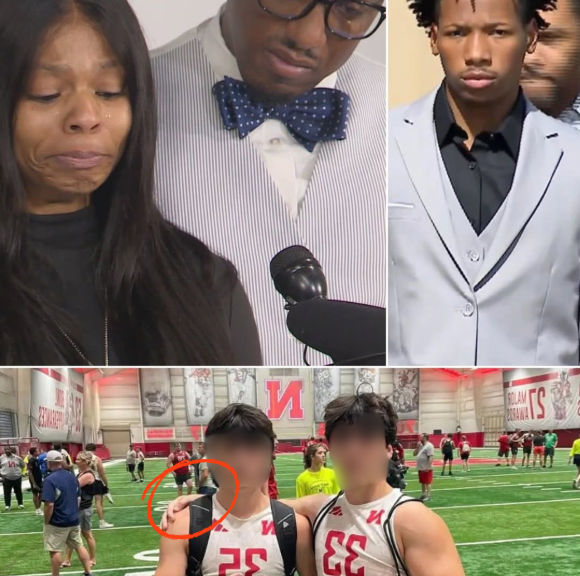
In the age of viral justice, the lines between victimhood, villainy, and the desperate scramble for survival have become increasingly blurred. Nowhere is this more apparent than in the ongoing murder trial of 19-year-old Karmelo Anthony, currently unfolding in the Collin County Courthouse. Yet, as the legal battle over the tragic stabbing death of 17-year-old Austin Metcalf enters its critical phase, a different kind of war is being waged in the digital sphere—a war over money, optics, and the morality of a $600,000 crowdfunding campaign.
The Anatomy of an Outcry
On April 2, 2025, a sunny day at the David Kuykendall Stadium in Frisco, Texas, turned into a scene of unspeakable horror. A rain-delayed track meet became the site of a fatal altercation between two high school students. Karmelo Anthony, then 17, was arrested and charged with the murder of Austin Metcalf.
The facts of the incident are well-documented: a tent, a push, a backpack, a black knife, and a single, fatal wound to the chest. But in the year that followed, the case evolved from a local tragedy into a national flashpoint, fueled by competing narratives of self-defense and cold-blooded murder.
As the trial began on June 1, 2026, the focal point for many outside the courtroom shifted from the evidence to an online phenomenon: the Karmelo Anthony Legal Defense Fund hosted on GiveSendGo. As the goalpost for the fundraiser crept steadily toward $600,000, public outrage simmered. Why, the public asked, was a murder suspect the recipient of such immense financial support?
The Digital Defense Fund
Crowdfunding for legal defense is not new. From the high-profile cases of the 1990s to the era of GoFundMe, public appeals for legal aid are a staple of the American justice system. However, the sheer scale of the funds raised for Anthony—surpassing $500,000 by late May and aiming for $600,000—has set a troubling precedent for many, particularly given the violent nature of the charges.
The fund’s description, updated periodically, paints a picture of a family under siege. It cites the need for legal representation, but it goes further, listing “safe relocation” due to “escalating threats,” counseling, and basic living expenses as primary beneficiaries of the donors’ generosity.
For the Anthony family, the campaign is not a luxury; it is a necessity. To them, the donations represent a community rallying against a system they perceive as biased and hostile. But for those watching the case from the outside, the transparency remains opaque. When does a “defense fund” become a lifestyle subsidy? And does the speed at which these funds are gathered influence the perceived legitimacy of the defendant’s claims?
The Mother’s Voice: A Family Under Siege
Kala Hayes, Karmelo Anthony’s mother, has found herself at the center of this firestorm. In her few public statements, she has rejected the characterization of the fund as “blood money” or a “payout.”
“I don’t know why we are being targeted and discriminated against before a fair trial,” Hayes stated in a recent interview. Her defense is rooted in the idea of the presumption of innocence. She argues that her family has been forced into hiding, that her son is being demonized by a media narrative that ignores the “self-defense” aspect of his claims, and that the financial burden of a murder trial—even for an innocent person—would be enough to bankrupt any middle-class family.
Hayes represents a perspective often lost in the noise of social media: the reality of the accused’s family. In her view, the $600,000 is not a victory or a windfall; it is a shield. She posits that if the community is willing to support them, it is because those donors see the same bias she does. She claims they are not paying for a murderer to live in luxury, but for a young man to have the best possible chance to prove his innocence in a system that she believes has already condemned him.
The Friction of Public Perception
The controversy is, at its heart, a clash of values.
For the supporters of the fund, the donation is an act of ideological solidarity. They view the case through the lens of racial tensions in Frisco and the perceived over-policing of minority youth. To them, the financial support is a way to “even the playing field” in a legal system that often favors those with the deepest pockets.
Conversely, for the critics—and there are many—the optics of a defendant sitting under house arrest while receiving half a million dollars in community donations are deeply uncomfortable. The pain of the Metcalf family, who must live with the void left by Austin’s death, casts a long shadow over the Anthony fund. Every update to the fundraising goal is felt by those who argue that the money is an insult to the victim’s memory.
The Legal Implications
While the court of public opinion is divided, the legal system remains unmoved by the fundraiser. District Attorney Bill Wirskye has kept the focus strictly on the evidence: the “six-word threat” allegedly uttered by Anthony, the witnesses who described the defendant as the clear aggressor, and the physical evidence of the weapon.
Defense attorney Michael Howard has consistently argued that the focus on the fund is a distraction intended to prejudice the jury. The legal strategy is clear: the money is for the counsel and the survival of the family, and it has no bearing on what occurred inside that tent on April 2, 2025.
However, the intersection of the two cannot be ignored. When a defendant is the subject of national crowdfunding, the trial itself becomes a performance. Every dollar raised increases the stakes, elevating a local tragedy into a national referendum on justice, race, and accountability.
The Uncertain Future
As the trial moves toward a verdict, the $600,000 question remains unanswered. Will the funds be sufficient to secure an acquittal? Or will they serve as a historical footnote—a testament to the polarization of our society in the mid-2020s?
For Kala Hayes, the outcome will be measured in the freedom of her son. For the Metcalf family, it will be measured in the cold delivery of a verdict. And for the rest of us, the Anthony case serves as a grim reminder that in the digital age, the price of justice is not just the cost of a lawyer, but the cost of our collective empathy.
The silence of the courtroom is heavy, but outside its doors, the noise of the donation page continues to ring, echoing the divisions of a nation trying to decide who is a villain, who is a victim, and what we owe to each in the name of truth.