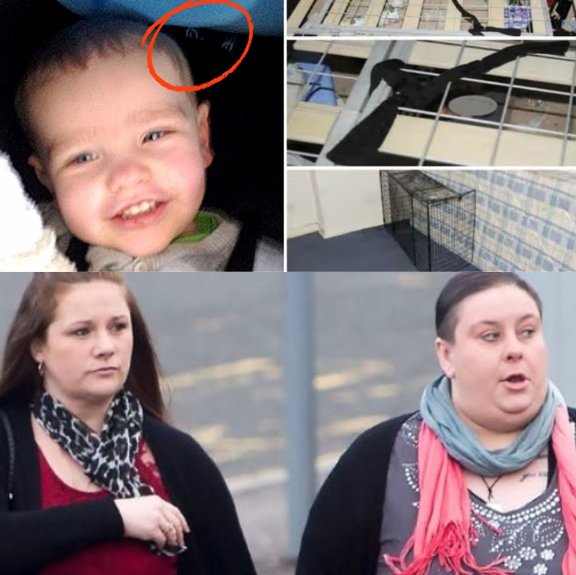
The house in Thornton, Fife, was supposed to be a home. It was a space defined by the domestic rituals of childhood—the small shoes by the door, the sounds of cartoons, the quiet hum of family life. But for two-year-old Liam Fee, that address became a theater of calculated cruelty.
When the news of his death first broke, the community was shocked by the brutality. But as the investigation unfolded, the shock turned into something far more visceral and terrifying. It was not just the horrific nature of the violence that stunned the world; it was the chilling realization that Liam’s death was the result of a slow, systematic eradication of a child’s life, conducted by the very people sworn to protect him.
This is the story of a shattered toddler, the monsters who wore the masks of mothers, and the agonizing question that still haunts the social services of Scotland: How did we miss the signs?
The Anatomy of a Tragedy
The call that reached emergency services on March 22, 2014, was deceptively calm. Rachel and Nyomi Fee reported that their young son, Liam, was unresponsive. But when paramedics arrived at the property, the reality they encountered defied human comprehension.
Liam’s tiny body was a map of agony. Investigators would later determine that he had been subjected to a sustained campaign of torture. He was covered in more than 30 separate, savage injuries. His heart was essentially shattered, not by a single accident, but by a series of blunt force impacts so severe that medical experts would later compare the damage to that sustained in a major car crash.
There were no tears from the women when the medical team arrived. There was no hysteria, no frantic desperation of a parent losing a child. There was only a cold, performative detachment. While Liam lay dying—and for hours before, as he languished in unimaginable pain—these women stood by. They watched the light leave his eyes without ever reaching for a phone, without ever seeking the help that might have saved him.
The Sound of Silence
For the neighbors in Thornton, the nightmare did not begin with the police sirens. It began months earlier.
The walls of their home, thin and porous, had carried the sounds of something wrong. Neighbors spoke of blood-curdling screams, the desperate, high-pitched cries of a toddler in distress, and eerie, mysterious silences that felt more unnatural than the noise.
“You hear a child cry, and you think, ‘that’s normal,’” one neighbor recalled, the weight of the memory clearly still heavy. “But this… this was different. This was the sound of a child being broken.”
Yet, in a society that prides itself on privacy and the sanctity of the family unit, the barriers to intervention remained high. The tragedy of Liam Fee is not that the signs were invisible; it is that they were ignored. The cries in the night were muffled by the fear of overstepping, the hesitation to accuse, and the manipulative narrative the perpetrators had woven around their lives.
“I Have the Right”
The most chilling revelation during the trial was not the medical report, but the psychological profile of the abusers. Rachel and Nyomi Fee presented a facade of maternal concern to the outside world, but behind closed doors, they operated with a sadistic entitlement.
During the investigation, a haunting quote emerged—a statement that encapsulates the distorted reality these women lived in. When confronted about the control they exerted over the children in their care, the sentiment was clear, defiant, and terrifying: “I’M HIS MOTHER, I HAVE THE RIGHT TO DO WHATEVER I WANT TO HIM!”
This belief—that a child is a possession rather than a human being—is the dark heart of this case. It is the justification used by abusers throughout history to strip children of their agency and their safety. For Rachel and Nyomi Fee, Liam was not a person to be nurtured; he was a subject to be dominated.
A Wider Web of Terror
The public narrative initially focused solely on the tragic end of a single toddler. But as the police began to peel back the layers of the family dynamic, they uncovered horrors far more shocking than anyone could have expected.
Liam was not the only victim. The household was a place of collective psychological and physical incarceration. There were other children involved, children who had been forced to witness the abuse, who had been manipulated and coerced into silence.
The investigation revealed that the Fee women had successfully manipulated social services, schools, and even their own extended family. They had perfected the art of the victim-blamer. They painted themselves as struggling, isolated, and misunderstood, all while the house in Thornton served as a prison for the children under their control. The discovery of the other victims transformed the case from a “domestic tragedy” into a systemic failure of unprecedented proportions.
The Systemic Betrayal
In the wake of the conviction, the “Significant Case Review” (SCR) was inevitable. It is a dry, bureaucratic term for a necessary but agonizing process: an autopsy of the systems that failed.
The review into the death of Liam Fee was damning. It highlighted a series of “missed opportunities.” There were concerns raised by neighbors, by extended family, and by medical professionals, yet these threads were never woven into a coherent picture of danger. Information was siloed. Professionals were wary of being seen as prejudiced against the family structure. The Fees were, in retrospect, master manipulators who knew exactly which buttons to press to keep social workers at bay.
The system relies on a level of cooperation and honesty that the perpetrators did not possess. When a parent or guardian is determined to hide abuse, the system—as it stood—was ill-equipped to look past the mask.
The Verdict and the Void
When the jury delivered their verdict—guilty of the murder and the horrific abuse of children in their care—there was a sense of somber justice. Rachel and Nyomi Fee were sentenced to life in prison.
But for the community, for the other children who survived the nightmare, and for the family of Liam, the verdict did not close the book. The trauma of the “what ifs” remains.
What if someone had walked through the front door during one of those screams? What if the suspicion had been treated as a report instead of a rumor? The death of Liam Fee has become a touchstone for child protection advocacy in Scotland and beyond. It serves as a grim reminder that we are responsible for the silence we keep.
A Legacy of Visibility
The tragedy of Liam Fee is not just about the two women who killed him; it is about the society that allowed such isolation to exist. It is about the “something bigger” that the authorities uncovered—the realization that abuse thrives in the dark corners where we choose not to look.
Today, the house in Thornton is just another building. The street is quiet. But the memory of the little boy whose life was stolen in the dark remains a call to action. We are all witnesses. We are all, in some capacity, our brother’s—and our children’s—keeper.
If we learn anything from the horrific, shattered life of Liam Fee, it must be this: the right to parent is not the right to own. And the cries of a child, no matter how faint, should never be ignored. We must stop prioritizing the comfort of the adult over the safety of the child.
Because as the story of Liam proves, the silence of the witness is the loudest sound of all.