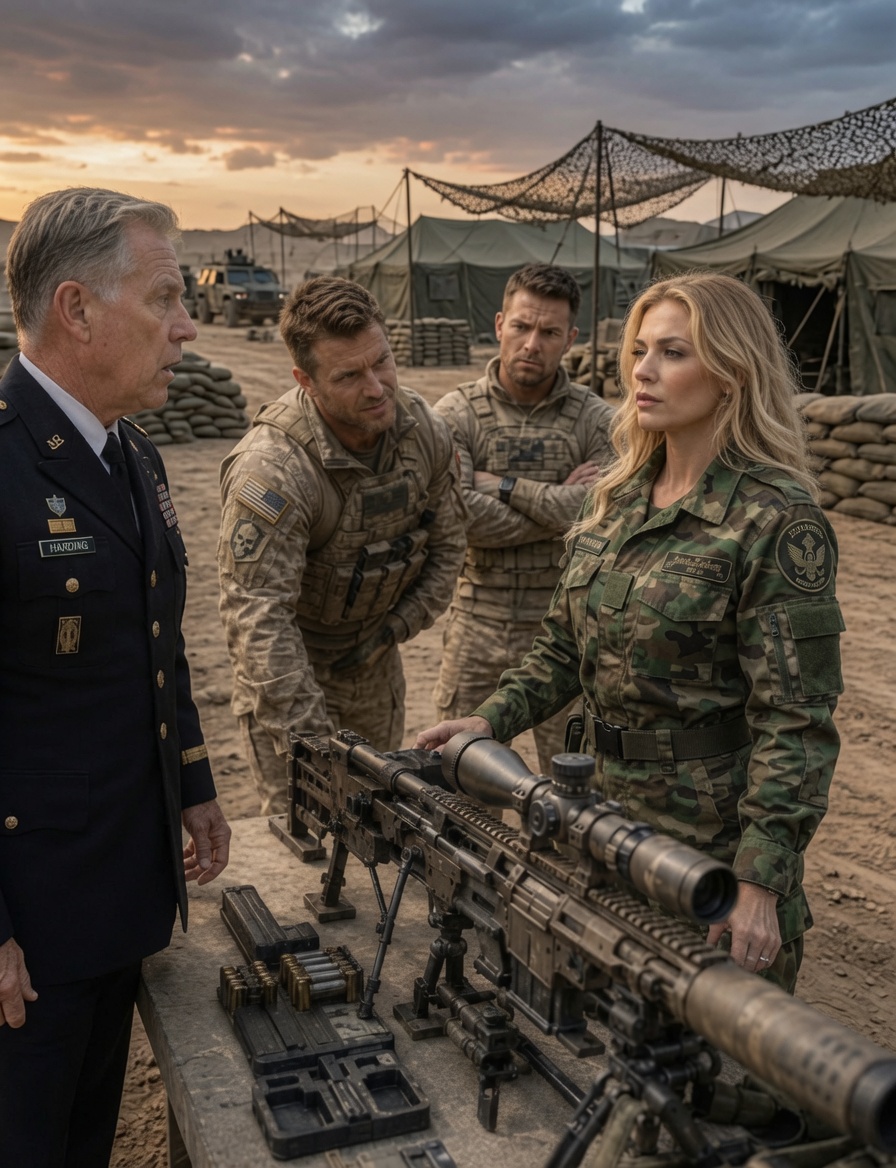
They Laughed at the Quiet Woman With the Crooked Rifle — Until the Commander Whispered, “That’s the Ghost of the Battlefield”
The first man who laughed at Staff Sergeant Emily Cross ended up dropping his coffee when he saw her name on the sealed casualty report.
The second man called her rifle setup “a thrift-store disaster” in front of thirty Marines.
The third man, Captain Mason Vale, made the mistake of touching the faded black tape wrapped around her scope.
Emily did not raise her voice.
She did not snatch the rifle back.
She only looked at his hand.
And every veteran in the room who had ever survived real fear would have recognized the warning in her eyes.
Captain Vale did not.
“Relax, Sergeant,” he said, smiling for the crowd. “I’m just trying to figure out if this thing came from a museum or a garage sale.”
A few men laughed.
Not all.
The older ones stayed quiet.
The ones with scar tissue under their sleeves watched Emily Cross like she was a closed door in a burning house.
She stood near the rear of the armory at Fort Redstone, Virginia, dressed in a plain tan field shirt with no flashy patches, no silver wings, no chest full of decorations. Her brown hair was pulled into a tight knot. Her face was calm in a way that made people uncomfortable. Not cold. Not empty.
Controlled.
The rifle on the table in front of her looked wrong to men who loved things clean and new.
The sling was old.
The grip was worn.
There was black tape at the edge of the optic.
A tiny notch had been carved into the stock, then sanded smooth by years of use.
A strip of faded gray cloth was tied under the rail, almost invisible unless you knew to look.
It did not look like the polished setups in recruiting videos.
It looked like something that had been dragged through mud, smoke, blood, freezing rain, and three countries that never made the evening news.
Captain Vale had arrived at Fort Redstone two weeks earlier with perfect teeth, a perfect haircut, and a reputation he carried like cologne. He was thirty-four, fast-tracked, connected, and hungry. His father was a retired senator. His uncle sat on a defense committee. Mason Vale had never met a room he did not try to own.
That morning, the room was full.
Marines.
Army observers.
Two Air Force liaisons.
A Navy chief with arms like fence posts.
And near the front, under the fluorescent lights, stood Colonel Rebecca Shaw, commander of the joint evaluation exercise that would decide which team earned a classified overseas rotation.
Vale wanted that rotation.
Badly.
Everyone knew it.
He needed one more clean win, one more glowing report, one more story his family could repeat at a fundraiser.
Then Emily Cross walked in with a rifle that looked like a rumor.
Vale noticed the room glance her way.
That was enough.
He smiled.
“Sergeant Cross,” he said, loud enough to turn heads. “You planning to qualify with that, or are we donating it to a Civil War museum after lunch?”
The younger Marines laughed first.
Quick, nervous laughs.
The kind men give when a captain makes a joke and they do not know yet whether it is safe not to.
Emily set her equipment bag on the table.
Slowly.
No slam.
No performance.
“Planning to qualify, sir.”
Her voice was low, even, American Midwest flat.
Born in Nebraska, someone would later say.
Raised around grain elevators, winter roads, and men who thought silence meant weakness until it was too late.
Vale stepped closer.
He picked up the rifle before asking.
That was the first mistake.
Emily’s eyes moved to his fingers.
Not his face.
His fingers.
The room lost a little oxygen.
Chief Daniel Briggs, the Navy observer, stopped chewing his gum.
A gray-haired Army major named Holt shifted his weight and looked at Colonel Shaw.
Colonel Shaw did not move.
Vale turned the rifle sideways.
“Oh, wow,” he said. “Look at this. Tape on the optic. Modified cheek rest. Old sling. What is this, sentimental equipment day?”
Someone chuckled.
Emily said nothing.
Vale ran his thumb over the tiny carved notch in the stock.
“Is this supposed to be a kill mark?”
The laughter died badly.
Not because anyone suddenly respected her.
Because the question had weight.
Emily’s left hand closed once, then opened again.
“No, sir.”
“No?” Vale leaned in. “Then what is it?”
“A reminder.”
“Of what?”
Emily looked him in the eye for the first time.
“To keep breathing.”
A young lieutenant laughed because he thought she was joking.
Nobody else did.
Vale placed the rifle down with theatrical care.
“Well, Staff Sergeant, around here we use standard configurations for standard evaluations. This isn’t a scrapbook. This is a military exercise.”
Emily nodded once.
“Yes, sir.”
“That means you’ll reconfigure before the range.”
“No, sir.”
The room froze.
Vale blinked.
“Excuse me?”
Emily stood straight, hands loose at her sides.
“I said no, sir.”
A whisper moved through the back of the armory.
Colonel Shaw finally lifted her eyes from the clipboard.
Vale smiled wider, but now it had sharp edges.
“You refusing an order?”
“I’m refusing a change that was not issued through proper equipment review and would compromise my assigned evaluation.”
A few people looked down.
Not because they disagreed.
Because that sentence had landed clean.
Vale’s jaw tightened.
“Careful.”
“I am, sir.”
He stepped closer.
“You think you’re special?”
“No, sir.”
“You think because you’ve got some mysterious little setup, the rules bend?”
“No, sir.”
“You think quiet makes you dangerous?”
Emily’s face did not change.
“No, sir. Quiet keeps people from wasting breath.”
Someone coughed.
It might have been a laugh.
It might have been a warning.
Vale turned to the room.
“You all hearing this?”
The younger Marines straightened like schoolboys caught watching a fight.
Emily reached into her bag and pulled out a small laminated authorization card.
She placed it on the table.
Vale glanced at it.
His eyes flicked once.
Then again.
It had signatures he did not expect.
One from the armory chief.
One from the range safety officer.
One from the evaluation command.
And one blacked-out section under a stamped code he was not cleared to read.
That annoyed him more than the refusal.
“What is this supposed to prove?”
“That the rifle is authorized.”
Vale picked up the card.
“By who?”
Emily did not answer.
Colonel Shaw did.
“By me.”
The room shifted.
Vale turned.
Colonel Shaw walked forward in polished boots, each step slow enough to make everybody feel it. She was in her late forties, lean, silver at her temples, with the kind of command presence that did not need volume.
Vale recovered fast.
“Ma’am, with respect, I wasn’t aware we were allowing personal antiques into a joint assessment.”
“We’re not.”
He smiled.
“Then I’m confused.”
“Yes,” Shaw said. “You are.”
A few throats tightened.
Emily stared at the table.
Colonel Shaw picked up the rifle.
Not casually.
Not like Vale had.
She lifted it with both hands, checked it like she knew its weight, and placed it gently back down in front of Emily.
Then she looked at Vale.
“This setup is documented.”
Vale’s expression hardened.
“Documented from where?”
Shaw held his gaze.
“Places you haven’t earned the right to ask about.”
That should have ended it.
It did not.
Mason Vale had built his life on rooms bending before he broke. His mistake was thinking this room worked like all the others.
He laughed once.
Softly.
“Understood, ma’am. Though I hope this exercise isn’t becoming a shrine to old war stories.”
Emily looked up.
Not at Vale.
At Colonel Shaw.
For half a second, something passed between them.
A question.
A warning.
Or a memory neither woman wanted to touch.
Then Shaw said, “Range begins in thirty minutes.”
Vale nodded.
“Yes, ma’am.”
But his eyes stayed on Emily.
And in that look, she saw it.
Not simple arrogance.
Not just male pride.
Fear.
He was not afraid of her yet.
He was afraid of being embarrassed.
Those were different things.
A man afraid of danger might retreat.
A man afraid of humiliation usually attacked.
Emily closed her case.
Her fingers moved carefully around the old rifle.
She could feel thirty people pretending not to watch.
She could feel Vale planning.
She could feel the day bending toward something ugly.
And still, her breathing remained slow.
In for four.
Hold.
Out for four.
She had learned that behind a blown-out schoolhouse wall while dust settled on her eyelashes and a boy named Ramos whispered his mother’s name through cracked lips.
She had learned that in a valley where the radio went dead and the sky turned white with smoke.
She had learned that when everyone else thought rescue was coming, and she already knew it wasn’t.
They laughed because the tape looked cheap.
They laughed because the sling was old.
They laughed because the woman holding it did not decorate herself with noise.
They laughed because nobody had told them what survived behind her silence.
They laughed because they had never heard the battlefield go quiet right before the ghost arrived.
Thirty minutes later, the laughter followed her to Range Seven.
Fort Redstone’s long-distance range sat beyond a line of pine trees and scrub grass, under a pale Virginia sky that threatened rain but never committed. The air smelled like wet dirt, gun oil, coffee, and the hot rubber mats laid across firing positions.
Targets stood at staggered distances.
Some visible.
Some half-hidden.
Some mounted behind shifting screens.
A line of observers gathered under a canopy where tablets displayed scoring data.
The exercise was simple on paper.
Identify.
Move.
Hold under pressure.
Make decisions.
Protect a simulated convoy team.
Avoid civilian markers.
Respond to bad intelligence.
It was not a shooting contest.
Not really.
It was a test of judgment under humiliation, noise, exhaustion, and conflicting orders.
Most people failed at judgment long before they missed a target.
Emily knew that.
Vale knew the scoring system but not the soul of it.
That was another mistake.
He had built his team around speed and aggression. Young men with sharp cheekbones, expensive sunglasses, and the restless energy of people who still believed war was mostly about being brave in front of witnesses.
Emily was assigned to an opposing support element.
One woman.
One rifle.
One radio operator named Private First Class Jordan Pike, who looked about nineteen and terrified to be standing next to her.
Pike had freckles, big ears, and hands that shook whenever officers came close.
Vale noticed immediately.
“Cross,” he called as teams formed. “They gave you Pike?”
A few Marines grinned.
Pike’s face flushed red.
Emily did not look at Vale.
She looked at Pike.
“Check your battery.”
Pike fumbled with the radio.
“Y-yes, Sergeant.”
Vale kept going.
“You two should be fine. She’s got a museum piece. You’ve got a radio that probably works if you pray hard enough.”
More laughter.
Pike swallowed.
Emily adjusted the strap on her glove.
“Private.”
“Yes, Sergeant?”
“People who talk before the first signal usually need the noise.”
Pike looked at her.
Emily kept her eyes downrange.
“Do your job. Let them do theirs.”
Pike nodded.
Something steadied in his face.
Not confidence.
Not yet.
But the beginning of it.
That was Emily’s gift.
She did not inflate people.
She anchored them.
A horn sounded.
The first team moved.
Vale’s men swept through the initial lane fast and clean. They handled the visible targets well. They communicated with crisp phrases. They looked good.
Too good.
That was the point of the first lane.
It made aggressive teams feel brilliant.
The second lane introduced civilian shapes.
Vale slowed, but only slightly.
His score remained high.
The third lane added false radio traffic.
A fake distress call from the east.
A simulated ambush warning from the west.
Wind picked up across the range.
Rain spotted the dust.
Vale’s team adjusted quickly.
Again, polished.
Again, impressive.
Colonel Shaw watched from under the canopy, expression unreadable.
Beside her stood Brigadier General Thomas Rourke, who had arrived without announcement in a dark field jacket. He had a heavy face, tired eyes, and a scar along his chin that made him look less like a general and more like a man who had been assembled from bad winters.
Rourke had not spoken to Emily.
He had only looked at her once.
And when he did, his jaw locked so hard a muscle jumped near his ear.
Captain Vale did not see that.
Emily did.
She also saw Rourke fold his hands behind his back to hide the tremor in his right thumb.
The horn sounded again.
Emily’s lane began.
“Support element Cross, move to Position One,” the range controller called.
Pike lifted the radio.
“Cross element moving.”
His voice cracked.
Vale smirked from the sidelines.
Emily walked.
Not hurried.
Not slow.
Measured.
She reached the first position, settled behind cover, and scanned.
The target screen lifted.
Three shapes.
Two threats.
One civilian.
Easy.
Too easy.
Emily did not fire.
Five seconds passed.
Then ten.
Someone whispered, “What is she doing?”
Vale said loudly, “Apparently admiring the scenery.”
Pike looked panicked.
“Sergeant?”
Emily held up two fingers.
Wait.
The civilian target shifted half an inch on its track.
Behind it, barely visible through the gray mesh, a second threat marker slid into view.
The trap was designed to punish fast shooters.
Emily fired once.
Then shifted.
Second shot.
The threat targets dropped.
The civilian remained standing.
Under the canopy, a scoring officer leaned forward.
“Clean.”
Vale’s smile thinned.
Lane Two.
Moving cover.
Audio stress.
A fake command override ordered Emily to change position.
Pike looked down at the radio transcript.
“Sergeant, command says move right.”
Emily did not move.
Pike swallowed.
“It says move right.”
Emily watched the far tree line.
“Who signed the command?”
Pike stared at the tablet.
“Uh…”
“Read the call sign.”
Pike read it.
Emily said, “That unit is dead in this scenario.”
Pike blinked.
The false command repeated, louder this time.
Move right.
Move right now.
Emily stayed where she was.
Ten seconds later, three threat targets appeared exactly where she would have moved.
She dropped two.
The third vanished behind cover.
She did not chase it.
She waited.
A child-sized civilian marker rolled out from behind the same barrier.
Then the third threat popped up behind it.
Emily fired through a narrow window at the lower edge of the screen.
The threat dropped.
The child marker kept moving untouched.
Now no one laughed.
Vale crossed his arms.
“That was luck,” he said.
Chief Briggs, standing three feet away, spit his gum into a wrapper.
“No, Captain.”
Vale looked at him.
Briggs did not look back.
“That was patience.”
Lane Three changed everything.
A simulated convoy distress call came through Pike’s radio.
Static.
Shouting.
Coordinates.
Then the voice of a woman screaming for help.
Pike froze.
Everyone heard it.
The sound designers had done their job too well.
The voice cracked open the air and left something raw behind.
Emily’s left hand tightened on the rifle.
For the first time all morning, her breathing changed.
Just slightly.
Colonel Shaw saw it.
General Rourke saw it.
Mason Vale saw only opportunity.
The scenario required Emily to choose whether to hold overwatch or abandon position to aid the convoy. Most candidates rushed. Some hesitated. A few split the difference and failed both.
Emily closed her eyes for one second.
In that second, Range Seven disappeared.
The wet dirt became powder dust.
The pine trees became broken stone.
The radio scream became a voice from eight years earlier.
Ghost, do you copy?
Ghost, we’re pinned.
Ghost, please.
Ghost—
Emily opened her eyes.
“Pike.”
Pike flinched.
“Yes?”
“Map.”
He handed it over.
Her finger traced the simulated route.
Then stopped.
“The distress call is bait.”
Pike stared.
“How do you know?”
“Engine sound is wrong.”
“What?”
Emily kept watching the lane.
“The convoy audio has four vehicles. Scenario brief gave us three.”
Pike looked at the transcript.
His mouth opened.
Emily said, “Hold position.”
The screaming continued.
“Please help us!”
A few observers shifted uncomfortably.
Vale muttered, “Cold.”
Emily heard him.
She did not answer.
At the forty-second mark, the entire left side of the range came alive.
Targets rose from the area she would have crossed if she had gone toward the voice.
She neutralized the first two.
Let the third pass.
Waited.
Dropped the fourth.
Then spoke into Pike’s radio.
“Convoy Alpha is compromised. Distress signal is false. Maintain western route. Do not enter the wash.”
The scoring officer stared at his screen.
Then he looked at Colonel Shaw.
“Ma’am.”
Shaw did not turn.
“What?”
“Perfect decision score so far.”
Vale heard.
His face changed.
Not much.
Enough.
The exercise continued.
Rain came harder.
Emily’s sleeves darkened.
Mud splashed her boots.
The old rifle did not shine. It absorbed the weather like it belonged to it.
Vale’s men had speed.
Emily had memory.
At Position Four, she spotted a target reflection in a puddle before the target rose.
At Position Five, she caught a fake friendly marker wearing the wrong shoulder color.
At Position Six, she refused another command override and saved the simulated convoy from a blocked bridge.
Each time, the payoff was small.
Clean score.
Correct call.
Civilian safe.
Threat dropped.
Pike’s voice grew steadier.
By the final lane, he was no longer shaking.
He moved like a different young man.
Still nervous.
But useful.
Still scared.
But present.
Emily noticed.
“Good work,” she said.
Two words.
Pike looked as if she had handed him a medal.
Then came the final scenario.
No one had told Vale what it was.
No one had told Emily either.
But Colonel Shaw and General Rourke exchanged a look when the range controller loaded it.
That look had history in it.
The lane was called Red Orchard.
Emily felt the name hit her body before her mind processed it.
Her fingers went still.
Pike checked the tablet.
“Sergeant?”
Emily did not move.
Rain tapped against her helmet.
Downrange, the screens shifted.
A ruined village facade rose on hydraulic frames.
Window cutouts.
Doorways.
A broken wall.
A narrow alley.
Then came the sound.
Not gunfire.
Not explosions.
A bell.
One small metal bell ringing in the wind.
Emily’s throat tightened.
Eight years vanished.
She was twenty-six again.
Hungry.
Awake for thirty-one hours.
Blood dried under one fingernail.
Snow blowing sideways across a valley nobody admitted American troops had entered.
A bell hanging from a goat pen.
Ramos breathing hard beside her.
Miller bleeding through his vest.
Two children hiding under a blue tarp.
And a voice on the enemy radio saying, Find the woman. Find the ghost.
“Sergeant Cross.”
It was Colonel Shaw.
Emily looked back.
Shaw stood beyond the firing line, face pale under the brim of her cover.
“You are cleared to step off the lane.”
The entire range went quiet.
Vale’s eyebrows lifted.
Step off?
During an evaluation?
Emily looked downrange.
The bell kept ringing.
Pike whispered, “Sergeant, what is this?”
Emily did not answer him.
She answered Shaw.
“No, ma’am.”
General Rourke took one step forward.
“Emily.”
That name moved through the range like a match dropped in dry grass.
Not Sergeant.
Not Cross.
Emily.
Vale looked from Rourke to her.
Then to Shaw.
He understood there was a story now.
He just did not understand he was standing inside the shadow of it.
“Run the lane,” Emily said.
Shaw’s voice hardened.
“That is not an order.”
“I know.”
Rourke’s scar pulled tight.
“Don’t.”
Emily looked at him.
For the first time, her calm cracked enough for everyone to see the person underneath.
Not weakness.
Pain under discipline.
A wound that had learned posture.
“If it’s in the system,” she said, “someone put it there.”
Rourke did not answer.
Emily turned back downrange.
“Pike.”
His voice came small.
“Yes, Sergeant?”
“Stay behind me. Relay only what I say. If I stop talking, you keep breathing.”
He nodded too fast.
“Yes, Sergeant.”
The horn sounded.
Red Orchard began.
A child marker appeared in a window.
No shot.
A threat marker moved behind it.
No shot.
A second threat appeared at the alley mouth.
Emily dropped it.
The bell rang.
A civilian shape crossed the doorway.
No shot.
A hidden target flashed behind the roofline.
Emily fired.
Clean.
Then the radio burst to life.
Not the standard range audio.
A real voice.
Distorted.
Older.
Male.
“Ghost.”
Emily stopped.
Every head turned toward the speakers.
The range controller slapped buttons.
“That’s not in the file.”
The voice came again.
“Ghost of the battlefield.”
Pike went white.
Vale stepped back.
Colonel Shaw moved toward the control station.
“Kill the audio.”
The technician yanked a cable.
The speakers went dead.
For one second, only rain remained.
Then Pike’s radio crackled.
Same voice.
Lower now.
Closer.
“You left one alive.”
Emily did not blink.
But the rifle lowered half an inch.
General Rourke reached for the sidearm he was not wearing.
Chief Briggs whispered, “Jesus.”
Vale finally understood enough to be afraid.
“Is this part of the test?”
Nobody answered him.
Downrange, the village facade shifted again.
The final target rose from behind a broken wall.
It was not a standard silhouette.
It was a photograph mounted to a board.
A man’s face.
Bearded.
Sunken eyes.
A scar across the mouth.
Emily knew him.
She had last seen that face through smoke and snow, eight years earlier, when he was supposed to be dead under a collapsed radio tower in a valley the Pentagon later erased from every public record.
Her breath left her slowly.
Not fear.
Recognition.
Colonel Shaw saw the photo and said one word.
“No.”
The radio hissed.
Then the voice whispered, clear enough for everyone to hear.
“Hello, Emily.”
Pike backed into the mud.
Vale’s face had gone gray.
General Rourke looked at the scoring screen.
Numbers were scrolling across it now.
Not range data.
Coordinates.
Live coordinates.
Somewhere outside Fort Redstone.
Then a file name appeared in red letters.
ORCHARD WITNESS: ACTIVE.
Emily reached into the small pocket inside her vest and pulled out the gray strip of cloth that had been tied under her rifle rail all morning.
It was not cloth.
It was a folded piece of map.
Old.
Blood-stained.
Protected for eight years.
She opened it just enough to see the mark she had drawn the night everyone said no one survived.
Her eyes lifted to the tree line beyond the range.
A black SUV sat there between the pines.
No plates.
No lights.
Watching.
The radio crackled one last time.
“Run, Ghost.”
Emily raised the old rifle.
Not at the target.
At the trees.
And for the first time all day, the woman everyone had mocked smiled.
It was small.
It was cold.
It was the kind of smile that made General Rourke whisper, “Everybody down.”
Because he finally remembered what the enemy had learned too late.
The Ghost of the Battlefield did not run from hunters.
She let them come close.
Then she counted who was missing.
The black SUV’s rear door opened.
A man stepped out holding a folder wrapped in red tape.
Across the front, in thick black marker, were three words Emily had not seen since the night her entire unit disappeared from the official record.
RAVEN SIX LIVES.